
Insertion Flow Meters: 6 Types
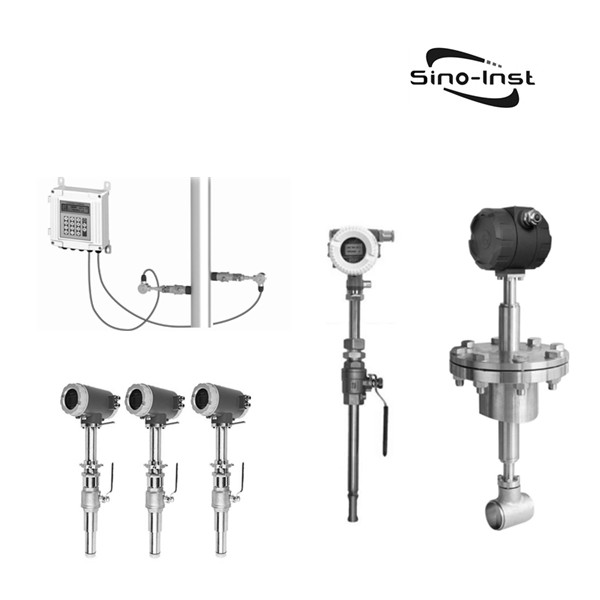
Measuring flow in large pipes with insertion type flow meters.
If you need to measure the fluid flow of a larger pipe diameter, you are most likely to choose an insertion type flow meter.
But what insertion type flow meter should you use?
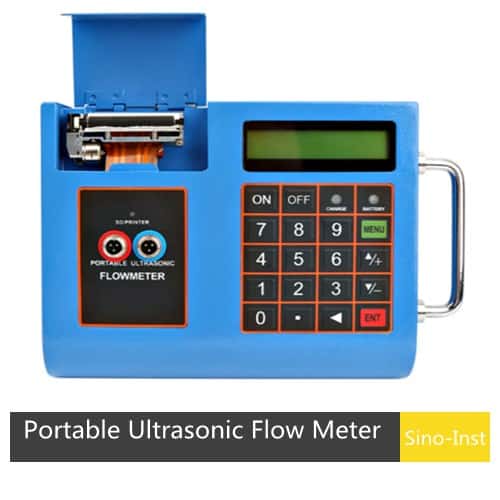
The market has insertion electromagnetic flowmeter, insertion vortex flowmeter, insertion ultrasonic flowmeter, insertion ultrasonic flowmeter and so on.
Next, let us compare various insertion type flow meters. Hope to help you choose the right insertion type flow meter!
When should you use Insertion type flow meters?
- When the pipe diameter is large;
- When there is a tight inner lining;
- When the scale in the pipe is serious;
- When the pipe is a poor conductor of ultrasound;
- When the external clamp probe fails to reach the required signal strength or the measurement is unstable.
Benefits
1. Lower Cost on Large Pipes
Insertion flow meters cost 3-5× less than full-bore inline meters above DN1000. Above DN2000, the gap widens further. On large-pipe projects, insertion is often the only option that fits the budget.
2. Hot-Tap Installation, No Shutdown
A ball valve and retractable fitting let you insert the probe while the pipe stays under pressure. Standard probes handle 1.6 MPa; heavy-duty versions reach 10 MPa. No draining, no welding downtime, no production loss.
3. Handles Pipes up to DN6000
Works from DN100 to DN6000 — well beyond the practical limit of most inline meters. Typical fits: municipal water mains, power plant cooling loops, large HVAC circuits, wastewater headers.
4. Simple Retrofit — Drill, Weld, Insert
No pipe cutting, no flange matching, no re-routing. Drill a hole, weld a mounting base, thread in the probe. A retrofit that would take days with an inline meter drops to hours.
5. Pull the Probe Without Stopping Flow
Close the isolation valve, withdraw the probe for cleaning, electrode replacement, or on-site recalibration — the line keeps running. Inline meters require a full shutdown for the same work.
6. Negligible Pressure Loss
The probe blocks under 5% of the pipe cross-section, so added pressure drop is minor. Compared to an orifice plate at 30-50% loss, pumping energy savings accumulate fast on 24/7 operations.
Featured Insertion type flow meters for Sale

Insertion magnetic flow meter
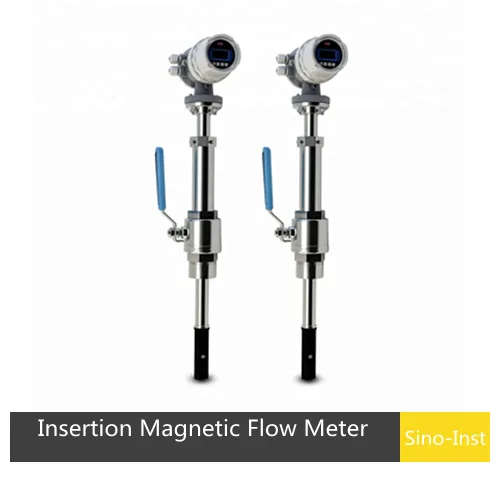
Insertion Magnetic Flow Meter is the magnetic flow meter that measures the fluid velocity of conductive liquids in applications where hot-tap or insertion installations are preferred. Like, measures the flow velocity of conductive liquids in large diameter pipes.
| NO. | SI-Magnetic Water Flow Meter |
| Payment | T/T, Paypal |
| Product Origin | Shaanxi, China |
| Shipping Port | Shanghai/Ningbo/Shenzhen |
| Lead Time | 3-5 days after payment received |
Insertion Magnetic Flow Meter: Working Principle and Applications
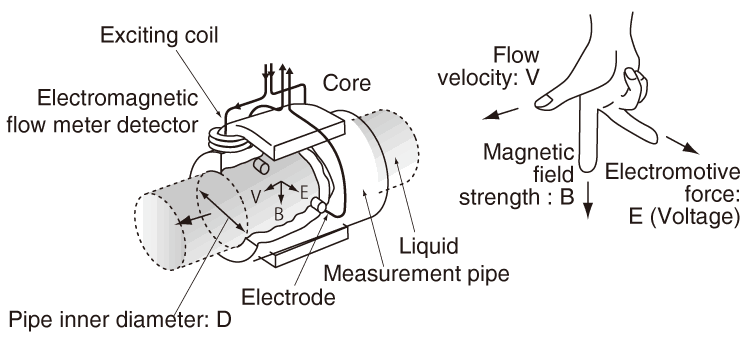
Faraday’s Formula
E is proportional to V x B x D where:
E = The voltage generated in a conductor
V = The velocity of the conductor
B = The magnetic field strength
D = The length of the conductor
The insertion electromagnetic flow meter is based on Faraday’s law. When measuring flow, a liquid flows through a magnetic field perpendicular to the direction of flow and induces a voltage proportional to the average flow rate (volume flow). Its induced voltage signal is detected through two electrodes that are in direct contact with the liquid. Voltage signal will be transmitted to the smart transmitter through a dedicated cable. The smart transmitter performs calculations based on the magnitude of the electric potential and the mathematical model of the electromagnetic flow. And converts it into a flow signal for on-site display. Including instantaneous and cumulative quantities can be display. Then output the standard 4 ~ 20MA and 1 ~ 5VDC signals to the flow secondary meter or DCS.
Best Technology Guide to Magnetic Flow Meters
Insertion type vortex flow meter
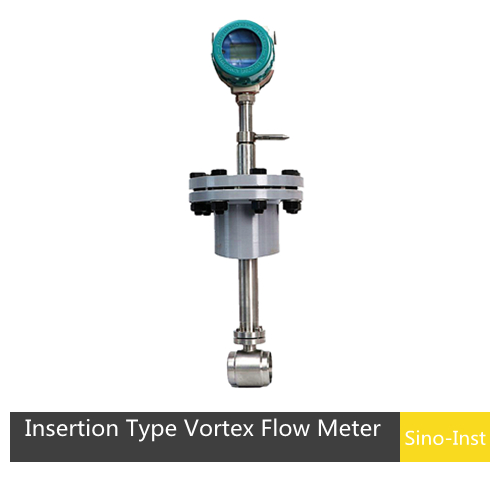
SI-3304 Insertion Type Vortex Flow Meter is designed for large pipeline size over 10 inches, users can install and removal the vortex sensor without closing down the whole running system. Customers can get volumetric or mass flow of gas, air or steam through our powerful vortex flow meter.
| Diameter | DN200~DN3000mm |
| Accuracy | ±0.5% |
| Temp. range | -50~+400℃ |
| Nominal pressure | PN25, PN40 (customized) |
| Protection | IP67 |
| Explosive-proof | Flameproof type ExdIIBT4-T6, Aniline type ExiaIICT4-T6 |
Insertion type turbine flow meter
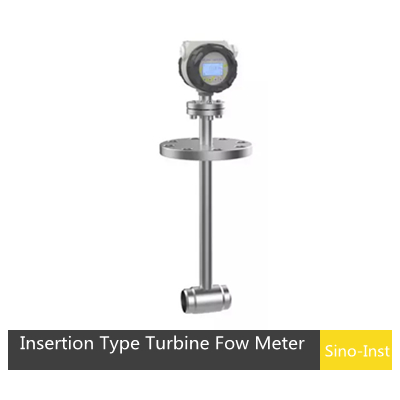
SI- 3208 Series Insertion Turbine Flow Meters are designed for accurate, cost-effective mass flow measurement of steam,high-temperature liquids and gases, including steam, and can be installed without line shutdown.
Insertion turbine flow meters are ideal for use in larger steam lines, where downsizing the line size to improve flow measurement is not desirable.
| Diameter | DN200~DN3000mm |
| Accuracy | 0.5% to 2.0% of reading |
| Temp. range | -20~+150℃ |
| Pressure | 1.6 MPa |
| Flow rate | 0.5~6m/s |
| Straight pipe required | Up stream≥5DN, down stream≥3DN |
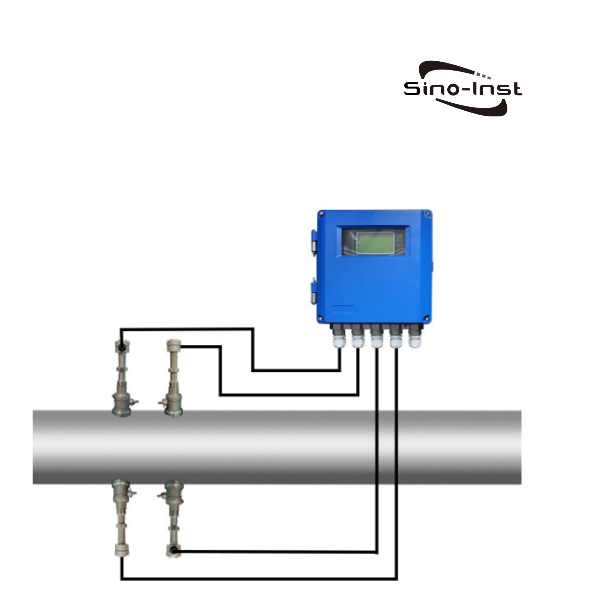
Insertion Ultrasonic Flow Meter

The core advantage of insertion ultrasonic flow meters stems from their “sensor directly immerses itself in the fluid” measurement mode. Installation is possible without penetrating the entire pipe wall, requiring only pipe drilling, which reduces construction difficulty and minimizes energy loss of sound waves within the pipe wall.
The sensor’s contact with the medium increases signal strength, providing greater penetration through various scale deposits, pipe rust, and internal linings.
Supports large pipe diameters from DN25 to DN6000. Customization options include single-channel, dual-channel, and four-channel models.
Insertion ultrasonic flow meters offer relatively stable measurements, and current models can be installed online under pressure, allowing production lines to operate without interruption and minimizing pressure loss.
Insertion flow meters support special pipe materials like cement pipes, but are also compatible with common pipe materials such as stainless steel and cast iron. They are ideal for measuring water usage in wastewater treatment plants, waterworks, irrigation, and industrial processes.
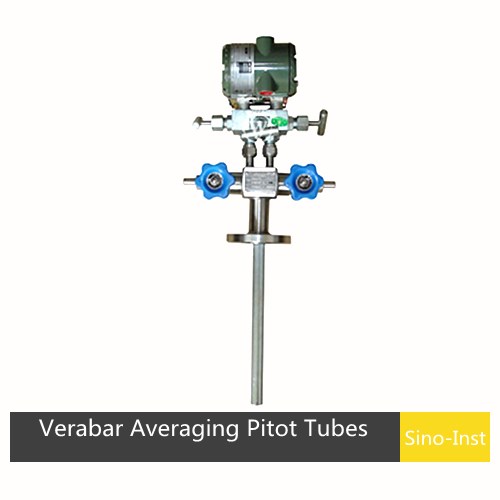
Insertion Annubar (Pitot Tube) Flow Sensor
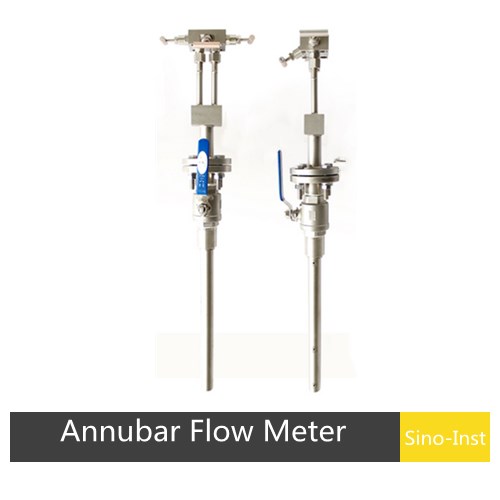
Annubar flow sensor can be used in petrochemical, metallurgical, papermaking, pharmaceutical and other industrial sectors as a flow sensor for measuring liquids, gases and steam.
Used in conjunction with display instruments. It can accurately measure various fluids in rectangular or circular pipes of 25~4000mm.
And it can work normally in dangerous central areas such as high temperature and high pressure or in contaminated fluids that are difficult to solve.
| Pipe diameter: | DN25~4000mm |
| Nominal pressure: | ≤12MPa |
| Range ratio: | ≤3:1 |
| Medium viscosity: | ≤0.3Pas |
| Medium temperature: | ≤500℃, high temperature 850℃ can be customized. |
Insertion Thermal Mass Flow Meter

The insertion thermal mass flow meter is a gas mass flow measurement device based on the thermal diffusion effect. It consists of an insertion probe, a signal processing unit, and installation accessories. During operation, the dual temperature sensors on the probe generate a temperature difference due to gas flow, and the mass flow rate is calculated through signal processing, eliminating the need for temperature and pressure compensation.
It uses insertion installation, requiring minimal pipeline modification. It is compatible with pipe diameters from DN50 to DN3000, has a measurement range of 0.1-100 m/s, and features fast response and low maintenance costs.
It can simultaneously display flow velocity (flow rate) and temperature. It exhibits high sensitivity at low flow rates and maintains excellent accuracy even at high flow rates. Custom high-temperature models are also available.
| Diameter | DN25~8000mm |
| Accuracy | ±1.5% |
| Temp. range | -40~200℃, Sensor: -25~+800℃, special material, 1500℃ |
| Pressure | Max 4MPa |
| Flow rate | 0.5-100m/s |
| Protection | IP67 (sensor part) |
How to Choose an Insertion Flow Meter by Type
Choose by media type first, then by pipe size and accuracy requirements. For conductive water, insertion magnetic is the default. For large cooling-water or retrofit, insertion ultrasonic. For steam or gas, vortex or Annubar.
| Type | Best For | Pipe Size | Accuracy | Media | Hot-Tap |
|---|---|---|---|---|---|
| Insertion Magnetic | Conductive liquids (water, wastewater) | DN80–DN3000 | ±1-2% | Conductive liquids only | Yes |
| Insertion Ultrasonic | Clean liquids, retrofit | DN25–DN6000 | ±1-2% | Water, oil, hydrocarbons | Yes |
| Insertion Turbine | Clean low-viscosity liquids/gases | DN200–DN3000 | ±1-2% | Clean liquids, gases | Yes |
| Insertion Vortex | Steam, gas, low-viscosity liquids | DN200–DN3000 | ±1-1.5% | Steam, gas, liquids | Yes |
| Insertion Annubar (Pitot) | Large-pipe gas/steam DP measurement | DN100–DN4000 | ±1-3% | Gas, steam, liquids | Partial |
| Insertion Thermal Mass | Gas mass flow | DN25–DN8000 | ±1-2% | Gases only | Yes |
What is the difference between inline and insertion flow meter?
| Feature | Inline Flow Meter | Insertion Flow Meter |
|---|---|---|
| Installation | Cut pipe, bolt flanges | Drill hole, weld fitting, insert |
| Accuracy | ±0.2 to ±0.5% | ±1 to ±2% |
| Pipe size | DN15–DN2000 (practical) | DN25–DN6000 |
| Cost at DN1000+ | Baseline | 1/3 to 1/5 of inline |
| Hot-tap capable | No | Yes |
| Maintenance | Requires shutdown | Pull probe, line stays on |
1. The main difference between Inline flow meter and insertion flow meter is the different structure.
Inline flow meter is directly installed on the pipeline, and the flow measurement element and the pipeline are connected together.
While insertion flow meter needs to insert the measuring probe into the pipeline.
2. Different measurement accuracy.
Inline flow meter has relatively high measurement accuracy and is suitable for high-demand occasions.
While insertion flow meter has relatively low measurement accuracy and is suitable for general occasions.
3. Different applicable pipe sizes:
Generally, small-diameter pipes, such as DN25, DN100, etc., can choose Inline flow meters.
While insertion flow meter is mainly suitable for large-diameter pipes. For example, DN1000, DN2000, etc.
4. Different installation and maintenance costs:
The installation and maintenance costs of Inline flow meters are higher than those of insertion flow meters. Because Inline flow meters need to be installed directly on the pipeline, more labor and time are required.
While insertion flow meter only needs to insert the measuring probe into the pipeline, the installation and maintenance costs are relatively low.
Of course, the choice of Inline or Insertion flowmeter should be based on the requirements and conditions of the actual application.
FAQ
Insertion type flow meter price
Sino-Inst offers 10 Insertion type Flow Meters. With best price. A wide variety of Industrial flow meters options are available to you. such as free samples, paid samples.
Sino-Inst is Industrial flow Transmitter suppliers, located in China. The top applying countries are China (Mainland), Hong Kong, and the United States, which supply 96%, 2%, and 1% of wireless pressure transmitter respectively.
Insertion type Flow Meter products are most popular in North America, Domestic Market, and South America. You can ensure product safety by selecting from certified suppliers, with ISO9001, and ISO14001 certification.
Zhang Wei, possesses 20 years of experience as an automation instrumentation engineer, specializing in the research, design, installation, commissioning, and maintenance of automation instruments.
Face to various instrument communication protocols (such as Modbus, Profibus, etc.), with solid hardware circuit design and software programming skills (proficient in C language and PLC programming). Has extensive project experience; projects he has led and participated in have all achieved outstanding results, improving product accuracy, reducing costs, and increasing production efficiency.
Possesses excellent communication and coordination skills and a strong team spirit, enabling him to quickly respond to customer needs and provide high-quality automation instrumentation solutions.