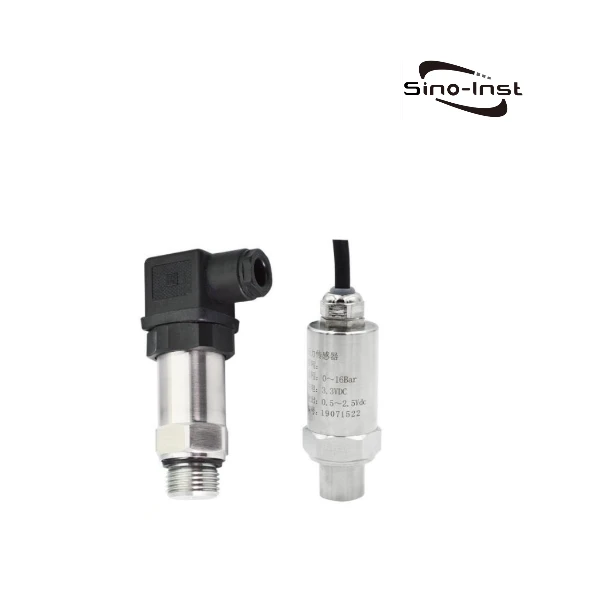
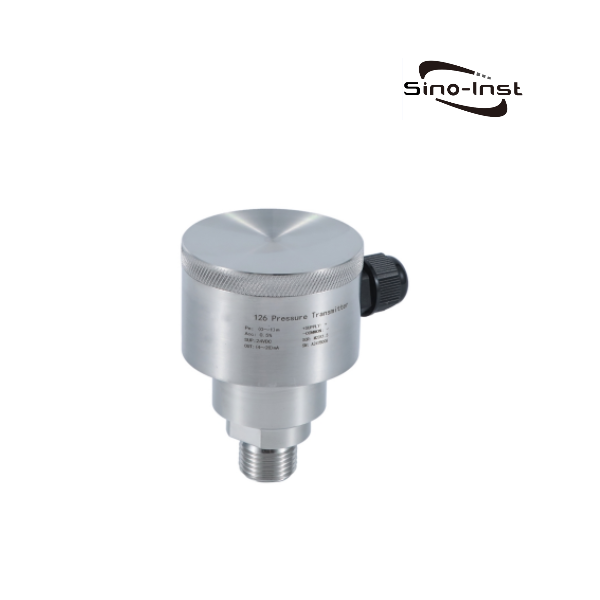
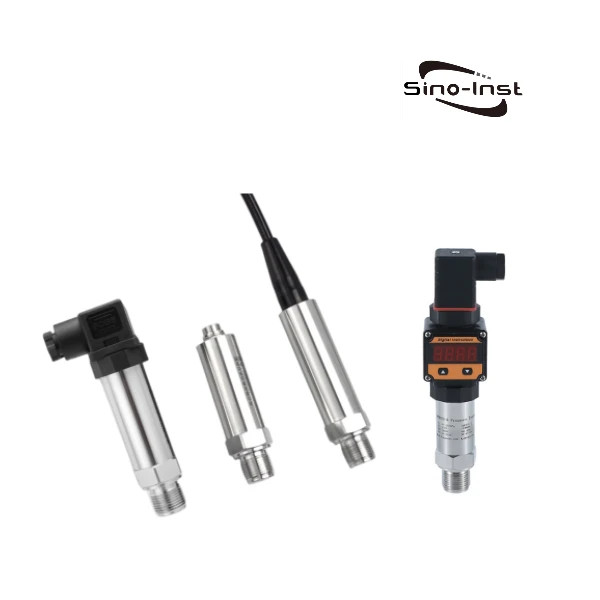
Ceramic Pressure Sensor refers to a type of pressure transmitter that uses a ceramic pressure core. The SI-1102 Ceramic Pressure Sensor can measure the pressure of various liquids, gases and vapors compatible with ceramics. Small structure, wide range and a variety of output signals. The product can have good stability in a wide temperature range. Can be uniquely applied to compressors.
Strong anti-interference, good long-term stability
Various forms and structures, easy to install and use
Wide measuring range, can measure absolute pressure, gauge pressure and sealing pressure
Wide variety of process and electrical connection options
Suitable for mass production, economical and reliable
SI-1102 Ceramic Pressure Sensor Specifications
Measuring medium:
Various liquids, gases and vapors compatible with ceramics
Range:
0~50kPa…60MPa
Overload:
2 times full scale pressure
Pressure type:
Gauge or absolute or sealed gauge
Accuracy:
±0.5%FS
Long-term stability:
±0.2%FS/year
Zero temperature coefficient:
±0.02%FS/°C (reference 25°C)
Full scale temperature coefficient:
±0.02%FS/°C (reference 25°C)
Operating temperature:
-30~85℃
Storage temperature:
-40~120℃
Power supply:
5V, 24VDC
Output signal:
4~20mADC, 0.5~4.5VDC, etc.
Insulation resistance:
100MΩ, 500VDC
Shell protection:
IP65
Electrical connections:
Packard connectors, Hessmann connectors or aviation plugs, etc.
Order Guide
SI-1102
Ceramic Pressure Sensor
Code
Range
(0~X)KPa
-100kPa…0-0.01…60MPa
Code
Output Signal
B1
4-20mA
B2
0.5~4.V
Code
Process Connection
P3
G1/4
P6
R1/4
P8
NPT 1/4
P24
M14*1.5
P25
M12*1.5
Code
Electrical connections
C1
Hirschman joint
C2
cable output
C3
Aviation connector
C4
Packard connector
Code
sensor type
M5
ceramic piezoresistive
Code
Additional functions
G
Gauge pressure (default)
A
Absolute pressure
S
Sealed gauge pressure
SI-1102 (0-1)MPa B1 P3 C4 M5 G
ceramic pressure sensor working principle
Ceramic is a recognized highly resilient, corrosion-resistant, wear-resistant, shock- and vibration-resistant material.
The thermal stability of ceramics and its thick-film resistance enable its ambient temperature range to be as high as -40 to 135°C. And it has high precision and high stability of measurement. The electrical insulation degree is >2kV, the output signal is strong, and the long-term stability is good.
High-featured, low-price ceramic sensors will be the development trend of pressure sensors. Applicable occasions With laser calibration, the sensor has high temperature stability and time stability. The sensor comes with a temperature compensation of 0-70°C, and can be in direct contact with most media.
The ceramic pressure sensor is mainly composed of three parts: a ceramic ring, a ceramic diaphragm and a ceramic cover.
As a force-sensitive elastic body, the ceramic diaphragm is made of 95% AL2O3 porcelain. It is required to be flat, uniform, and dense, and its thickness and effective radius depend on the design range.
Porcelain rings are molded by high-temperature firing in hot die-casting process. High-temperature glass paste is used between the ceramic diaphragm and the ceramic ring, and they are fired together by means of thick film printing and thermal firing technology. A force-sensitive cup-shaped elastomer that produces peripheral fixation. That is, there should be no creep in the peripheral part of the ceramic. rigid structure.
On the upper surface of the ceramic diaphragm, that is, the bottom of the porcelain cup tea set, the circuit of the sensor is made with thick film technology.
The circular groove at the lower part of the ceramic cover plate creates a corresponding gap between the cover plate and the diaphragm, and the limit can prevent the diaphragm from being broken due to excessive bending when it is overloaded. Produces anti-overload protection for the sensor.
What is the working principle of ceramic pressure sensor? I believe that after reading the introduction here, everyone can have a more comprehensive understanding of ceramic pressure sensors!
The ceramic pressure sensor is shock-resistant, anti-vibration, and has high precision and stability. At present, there are a large number of application scenarios in the industry. It is believed that ceramic pressure sensor technology will become more perfect and mature, and the application scenarios will become more extensive!
Ceramic pressure sensors are also called ceramic piezoresistive pressure sensors. It is a dry-type ceramic piezoresistive pressure sensor refined by a special process using ceramic materials. Ceramic is a recognized highly elastic, corrosion-resistant, wear-resistant, shock- and vibration-resistant material.
There are many types of pressure sensors. We cannot absolutely say which pressure sensor is the best. Because the best is not necessarily the most applicable.
When we purchase pressure sensors, we must combine our own measurement parameters to choose the most suitable pressure sensor. In order to ensure the best measurement results.
The following are several commonly used pressure sensors:
Ceramic piezoresistive pressure sensor: with high precision and high stability of measurement. The electrical insulation degree is greater than 2KV, the output signal is strong, and the long-term stability is good.
Single crystal silicon pressure sensor: wide measuring range, high precision, wide working temperature. Good stability and excellent static pressure characteristics. It has good one-way compression characteristics.
Capacitive pressure sensor: low input force and component Ru energy. High dynamic response, small natural effects. Good environmental adaptability.
Sapphire pressure sensor: The main advantage is that it can measure high temperature media. Insensitive to temperature changes. The drift in time at high temperature is the lowest among these types of sensors.
Quartz crystal pressure sensor: high frequency response pressure sensor, quick response. The digital output is stable and reliable. It has strong anti-interference and is suitable for long-distance transmission. Eliminates simulation The complexities of digital conversion and the errors it creates.
Sputtering thin film differential pressure sensor: the outstanding feature is that it is less affected by temperature. When the temperature changes by 100°C, the zero point drift is only 0.5%. Its temperature performance is much better than that of diffused silicon, and it can be used under harsh environmental conditions.
Strain-type differential pressure sensor: The most widely used is the strain-type pressure sensor, which has extremely low price, high precision and good linearity. Resistance strain gauge There are mainly two types of metals and semiconductors. Metal strain gauges are divided into wire type, box type and film type. Semiconductor strain gauges have the advantages of high sensitivity and small lateral effects.
The above is the introduction of the pressure sensor. These are the commonly used ones, and each has its own characteristics. When choosing, determine the type according to your needs.
Ceramic Pressure Sensor is widely used in many fields such as process control, environmental control, hydraulic and pneumatic equipment, servo valves and transmissions, chemicals and chemical industry and medical instruments.
SI-1102 Ceramic Pressure Sensor has a small size, a measuring range of 1 to 600bar, and a low price. It is widely used in various pressure measurement occasions.
Sino-Inst has provided pressure measurement solutions to customers for many years. Our pressure sensor, made in China. Widely exported to the United States, Britain, Germany, South Africa, Norway and other countries.
If you need Ceramic Pressure Sensor, but have technical questions, please feel free to contact our sales engineers.
Zhang Wei, possesses 20 years of experience as an automation instrumentation engineer, specializing in the research, design, installation, commissioning, and maintenance of automation instruments.
Face to various instrument communication protocols (such as Modbus, Profibus, etc.), with solid hardware circuit design and software programming skills (proficient in C language and PLC programming). Has extensive project experience; projects he has led and participated in have all achieved outstanding results, improving product accuracy, reducing costs, and increasing production efficiency.
Possesses excellent communication and coordination skills and a strong team spirit, enabling him to quickly respond to customer needs and provide high-quality automation instrumentation solutions.
SI-1102 Ceramic Pressure Sensor for Compressors
SI-1102 ceramic pressure sensor for compressors. Ceramic core, range 0 to 50kPa up to 60MPa, 0.5%FS accuracy, gauge, absolute or sealed pressure type.