Home > Blog > Ultrasonic Clamp On Flow Meter – For Easier Water Flow Measurement
Ultrasonic Clamp On Flow Meter – For Easier Water Flow Measurement
Starting from farming and domestic water distribution to industrial processes and environmental observation, Water flow measurement plays a vital part. It’s all-important to accurately measure water flow to optimize efficiency, cut down costs, and meet restrictive requirements.
There are several methods utilized to measure the flow rate of water, each with its own plus and minuses. Here, we will focus on measuring the water flow rate with clamp on ultrasonic flow meter.
A Water Flow Meter is a Flow Meter Designed to Measure the Flow of Water Specifically, as opposed to other liquids (like oil or gasoline).
Water Flow Meters Can be used to track the flow of water within a variety of applications. They can:
Measure usage by individual HouseHolds or Communities with Municipal Drinking Water Systems.
Track Sewage Flow to Help Municipalities Ensure That Their Wastewater Systems Adequately Meet Demand.
Help Factory Operators Assess the Amount of Water Being Use to Cool An Industrial Plant.
There are several Water Flow Meter Technologies to Choose from Depending on the Water Measurement Application, Maintenance Requirements, and budget. After Flow Meters Has a UNIQUE Principle of Operation, application advantage. For example, electromagnetic flowmeters, ultrasonic flowmeters, turbine flowmeters, vortex flow meters, etc.
How Ultrasonic Flow Meters Work: Working Principle
The ultrasonic flow meter runs on the principle of the Doppler effect or transit-time method.
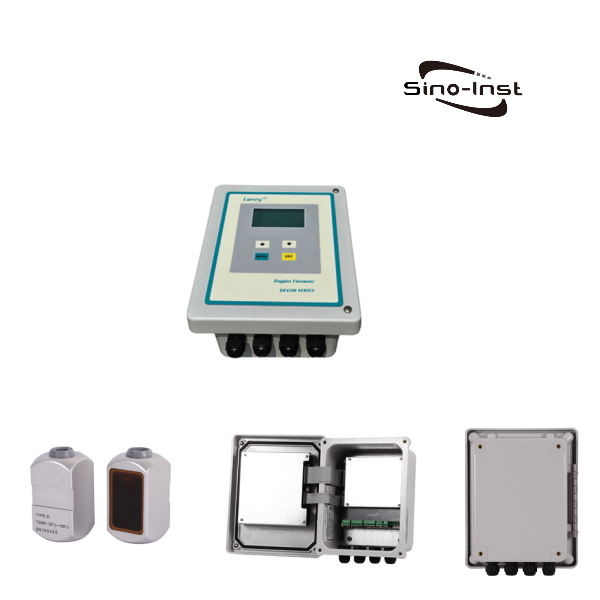
‘Doppler ultrasonic meters’ work on the principle of detecting changes in the frequency of sound waves as they reflect off particles or bubbles in the water. These types of ultrasonic meters are particularly effective when the water contains particulates or bubbles.
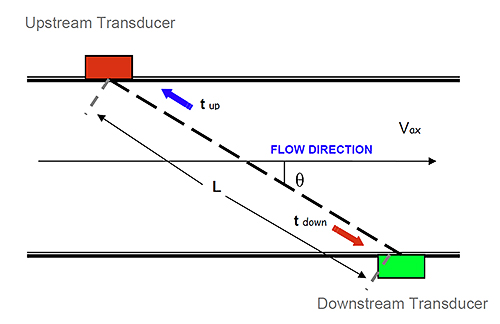
In contrast, in ‘transit-time ultrasonic meters’, the flow is calculated by comparing the time taken by ultrasonic signals to travel with and against the flow of water. This difference in time allows for the calculation of the flow rate.
What Is the Ultrasonic Flow Meter Formula?
The core formula of an ultrasonic flow meter is based on the transit-time principle: sound waves propagate faster with the current than against it, and the time difference ΔT is proportional to the flow velocity.
Basic Formula:
V = Dsin 2θ × t₂ − t₁t₁ · t₂
Where:
V — Average fluid velocity (m/s)
D — Pipe inner diameter (m)
θ — Angle between the ultrasonic probe and the pipe axis (typically 45°)
t₁ — Propagation time with the current (s)
t₂ — Propagation time against the current (s)
After obtaining the flow velocity, multiplying it by the pipe cross-sectional area gives the volumetric flow rate:
Q = V × A = V × πD²4
For example, for a DN100 pipe (100 mm inner diameter), with a probe angle of 45°, the measured downstream time is 272.5 μs and the upstream time is 273.5 μs, then ΔT = 1 μs. Substituting into the formula:
V = (0.1 / sin 90°) × (1×10⁻⁶) / (272.5×10⁻⁶ × 273.5×10⁻⁶) ≈ 1.34 m/s
Q = 1.34 × (π × 0.1² / 4) × 3600 ≈ 37.9 m³/h
The Doppler principle uses a different formula, applicable to water containing particles or bubbles. The frequency shift Δf of the sound waves reflected from the particles is proportional to the flow velocity: V = c × Δf / (2f₀ × cosθ). Doppler is more expensive, but it most be used in “dirty water” scenarios; it cannot be detected in clean water where there are no reflectors.
Benefits of Ultrasonic Flow Meter: Edge Over Other Flow Meter
A. Non-invasive Measurement; B. Accuracy; C. Versatility; D. No Moving Parts; E. Low Pressure Drop; F. Low-cost measurement of large-caliber pipelines.
Clamp-On Water Flow Meters
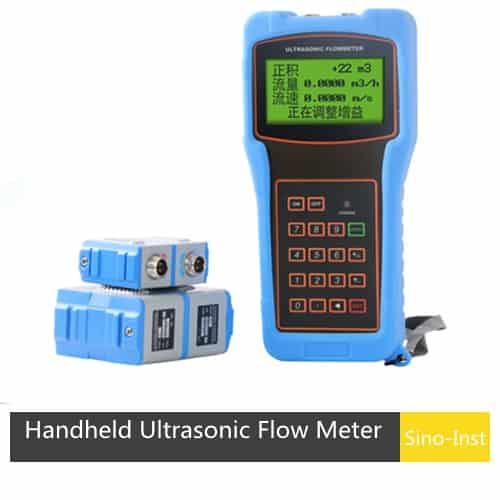
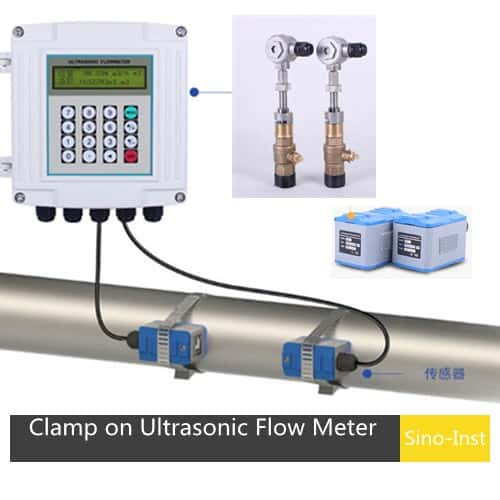
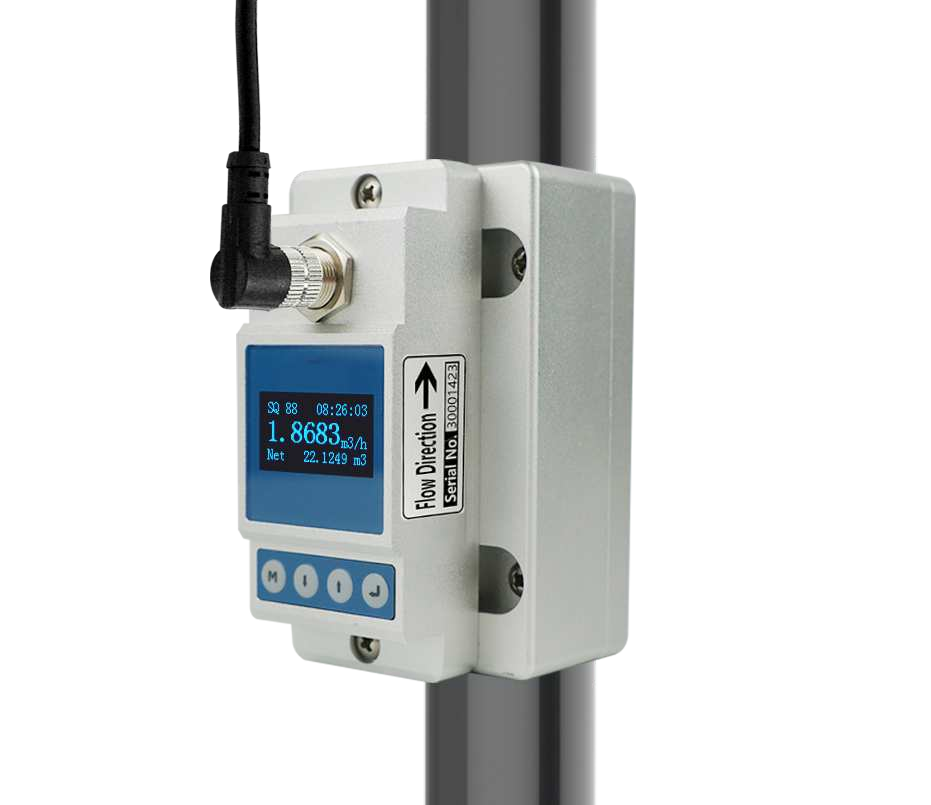
Clamp-on water flow meter doesn’t require the meter to be inserted into the pipe or interfere with the flow of water.
How Clamp-On Water Flow Meters Work?
Clamp-on flow meters use ultrasonic waves to function. The transducers are clamped onto the exterior of the pipe and send ultrasonic signals through the pipe. This design is especially beneficial because it gets rid of the need for cutting pipes or discontinuing the flow.
Ultrasonic clamp-on meters are inherently accurate with an impressive accuracy of reading of ± 1% and a repeatability performance of ±0.2%. They maintain accuracy across a wide range of flow applications and have a greater extended low flow accuracy compared to mechanical meters.
Uses of Clamp-On Water Flow Meters
Clamp-On Flow Meters are widely used in industrial settings, HVAC systems, water treatment plants, and irrigation systems.
These are perfect for use in applications where pipes are large, access is limited, or it’s impractical to shut down systems for installation.
Transit time clamp-on flow meters are used to flow clean, single-phase fluids without particulates or bubbles. On the other hand, Doppler Clamp-on flow meters are used for multi-phase fluids containing bubbles or particulates – which is why they are often used for wastewater flows.
Benefits of Clamp-On Water Flow Meters
Non-Intrusive Installation
Cost-Effective
Flexibility
Portability
How to Install a Clamp-On Ultrasonic Water Flow Meter?
The installation of a clamp-on ultrasonic flow meter involves 5 steps: selecting a straight pipe section, measuring pipe parameters, inputting data to the main unit, attaching the probe, and zeroing. The entire process takes 1-2 hours, requires no pipe cutting or production interruption, and can be done by one person.
Step 1: Selecting the Installation Location
Sufficient straight pipe sections must be left before and after the meter:
Upstream ≥ 10D (D is the pipe’s inner diameter)
Downstream ≥ 5D
Avoid the following locations: pump outlet (30D upstream required), after valves, elbows, reducers, T-junctions, and pipe sections with vertical downward flow. Horizontal pipes are preferred; if vertical installation is necessary, select a pipe section with upward flow (to avoid air bubbles).
The pipe surface must be thoroughly cleaned, removing rust and paint to expose smooth metal or bare pipe material.
Step 2: Accurately Measure Pipe Parameters
Enter the following four key parameters into the host unit:
Pipe outer diameter (measure with a tape measure, accurate to 1 mm)
Pipe wall thickness (measure with an ultrasonic thickness gauge, not by visual inspection)
Pipe material (steel, cast iron, PVC, HDPE, etc., each with different sound velocities)
Liner material and thickness (if applicable)
This step is crucial for accuracy. A 1 mm error in the pipe diameter can result in a flow rate error exceeding 3%.
Step 3: Select Installation Method (V/Z/W)
The host unit will recommend a method based on the pipe diameter and signal strength:
Method
Probe arrangement:
Applicable pipe diameter
Features
V Method
On the same side of the probe, sound waves are reflected once.
DN50 – DN500
Most commonly used, high accuracy
Z Method
On opposite sides of the probe (180° distribution), sound waves pass through the tube once.
DN300 – DN6000
Ideal for large tubes, strong signal
W Method
On the same side of the probe, sound waves are reflected three times.
DN15 – DN50
Designed for small tubes, improved accuracy
The host unit will provide the spacing between the two probes. Measure and mark the position according to this dimension.
Step 4: Apply Coupling Agent and Attach Probes
Use silicone grease or a dedicated ultrasonic coupling agent. Do not use petroleum jelly or toothpaste (they will dry out and crack over time, causing unstable sound velocities). Apply a 2-3 mm thick layer evenly to the bottom of each probe, attach it to the marked position, and secure it with a stainless steel fastening strap to prevent air from entering between the probe and the pipe wall.
Step 5: Signal Confirmation + Zeroing
The main unit screen will display three signal indicators:
Signal Strength: ≥ 60% (Pass)
Signal Quality: ≥ 60%
Transit Time Ratio: Close to 100% (within ±3%)
If any indicator fails to meet the standard, first fine-tune the probe position (slide it back or forth 5-10 mm), then reapply the coupling agent. After all three indicators meet the standard, perform zero-point calibration with the pipeline disconnected (or confirm zero flow). The entire installation is now complete.
The importance of water flow measurement
Water is the most basic resource in every industry. Every industry needs accurate flow monitoring to ensure the operation of the production process. The more accurate the flow meter is, the higher its value to the enterprise or agency.
Agriculture: In applications like agricultural irrigation, too much flow can flood a crop, leading to rot and a wasted harvest. Too little, which starves plants of water, is just as dangerous. Accurate flow meters remove the guesswork to ensure healthy, productive fields.
Wastewater: Accurately measuring the flow of sewage and other types of wastewater is essential for preventing clogs, especially in systems where wastewater includes sludge as well as liquid effluent.
Drinking water:Potable water systems require accurate flow measurements to ensure that the right amount of water reaches each branch and building on the system, even as water consumption rates vary across the systems.
Cooling water: In settings like factories and data centers, cooling water plays a vital role in preventing equipment from overheating—but it only does so if cooling systems deliver just the right volume of water, which requires accurate flow meter readings.
Oil and gas: To manage production and ensure adequate energy supply across large networks, the oil and gas industry must accurately measure flows, even when materials aren’t pure or when liquids travel very long distances.
FAQ
An ultrasonic water flow meter is a non-contact flow meter that measures water flow velocity using sound waves. Two probes emit and receive ultrasonic signals, respectively. The flow velocity is calculated using the time difference between upstream and downstream propagation, and then multiplied by the pipe cross-sectional area to obtain the flow rate. Its biggest advantage is that it can be clamped to the outside of the pipe for measurement, without cutting the pipe, stopping production, or causing pressure loss.
Standard industrial-grade clamp-on ultrasonic flow meters typically have an accuracy of ±1% of the reading (RD) in clean water. Pipe-section type flow meters can achieve ±0.5% RD, and Doppler type flow meters can achieve ±2% ~ ±5% RD. Actual accuracy is greatly affected by pipe wall thickness, water temperature, air bubble content, and straight pipe length—the same meter might be ±0.5% under ideal conditions, but could drop to ±3% in a vibration + air bubble environment.
Yes, but it depends on the turbidity of the wastewater. Transit-time flow meters operate normally in lightly polluted wastewater with turbidity below 500 NTU. When suspended solids are high enough to cause excessive acoustic attenuation (typically >1000 NTU), a Doppler flow meter should be used instead. For heavily polluted wastewater (containing large amounts of sediment or air bubbles), an electromagnetic flow meter is recommended for more stable accuracy.
Standard requirements: Upstream ≥ 10D, downstream ≥ 5D (D is the pipe diameter). When encountering pump outlets or multiple bends, the upstream diameter should be increased to 20D or even 30D. Insufficient straight pipe section will deteriorate the accuracy from ±1% to over ±3%, and zero-point drift will become severe.
Mechanical flow meters measure water flow by measuring the movement of mechanical components such as gears, propellers, or rotors. They typically display the flow rate using a pointer or gear-based control panel. Generally, they do not require a power source…
A clamp-on ultrasonic flow meter is an instrument that uses high-precision ultrasonic sensing technology to measure flow rate. It mainly consists of a host and a set of ultrasonic sensors. These sensors can be installed on the outer wall of…
Cooling water flow meters are used to monitor cooling water flow. They are commonly used in cooling towers, circulation systems, pipes, tanks, and pumps. They are crucial for industries such as power plants and pumping stations. Sino-Inst’s cooling water flow…
For sustainable development strategies, companies usually install industrial wastewater treatment equipment. Install monitoring instruments such as Sewage Flow Meters and Effluent Flow Meters to monitor wastewater treatment and discharge. In this blog post, we’ll dig into what sewage and effluent…
There are several types of flow meters designed to measure the flow of dirty water fluids, and they work in slightly different ways. The electromagnetic flow meter solution is best for measuring the flow of dirty water such as mining…
Drinking water is possibly the most widely acknowledged and regulated water type measured by flow meters. The water is typically treated in a municipal water treatment plant, and from there, it flows through a network of pipes to homes, businesses,…
Whether you’re measuring water flow in a home setting, an agricultural irrigation system, or a large-scale industrial process, deciding the right flow meter is central to accurate measurement.
Understanding how to measure and calculate the flow rate of water can help optimize efficiency and reduce costs, making these tools invaluable across a wide array of industries. Sino-Inst is a company, which provides you with perfect water flow meters according to your requirements.
Zhang Wei, possesses 20 years of experience as an automation instrumentation engineer, specializing in the research, design, installation, commissioning, and maintenance of automation instruments.
Face to various instrument communication protocols (such as Modbus, Profibus, etc.), with solid hardware circuit design and software programming skills (proficient in C language and PLC programming). Has extensive project experience; projects he has led and participated in have all achieved outstanding results, improving product accuracy, reducing costs, and increasing production efficiency.
Possesses excellent communication and coordination skills and a strong team spirit, enabling him to quickly respond to customer needs and provide high-quality automation instrumentation solutions.