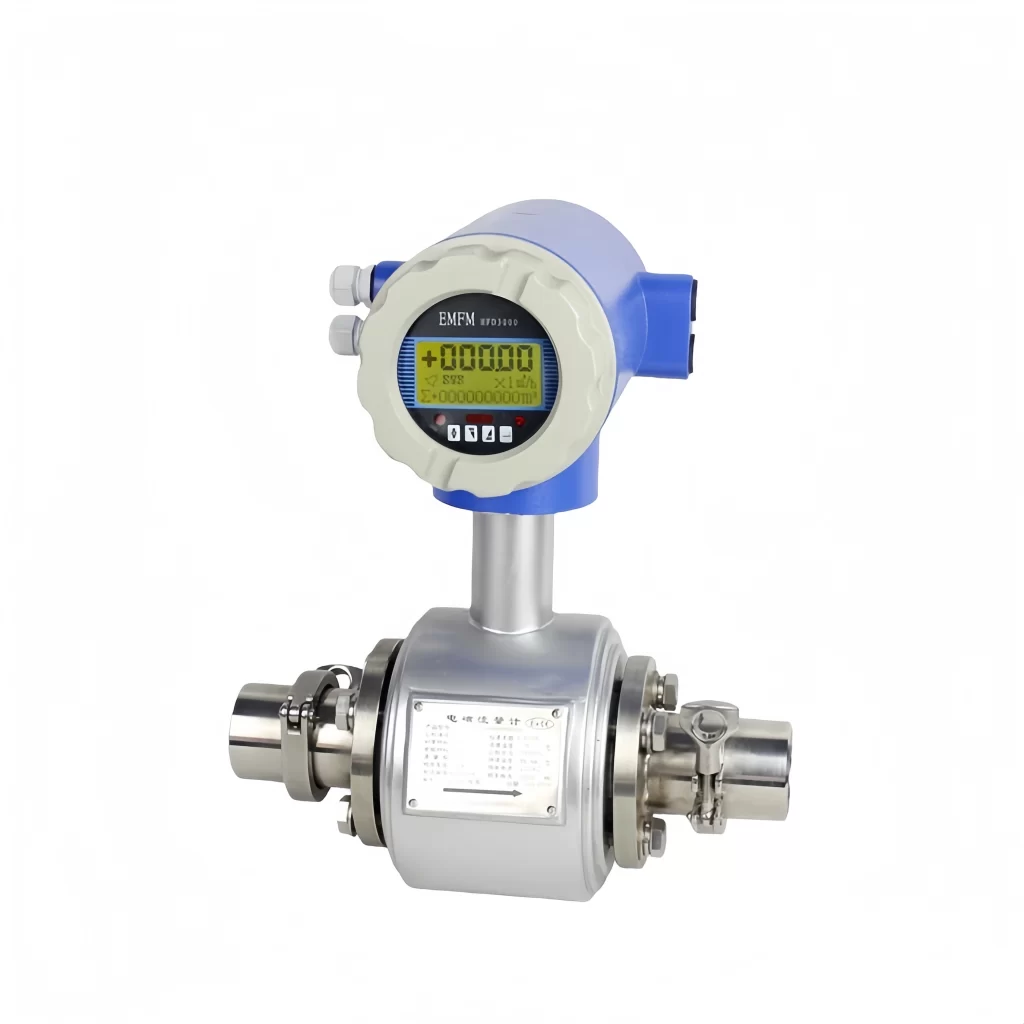
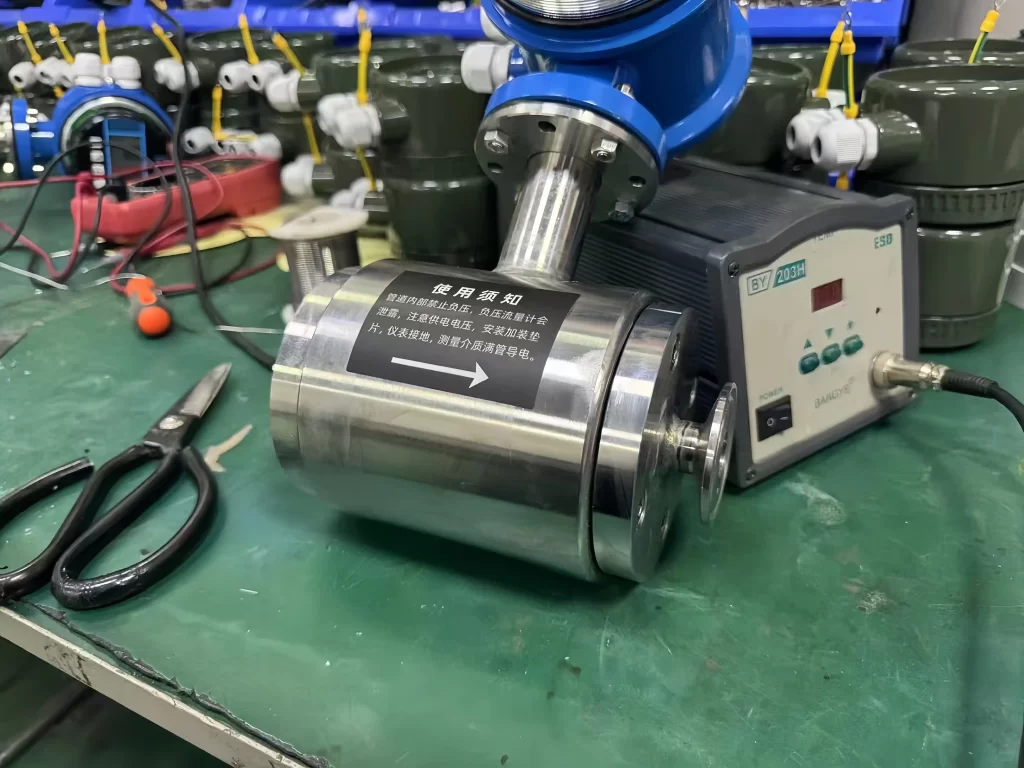
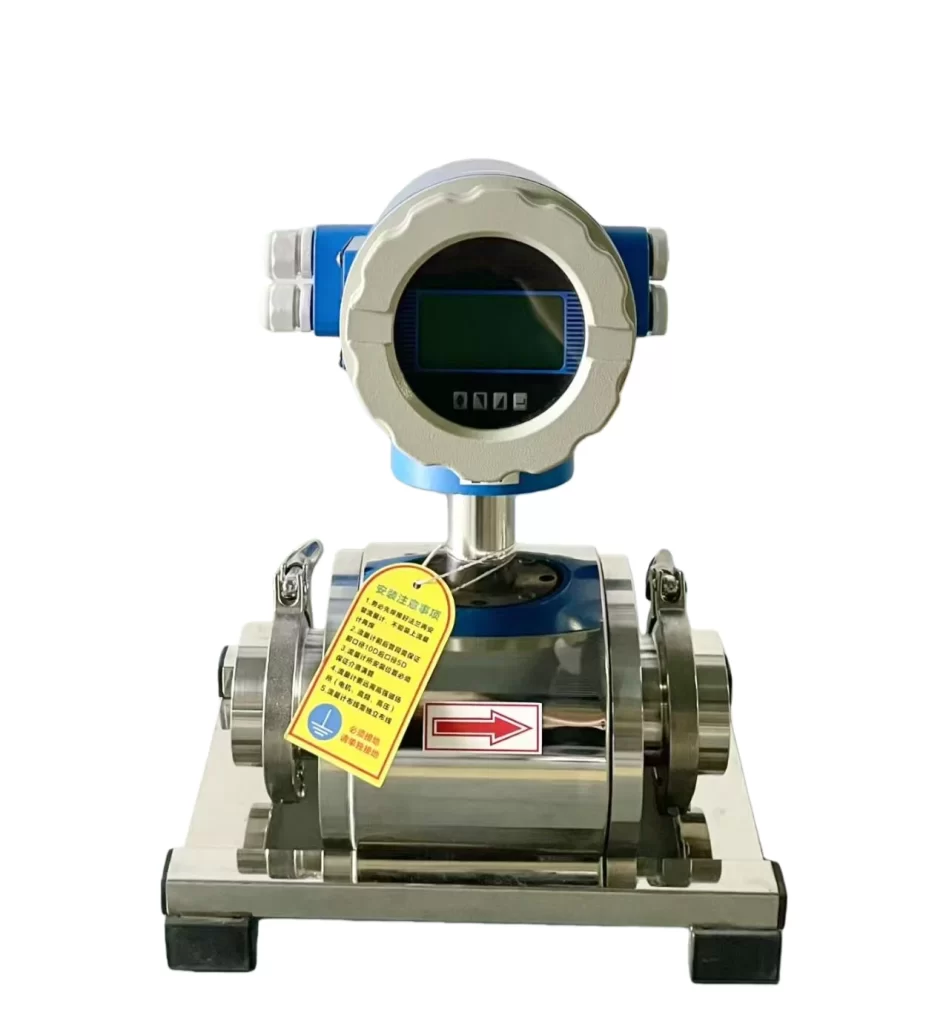
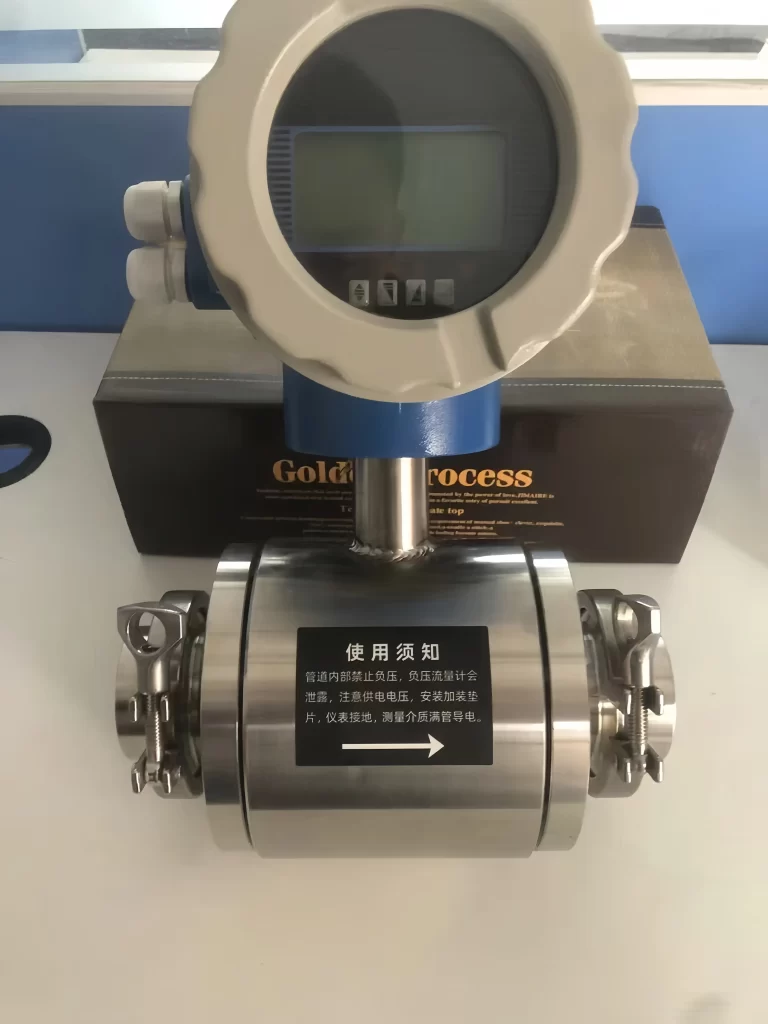
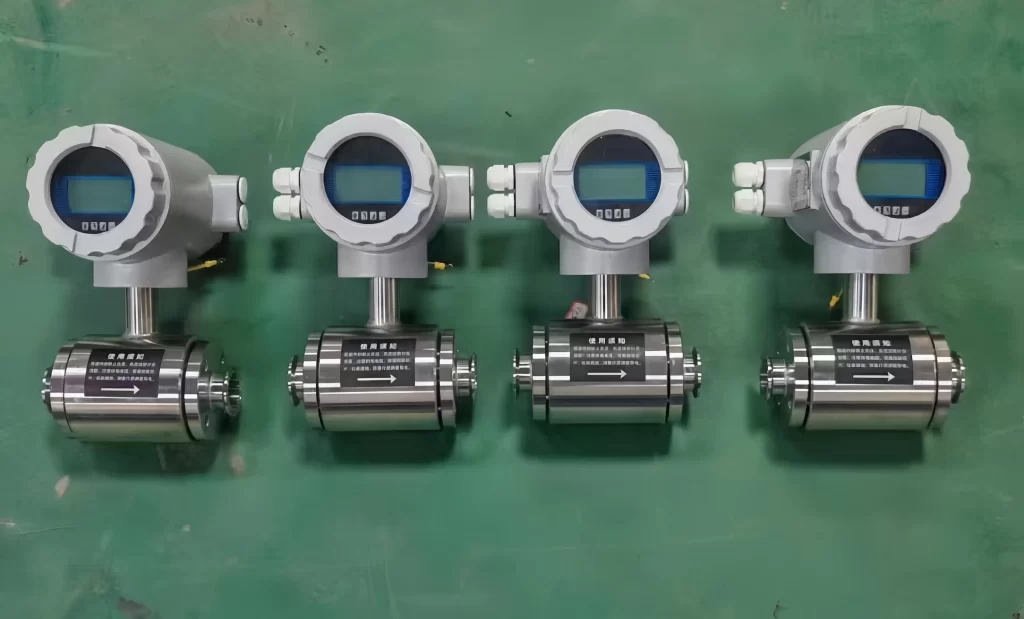
SI-3106 Sanitary Magnetic Flow Meter Tri-Clamp Connection
The Sanitary Magnetic Flow Meter is a sanitary-grade flow meter that meets the stringent requirements of the food processing, biotechnology, and pharmaceutical industries. It is constructed from stainless steel (304 or 316L), and the electrodes and lining materials meet hygiene standards. It features a sanitary three-piece clamp connection. It meets users’ requirements for safety, hygiene, and reliable performance.
Based on Faraday’s law of electromagnetic induction, the Sino-Inst Sanitary Magnetic Flow Meter can measure conductive media such as milk, juice, and pharmaceuticals. Custom configuration parameters are also supported!
Materials in contact comply with food industry standards;
High-temperature steam sterilization within a short timeframe;
Clamp connections enable easy disassembly, maintenance, and cleaning of the electromagnetic flowmeter;
Suitable for measurement in food and pharmaceutical industries;
Utilizes new sanitary lining materials to prevent accumulation of residual measured medium within the measuring tube;
Simple sensor structure without throttling devices, resistant to clogging, suitable for measuring liquids containing solid particles, fibers, or suspended solids.
Multiple wetted material options available for measuring various corrosive liquids.
The sanitary electromagnetic flowmeter is a precision instrument designed to meet the needs of high hygienic standards for fluid measurement. It plays a vital role in the food, pharmaceutical, chemical and other industries. It is used in creating sanitary fluid control, ensuring food safety and production hygiene.
Brewery flow meters are specialized devices that are used to measure the flow rate of liquids, such as beer and wine, in a brewery or winery setting. These devices can be used to monitor the production process, ensure quality control, and optimize the use of resources. There are a variety of different types of brewery … Read more
Magnetic Flow Meter: How It Works
The sanitary electromagnetic flowmeter is a flow measurement instrument specifically designed for industries with high hygiene requirements, such as food, pharmaceuticals, and beverages. It operates based on Faraday’s law of electromagnetic induction, calculating the flow rate by utilizing the electromotive force (EMF) generated when a conductive medium cuts magnetic field lines.
According to Faraday’s principle of electromagnetic induction, a pair of detection electrodes are installed on the pipe wall perpendicular to the axis of the measuring pipe and the magnetic field lines. When the conductive liquid moves along the axis of the measuring pipe, it cuts the magnetic field lines, generating an induced EMF. This induced EMF is detected by the two electrodes, and its value is directly proportional to the flow velocity. Its value is:
Where: E = B.V.D.K
E – Induced EMF;
K – Coefficient related to magnetic field distribution and axial length;
B – Magnetic induction intensity;
V – Average flow velocity of the conductive liquid;
D – Electrode spacing (inner diameter of the measuring pipe)
The sensor transmits the induced EMF E as a flow signal to the converter. After amplification, conversion, filtering, and other signal processing, the instantaneous flow rate and cumulative flow rate are displayed on a backlit dot-matrix LCD. The converter has 4-20mA output, alarm output and frequency output, and is equipped with RS-485 and other communication interfaces, and supports HART and MODBUS protocols.
A minimum straight pipe section of 5D length is required before the flow meter and a minimum straight pipe section of 3D length is required after it, where D is the inner diameter of the flow meter. For ease of installation and disassembly, a pipe expansion joint can be installed after the flow meter.
When an electromagnetic flow meter is operating, the liquid’s conductivity should be higher than 5 μS/cm. Below this value, the induced electromotive force is too small, the signal-to-noise ratio decreases, and this may lead to measurement instability or increased error.
For some high-performance electromagnetic flow meters, the conductivity can be reduced to 1 μS/cm or lower, but the specific value depends on the flow meter’s design and the manufacturer’s specifications.
Common conductive liquids (such as water, brine, and acid/alkali solutions) generally meet the conductivity requirements. Pure water or deionized water has lower conductivity (0.055~10 S/cm) and may require a high-sensitivity electromagnetic flow meter.
If the liquid’s inherent conductivity is insufficient, an appropriate amount of conductive agent (such as salt or acid/alkali solution) can be added to improve it, but care must be taken to ensure this does not affect process requirements.
For low-conductivity or non-conductive liquids, other types of flow meters can be selected, such as ultrasonic flow meters or mass flow meters.
Electromagnetic flow meters are a common type of flow meter, but they have limitations in certain situations. For example, they cannot be used with non-conductive liquids, in high-temperature and high-pressure environments, in liquids containing air bubbles or particles, or in high-viscosity liquids.
Furthermore, liquids with a volumetric gas content exceeding 5% and liquids with magnetic properties are also unsuitable for measurement using electromagnetic flow meters. In specific situations, it is necessary to select a suitable flow meter and take appropriate measures to ensure measurement accuracy and reliability.
Electromagnetic flow meters are typically classified into several accuracy levels, including:
0.2 level: Measurement error within ±0.2%, suitable for applications requiring extremely high accuracy.
0.5 level: Measurement error ±0.5%, suitable for high-precision applications in industries such as chemical and pharmaceutical manufacturing.
1.0 level: Measurement error ±1%, suitable for general industrial applications, meeting most routine flow monitoring needs.
Yes, you can calibrate an electromagnetic flow meter yourself. Calibration of an electromagnetic flow meter requires following certain standards and procedures to ensure the reliability and accuracy of the measurement results.
On-site calibration of an electromagnetic flow meter should be performed according to the following steps:
Verify that the calibration environment meets requirements, including temperature, pressure, and medium conditions.
Inspect all equipment connections before calibration to ensure they are secure and leak-free.
Select appropriate calibration equipment and tools, such as flow calibrators and standard flow meters.
Gradually adjust the flow rate according to the specified procedure, recording the flow meter’s indicated values.
Calculate the flow meter’s error and perform necessary adjustments.
After calibration, organize data, perform error analysis, and prepare the calibration report.
Positive displacement flow meters(PD Meter) are versatile and cost-effective. They can be used to measure clean, corrosive fluids and gases. When you need a high-precision flow meter at a reasonable price, a positive displacement flow meter is often the best choice. This article will explain how positive displacement flow meters work, the technology behind different … Read more
Heating oil flow meters are devices that measure the flow rate of heating oil through a pipeline. Ensuring accurate monitoring and control of fuel consumption. They are essential in various industries. Including manufacturing, energy, and transportation, where heating oil is used as a primary fuel source. Choosing the right heating oil flow meter for your … Read more
Measuring the flow of media at extreme temperatures in industrial processes has always been a challenging task, whether it’s high-temperature gas, high-temperature liquid, or extremely low-temperature liquid. Conventional flow meters may experience reduced accuracy or even damage when exposed to high-temperature media. Based on years of experience in flow measurement, Sino-Inst has summarized flow measurement … Read more
Sulfuric acid is a vital industrial raw material used in the manufacture of fertilizers, pharmaceuticals, pigments, detergents, and batteries. It is widely used in industries such as petroleum purification, metal smelting, and dye production. In the production and transportation of sulfuric acid, accurate flow measurement is crucial for process control, cost management, and safety. Due … Read more
Gravity flow meters can be used to measure flow in gravity-fed pipelines. These pipelines typically do not have a pressurized pump. Instead, the fluid flows downward from a height, relying on gravity. This type of measurement is often difficult due to the slow flow rate and low flow rate. In our experience, if the fluid … Read more
Flow meter accuracy directly impacts a manufacturer’s profitability and operational integrity. A flow meter is more than just a process instrument; it’s a critical tool. Understanding flow meter accuracy and related parameters is crucial for process control, quality assurance, and cost-effectiveness across various industries. What Is Flow Meter Accuracy? Flow meter accuracy is the degree … Read more
An ultrasonic liquid flow meter is a non-contact flow measurement instrument. It uses ultrasonic waves to measure the velocity of a given fluid or gas. It calculates the flow rate by detecting the difference in forward and reverse sound wave propagation. It has no pressure loss and is widely applicable. It is widely used in various … Read more
Cooling water flow meters are used to monitor cooling water flow. They are commonly used in cooling towers, circulation systems, pipes, tanks, and pumps. They are crucial for industries such as power plants and pumping stations. Sino-Inst’s cooling water flow meters can be configured with a local digital display showing flow velocity, instantaneous flow, and … Read more
Sino-Inst’s sanitary electromagnetic flowmeters use 316L stainless steel and PTFE (PFA) sanitary-grade materials for the measuring tube and feature a clamp-type quick-connect structure. They support residue-free cleaning and comply with ISO, EHEDG, and other sanitary certification standards.
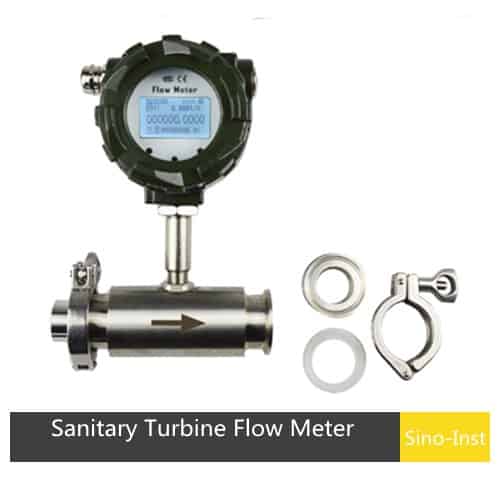
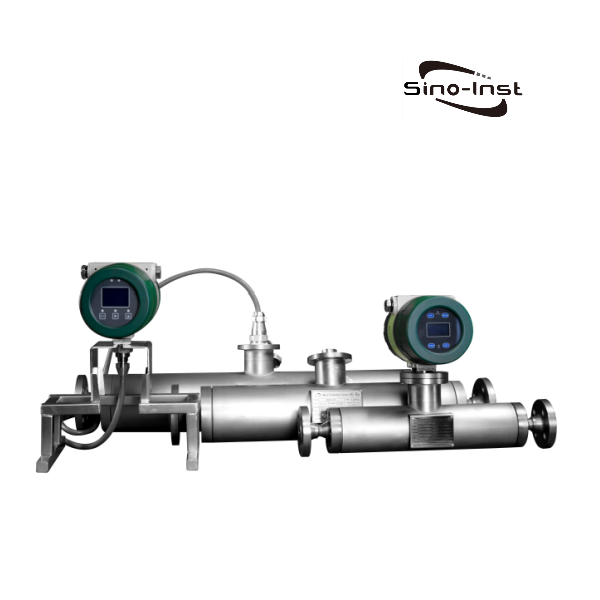
We also supply various other types of sanitary flowmeters, including sanitary turbine flowmeters and sanitary mass flowmeters. With years of experience in flow measurement services, we support customized flowmeter parameters. Please feel free to contact our sales engineers!
Li Rui is responsible for the R&D and design of the company’s automated instrumentation products, leading the development project of the intelligent pressure transmitter. Start with demand analysis and communicate with the market and customers to obtain key parameters, such as measurement range (0 – 10MPa) and accuracy requirements (±0.1%FS).
Responsible for designing hardware circuits, selecting high-performance microprocessors and pressure sensor chips, and building signal conditioning circuits to achieve accurate signal acquisition and processing. On the software side, he wrote C language programs to implement algorithms such as data linearization and digital filtering, ensuring the stability and accuracy of measurement data. After the product was launched, sales reached 5 million yuan in the first year, with positive market feedback, opening up new market areas for the company.
Sanitary Magnetic Flow Meter Tri-Clamp Connection |Sino-Inst
The Sanitary Magnetic Flow Meter is a sanitary-grade flow meter that meets the stringent requirements of the food processing, biotechnology, and pharmaceutical industries. It is constructed from stainless steel (304 or 316L), and the electrodes and lining materials meet hygiene standards. It features a sanitary three-piece clamp connection. It meets users' requirements for safety, hygiene, and reliable performance.
Product SKU:
SI-3106 Sanitary Magnetic Flow Meter Tri-Clamp Connection