Home > Blog > What is a Radar Level Sensor? Selection Guide with Example
What is a Radar Level Sensor? Selection Guide with Example
What is a Radar Level Sensor?
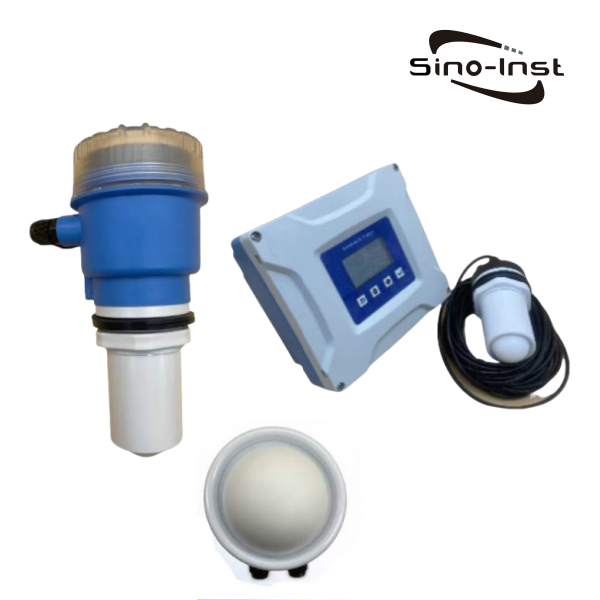
A radar level sensor is an instrument that uses microwave echo ranging to measure liquid levels non-contactly. It can measure both liquid and solid levels and is widely used in river level measurement, container, storage tank, and silo level monitoring. Measurement accuracy is up to ±1mm, and the measurement range can reach 150m. For a worked example on vegetable oil storage, see level monitoring for edible oil tanks.
Radar level sensors determine the liquid level by emitting electromagnetic waves and receiving reflected signals, measuring the distance between the liquid surface and the sensor.
The radar level sensor transmits high-frequency electromagnetic waves (typically in the microwave band) through its built-in antenna system.
These electromagnetic waves propagate at the speed of light and reflect when encountering the surface of the measured medium.
A portion of the reflected signal is received back into the sensor by the same antenna, initiating subsequent signal processing.
Upon receiving the reflected signal, the sensor’s internal electronic components process and analyze it. First, by precisely measuring the time interval between the transmitted and received signals (i.e., the time-of-flight) and combining this with the propagation speed of electromagnetic waves in air (the speed of light), the distance between the sensor and the medium surface can be calculated.
Then, based on the relative position between the sensor installation location and the bottom of the container, along with known container geometric dimensions and other information, the actual liquid or material level height within the container is further calculated.
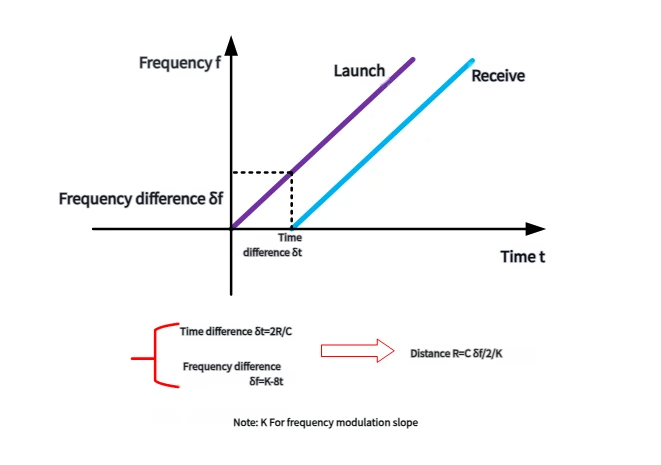
Electromagnetic waves are reflected by a medium and received by radar. The frequency difference δf between the received and transmitted signals is proportional to the distance R from the medium surface:
R = C (velocity) * δf (frequency difference) / 2 / K (modulation slope).
Since the speed of light C and the modulation slope K are known, the frequency difference δf can be calculated to obtain the distance R from the radar installation location to the material surface. Then, by subtracting the spatial distance from the radar to the material surface (referred to as air height) from the known total height of the tank, the height of the material level can be obtained.
When to Use Radar Level Sensors?
Whether it’s liquids, solids, or slurries, radar level sensors are highly adaptable. They can provide stable, continuous level monitoring in special operating conditions such as high temperature and pressure, dusty environments, steam, highly viscous media, corrosive media, and agitation.
Radar Level Sensor for Tanks
Radar level sensors offer superior penetration and measurement accuracy, making them the perfect choice for tank level measurement. They operate normally even in environments with adhesion and condensation.
In industries such as petroleum and chemical manufacturing, high-temperature and high-pressure environments are frequently encountered. The 80G radar level sensor utilizes special materials and structural design to operate stably under these conditions. Examples include reactors and autoclaves in oil refineries.
In containers requiring agitation, level measurement can be affected by the agitator. Traditional level measurement equipment may fail to accurately measure the level due to agitator interference. The 80G radar level sensor has strong anti-interference capabilities, enabling accurate level measurement in agitated containers.
Radar Level Sensor for Solids
In some industrial production processes, such as cement, coal, and flour milling, large amounts of dust are generated. This dust can cause blockages and damage to traditional level measurement equipment. The 80G radar level sensor uses high-frequency electromagnetic wave technology, which can penetrate dust and accurately measure the level.
Radar level sensors can monitor large water levels at a lower cost. Radar level sensors do not need to be in contact with the water surface, making them ideal for use in complex or harsh environments. For example, floating debris, air bubbles, and sludge will not affect the measurement results. Furthermore, radar level sensors are highly adaptable to environments with large water surface fluctuations and inclement weather.
Electromagnetic wave emission angle less than 3°, ideal for narrow spaces or guided wave pipe measurements;
Measuring range up to 120M, suitable for ultra-large storage tanks;
The product’s measurement blind zone is within 7-8 cm, making it suitable for small storage tanks;
It offers extremely high measurement accuracy, making it suitable for high-precision metering-grade applications;
It incorporates advanced echo processing algorithms and extensive empirical data for various operating conditions, providing unique advantages over comparable products in extremely harsh environments such as heavy dust or steam; or in special process storage tanks with agitators, heating rods, and other features.
Millimeter-wave RF chips enable more compact RF architectures, higher signal-to-noise ratios, and smaller blind zones.
The 5GHz operating bandwidth enables higher measurement resolution and accuracy.
With a minimum antenna beam angle of 6°, interference from the installation environment has minimal impact on the instrument, and installation is more convenient.
Integrated lens design, compact form factor.
Display controls and level gauge feature a separate design, allowing for customization.
Low-power operation with a service life exceeding 3 years.
Maximum product range reaches 85m, with a blind zone of 10cm.
Selection Case
Asphalt, a viscous byproduct of crude oil refining, is a high-viscosity organic liquid. It serves as a binder for asphalt used in road, bridge, and waterproofing applications.
A customer at an asphalt mixing plant contacted us requiring asphalt level monitoring. Three main issues needed to be considered:
The temperature range of asphalt tanks is typically between 140°C and 180°C.
Asphalt fumes condense upon cooling in air.
Asphalt volatilization produces asphalt fumes, which are corrosive.
Based on the customer’s comprehensive operating parameters, we selected the 80GHz FMCW Radar Level Snesor, specifically designed for challenging applications such as asphalt tanks. With its narrow beam angle and high-frequency signal, it provides continuous and reliable level measurement even under interference from steam, condensate, or tank obstructions.
Radar level transmitters boast advanced technology and broad applicability. They have become the preferred solution for industrial liquid level monitoring. These devices are widely used in petrochemicals, water treatment, and food and pharmaceutical industries. Therefore, understanding radar level transmitters and their operating principles is crucial for achieving precise and reliable liquid level measurement. This article … Read more
Tank level monitoring is critical in industrial production. Radar level gauges provide real-time water level measurements with exceptional accuracy. Consequently, they have become the preferred choice for industrial-level monitoring. Radar level gauges offer an ideal solution for chemical storage tanks, oil fields, and reservoirs. In large tank installations, they achieve measurement accuracy of ±2mm—significantly surpassing traditional … Read more
Due to its unique non-contact measurement capabilities, this intelligent radar level/liquid level meter accurately measures contaminants and corrosive media. Its 4-20mA and RS-485 output signals enable remote control. Its pulse operation allows for measurement of low-dielectric-constant media and is safe for use in various metal and non-metal containers, harmless to humans and the environment. It utilizes … Read more
Radar level gauges, with their non-contact measurement, high accuracy, and adaptability, have become the preferred technology for tank level monitoring. Using high-frequency microwave pulse or continuous wave technology, radar level gauges accurately measure levels by calculating the time difference between the electromagnetic wave’s transmission and its reflection back to the receiving antenna. In large tank … Read more
The biggest difference between radar and ultrasonic level transmitter is the different measurement principles. Ultrasonic level transmitter uses sound waves, and radar level meter uses electromagnetic waves. Different measurement principles lead to different application scenarios. Radar and ultrasonic level transmitters are both non-contact level measurement technologies. Both types of liquid level meters send signals to … Read more
Understanding the different Guided Wave Radar Level Transmitter Types can help you choose a more suitable model. Since the electromagnetic waves emitted by guided wave radar level transmitters are mostly pulse waves, we can classify guided wave radar level transmitters according to the type of probe. According to the structure of the probe, guided wave … Read more
Radar and Guided Wave Radar Level Transmitter are often used in tank level measurement. Radar Level Transmitter and Guided Wave Radar Level Transmitter both use the principle that electromagnetic waves will be reflected on the surface of the medium to measure the level. For tanks that are tall, have a large measuring range, use clean … Read more
Only a reasonable Guided Wave Radar Level Transmitter Installation can ensure long-term reliable and accurate measurement. And paying attention to the details during installation can avoid many troubles during use. Guided Wave Radar Level Transmitter is a contact type liquid level measuring instrument. It can measure liquids, particles and slurries and is not affected by … Read more
In industries such as chemical engineering, metallurgy, pharmaceuticals, electroplating, and sulfuric acid storage and transportation, sulfuric acid, as a basic raw material, is extremely corrosive. 98% concentrated sulfuric acid is viscous, fuming, and easily releases volatile acid mist. Under certain operating conditions, it is also accompanied by complex conditions such as high temperature and crystallization. … Read more
Radar level sensors are widely used in various production industries such as chemical and petroleum due to their high measurement accuracy and media compatibility. In addition to radar level sensors, Sino-Inst also supports customized level measurement solutions for other types of liquid levels. Please feel free to contact us!
Zhang Wei, possesses 20 years of experience as an automation instrumentation engineer, specializing in the research, design, installation, commissioning, and maintenance of automation instruments.
Face to various instrument communication protocols (such as Modbus, Profibus, etc.), with solid hardware circuit design and software programming skills (proficient in C language and PLC programming). Has extensive project experience; projects he has led and participated in have all achieved outstanding results, improving product accuracy, reducing costs, and increasing production efficiency.
Possesses excellent communication and coordination skills and a strong team spirit, enabling him to quickly respond to customer needs and provide high-quality automation instrumentation solutions.