Orifice Plate Tapping Guide

Orifice Plate Tapping Guide

An orifice plate flow meter is a high-range differential pressure flow measurement device consisting of a standard orifice plate and a multi-parameter differential pressure transmitter. Orifice plate tapping refers to the method of extracting the differential pressure before and after the orifice plate. Common types of orifice plate pressure taps include: flange taps, corner taps, and radius taps (D-D/2 taps).

In orifice differential pressure flow measurement systems, the choice of tapping method significantly affects measurement accuracy, installation complexity, and maintainability.

1. Flange Pressure Tapping

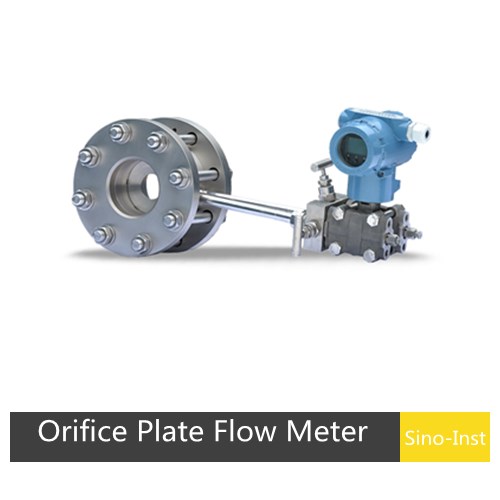
Flange pressure tapping involves placing the pressure taps on a dedicated tapping flange. The distance between the upstream and downstream pressure taps is 25.4 mm (or “1-inch tapping”) from the upstream and downstream faces of the orifice plate.

Structure: The flange pressure tapping structure is relatively simple. The flange is a dedicated orifice plate flange with a high-pressure rating (e.g., 300LB).

It is easy to install and suitable for various media, especially widely used in low-pressure conditions. It is easy to clean, therefore it is quite common in industrial applications.
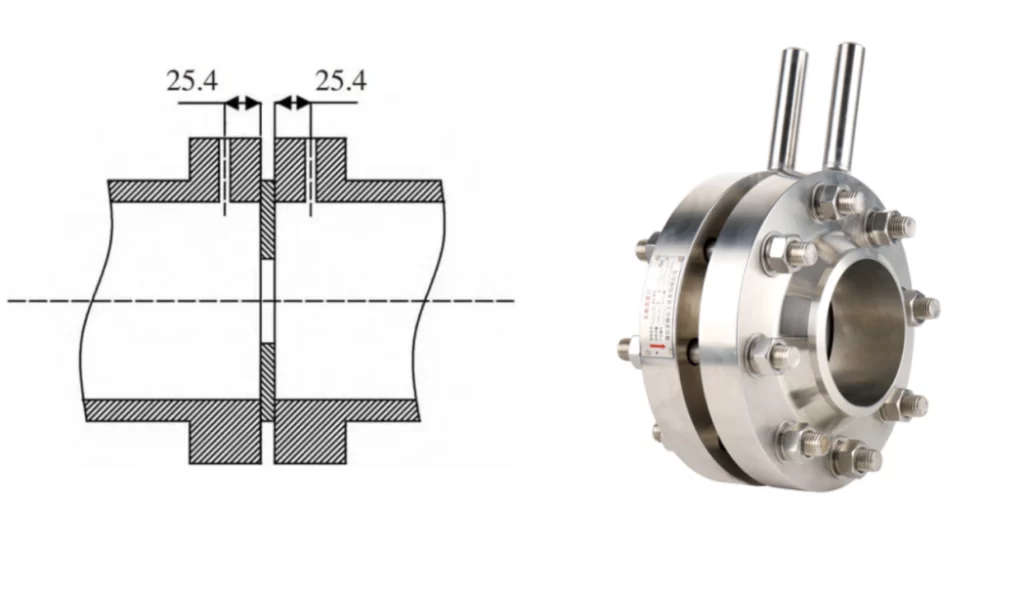
Flange Pressure Tapping

2. Corner Tapping

Corner tap pressure measurement is divided into two forms: annular chamber tapping and separate drilling. The two pressure taps are located at the angle between the upper and lower end faces of the orifice plate and the pipe wall. The distance from the center of the upstream and downstream pressure taps to the front and rear end faces of the orifice plate is equal to half of the pressure tap diameter (for single-hole tapping); in the case of annular chamber tapping, it is equal to half of the annular gap width.

Annular chamber tapping can improve measurement accuracy and is suitable for clean media, especially under high temperature and high pressure conditions. However, the annular chamber structure is complex, time-consuming and costly to manufacture, and is prone to clogging and difficult to clean.

Separate drilling for pressure tapping is relatively simple, but the accuracy is lower.

Corner tap pressure measurement is usually used in situations with smaller pipe diameters or where high-precision measurement is required. Annular chamber tapping is suitable for pipe diameters below DN400, while separate drilling is suitable for pipe diameters above DN400.
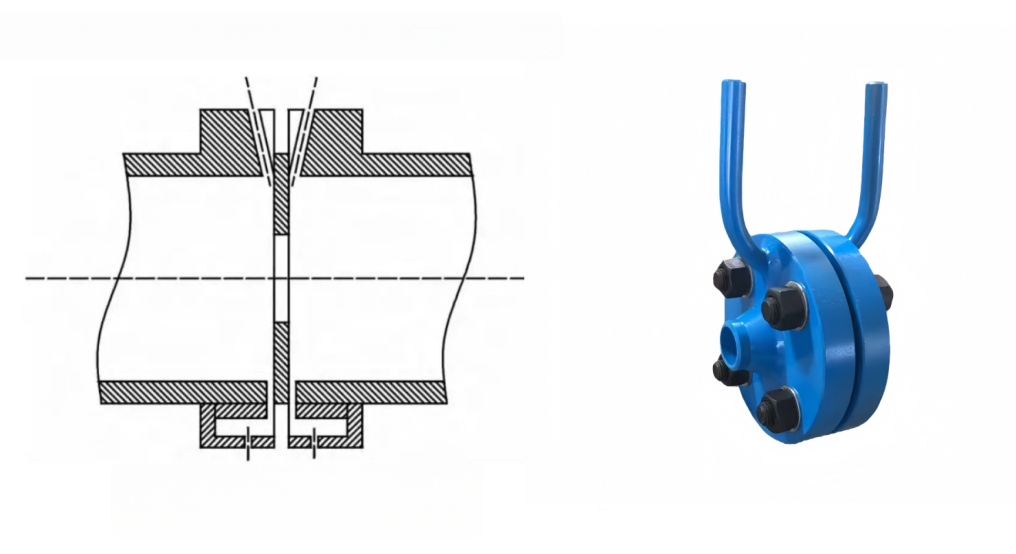
Corner Tapping

3. Radius Tapping (D – D/2 Tappings)

In this pressure tapping method, the distance between the pressure taps is the distance between the centerline of the pressure tap and a specified end face of the orifice plate. The upstream pressure tap distance is the pipe diameter D, and the downstream pressure tap distance is D/2. To avoid installation errors on-site, when using radius tapping, the throttling device is generally supplied as a complete set with straight pipe sections.

Radius tapping does not require complex machined parts and is easy to install and use on-site, especially in European and American countries. Radius tapping is suitable for large-diameter pipes and situations with high Reynolds numbers, but its signal-to-noise ratio is lower, and the measurement accuracy may not be as good as other methods.
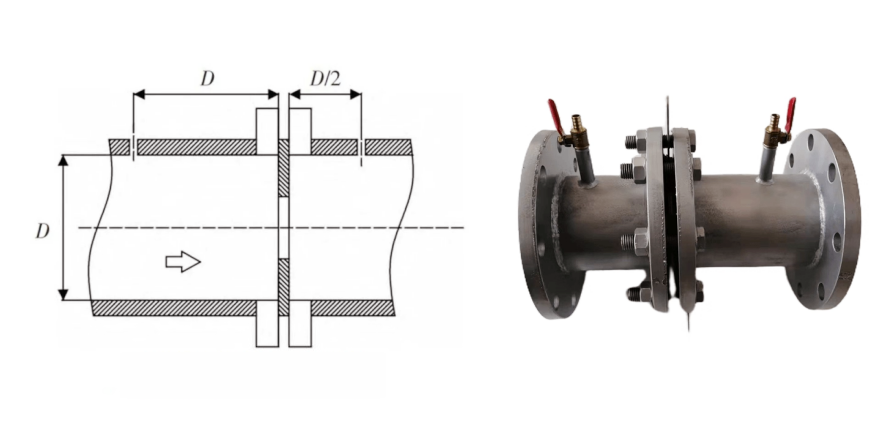
Radius Tapping D - D 2 Tappings

The theoretical basis of the orifice plate flowmeter is Bernoulli’s principle in fluid mechanics. This principle states that in a steady flow of fluid, the pressure is lower where the flow velocity is higher, and the pressure is higher where the flow velocity is lower.

When the medium filling the pipe flows through the orifice plate inside the pipe, the flow velocity will form a local contraction at the orifice plate, causing the flow velocity to increase and the static pressure to decrease, resulting in a pressure difference before and after the orifice plate. The greater the medium flow rate, the greater the pressure difference before and after the orifice plate. The flow rate is calculated by measuring the pressure difference.

The flow rate calculation formula for the orifice plate flowmeter is:

Q = αA√(2ΔP/ρ)

Where Q is the flow rate, α is the flow coefficient, A is the orifice plate area, ΔP is the differential pressure across the orifice plate, and ρ is the fluid density.

  1. Standard Orifice Plate:

The standard orifice plate is a type of standard throttling device with the most specifications, widely used in the measurement of various fluid flows, especially gas flow. Its structure varies depending on the pressure, diameter, and pressure tapping method. Standard orifice plates can be divided into three types according to the commonly used pressure tapping methods: corner tapping, flange tapping, and radius tapping.

  1. Segmental Orifice Plate:

The segmental orifice plate is suitable for media with high viscosity and relatively dirty fluids. Its pressure tapping method is usually flange tapping.

  1. Eccentric Orifice Plate:

The eccentric orifice plate is suitable for flow measurement of fluids containing solid particles. Its pressure tapping method is corner tapping. Eccentric orifice plates and segmental orifice plates are only suitable for installation on horizontal or inclined pipes, and cannot be used on vertical pipes.

  1. Integrated Orifice Plate:

An integrated orifice plate combines the orifice plate and the measuring pipe into a single unit, generally used for small pipe diameters (DN ≤ 50mm), and is therefore also called a small-diameter orifice plate.

  1. Flow Limiting Orifice Plate:

Flow limiting orifice plates are used for pressure reduction and flow limitation in fluid transportation processes. They utilize the pressure loss characteristics of the throttling element to achieve pressure reduction and flow limitation.

  1. Annular Orifice Plate:

Annular orifice plates are suitable for various fluid media (gas, steam, liquid). In addition to the simple structure, robustness, and ease of installation and use of standard orifice plates, they can also automatically resolve upstream flow disturbances and effectively avoid non-axisymmetric distribution in the flow meter, thus eliminating concerns about fouling of the throttling element.

  1. Balanced Orifice Plate Flow Meter – Multi-hole Orifice Plate

A balanced orifice plate, also known as a multi-hole orifice plate, is created by welding multiple insertion holes to both sides of two flanges connected to the pipe diameter, achieving a balancing effect. It is suitable for measuring gases such as steam, biogas, natural gas, and air.

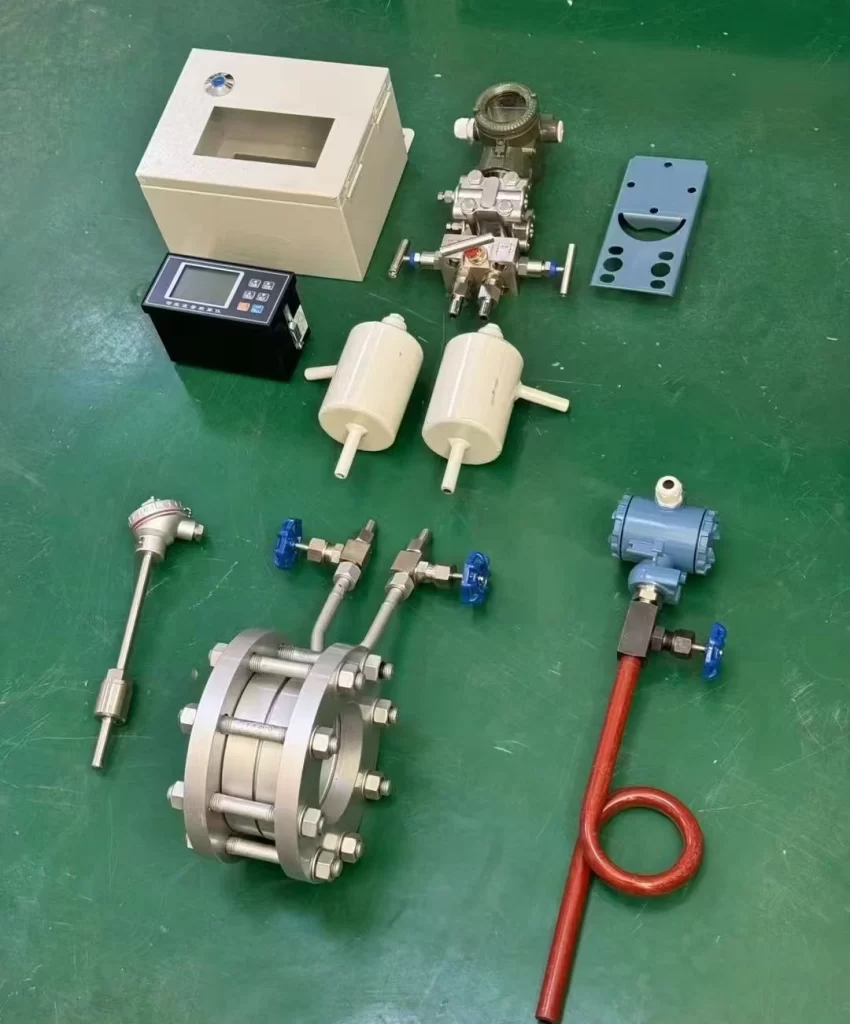
The integrated orifice plate flow meter is a high-range ratio differential pressure flow device composed of a standard orifice plate and a multi-parameter differential pressure transmitter (or differential pressure transmitter, temperature transmitter, and pressure transmitter). The integrated structure design makes installation simpler.

Features:

  1. The throttling device structure is easy to replicate, simple, robust, stable and reliable in performance, has a long service life, and is inexpensive.
  2. The integrated orifice plate is easier to install, requires no pressure tapping pipes, and can be directly connected to differential pressure transmitters and pressure transmitters.
  3. Standard orifice plate flow meters use standard calculations and processing, have a wide range of applications, can measure all single-phase flows, and can also be used for some mixed-phase flows.
  4. The orifice plate flow meter uses an imported single-crystal silicon intelligent differential pressure sensor, whose range can be programmed and adjusted.
  5. In addition to online, dynamic full compensation functions, it also has self-diagnosis and self-setting range capabilities.

More Flow Measurement Solutions

  • 10 Steps to Size a Turbine Flow Meter

    Need to size a turbine flow meter? Are you still only choosing based on pipe diameter? Please stop immediately. Turbine flow meters account for a significant portion of industrial flow measurement processes due to their low cost and wide range of media compatibility. However, sizing a turbine flow meter is not as simple as just … Read more
  • Mass Flow Rate and Volumetric Flow Rate: Key Differences and Conversion

    When it comes to flow measurement, understanding the distinction between mass flow rate and volumetric flow rate is crucial. Both concepts are widely used in various industries, but they differ in several aspects. We’ll explore the key differences between mass flow rate and volumetric flow rate, examine the factors that affect flow rate conversions, and … Read more
  • What Is the Flow Rate? Velocity vs Flow

    What Is the Flow Rate? Is the flow rate the same as Flow? When we choose a flowmeter, we often know the fluid parameters of the pipeline. Including flow range, pressure, pipe diameter, etc. Flow rates and flow ranges are different. Flow is divided into volume flow and mass flow. So what is the relationship … Read more
  • Hydrogen Flow Meters for Mass and Volume Flow

    Hydrogen flow meters are widely used in hydrogen energy fields, such as hydrogen production, hydrogen storage and hydrogen fuel cells. Typically used to monitor volumetric flow, mass flow and usage of hydrogen to ensure proper system operation and optimize performance. Since the value of hydrogen is very high, custody transfer metering is also a very … Read more
  • Case: Non-Contact Ultrasonic Flow Meter For Water

    A clamp-on ultrasonic flow meter is an instrument that uses high-precision ultrasonic sensing technology to measure flow rate. It mainly consists of a host and a set of ultrasonic sensors. These sensors can be installed on the outer wall of the pipe without the pipe or shutting down the system, and they will not contaminate … Read more
  • Orifice Plate Installation Guidelines

    Orifice plate flowmeter installation requirements and precautions Orifice plate is a standard throttling device with the most specifications. It is the simplest and most adaptable product among throttling devices. It is widely used in various fluids, especially gas flow measurement. CONTACT US What’s an orifice plate? The orifice plate only refers to the key part … Read more
  • DP Transmitter for Flow Measurement

    What Is a Differential Pressure Flow Meter? A differential pressure flow meter is a device that measures flow rate by measuring the pressure difference. The differential pressure transmitter is the key component in differential pressure flow measurement. Using a differential pressure transmitter, the pressure difference before and after a pipe throttling device can be measured. … Read more

As a mature flow measurement method, orifice plate flow meters utilize different types of orifice plates and pressure tapping methods depending on various operating conditions. Understanding the common types of orifice plate flow meters and pressure tapping methods helps in better selecting and applying this flow measurement instrument, thereby improving measurement accuracy and reliability.

Sino-Inst will consider factors such as media characteristics, pipeline conditions, and measurement requirements to select the appropriate orifice plate type and pressure tapping method for you. Please feel free to contact us anytime.

    Request For Quote