-1.jpg)
The vortex flowmeter is a velocity-type flow instrument that operates based on the principle of fluid oscillation. Due to its simple structure, high accuracy, and wide range of applications, it has become popular in industrial measurement. From petrochemicals to food and beverages, from liquid flow monitoring to gas flow monitoring, this instrument, thanks to its unique “vortex shedding” effect, has become one of the mainstays of modern industrial flow measurement.
Case Study
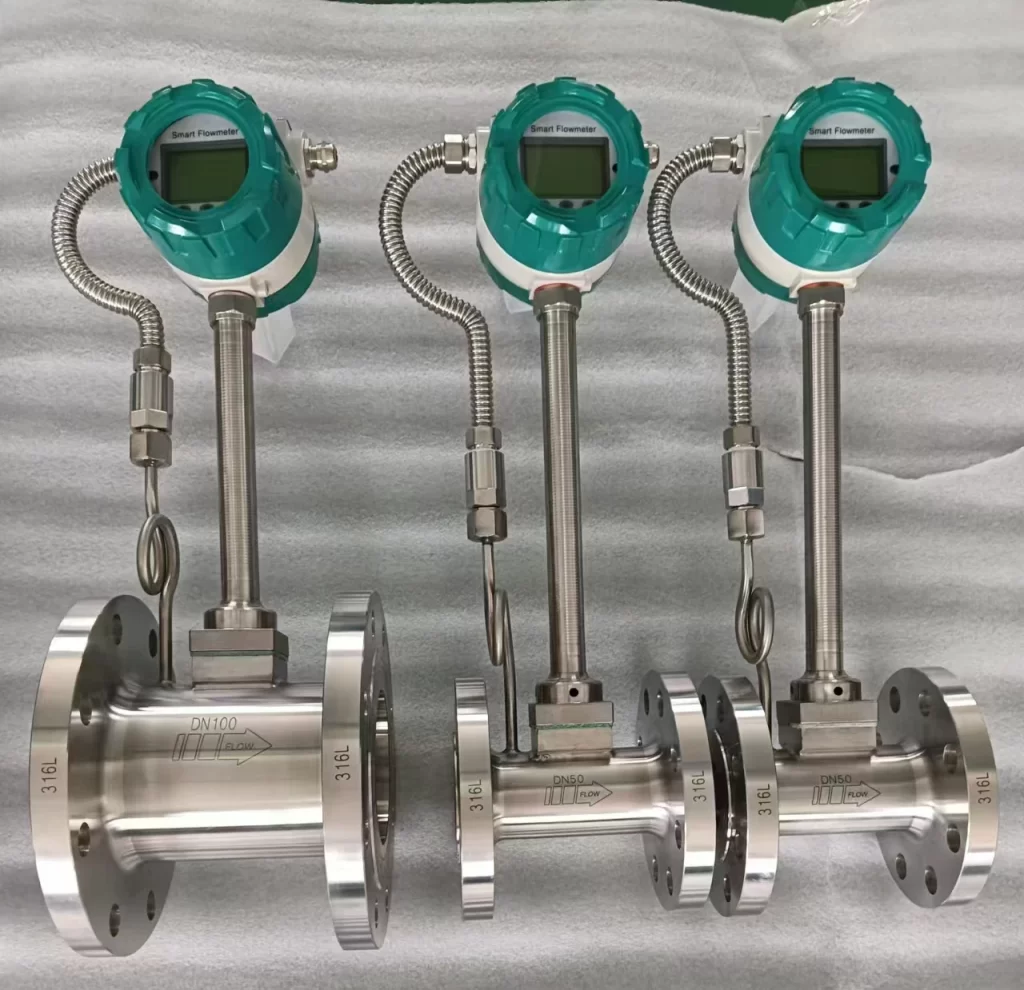
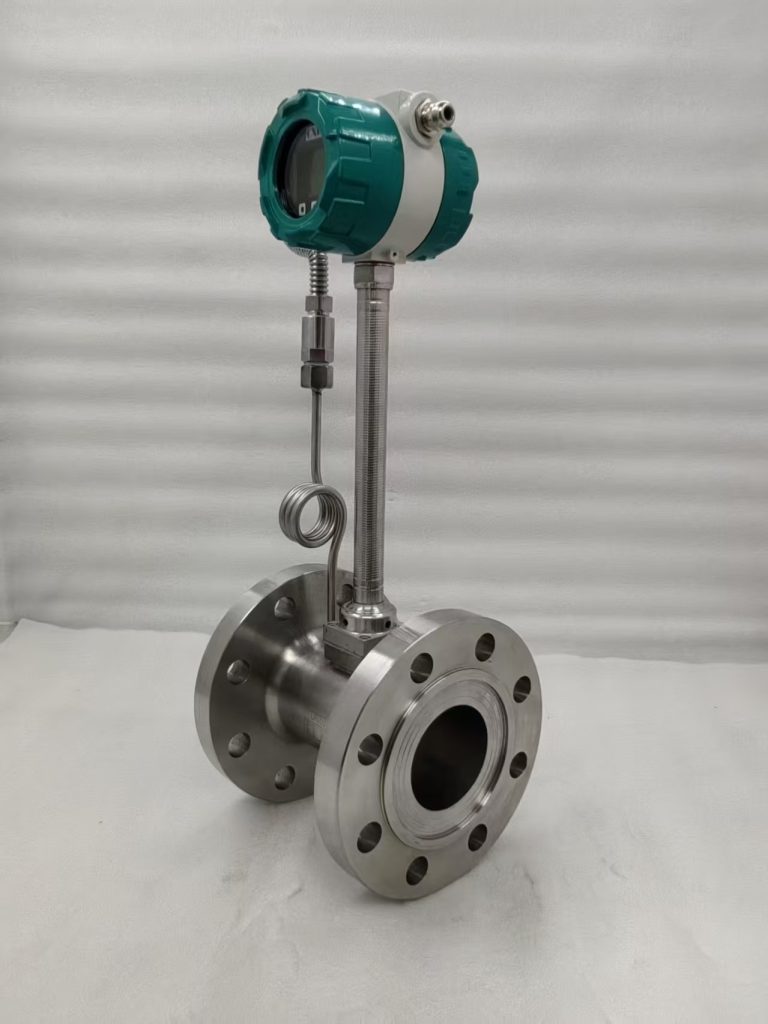
A student from a Canadian university needed to monitor the flow rate of high-temperature gas for his experiment. We recommended a vortex flowmeter to him. Because the gas he was measuring was at a high temperature, we specially customized a high-temperature resistant vortex flowmeter for him, with the following parameters:
- Vortex Flowmeter
- DN20
- Measuring medium: High-temperature air
- Flow range: 6-30 m³/h
- Pressure: 2 MPa
- Temperature resistance: 350℃
- DC24V
- Signal output: 4~20mA
- With integrated temperature and pressure compensation
- ASME flange mounting
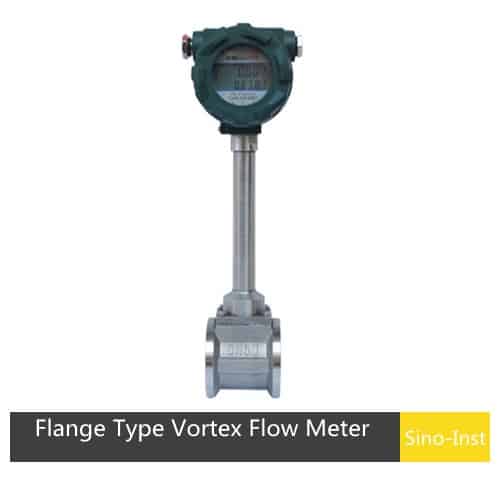
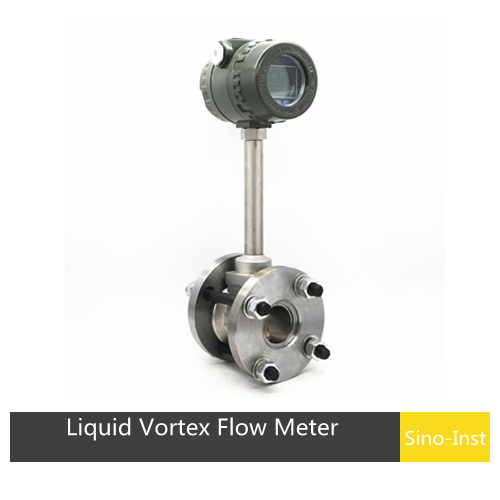
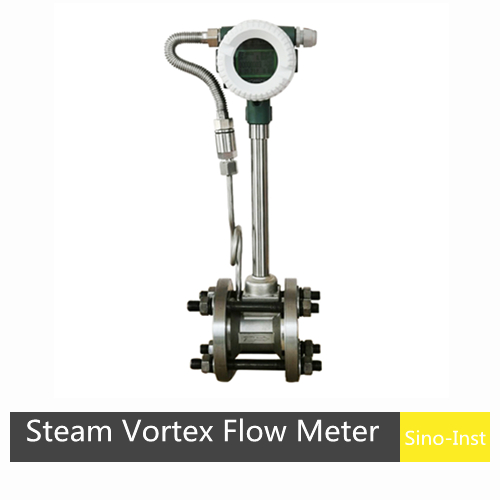
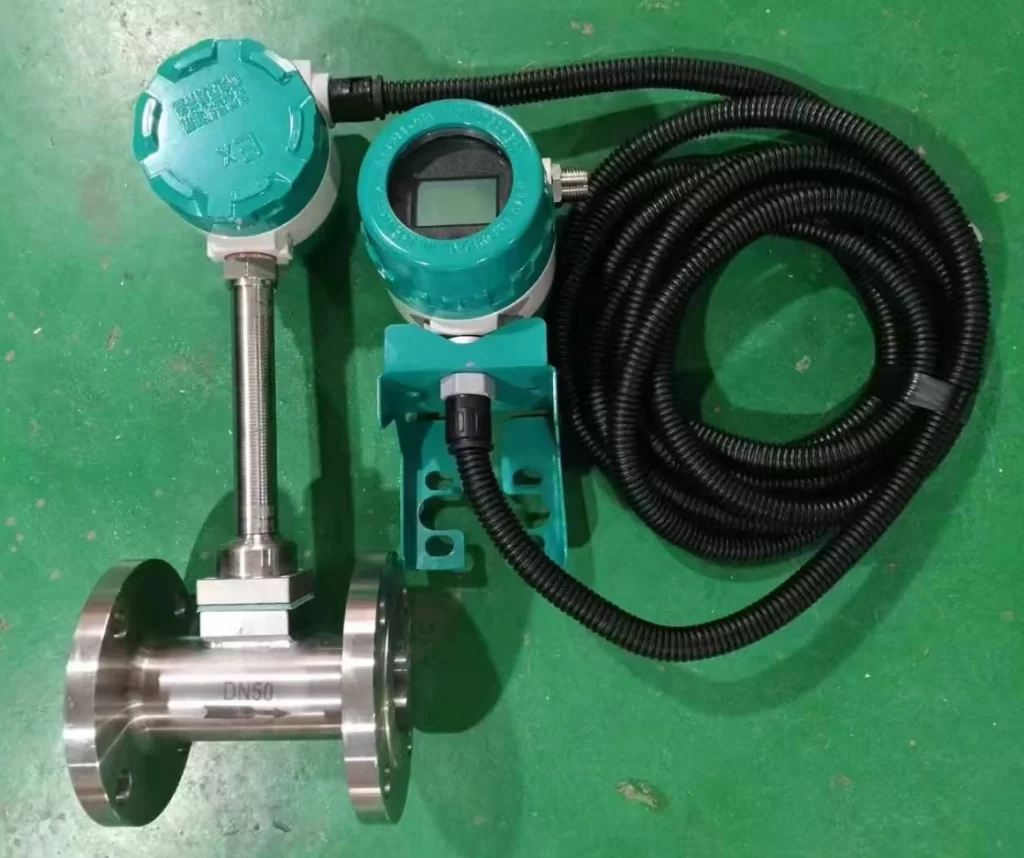
Structure Of The Vortex Flowmeter
1. Bluff body: The core component of the instrument, usually with a triangular, trapezoidal, or T-shaped cross-section, responsible for “creating” vortices.
2. Detection sensor: This is the key component for sensing the vortex frequency. Several types are available on the market. We use a piezoelectric stress-type detection sensor, which utilizes the pressure pulsations caused by the vortices to generate an electrical signal. This is currently the most widely used technology with the highest level of technological maturity and product stability.
3. Signal converter: Amplifies, shapes, and converts the sensor signal into a standard 4-20mA or pulse output.
Measurement Principle
In the early 20th century, the Hungarian-born mathematician and physicist Theodore von Kármán discovered that when a liquid or gas flows perpendicular to an obstacle, alternating vortices are generated on both sides of the obstacle. Later, von Kármán further discovered that the number of vortices generated is directly proportional to the velocity of the fluid producing the vortices.
Our vortex flowmeter is designed based on the Kármán vortex street effect. It calculates the flow rate by detecting the frequency signal which is generated when the fluid flows past the obstacle. The core principle is: an obstacle is installed in the pipe, and when the fluid flows through it, alternating vortices are generated on both sides. The separation frequency of the vortices is directly proportional to the flow velocity, and the volume flow rate can be calculated by detecting this frequency using a piezoelectric sensor.
How Is The Vortex Shedding Frequency Measured?
When vortices form and pass by an obstacle, the pressure in the obstacle region is lower than in other parts of the fluid. This low pressure creates a pressure difference across the sides of the obstacle. Stress is then applied from the high-pressure side to the low-pressure side. The location where the vortices are generated switches periodically, causing a change in the location of the low-pressure region and a shift in the direction of the stress, thus causing the obstacle to oscillate. The frequency of this oscillation is the von Kármán vortex shedding frequency.
Product Features
- Wide measurement range and high accuracy, with high reliability and long-term stability.
- Simple structure, no moving parts, and no mechanical wear.
- Easy installation, requiring relatively short straight pipe sections.
- Significantly lower permanent pressure loss compared to traditional throttling devices such as orifice plates.
- Brand new appearance design, the main body adopts precision casting technology, with a beautiful appearance, high temperature resistance, and strong corrosion resistance.
- Common signals include pulse or analog signals, which are stable and have strong anti-interference capabilities.
- Compared with electromagnetic flowmeters, the measurement process does not depend on the conductivity of the medium.
Why Is Temperature And Pressure Compensation Necessary When Measuring Gases?
In gas flow measurement, temperature and pressure compensation is a core link in ensuring measurement accuracy. This is because the flowmeter directly measures the actual flow rate (volume flow rate under actual operating conditions), but industrial metering and trade settlement require the standard flow rate (standard conditions: 101.325 kPa, 20℃ or 0℃). Gases are compressible, and their volume is closely related to temperature and pressure. Measurement results without compensation will produce big errors.
Typical Application Scenarios
- Steam metering: Trade settlement and energy consumption management of saturated steam and superheated steam
- Compressed air: Leakage monitoring and energy efficiency assessment of factory compressed air systems
- Natural gas: Process metering of city gas and industrial gas
- Petrochemical industry: Precise proportioning of process fluids and additives
- Food and beverage: Hygienic measurement of CIP cleaning fluids and high-temperature steam
- Pharmaceutical industry: Flow monitoring of purified water and water for injection
More Flow Measurement Solutions
Guide To Vortex Flow Meters For Steam Applications: Steam Vortex Flow Meter In detail
Checklist: Vortex Flow Meter Advantages and Disadvantages
Vortex Flow Meters for Natural Gas
Guide to Flow Measurement Devices: Types and Selection
Mass Flow Rate and Volumetric Flow Rate: Key Differences and Conversion
What Is the Flow Rate? Velocity vs Flow
Summary: The selection of a vortex flow meter requires careful consideration of fluid characteristics, flow range, environmental conditions (temperature and pressure), and system integration requirements to ensure the reliability and cost-effectiveness of the measurement system. If you have any questions, please feel free to contact our technical staff.