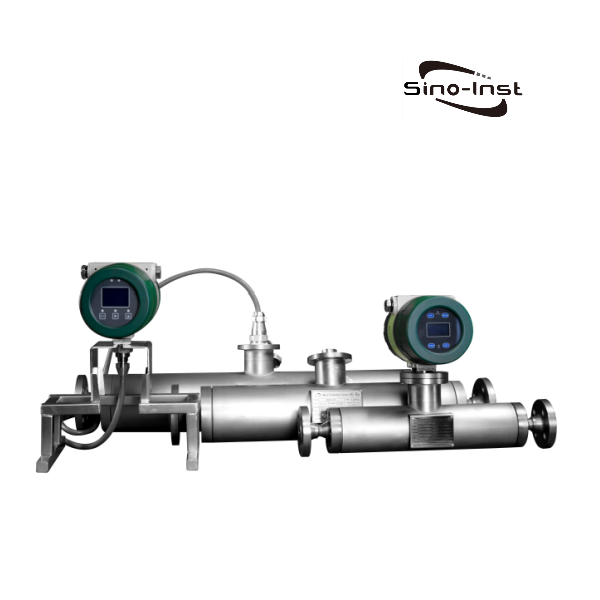
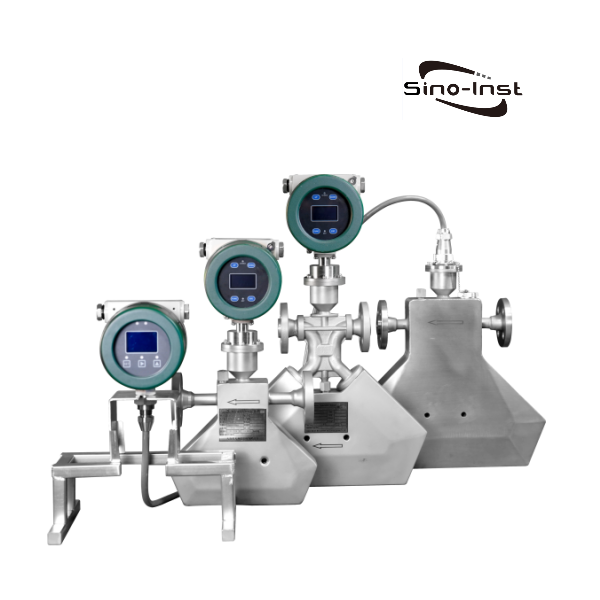
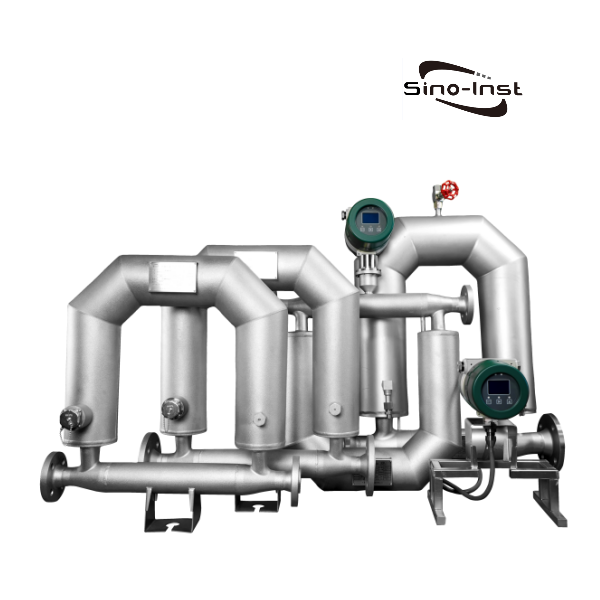
Coriolis Mass Flow Meters

Sino-Inst Coriolis Mass Flow Meters directly measure the mass flow rate, temperature, and density of gaseous, slurry, or liquid media. They are among the most accurate flow meters available, achieving an accuracy of 0.1%.

Sino-Inst’s Coriolis Mass Flow Meters feature high measurement accuracy, ease of installation and operation, and a compact, space-saving design. They exhibit minimal pressure loss and have no moving parts, making them widely applicable in both low- and high-flow-rate process control, including flow measurement and trade in industries such as chemicals, food processing, oil and gas, and pharmaceuticals.

Coriolis Flow Meters directly measure fluid mass flow rate based on the Coriolis force effect. According to Newton’s second law, when fluid flows in a vibrating tube, a Coriolis force proportional to the mass flow rate is generated. When no fluid flows, the vibrating tube does not twist, and the signals detected by the electromagnetic signal detectors on both sides of the tube are in phase. When fluid flows, the vibrating tube twists under the influence of torque, resulting in a phase difference between the two detectors. The transmitter measures the lag time between the left and right detection signals. Multiplying this time difference by the flow calibration coefficient determines the mass flow rate.

Featured Coriolis Mass Flow Meters

Data Sheet


A Coriolis mass flow meter is a device that directly measures the mass flow rate of fluids based on the Coriolis force effect. It consists of a sensor and a transmitter.

Its working principle is that when fluid flows through a vibrating tube, the Coriolis force causes the tube to twist and deform. The mass flow rate is calculated by detecting the phase difference between the inlet and outlet. Sensors often use U-shaped or S-shaped vibrating tube structures, utilizing electromagnetic drive to generate high-frequency vibration, and combining this with digital signal processing technology to improve accuracy. It can simultaneously measure parameters such as density and temperature, with an accuracy range typically from ±0.05% to ±0.35%. It is suitable for liquids and some gaseous media in industries such as petroleum, chemical, and pharmaceutical.

Coriolis mass flow meters are suitable for measuring a variety of fluids, including but not limited to:

Liquids: Water, oil, chemical raw materials, food and beverages, pharmaceuticals, etc.

Gases: Natural gas, air, nitrogen, argon, etc.

Slurries: Mud, pulp, mineral slurry, etc.

It is important to note that Coriolis mass flow meters have certain requirements for the cleanliness of the medium. For media containing a large number of solid particles or fibers, pretreatment is required, such as filtration or separation, to prevent clogging of the flow meter.

Yes. Coriolis meters can simultaneously measure mass flow rate, density, and temperature. Sino-Inst’s Coriolis mass flow meters also support local display and signal output for density and temperature.

When a Coriolis mass flow sensor measures density using a vibrating tube, the pipe stiffness, geometry, and the mass of the flowing fluid collectively determine the natural frequency of the pipe assembly. Therefore, the fluid density can be deduced from the measured pipe frequency. The transmitter uses a high-frequency clock to measure the duration of the vibration cycle. The measured value is digitally filtered to compensate for changes in pipe stiffness caused by operating temperature, which in turn affects the natural frequency. The process fluid density is then calculated using the sensor’s density calibration coefficient.

No. Coriolis meters do not require upstream or downstream straight pipe runs because they are less sensitive to fluid flow conditions (laminar/turbulent). This is a major advantage over other flow meters.

We recommend that you perform regular maintenance on your Coriolis mass flow meter. This includes:

Regular Calibration: The flow meter needs regular calibration to ensure its measurement accuracy. This includes zero-point calibration and span calibration to compensate for any possible long-term drift or errors.

Sensor Cleaning: Regularly clean the sensor section of the flow meter to prevent impurities or deposits in the medium from affecting the vibration frequency and amplitude of the measuring tube.

Vibrating Tube Inspection: Inspect the flow meter’s vibrating tube for signs of damage or excessive wear, which can affect measurement accuracy.

Pressure Compensation: If the operating pressure is a known fixed value, compensation can be performed by inputting an external pressure value on the mass flow meter transmitter. If the operating pressure varies significantly, the transmitter can be configured to poll an external pressure measuring device to obtain real-time dynamic pressure values ​​for compensation.

Temperature Control: Maintain a stable operating temperature for the flow meter, as temperature fluctuations can affect the material properties of the measuring tube and the density of the medium.

Firmware Updates: Regularly update the flow meter’s firmware to take advantage of the latest algorithms and calibration techniques to improve measurement accuracy.

Avoid strong magnetic fields and vibrations: Ensure the flow meter is kept away from strong magnetic fields and vibration sources, as these factors can interfere with the vibration of the measuring tube, thus affecting the measurement results.

A Coriolis mass flow meter can achieve an accuracy of 0.1%.

  1. High initial cost.
  2. Zero drift. Changes in density and viscosity can affect the zero-point stability of the instrument. A well-designed mass flow meter can suppress zero drift through manufacturing and commissioning processes, but if the design is flawed or the structure is inadequate, the impact of zero drift can become intolerable.
  3. Strict installation requirements. Installation requires strict support and fixation of the pipeline to avoid the influence of pipeline stress on the flow meter; otherwise, it may lead to increased measurement errors.

Yes, it can. If there is a possibility of particulate matter accumulating inside the vibrating tube of the measured medium, a vertical installation should be adopted to avoid particle accumulation inside the vibrating tube, which would affect normal measurement.

The basic principle of Coriolis flow sensor installation is to ensure that the vibrating tube inside the sensor operates in a vertical position. The flow meter vibrating tube can be installed vertically downwards, vertically upwards, in a flag-like position, or at an angle in a flag-like position, but horizontal installation must be avoided. In this case, the vibrating tube is subjected not only to the Coriolis force but also to the weight of the vibrating tube, making it impossible to perform measurements normally.

More Technical Support and Solutions

Mass Flow Meter Vs Magnetic Flow Meter

Mass flow meters quantify the fluid’s mass to ascertain the flow rate, whereas magnetic flow meters utilize magnetic fields to gauge the flow of conductive fluids. Selecting between a mass flow meter and a magnetic flow meter depends on your specific application needs. We’ll explore the key differences between mass flow meters and magnetic flow … Read more

Liquid Mass Flow Meters And Its Significance

Mass flow meters are not just noteworthy pieces of technology; they have practical applications across various industries. They play a crucial role in ensuring the accuracy of recipe formulations and material balance calculations in industrial process control and are key to financial operations such as billing and custody transfer. This blog post provides an in-depth … Read more

Types Of Mass Flow Meters And Different Measurement Techniques

Mass flow meters are basal for quantifying fluid and gas flow in industrial settings. A mass flow meter is a type of flow meter that accurately measures the mass flow rate of a fluid moving through a pipe. Mass flow rate measures the mass per unit of time, differing from volumetric flow rate – which … Read more

Industrial Digital Helium Flow Meters | Mass-Volume Flow

Helium flow meters are used to measure helium pipeline flow rate, volume flow or mass flow. Helium is an inert, non-flammable noble gas. The flow of helium gas through pipelines and circulation systems can be monitored through various flow sensing technologies. And present the results as physical quantities (such as volume flow or mass flow). … Read more

Application Case: Mass Flow Meter Measures Lime Slurry Flow and Density

A power plant uses lime slurry as a desulfurizer. Gypsum or calcium sulfate is formed by reacting with sulfur dioxide in the flue gas. Thus, the purification and emission control of harmful gases in exhaust gas can be achieved. Measuring the density (concentration) of lime slurry is to ensure that the appropriate amount of desulfurizer … Read more

Mass Flow Rate and Volumetric Flow Rate: Key Differences and Conversion

When it comes to flow measurement, understanding the distinction between mass flow rate and volumetric flow rate is crucial. Both concepts are widely used in various industries, but they differ in several aspects. We’ll explore the key differences between mass flow rate and volumetric flow rate, examine the factors that affect flow rate conversions, and … Read more

Use and Maintenance of Coriolis Mass Flowmeters

Coriolis mass flowmeters are leading precision flow and density measurement solutions, enabling the most accurate and repeatable mass measurement of liquids or slurries. Proper installation, proper use, and proper maintenance of Coriolis mass flowmeters ensure excellent performance, even in harsh operating environments. Coriolis Flow Meter Upstream Downstream Requirements First, mass flowmeters generally have lower requirements … Read more

Sino-Inst supports customized mass flow meters, including those for high-temperature applications (350°C), high-pressure applications (10MPa), and even liquid hydrogen mass flow measurement at -250°C.

Please feel free to contact us if you require customization.

    Request For Quote