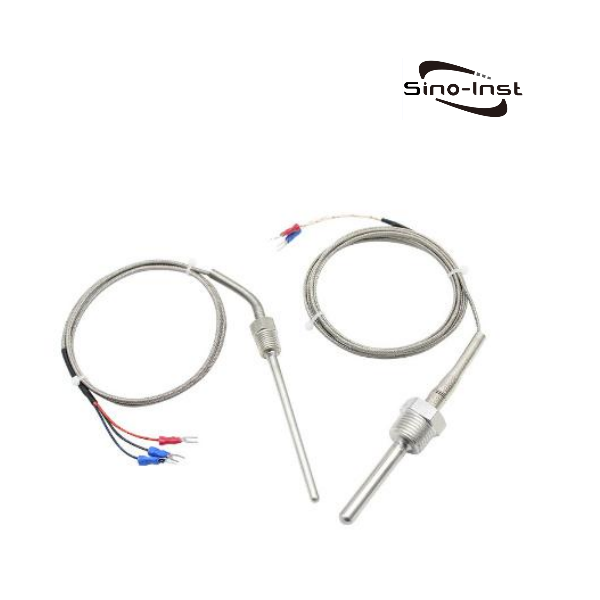
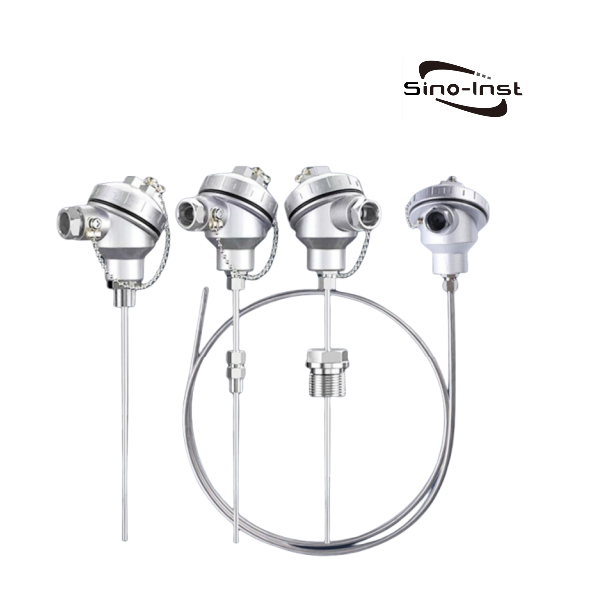
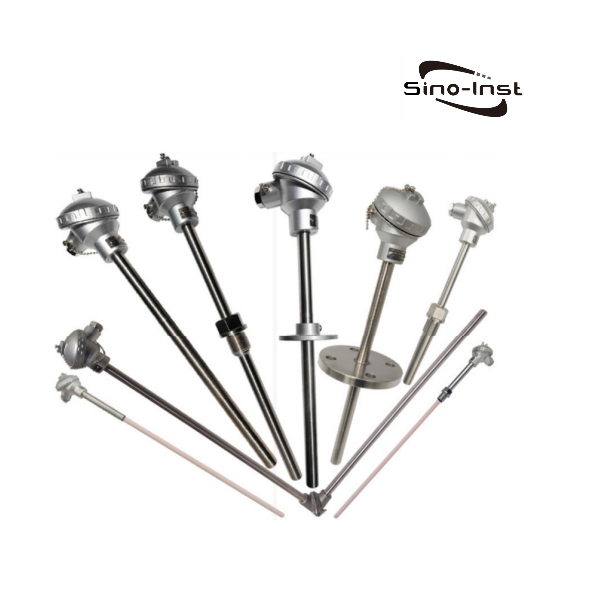
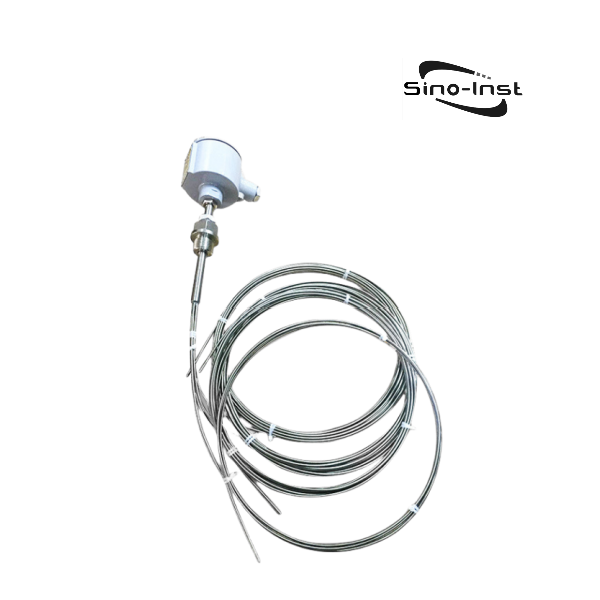
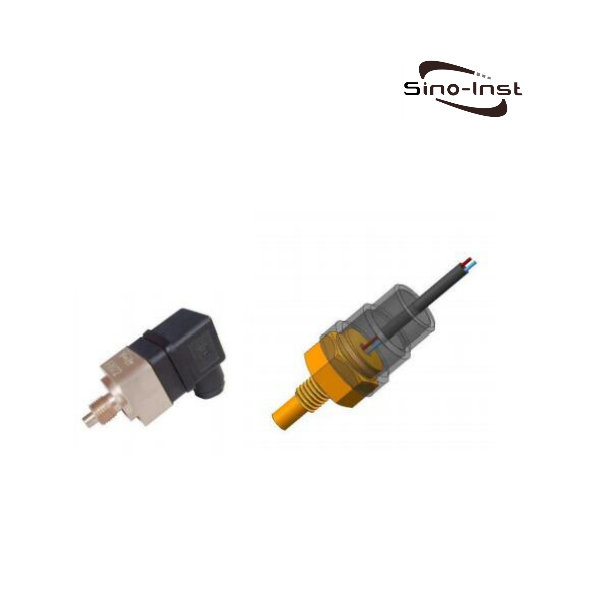
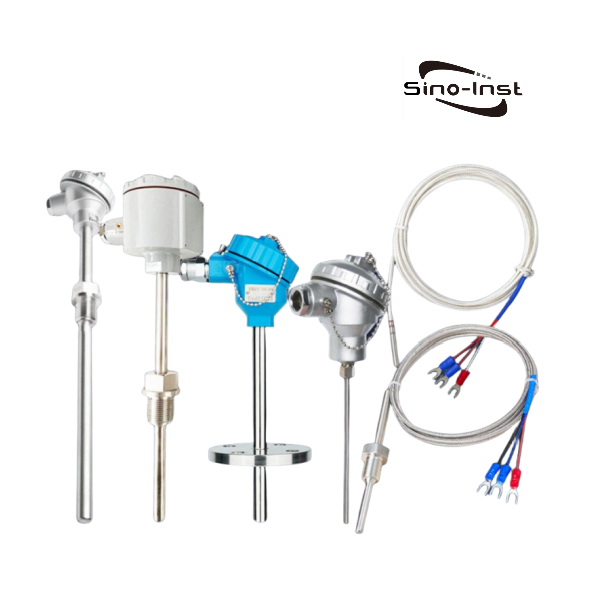
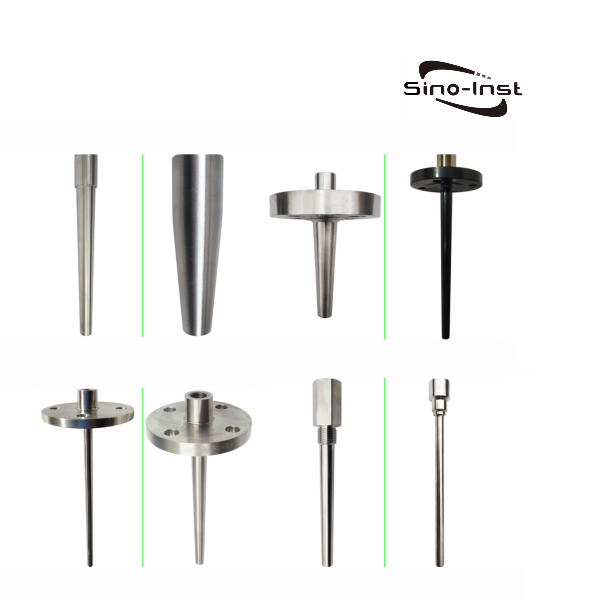
The 3-wire RTD PT100 is the most common of all wiring types used in industrial temperature measurement. Two leads are connected to one end of the thermal resistor temperature sensing element and one lead is connected to the other end. This lead form is called a three-wire system. Many instruments use this connection method, including temperature transmitters, temperature controllers, panel displays, and data loggers.
Our Sino-Inst’s RTD PT100 Temperature Sensor, 3-wire system, supports customization. Includes: temperature range, insertion depth, connection thread, cable length.
Support customization of movable threads and fixed threads.
Manufactured in accordance with the international IEC751 international standard, plug and play
A variety of probe sizes are available, with wide adaptability
High precision, high stability and high sensitivity
Small size, economical and practical
RTD PT100 technical parameters
Temperature measurement range:
-200-400℃
Probe diameter:
Φ 6 / φ5mm or customized
Installation method:
fixed / movable screws
Lead length:
generally 2 meters, can be customized length(special lead)
Wiring method:
wiring fork
Sensing device:
PT (platinum)
Probe length:
5cm/10cm/15cm/20cm or customized
Resistance change:
0.3851Ω/℃
Screw specification:
M8*1.0 or customized
Lead connection method:
three-wire
Casing material:
stainless steel
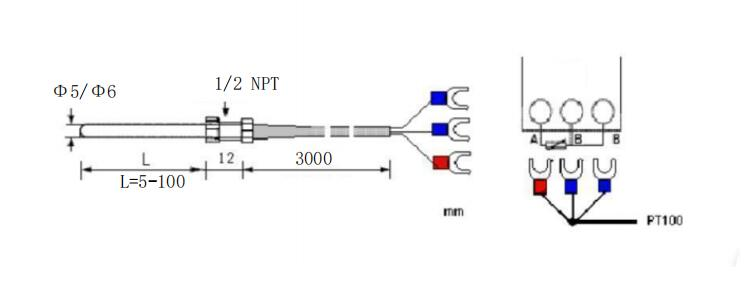
3 Wire RTD PT100 Dimensions
All dimensions of the PT100 resistance thermometer are customizable, including probe diameter, length, thread type, cable, and wiring configuration.
3 Wire PT100 Connection Diagram
The PT100 platinum resistance sensor has three leads, which can be represented by A, B, and C. The following relationships exist between the three leads: the resistance between A and B or C is approximately 110 ohms at room temperature, and the resistance between B and C is 0 ohms. B and C are directly connected internally, and in principle, there is no difference between B and C. However, they must be connected in practical applications. You cannot connect only two wires.
PT100 Sensor End:
The PT100 thermistor has three leads. The standard color coding for these three wires is:
One red wire: labeled A, connected to one end of the platinum resistor.
Two white wires: labeled B and C, both connected to the other end of the platinum resistor.
Note: Internally, B and C are short-circuited together and connected to the opposite end of the red wire.
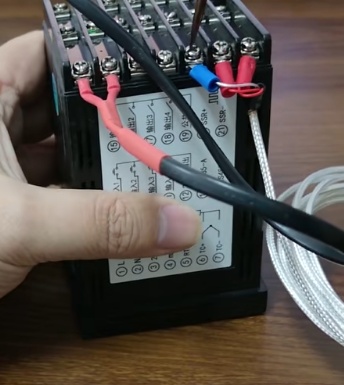
Display Instrument/Transmitter/PLC Module End (Receiving End):
The PT100 input of the instrument usually has three terminals or connection points. Their standard symbols (or equivalent meanings) are:
A (or “+”, “Exc+”, “Ref+”, etc.)
B (or “-“, “Sig+”, “P-“, etc.)
C (or “Ref-“, “S-“, “Com”, etc.)
Wiring Method:
Red wire (A from PT100) → Connect to instrument terminal A (or “+”, “Exc+”, “Ref+”)
First white wire (B from PT100) → Connect to instrument terminal B (or “-“, “Sig+”, “P-“)
Second white wire (C from PT100) → Connect to instrument terminal C (or “Ref-“, “S-“, “Com”)
Three lead methods for thermal resistors: 2-wire system – 3-wire system – 4-wire system
The method of connecting a wire at both ends of the thermal resistor to draw out the resistance signal is called the two-wire system: This wiring method is very simple, but since the connecting wire must have a lead resistance r, the size of r is related to the material and length of the wire. Therefore, this lead method is only suitable for occasions with low measurement accuracy.
The method of connecting one lead to one end of the root of the thermal resistor and two leads to the other end is called a three-wire system. This method is usually used in conjunction with a bridge, which can better eliminate the influence of lead resistance and is an important part of industrial process control. The most commonly used lead resistors.
The method of connecting two wires at each end of the root of the thermal resistor is called a four-wire system. Two of the leads provide a constant current I for the thermal resistor, convert R into a voltage signal U, and then lead U to Secondary instruments. It can be seen that this lead method can completely eliminate the resistance influence of the lead and is mainly used for high-precision temperature detection.
RTD PT100 – 3 wire custom movable thread
Why does PT100 have 3 wires?
The reason why the RTD PT100 uses a three-wire system is to eliminate the measurement error caused by the resistance of the connecting wires.
This is because the circuit used to measure thermal resistance is generally an unbalanced bridge. The thermal resistor is an arm resistor of the electric bridge, and its connecting wire (from the thermal resistor to the central control room) also becomes part of the bridge arm resistor. This portion of resistance is unknown and changes with ambient temperature. causing measurement errors.
Using a three-wire system, connect one wire to the power end of the bridge. The remaining two are connected to the bridge arm where the thermal resistor is located and the bridge arm adjacent to it. This eliminates measurement errors caused by wire line resistance. In industry, the three-wire connection method is generally adopted.
What is the resistance of PT100 3 wire?
The resistance value of PT100 temperature sensor is 100Ω at 0℃, and the resistance change rate is 0.3851Ω/℃.
More Featured Temperature Sensors and Measurement Solutions
“RTD” stands for “resistance temperature detector.” It is a type of temperature sensor. And it uses the electrical resistance of metal to measure temperature. RTDs offer high accuracy and stability. But they are more expensive than other sensors, such as thermocouples. They are widely used in various industries, including automotive, aviation, and food processing. The … Read more
Water temperature during the production process is an important parameter to monitor. Water temperature sensors are key components in modern industries, automobiles, home appliances, and other fields. Their core function is to accurately sense and feedback temperature information. Sino-inst offers a variety of sensors for measuring water temperature. The electrical signal transmitted from the sensor … Read more
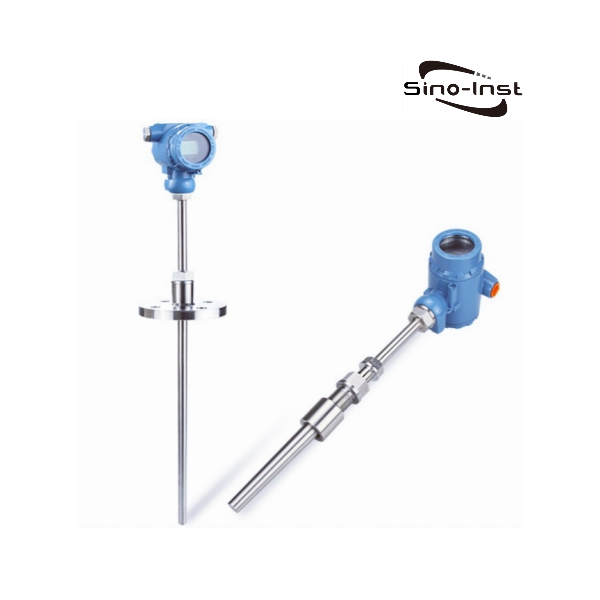
Temperature transmitters convert input signals from various sensors into standard output signals. Typically, these are 4-20 mA or 0-10 V. Examples include resistance sensors, thermocouples, and potentiometers. Temperature transmitters connect temperature sensors to subsequent data processing and control systems. It ensures the stability and safety of the production process. Sino-Inst offers a variety of temperature transmitter … Read more
RTD temperature sensors are small devices. They are commonly used for temperature measurement in a variety of industrial applications. These sensors are more accurate and stable than thermocouples and other temperature probes. They are widely used in various industries, including automotive, aerospace, and food processing. When you need accurate and repeatable temperature readings, Sino-Inst’s RTD … Read more
Industrial Temperature Monitoring System can detect and record temperature changes. Temperature sensors are installed on key equipment, pipelines, furnaces, etc. in the factory to monitor temperature changes during equipment operation in real time. The data detected by the sensor can be transmitted to the inspection meter, recorder, and even to the cloud platform through the … Read more
The resistance thermometer converts resistance into a temperature signal. Therefore, the resistance thermometer can be equipped with Pt100 when measuring process temperature. RTD Pt100 can be connected to the transmitter using 2-wire, 3-wire, or 4-wire systems. The three-wire connection is the most common of all wiring types used in Pt100 temperature measurements.
We, Sino-Inst, manufacture and supply various sizes of thermocouples, RTDs and other temperature sensors and transmitters. Support customization and OEM. If you have relevant purchasing needs or technical questions, please feel free to contact us!
Zhang Wei, possesses 20 years of experience as an automation instrumentation engineer, specializing in the research, design, installation, commissioning, and maintenance of automation instruments.
Face to various instrument communication protocols (such as Modbus, Profibus, etc.), with solid hardware circuit design and software programming skills (proficient in C language and PLC programming). Has extensive project experience; projects he has led and participated in have all achieved outstanding results, improving product accuracy, reducing costs, and increasing production efficiency.
Possesses excellent communication and coordination skills and a strong team spirit, enabling him to quickly respond to customer needs and provide high-quality automation instrumentation solutions.