Home > Blog > How to Choose the Right Probe Material for Your Ultrasonic Level Sensor
How to Choose the Right Probe Material for Your Ultrasonic Level Sensor
By Li Rui, Senior Process Engineer at Sino-Inst | Published 2026-03-24.
If you’ve ever had an ultrasonic level sensor fail prematurely, there’s a good chance the probe material was wrong for the job. I’ve seen this happen more times than I’d like to admit — a perfectly good sensor, installed in a sulfuric acid tank, corroded within weeks because someone went with the default ABS housing without thinking twice.
Choosing the right transducer probe material isn’t glamorous work, but it’s one of those decisions that directly determines whether your level measurement stays reliable for five years or five months. In this article, I’ll walk through the five most common probe material options we offer at Sino-Inst, when to use each one, and — just as importantly — when not to.
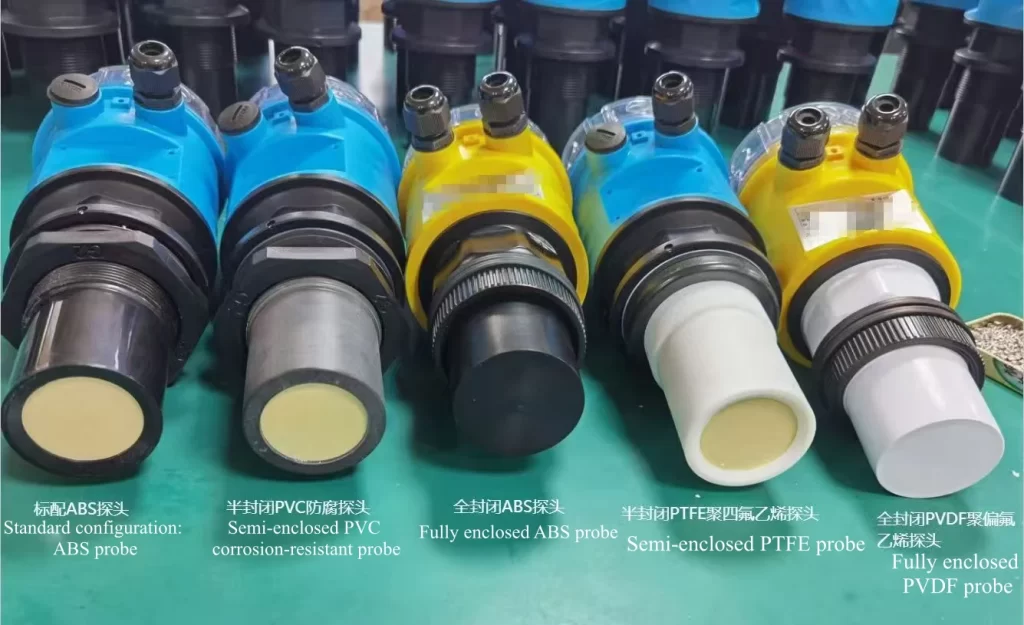
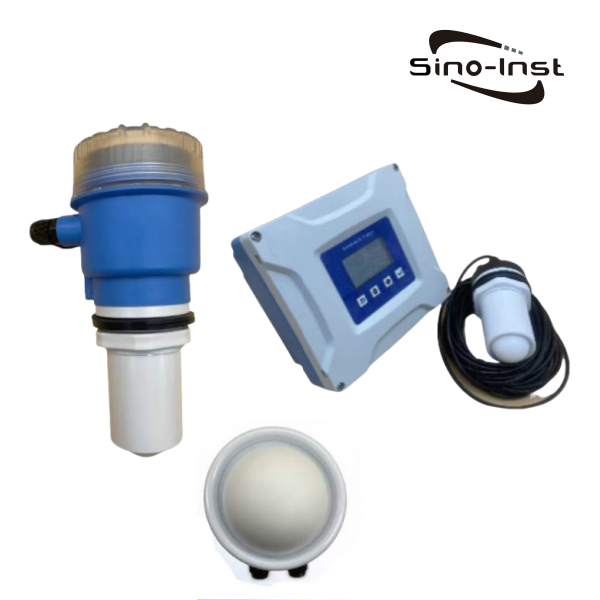
Five probe material options for ultrasonic level sensors (from left): Standard ABS, Semi-enclosed PVC, Fully Enclosed ABS, Semi-enclosed PTFE, and Fully Enclosed PVDF.
Why Probe Material Matters More Than You Think
The transducer probe is the part of the sensor that actually contacts your process environment — or at least sits directly above it. Even in non-contact ultrasonic sensors, the probe face is exposed to vapors, condensation, temperature extremes, and sometimes splashing liquid. If the material can’t handle those conditions, you’ll get signal degradation, corrosion, or outright mechanical failure.
The most common failure I see from wrong material selection include chemical attack on the probe face (which dampens the ultrasonic signal), cracking from thermal cycling, and swelling or warping in high-humidity environments. All of these are preventable with the right choice upfront.
The Five Probe Material Options – Where Each One Fits
1. Standard ABS Probe — Common choice
ABS (Acrylonitrile Butadiene Styrene) is the default probe material for most ultrasonic level sensors, and for good reason. It’s cost-effective, mechanically strong, and works well across a wide range of non-corrosive applications. If you’re measuring water, wastewater, or other neutral liquids and solids at moderate temperatures (typically –20°C to +60°C), ABS will serve you perfectly fine.
Where ABS falls short is chemical resistance. It doesn’t hold up well against concentrated acids, strong alkalis, or many organic solvents. I’ve seen ABS probes go cloudy and brittle after just a few months in chemical storage tanks. So if there’s any chance the probe will be exposed to aggressive chemicals — even as vapor — don’t default to ABS.
Best for: Water & wastewater treatment, grain silos, general-purpose tank level monitoring.
2. Semi-Enclosed PVC Anti-Corrosion Probe
PVC (Polyvinyl Chloride) probes are the go-to step up from ABS when you need basic chemical resistance on a budget. PVC handles most dilute acids and alkalis well, and the semi-enclosed design offers some protection to the transducer element while still allowing proper ultrasonic emission.
The ‘semi-enclosed’ design means the transducer face is exposed for signal transmission, but the surrounding structure shields the internal components from splash and condensation. This makes it a practical mid-range option for chemical processing facilities where exposure isn’t extreme but is still a concern.
One limitation: PVC becomes brittle at low temperatures and softens above about 60°C. So it’s not the right call for outdoor winter installations in extremely cold regions, or for hot process tanks.
Best for: Chemical storage tanks with dilute acids or alkalis, water treatment plants with chemical dosing.
3. Fully Enclosed ABS Probe
This variant uses the same ABS material as the standard probe but with a fully enclosed, sealed construction. The full enclosure protects internal electronics and connections from moisture ingress, condensation, and dust — making it significantly more durable in harsh ambient environments.
I recommend this option for outdoor installations, or anywhere with high humidity, heavy dust, or frequent washdowns. The measurement performance is identical to standard ABS, but the sealed design extends service life considerably in tough physical (though not chemical) environments.
Best for: Outdoor tanks, dusty environments, food processing with washdown requirements, humid climates.
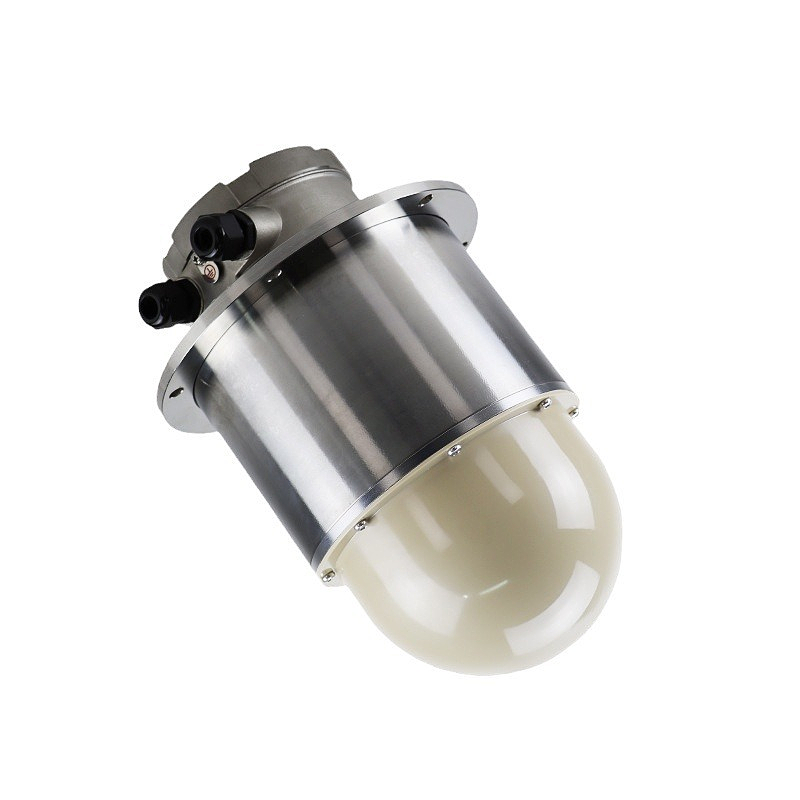
Previously, we installed ultrasonic level meters for a wastewater treatment plant. In the open-air environment with high humidity, we recommended a fully enclosed ABS probe. Standard ABS probes would fail within a few months due to moisture, but this sealed design has allowed for over two years of maintenance-free operation.
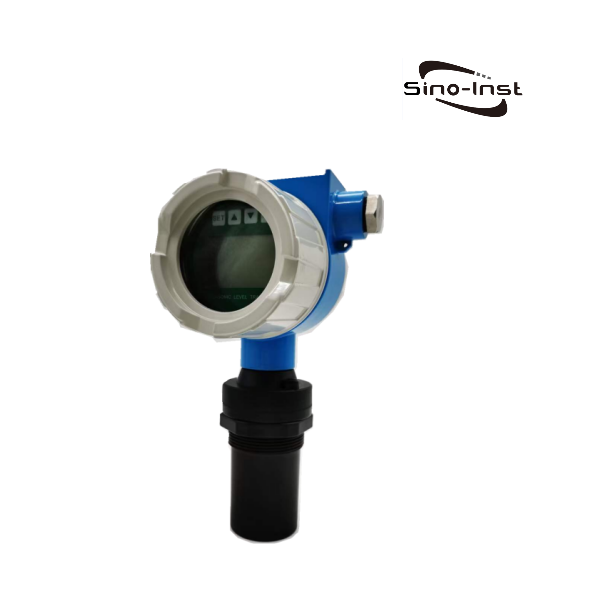
Ultrasonic Level Meter
2-wire
Measuring Range: 5m
Output: 4-20mA
Connection: M602 ABS
Protection Rating: IP65
Power Supply: 24VDC
Accuracy: ±0.3%
Blind Zone: 0.3m
Display: LED
Electrical Interface: M201.5
Explosion-proof EXIA IIC T6
With corrosion resistance
4. Semi-Enclosed PTFE Probe
PTFE (Polytetrafluoroethylene), commonly known by the brand name Teflon, is the material you reach for when the chemical environment gets serious. PTFE offers outstanding resistance to virtually all acids, bases, and organic solvents. It also handles a much wider temperature range — typically –40°C up to +100°C or even higher depending on the design.
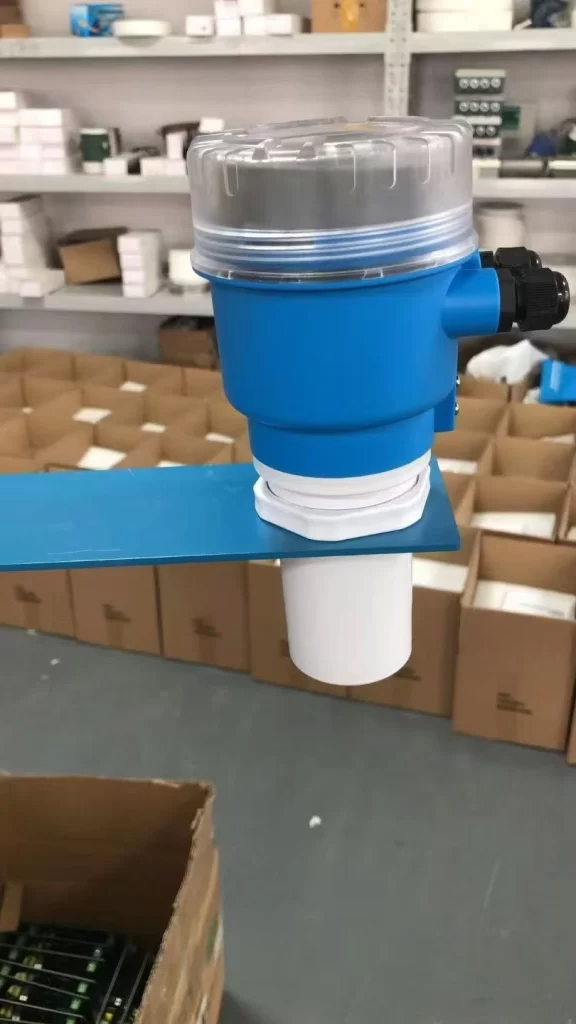
The semi-enclosed PTFE probe at Sino-Inst uses a PTFE transducer face with a partially shielded housing. This gives you excellent chemical protection at the critical contact surface while keeping the cost below a fully enclosed fluoropolymer design.
The tradeoff? PTFE probes cost more than ABS or PVC options, and PTFE is mechanically softer, which means you need to be a bit more careful during installation. But for applications involving concentrated sulfuric acid, hydrochloric acid, sodium hydroxide, or organic solvents, PTFE is really the only sensible choice.
Best for: Concentrated acid/alkali tanks, pharmaceutical processing, aggressive chemical environments.
5. Fully Enclosed PVDF Probe — Maximum Protection
PVDF (Polyvinylidene Fluoride) is the premium option in our lineup. It combines excellent chemical resistance — nearly on par with PTFE — with significantly better mechanical strength and abrasion resistance. The fully enclosed design means every component is sealed against chemical attack and environmental exposure.
PVDF handles a temperature range of roughly –20°C to +80°C and resists most acids, bases, halogens, and oxidizers. Where it really shines over PTFE is durability: PVDF is stiffer and tougher, so it holds up better in applications where the probe might be subject to physical stress, vibration, or abrasive particles.
This is our recommendation for the most demanding installations — concentrated chemical tanks, environments with both chemical and physical stress, or any application where sensor replacement would be costly or disruptive.
Best for: Highly corrosive chemical storage, mining and mineral processing, applications requiring both chemical and mechanical durability.
One of our Singaporean chemical plant customers needed to monitor the level in a concentrated sulfuric acid storage tank. The original ABS probe corroded within weeks, and it was replaced with our fully enclosed PVDF probe. It has been operating reliably for two years without any performance degradation.
Quick Comparison Table
Material
Chemical Resistance
Temp. Range
Mechanical Strength
ABS (Standard)
Low
-20 to +60°C
Good
PVC (Semi-enclosed)
Moderate
-10 to +60°C
Moderate
ABS (Fully enclosed)
Low
-20 to +60°C
Good
PTFE (Semi-enclosed)
Excellent
-40 to +100°C
Low-Moderate
PVDF (Fully enclosed)
Excellent
-20 to +80°C
High
A Simple Decision Framework
In practice, the decision comes down to three questions:
First, what chemicals will the probe be exposed to? If the answer is ‘nothing aggressive’ — water, wastewater, oils, grains — ABS is fine. If there’s any acid, alkali, or solvent exposure, move to PVC, PTFE, or PVDF depending on concentration.
Second, what’s the operating temperature? Standard ABS and PVC both top out around 60°C. If you need higher, PTFE is your best bet. For sub-zero conditions, check that PVC’s brittleness won’t be a problem.
Third, what’s the physical environment like? Outdoor, dusty, high-humidity, or high-vibration settings benefit from fully enclosed designs. If mechanical stress is a concern alongside chemical exposure, PVDF’s combination of toughness and corrosion resistance is hard to beat.
The Magnetic Float Level Gauge continuously measures the liquid level in a tank based on the principles of buoyancy and magnetic coupling. It indicates changes in liquid level by utilizing the influence of a magnet on nearby magnets; this mechanical structure is simple yet highly effective. Its simple structure provides…
Powder/Dry Material Level Switches are devices used to detect when material reaches a preset level. When the material reaches or exceeds the set position, the level switch sends a signal, typically used to control the starting or stopping of equipment. They are widely used in silos, hoppers, storage tanks, and…
The water level pressure transducer measures water level based on the relationship between pressure and water level. It is an extremely simple, practical instrument. Of course, it can be used to measure more than just water. Any other liquid can be measured. Wastewater, seawater, chemical liquids, oils, etc. Sino-Inst produces…
The portable ultrasonic liquid level indicator is a non-contact, handheld detection device primarily used to quickly determine the presence of liquid at a specific height within a sealed container without opening it. Its measurement technology is unaffected by factors such as the medium, height, or pressure. Due to its non-contact…
In the rapidly developing industrial sector, liquid level measurement is becoming increasingly important. Capacitive level transmitters are an important solution. They have no moving parts and are unaffected by water vapor, dust, or condensation. They are widely used in the petroleum, chemical, and pharmaceutical industries. Capacitive level transmitters are a…
What is a Radar Level Sensor? A radar level sensor is an instrument that uses microwave echo ranging to measure liquid levels non-contactly. It can measure both liquid and solid levels and is widely used in river level measurement, container, storage tank, and silo level monitoring. Measurement accuracy is up…
Getting the probe material right isn’t just about preventing failure — it’s about reducing total cost of ownership. A sensor that lasts five years without maintenance is worth far more than a cheaper unit that needs replacing every year. At Sino-Inst, we offer all five probe options across our ultrasonic level sensor range, and our engineering team can help you match the right material to your specific process conditions.
If you’re not sure which material fits your application, feel free to reach out. We’re happy to review your process conditions and recommend the best option.
Zhang Wei, possesses 20 years of experience as an automation instrumentation engineer, specializing in the research, design, installation, commissioning, and maintenance of automation instruments.
Face to various instrument communication protocols (such as Modbus, Profibus, etc.), with solid hardware circuit design and software programming skills (proficient in C language and PLC programming). Has extensive project experience; projects he has led and participated in have all achieved outstanding results, improving product accuracy, reducing costs, and increasing production efficiency.
Possesses excellent communication and coordination skills and a strong team spirit, enabling him to quickly respond to customer needs and provide high-quality automation instrumentation solutions.