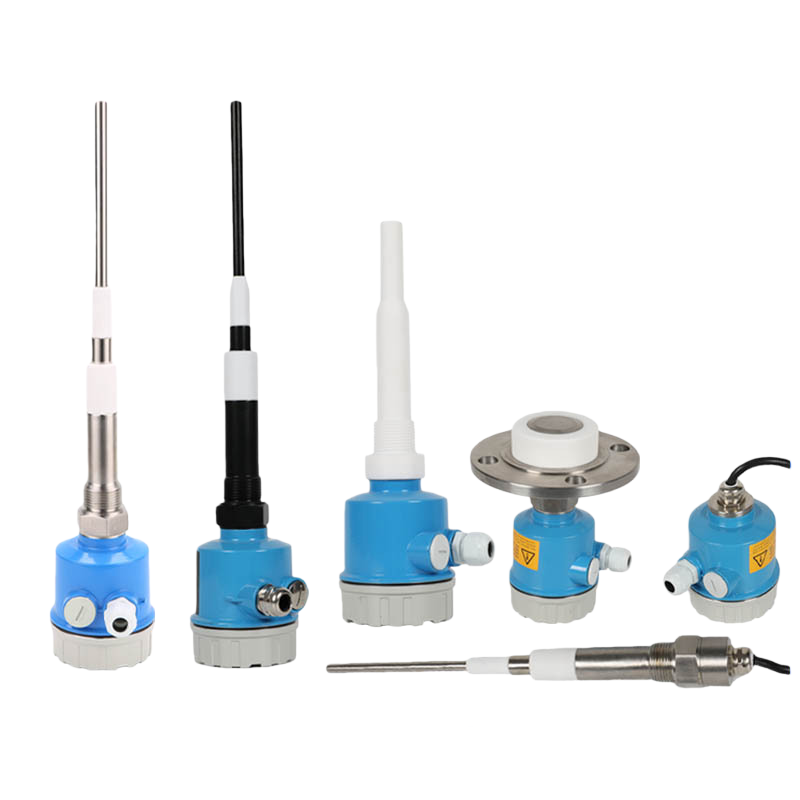
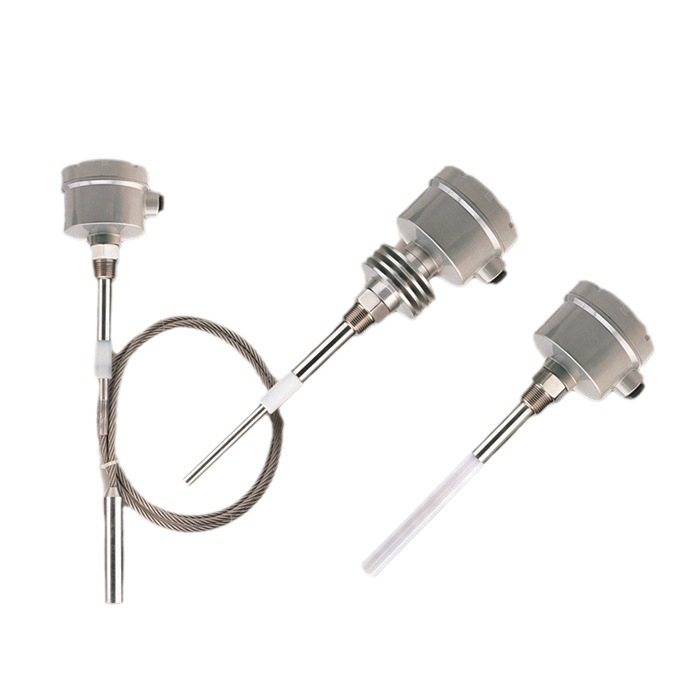
Conductive Level Switch | 2~6 Electrodes Available
The conductive level switch utilizes the conductivity of the liquid to detect the liquid level. When the substance in the tank touches the electrodes, it conducts electricity, thus generating a signal. After the signal is amplified by the controller, a set of relay contact signals is output for the user to control the liquid level.
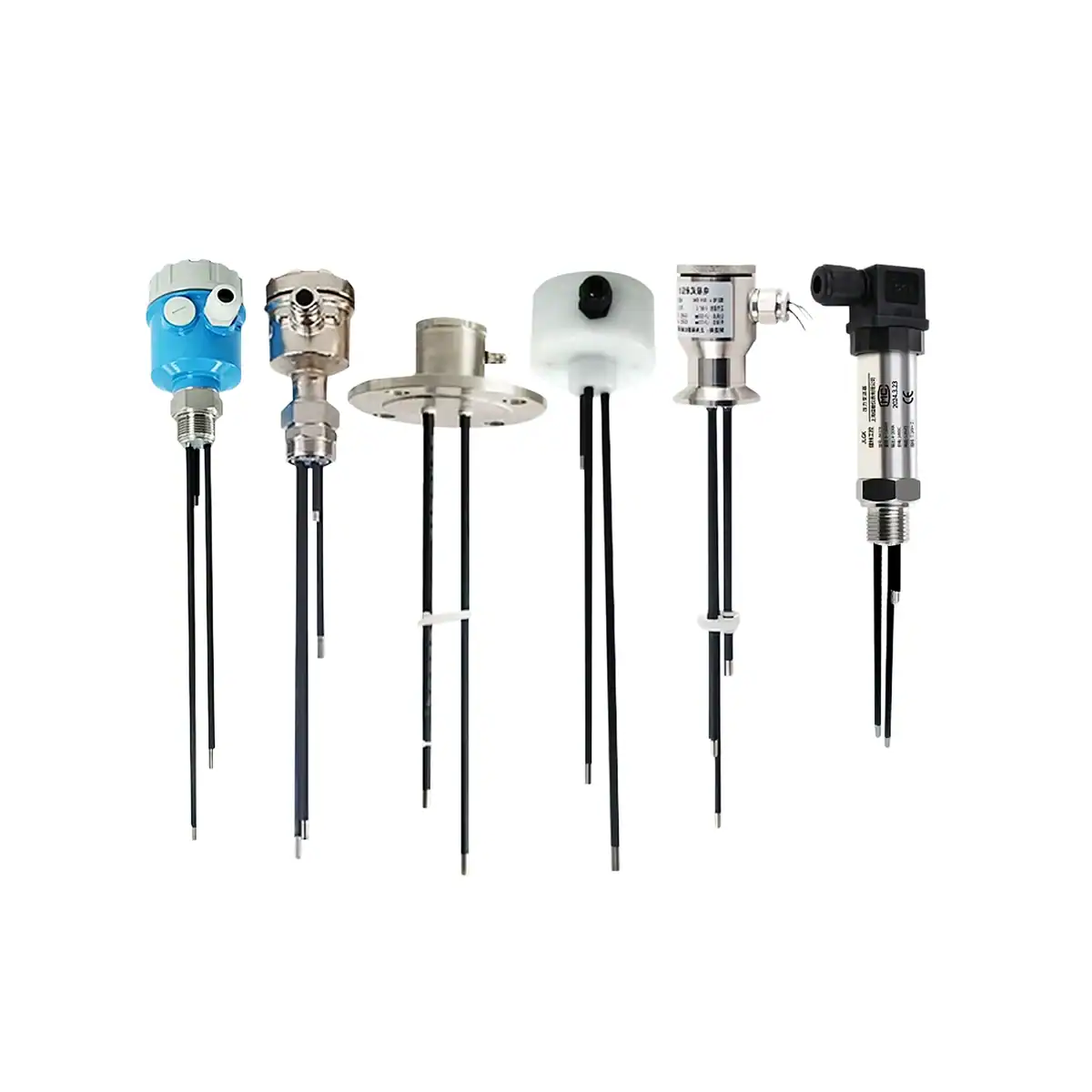
The electrode-type level switch is suitable for conductive liquids, features surge protection, and effectively prevents surge interference. It can provide multi-point control, and the control positions can be customized according to customer needs.
Suitable for controlling the liquid level of any conductive liquid. Not suitable for volatile liquids.
Features surge protection to effectively prevent surge interference.
Supports multi-point control; control positions can be customized according to user needs.
The electrode heads use low AC voltage to prevent electrolysis, extending service life.
Equipped with two indicator lights to display water supply and drainage status.
Technical Parameters
Power supply:
220V AC 50/60Hz, 24VDC
Contact capacity:
5A 240VAC/30VDC
Control method:
Supports low-level start/high-level stop or high-level start/low-level stop modes; the relay is energized when the liquid level is below E2, and de-energized when it is above or equal to E1.
Mounting type:
3/8″~6″ flange, or threaded BSP, NPT, customizable
Withstand voltage:
10bar~40bar, customizable
Electrode material:
SUS304, SUS316, SUS316L, PP coated
Number of electrodes:
2, 3, 4, 5, 6
Temperature:
-10℃~250℃
Length:
50~6000mm, customizable
Measured medium:
Conductive liquids
Protection class:
IP65
Controller:
Integrated type, separate type
We support custom threaded, flanged, and sanitary chuck mounting methods. Electrical junction boxes can be made of aluminum alloy, armored, full stainless steel, or with Hirschmann connectors.
Conductive Level Switch Working Principle
The conductive level switch utilizes the conductivity of the liquid to detect the liquid level. By amplifying the current in the circuit, it reaches the activation point and outputs a signal. When the conductive medium in the tank contacts the electrode rod, a set of switching signals is output.
As shown in the figure, when the liquid level is below electrode E3, the liquid level controller is powered on, the WATER SUPPLY indicator light illuminates, the NO-COM contact is closed, and the NC-COM contact is open. When the liquid level rises to E1, the drainage indicator light illuminates, the NO-COM contact opens, and the NC-COM contact closes. When the liquid level drops below E2, the drainage indicator light turns off, the NO-COM contact closes, and the NC-COM contact opens. This completes one control cycle.
Installation Precautions
For vertical installation only.
The voltage fluctuation range should be within ±5%, and the voltage must be stable.
Avoid installation in locations with strong vibration or shock (which may cause malfunctions).
This product is not suitable for non-conductive liquids, such as gasoline, diesel fuel, heavy oil, pure water, etc.
All electrodes must be at least 50mm apart from the longest electrode.
When the liquid contacts the electrodes, the operating position may vary depending on the type of liquid and changes in power supply voltage.
To ensure that the electrode rods do not come into contact with each other in the water, insulating sleeves can be added to the rods.
Featured Applications
Conductive level switches are suitable for the following industries: shipbuilding, power generation equipment, petrochemicals, wastewater/water treatment, electronics, dyeing and finishing, chemical, chemical fiber, and other industrial applications.
Power plants: fuel storage tanks, reservoirs, exhaust gas purification tanks, ash silos, oil tanks, etc.
Chemical industry: distillation towers, raw material and intermediate material silos, reaction tanks, ammonia water tanks, toxic liquid tanks, solid material silos, separators, etc.
Petrochemicals: oil pipelines, distillation towers, concentration tanks, liquefied gas tanks, ammonia water tanks, steam drums, refinery oil depots, etc.
Water and water treatment: reservoirs, sewage tanks, water treatment tanks, sedimentation tanks, digestion towers, gas pipelines, deep wells, drinking water pipelines, etc.
Cement: cement silos, coal powder silos, slag storage silos, etc.
Metallurgy: auxiliary material silos, alumina powder silos, electrolytic cell buffer tanks, etc.
Oil fields: crude oil or refined oil storage tanks, three-phase separators, settling sewage tanks, drilling mud tanks, etc.
Paper industry: storage towers, drying drums, etc.
The number and length of electrodes can be customized according to user requirements:
1 electrode is suitable for liquid level alarm in metal tanks and pipeline leak detection alarms, with the tank serving as the common terminal;
2 electrodes are suitable for single-point alarms in non-metallic tanks and water tanks, and for leak detection alarms in non-metallic pipelines;
3 electrodes are the most commonly used, suitable for water supply and drainage and other liquid inlet or outlet control, and can achieve automatic control of water supply and drainage when combined with pumps;
4 electrodes add upper limit alarm or lower limit alarm functions on the basis of liquid inlet or outlet functions, preventing overflow due to excessively high water levels or dry running of the pump due to excessively low water levels.
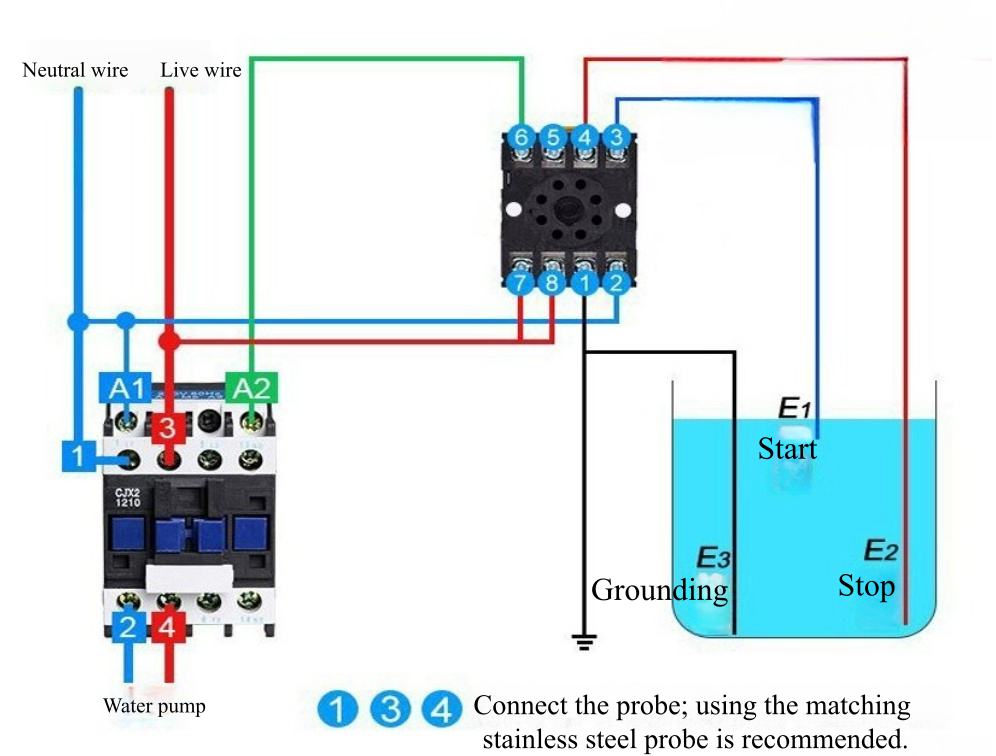
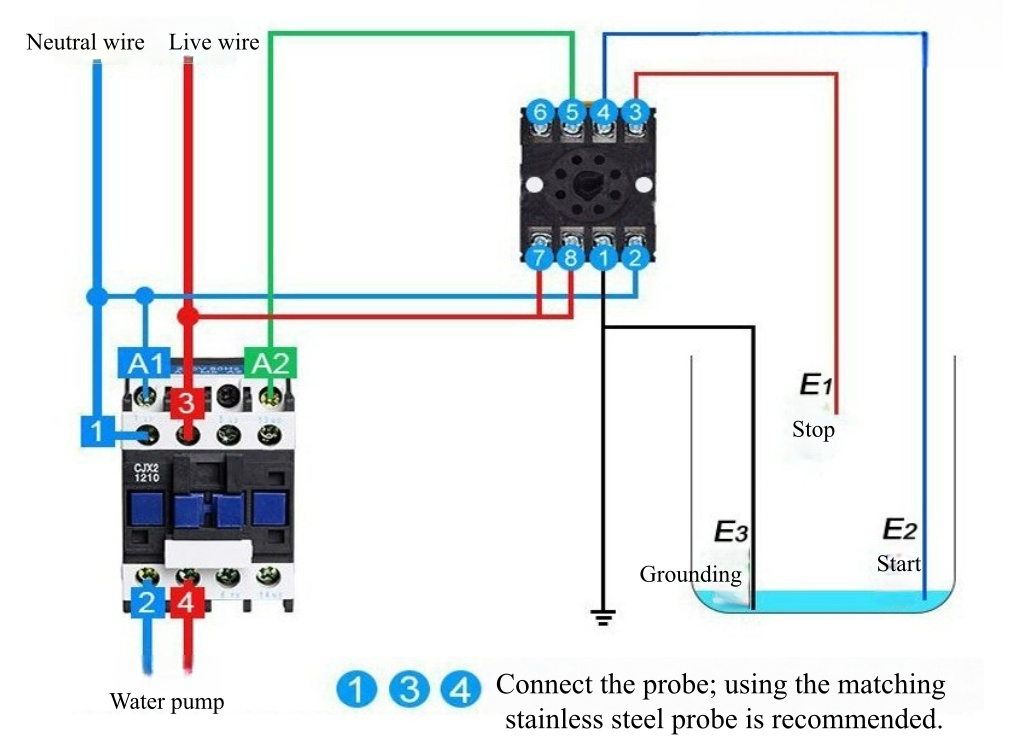
Water Level Control Wiring Diagram
220VAC automatic water supply wiring diagram
220VAC automatic drainage wiring diagram
FAQ
A conductive liquid level limit switch is an industrial sensor that works based on the principle of liquid conductivity. It is used to detect whether the liquid level of a conductive liquid has reached a preset position and outputs a switching signal to control related equipment.
Conductive level switch: Consists of two electrodes with a gap between them, forming an open circuit. When the liquid level rises and contacts the electrodes, the conductive liquid creates a path, allowing current to flow and triggering the switch signal.
Only applicable to conductive liquids (such as acids, alkalis, and aqueous solutions); ineffective for non-conductive liquids such as oil and pure water.
Capacitive level switch: The probe and the container wall (or another electrode) form a capacitor. When the liquid level covers the probe, the change in the dielectric constant of the medium causes an increase in capacitance. The electronic circuit detects this change and triggers the switch.
Can detect both conductive and non-conductive liquids, and even solid materials such as slurries and powders.
Contact level switches typically involve a probe that comes into contact with the measured medium. Non-contact level switches generally measure the medium from the top or outside of the tank, without contact.
Examples include float level switches and electrode level switches. Contact level switches provide more accurate results. However, the material of the contacting parts must be compatible with the medium. Furthermore, because of the contact, there is a risk of contamination of the measured medium. Therefore, careful consideration of details is crucial when choosing a contact level switch.
Non-contact level switches generally employ ultrasonic or radar technology. For example, our company’s ultrasonic level switches can be installed on the outer wall or bottom of the tank without requiring openings in the tank. This significantly reduces maintenance and operating costs and ensures no contamination of the measured medium.
In summary, both contact and non-contact level switches have their advantages. You can choose the appropriate level switch based on your specific operating requirements.
The water level pressure transducer measures water level based on the relationship between pressure and water level. It is an extremely simple, practical instrument. Of course, it can be used to measure more than just water. Any other liquid can be measured. Wastewater, seawater, chemical liquids, oils, etc. Sino-Inst produces and supplies a full range … Read more
The portable ultrasonic liquid level indicator is a non-contact, handheld detection device primarily used to quickly determine the presence of liquid at a specific height within a sealed container without opening it. Its measurement technology is unaffected by factors such as the medium, height, or pressure. Due to its non-contact measurement method, this product is … Read more
Stilling Wells are ingeniously designed to suppress liquid surface fluctuations and turbulence, ensuring high-precision level measurements. Surface disturbances are a problem in level measurement, whether using contact or non-contact methods. By isolating a calmer liquid column, Stilling Wells provide the sensor with a clear and stable target, eliminating misreads. Sino-Inst has assisted customers in applying … Read more
The float level switch is a common level measurement and control instrument in industrial production. It operates faster and has a longer service life than mechanical switches; it is more resistant to interference than electronic switches; and it can achieve multi-point control. It is widely used in shipbuilding, papermaking, printing, generator equipment, petrochemicals, food industry, … Read more
Accurate liquid level detection is crucial for product quality and operational safety. Therefore, liquid level switches are essential components in industrial processes. They monitor and control liquid levels in tanks and containers. Level switches are widely used in industrial environments such as chemical and food production. Sino-Inst offers high-quality level switches and solutions. These includes … Read more
Rotary paddle level switches are suitable for controlling material levels in industrial production processes. When the material level reaches the upper or lower limit, the controller’s microswitch contacts output an alarm or control signal. Rotary paddle level switches offer a simple structure, reliable operation, and wide application, which make them an ideal instrument for measuring … Read more
A liquid level float switch is a simple, easy-to-use, safe and reliable industrial process liquid level controller. It detects single or multiple extreme liquid level points, outputs switching signals, and provides liquid level control. Liquid level float switches are specifically designed for liquid level detection, on-site signal transmission, and liquid level alarms in various small … Read more
Firstly, let’s know what is Floating level?Float level switches run on the concept of buoyancy. The float rises or lowers when the liquid level alters and the location of the float is monitored by a switch or sensor. Whether you are carry off a primary residential water tank or operating a high-pressure industrial system, the … Read more
Conductive Level Switches are widely used in industrial applications. For example, in storage tanks, Conductive Level Switches can be used to monitor the liquid level to prevent overflow or drying out. In chemical processes, Conductive Level Switches can monitor the liquid level in chemical reactors to control the reaction process or prevent reactor overflow. In addition, Conductive Level Switches can also be used in wastewater treatment, automatic irrigation systems, and drinking water equipment.
In short, Conductive Level Switches determine the liquid level by measuring the conductivity of the liquid and utilizing the change in resistance between the electrodes. It is a simple and reliable liquid level control device. However, it is not suitable for flammable, explosive, or poorly conductive liquids, such as oil, ultrapure water, volatile liquids, and high-density wastewater.
If you need a customized Conductive Level Switches, please feel free to contact us!
Zhang Wei, possesses 20 years of experience as an automation instrumentation engineer, specializing in the research, design, installation, commissioning, and maintenance of automation instruments.
Face to various instrument communication protocols (such as Modbus, Profibus, etc.), with solid hardware circuit design and software programming skills (proficient in C language and PLC programming). Has extensive project experience; projects he has led and participated in have all achieved outstanding results, improving product accuracy, reducing costs, and increasing production efficiency.
Possesses excellent communication and coordination skills and a strong team spirit, enabling him to quickly respond to customer needs and provide high-quality automation instrumentation solutions.