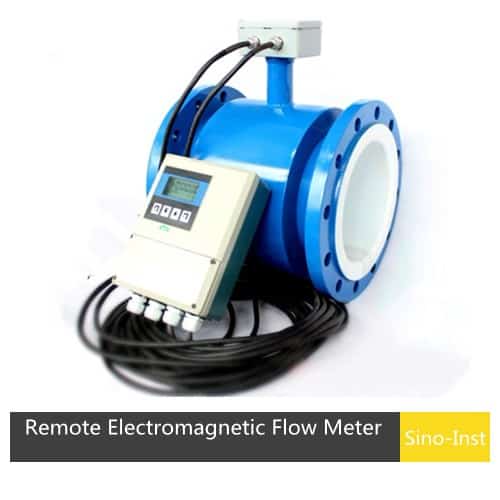
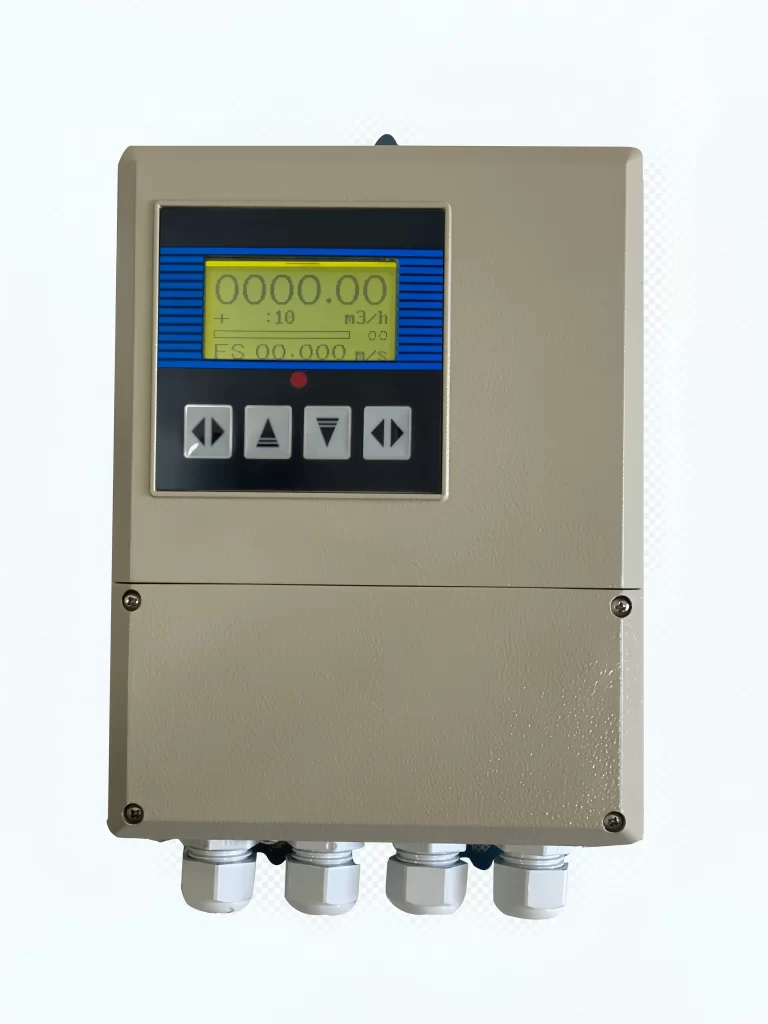
The remote water flow meter consists of an electromagnetic flow sensor and a remote flow display. Based on the principle of electromagnetic induction, it can measure most conductive aqueous solutions, including: domestic water, industrial water, raw water, groundwater, municipal sewage, industrial wastewater, treated neutral pulp, pulp slurry, etc.
Diameter
DN6~DN2200mm
Accuracy
±0.5%
Flow rate
0.3~10m/s
Electrode
316L(Suitable for domestic water, industrial water, raw water, underground water, sewage, etc.; not applicable to acid and alkali salt)
No throttling components, resulting in low pressure loss.
Unaffected by fluid temperature, pressure, density, and viscosity; only dependent on the average velocity of the measured fluid, offering a wide measurement range.
Requires only water calibration to measure other media without correction, making it ideal for billing and metering applications.
Bidirectional measurement capability: can measure both forward and reverse flow, and includes three integrators to display forward total, reverse total, and differential total.
Mainly used in wastewater treatment.
Customizable diameter range, covering DN2 to DN3000.
Electromagnetic flowmeters can measure the flow rate of dirty media, corrosive media, and liquid-solid two-phase flows. Only the measuring tube lining and electrodes of the electromagnetic flowmeter are in contact with the measured medium, and their materials can be selected according to the properties of the measured fluid.
Specifications
Power Supply
(210~230)VAC, (48~63)Hz (AC version) or 24VDC (DC version)
Power Consumption (including sensor)
≤22W (AC version) or ≤12W (DC version)
Accuracy Class
Class 0.5, Class 1.0
Repeatability
±0.16%, ±0.3%
Output Signal
(4~20)mA current signal, pulse/frequency, alarm
Communication
RS485 (MODBUS protocol)
Nominal Diameter
DN2~DN3000
Medium
Conductive liquids
Mounting Method
C (Integrated type), F (Split type), W (Wall-mounted type)
Flow Rate Range
(0.5~12)m/s
Pipe Pressure
(0.25~4.0)MPa (High pressure customizable)
Electrode Type
Standard, replaceable
Electrode Material
316L, HC, HB, Platinum-Iridium, PT, TA, TI
Lining Material
Hard rubber, Neoprene, Polyurethane, PTFE, PFA, PTFE mesh lining
Maximum Medium Temperature
Integrated type ≤130℃, Split type ≤180℃ (Rubber 80℃)
AC high-frequency switching power supply, voltage range: 85VAC — 250VAC;
DC 24V switching power supply, voltage range: 20VDC — 36VDC;
Communication functions: Standard MODBUS; HART;
Simplified Chinese, Traditional Chinese, and English display modes (other languages can be customized);
Three internal totalizers to record: forward total, reverse total, and difference total.
FAQ
First, determine the type of medium to be measured, such as clean water, wastewater, or water containing sand. Different media have different requirements for flow meters.
Then, based on the needs of the irrigation system, determine the required flow measurement range and pipe diameter. This will help in selecting the appropriate flow meter model and specifications.
Also consider pipe pressure and signal output requirements.
Finally, determine the required measurement accuracy based on the intended use of the measurement results. Typically, an accuracy of 0.5% is sufficient to ensure accurate control of irrigation volume.
Considering the above factors, you can choose one from common water flow meters (electromagnetic flow meters, turbine flow meters, ultrasonic flow meters).
A water meter is a type of flow meter, but water meters are for residential use, while flow meters are generally for industrial use.
In terms of function: Flow meters primarily measure instantaneous flow rate and cumulative flow. They provide real-time status, allowing monitoring of usage at each point, and can output pulses, 4-20mA signals, etc.; water meters mainly have a cumulative function and generally cannot display instantaneous flow rate.
In terms of cost: Water meters have a relatively low manufacturing cost, while flow meters are generally more expensive.
In terms of quality: Water meters have lower accuracy, are not resistant to high pressure or high temperature, cannot output linear signals, and cannot participate in modern industrial automation control, while flow meters can do all of the above.
In terms of application: Water meters basically only measure water and are not used to measure gases, and some liquid media cannot be measured by water meters. Flow meters can measure gases and liquids (water, oil, turbid liquids, etc.), including water.
Yes. Water leaks in pipes can be detected using a flow meter. Continuously monitor the flow rate displayed by the flow meter. If the flow rate suddenly increases or decreases without any expected operational changes (such as valve adjustments or stable pump output), a leak may be present.
For example, in a stably operating pipeline system, the flow rate displayed by an electromagnetic flow meter should be relatively stable. If the flow rate suddenly increases, there may be a leak downstream, causing more fluid to pass through the flow meter. If the flow rate suddenly decreases, there may be a leak upstream or in the flow meter itself, reducing the actual amount of fluid passing through the flow meter.
Electromagnetic flow meters are generally not suitable for measuring pure water. Electromagnetic flow meters operate based on Faraday’s law of electromagnetic induction, which requires the measured liquid to have a certain conductivity (usually ≥5 μS/cm). Pure water has extremely low conductivity, and ultrapure water can have a conductivity as low as 0.055 μS/cm, which prevents electromagnetic flow meters from functioning properly, leading to measurement errors or data fluctuations.
In industrial processes, the flow meters used to measure water flow include: electromagnetic flow meters, ultrasonic flow meters, turbine flow meters, vortex flow meters, oval gear flow meters, and metal rotor flow meters. Each has its own advantages.
A clamp-on ultrasonic flow meter is an instrument that uses high-precision ultrasonic sensing technology to measure flow rate. It mainly consists of a host and a set of ultrasonic sensors. These sensors can be installed on the outer wall of the pipe without the pipe or shutting down the system, and they will not contaminate … Read more
Cooling water flow meters are used to monitor cooling water flow. They are commonly used in cooling towers, circulation systems, pipes, tanks, and pumps. They are crucial for industries such as power plants and pumping stations. Sino-Inst’s cooling water flow meters can be configured with a local digital display showing flow velocity, instantaneous flow, and … Read more
A metal tube float flowmeter (metal tube rotor flowmeter) is a variable area flowmeter commonly used in industrial automation process control. It features a compact size, wide detection range, and ease of use. It can be used to measure the flow of various liquids, gases, and other gases. It is particularly suitable for measuring low … Read more
For sustainable development strategies, companies usually install industrial wastewater treatment equipment. Install monitoring instruments such as Sewage Flow Meters and Effluent Flow Meters to monitor wastewater treatment and discharge. In this blog post, we’ll dig into what sewage and effluent flow meters are!! It will give clients a broader perspective of wastewater flow measurement. What … Read more
There are several types of flow meters designed to measure the flow of dirty water fluids, and they work in slightly different ways. The electromagnetic flow meter solution is best for measuring the flow of dirty water such as mining slurries, wastewater plants, etc. Unlike standard water meters used for clean water applications, these specialized … Read more
Drinking water is possibly the most widely acknowledged and regulated water type measured by flow meters. The water is typically treated in a municipal water treatment plant, and from there, it flows through a network of pipes to homes, businesses, and other set-ups. Flow meters in drinking water systems ensure that the correct amount of … Read more
Raw water is water that has not undergone any treatment. It is found in natural sources and reserves, in surface and groundwater bodies. Likewise, fresh water is also found naturally on the Earth’s surface, such as ice, wetlands, ponds, lakes, rivers, streams, and groundwater. It usually has a low concentration of dissolved salts and solids. … Read more
A water flow meter can measure, monitor, and aid to control the flow of water through a pipe, hose, or other manner of instrumentation. It can provide a constant reading of the water flow rate. Measuring saltwater flow is a relatively complex process due to the corrosive nature, high salinity, and large temperature variations of … Read more
The Remote Water Flow Meter consists of two parts: a sensor and a converter (or display controller). The sensor is installed on the measuring pipe, while the converter is installed at a certain distance from the sensor. This design allows for more flexible and convenient installation, requiring less installation space. It can be adjusted according to the actual installation environment and requirements, minimizing the impact on the pipeline structure.
Sino-Inst supports customization of Remote Water Flow Meter parameters, including pressure, temperature, material, and separation distance. If you are planning to install a Remote Water Flow Meter, please feel free to contact us!
Zhang Wei, possesses 20 years of experience as an automation instrumentation engineer, specializing in the research, design, installation, commissioning, and maintenance of automation instruments.
Face to various instrument communication protocols (such as Modbus, Profibus, etc.), with solid hardware circuit design and software programming skills (proficient in C language and PLC programming). Has extensive project experience; projects he has led and participated in have all achieved outstanding results, improving product accuracy, reducing costs, and increasing production efficiency.
Possesses excellent communication and coordination skills and a strong team spirit, enabling him to quickly respond to customer needs and provide high-quality automation instrumentation solutions.