
Case Study-Portable Ultrasonic Liquid Level Indicator
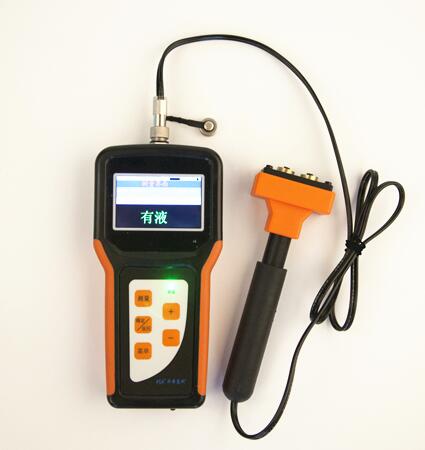
The portable ultrasonic liquid level indicator is a non-contact, handheld detection device primarily used to quickly determine the presence of liquid at a specific height within a sealed container without opening it. Its measurement technology is unaffected by factors such as the medium, height, or pressure. Due to its non-contact measurement method, this product is an ideal choice for toxic and corrosive hazardous liquids.
Case Sharing
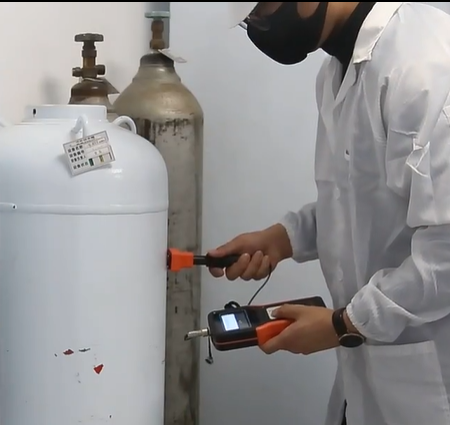
A customer from China wanted to know the liquid level in their CO2 cylinder to ensure timely replenishment of CO2. The customer wanted a non-invasive detection method and found our portable ultrasonic liquid level indicator on our website. The final specifications were determined as follows:
- Portable Ultrasonic Liquid Level Indicator
HS-ML1-1
Application: CO2 cylinder
190mm probe
Measurement Principle
Our portable ultrasonic liquid level indicator uses the attenuation detection method, based on the differences in the propagation characteristics of ultrasound in the container wall and different media. The working process is as follows:
1. Signal Transmission: The device couples high-frequency ultrasonic pulses generated by the sensor to the outer wall of the container via a coupling agent. The pulses propagate along the container wall and penetrate the wall.
2. Medium Differences: When ultrasound waves encounter the inner wall of a container, their behavior depends on the medium they are in contact with: In areas with liquid, the liquid effectively transmits ultrasound waves, resulting in less energy attenuation. In areas without liquid, i.e., the gas phase space, the gas absorbs more ultrasound waves, resulting in greater attenuation.
3. Signal Reception: The sensor receives the reflected waves from the container wall. The different media result in significant differences in the intensity of the received ultrasonic signal.
The core judgment criterion is the degree of signal attenuation or the change in electrical signal amplitude, rather than precise distance measurement. In practical use, the sensor is moved longitudinally along the outer wall of the container, and the liquid level indicator will show a significant jump at the actual liquid level.
Product Features
- Suitable for a wide range of container materials, including various metals, glass, or non-foaming plastics.
- It can be used on containers with a wall thickness of up to 30 mm.
- It can detect most fluids, such as oil, water, and chemicals.
- Non-contact measurement method, no internal installation required.
- Compact size – suitable for confined installation spaces.
- Equipment testing can be performed without disassembly or draining.
- Built-in display shows real-time data.
- One device can be used for multiple tanks.
Typical Applications
- Fire protection system testing: Detecting the liquid level in fire extinguishing agent cylinders such as heptafluoropropane and CO₂.
- Transformer oil conservator: Measuring the oil level in transformer oil tanks.
- Chemical storage tanks: Checking the liquid level in corrosive or toxic liquid containers.
- Laboratory/Industrial inspection: Quickly determining the liquid state in sealed reactors and pipelines.

What Is The Difference Between A Portable Ultrasonic Liquid Level Indicator And An Ultrasonic Liquid Level Sensor?
Although both types of devices utilize ultrasonic technology to measure liquid levels, they differ fundamentally in design philosophy and application scenarios. Simply put, a portable ultrasonic liquid level indicator is more like a “stethoscope” for on-site inspection, while an ultrasonic liquid level sensor is the “nerve ending” of an industrial system.
In terms of practical use, the biggest advantage of portable devices is non-invasive measurement. Inspection personnel only need to attach the magnetic probe to the outer wall of the container (usually the bottom area), and by transmitting ultrasonic waves through the wall thickness and receiving the echo signal from the liquid interface, they can quickly determine “whether there is liquid at this location.” This method is particularly suitable for temporary inspection of dangerous media such as high-pressure, toxic, flammable, and explosive substances, as it completely avoids the safety risks of opening the container.
However, its measurement results are more of a qualitative “presence/absence” judgment. The measurement results are affected by factors such as the container material and wall thickness, which result in lower measurement accuracy. The data is only for on-site reference and cannot be used for precise measurement or transaction settlement.
In contrast, the ultrasonic liquid level sensor is a true instrument in industrial automation systems. It must be installed in a pre-set mounting port at the top of the container. The ultrasonic waves emitted by the probe propagate in the gas phase space, reflect after encountering the liquid surface, and the liquid level height is determined by precisely calculating the time difference.
Although this installation method requires initial drilling, it enables continuous and precise measurement at the millimeter level, with high measurement accuracy. More importantly, it can output standard industrial signals, which directly connect to control systems such as PLCs and DCSs and enable real-time monitoring, automatic control, and interlock protection of liquid levels. It is an indispensable part of modern factory process control.
In terms of power supply and maintenance, portable devices usually use built-in lithium batteries or dry batteries, which can operate continuously for a long time after being fully charged, making them suitable for carrying around. Industrial sensors, however, must rely on an external 24VDC or 220VAC power supply, but considering their long-term continuous operation characteristics, this power supply method is more stable and reliable.
More Solutions For Liquid Level Measurement
- Capacitive Level Transmitters: How They Work
- What is a Radar Level Sensor? Selection Guide with Example
- Level Measurement: Why & When Is a Stilling Well Needed?
- Liquid Nitrogen Cryogenic Tank Level Monitoring
- Radar Level Transmitter Working Principle: A Complete Guide
- Case Study – Implementing Four-Point Liquid Level Control Using a Float Level Switch
- Differential Pressure Level Transmitter: Understanding, Principles and Uses
- RF Admittance Level Switch – Applicable to Solids and Liquids
- Case: Non-Contact Material Level Measurement – Radar Level meter
- What are Capacitive Level Sensors?
- Choosing the Right Level Switch for Industrial Applications: A Complete Guide
- Universal Intelligent Capacitive Level Transmitter
Summary: Can the liquid level be measured without shutting down the equipment? Yes. Our portable ultrasonic indicator is designed for this purpose. No need to drill holes in the container; simply hold the device against the outer wall to take measurements. It works for hydraulic oil, water tanks, and even CO₂ cylinders, providing results in just a few minutes on-site.