-1.jpg)
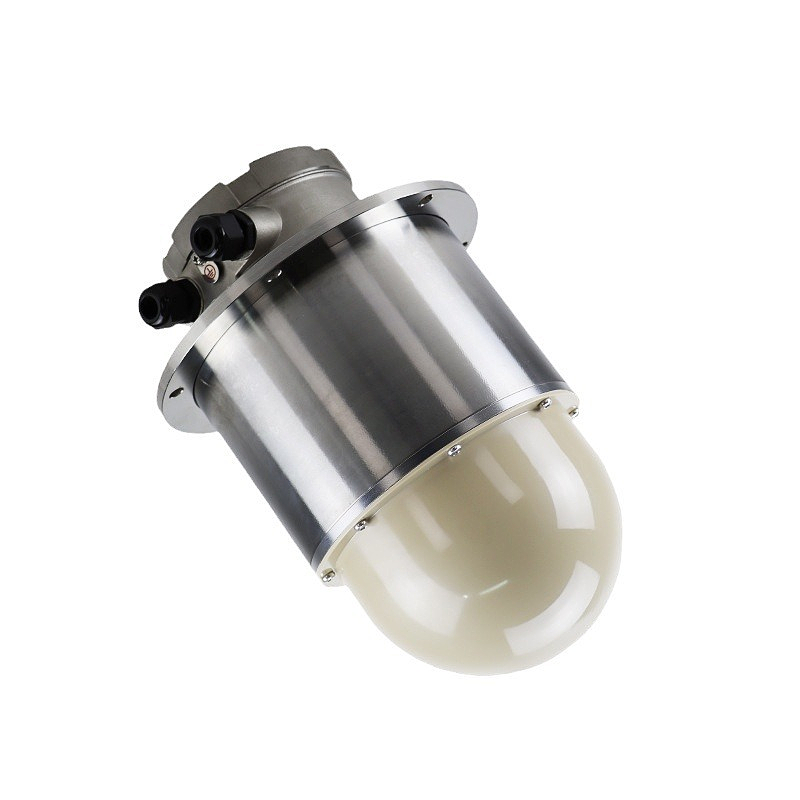
The 3D Level Scanner for Silos utilizes millimeter-wave penetration technology, enabling stable operation in complex environments with high dust and humidity, accurately sensing the surface morphology of material piles.
Traditional single-point radar level meters often cannot handle complex conditions such as the “angle of repose,” “material adhesion,” and significant material level differences formed by solid materials. Our “3D Level Scanner” focuses on three-dimensional data scanning, solving key pain points in material storage and level detection, bringing material management to a new level of intelligence and visualization.
Benefits
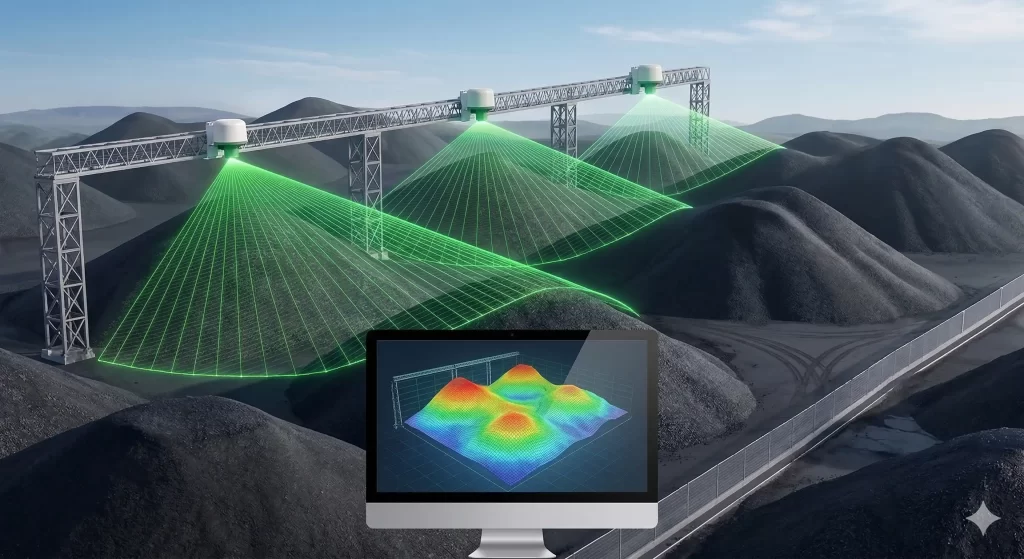
Technical Parameters
| Equipment | 80G | 120G |
| Operating Frequency | 80GHz | 120GHz~140GHz |
| Material | Solid material | Solid material |
| Range | ≤100m | ≤40m |
| Beam Angle | ≤3.5° | ≤2° |
| Horizontal Angle | 360° | 360° |
| Elevation Angle | +85° | +85° |
| Scan Cycle | 7 minutes | 15 minutes |
| Power Supply | 24 VDC | 24 VDC |
| Power | 20W | 20W |
| Equipment Weight | 8.32kg | 8.32kg |
| Networking Method | Ethernet | Ethernet |
| Output Data (Other options available upon request) | MODBUS TCP, WebAPI, 4…20mA | MODBUS TCP, WebAPI, 4…20mA |
| Operating Temperature | -35℃~70℃ | -35℃~70°C |
| Shipping Temperature | 40℃~100℃ | -40℃~100℃ |
| Process Pressure | 0…1bar | 0…1bar |
| IP Rating | IP67 | IP67 |
| Volume Accuracy | ≤±3%FS | ≤+2%FS |
| Mounting Method | Customizable | Customizable |
How it Works?
Because solid materials in silos easily form an angle of repose, resulting in significant differences in material level and frequent adhesion to the silo sidewalls, traditional single-point radar level gauges, regardless of their installation location, cannot accurately reflect the true internal structure of the silo. Therefore, 3D inspection is an inevitable trend and choice for certain industries.
The 3D Level Scanner for Silos, based on terahertz frequency-modulated continuous wave (FMCW) ranging, uses an internal horizontal rotation and pitch structure to drive its radar sensor to rotate in multiple dimensions. This allows for a high-resolution panoramic scan of the silo and the material surface within it.
Each time the radar sensor reaches a predetermined angle, it emits a microwave signal from its antenna. This microwave signal is reflected by the object being measured and received by the antenna. The radar sensor then moves to the next predetermined angle, completing the entire measurement cycle. This obtains the level measurement information corresponding to each angle throughout the entire measurement cycle.
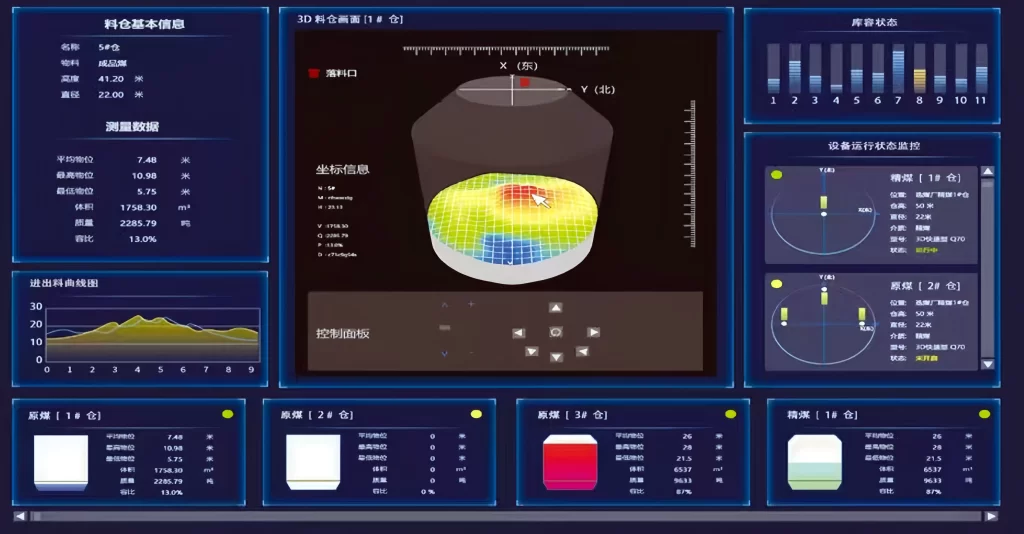
The system combines the angle information, the corresponding level measurement information, and the installation position of the 3D radar level gauge for computational processing. By integrating image processing, big data analysis, AI, machine learning, and 3D point cloud transformation, a 3D spatial coordinate system is established to obtain 3D point cloud coordinate values, thereby presenting a 3D visualized image. Based on this, relevant parameters such as volume, mass, and material level are calculated.
Featured Applications
The 3D Level Scanner for Silos employs a narrower beam with strong penetration, making it more adaptable to complex working conditions. It is unaffected by harsh conditions such as high temperatures, high dust levels, corrosion, steam, rain, and fog. It offers excellent cost-effectiveness and is widely applicable for measuring solid materials in various storage locations, such as silos, containers, and bulk solid material warehouses.
Applications in various industrial sectors include: grain, chemical, steel, energy, cement, food, power plants, plastics manufacturing, metal processing, glass manufacturing, and timber processing.
- Specific applications include: Grain industry: flat silos, shallow circular silos, vertical silos, star silos
- Thermal power industry: raw coal silos, fly ash silos, gypsum silos, desulfurization limestone silos
- Coal industry: raw coal silos, coal blending silos, coal stockpiles
- Cement industry: raw material powder silos, clinker silos, homogenization silos, finished product silos
- Steel industry: coal coking, sintering plants, blast furnace material levels
- Metallurgical industry: iron ore, lime, carbon powder, aluminum ore
New Silo Measurement Systems
Based on cutting-edge terahertz technology, they offer higher frequencies and bandwidth than traditional microwave radar, resulting in higher spatial resolution.
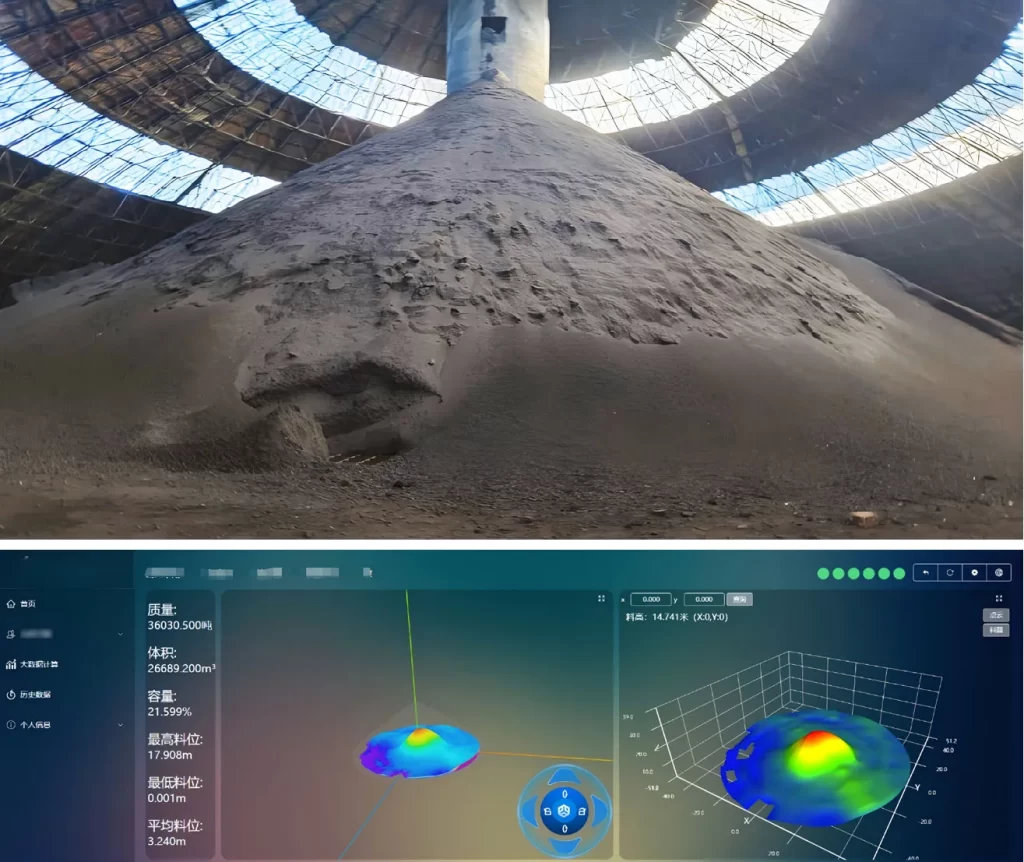
For ultra-large silos, dome silos, or large bulk storage yards, two or more devices can be installed simultaneously. Algorithms on the cloud server automatically stitch and register the 3D information from each radar to form a complete, single, visualized 3D view.
Furthermore, our 3D Level Scanner supports cloud management, allowing users to monitor in real time via desktop computers, mobile phones, tablets, or digital dashboards. It automatically transmits material inventory data to the ERP system, achieving closed-loop management throughout the entire process and optimizing procurement and delivery plans.
Remote debugging is supported via a mobile/tablet Bluetooth app, eliminating the need for on-site maintenance personnel to climb tanks, thus improving safety.
FAQ
More Level Measurement Solutions
Magnetic Float Level Gauge: Working Principle and Types
Powder/Dry Material Level Switches – Product List and Selection
Water Level Pressure Transducers
Case Study-Portable Ultrasonic Liquid Level Indicator
Level Measurement: Why & When Is a Stilling Well Needed?
Sulfuric Acid Storage Tank Level Measurement
The 3D Level Scanner for Silos solves the problem of inaccurate material level measurement by single-point radar level gauges, enabling multi-faceted monitoring of material level, volume, and quality within the silo. It provides remote visualization of the material level status during feeding and discharging. The distribution of materials within the silo and whether there is any adhesion to the walls can be clearly seen on a computer. This creates conditions for timely elimination of clinker caking and deterioration due to moisture, and provides important reference data for timely silo emptying. High and low level alarms can be set to achieve automatic interlocking protection for material entering and leaving the silo.
Sino-Inst supports customization of ultra-high frequency radar level measurement instruments with operating frequencies from 80G to 140GHz. Measurement error is accurate to 1 mm, and the transmission beam angle can reach 1.5°. It ensures measurement accuracy under conditions of high temperature (above 2000 degrees Celsius), high pressure, strong corrosion, and toxic gases, solving various complex working conditions. Welcome to contact our sales engineers!