
Coriolis Mass Flow Meters
Sino-Inst Coriolis mass flow meters provide direct, multivariable measurement of mass flow, density (±0.001 g/cm³), and process temperature (±1°C), with a batch measurement accuracy of up to 0.1%. Powered by advanced DSP and ARM digital processing technologies, these meters operate independently of fluid velocity profiles, swirl, viscosity variations, or Reynolds numbers—eliminating the need for straight pipe runs upstream or downstream of the instrument.
Coriolis mass flow meters feature a turndown ratio of up to 50:1, with a customizable medium temperature range spanning from -200°C to +350°C. High-pressure models—rated for 30 MPa, 45 MPa, and 96 MPa—are also available upon request. These meters are designed to meet the requirements of a diverse range of applications, from micro-dosing to large-scale custody transfer terminals.
Five Specialized Sensor Architectures: Engineering Selection
Featured Coriolis Mass Flow Meters
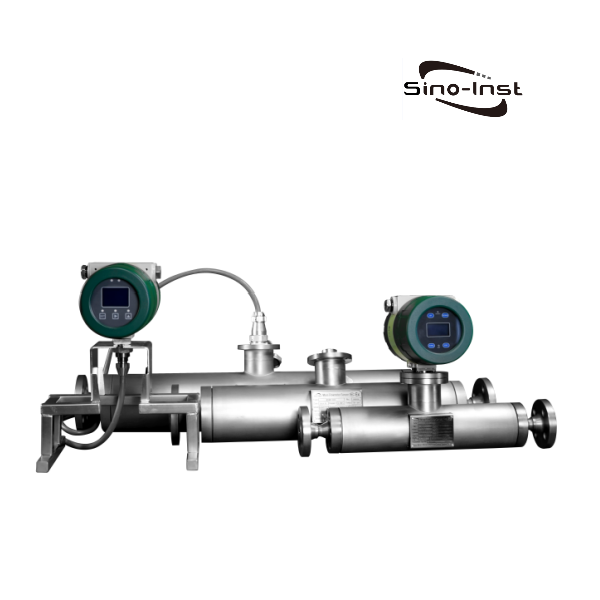
- Sizes: DN8–DN50 (1/4″–2″)
- Max flow: 650 kg/min (1,433 lb/min)
- Accuracy: ±0.15% of flow
- Single self-draining tube for slurries and sanitary lines
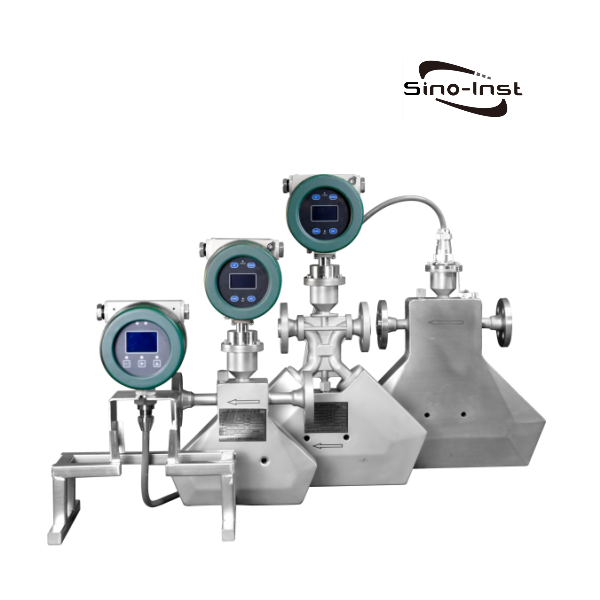
- Sizes: DN3–DN15 (1/8″–1/2″)
- Max flow: 3–60 kg/min (6.6–132 lb/min)
- Accuracy: ±0.15% of flow
- For low-flow dosing, filling and pilot lines
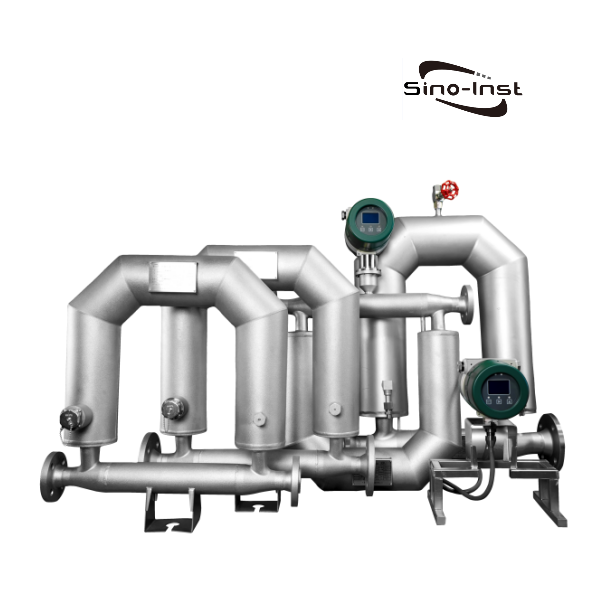
- Sizes: DN1–DN250 (1/12″–10″)
- Max flow: up to 29,000 kg/min (1,740 t/h)
- Accuracy: ±0.15% of flow, repeatability 0.075%
- Liquids, gases and multiphase flow; PN40 flanges
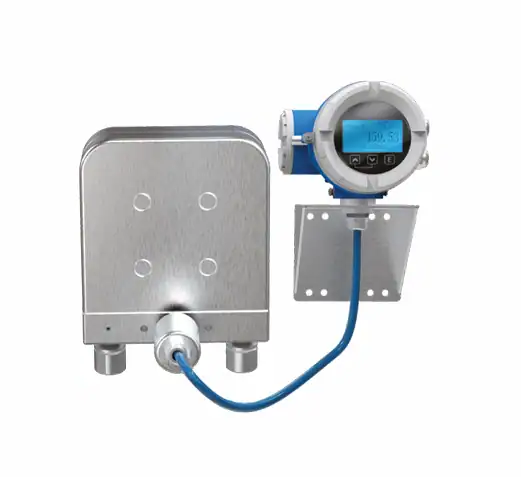
- Size: DN3 (1/8″)
- Pressure: up to 96 MPa
- Accuracy: ±0.5% of flow (high-pressure series)
- Hydrogen-embrittlement-resistant wetted parts for 35/70 MPa H₂ dispensers
Flow Sizing & Zero Stability
| Nominal Bore | Max Flow Rate (kg/min) | Max Flow Rate (t/h) | Zero Point Stability (kg/min) | Available Pressure Ratings |
|---|---|---|---|---|
| DN01 (1/12″) | 0.2 kg/min | 0.012 t/h | 0.0002 | Standard / 30 MPa |
| DN02 (1/10″) | 1.6 kg/min | 0.096 t/h | 0.0005 | Standard / 30 MPa |
| DN03 (1/8″) | 3.0 kg/min | 0.18 t/h | 0.001 | Up to 96 MPa (960 bar) |
| DN04 (1/6″) | 5.0 kg/min | 0.30 t/h | 0.001 | Up to 35 MPa |
| DN08 (1/4″) | 20 kg/min | 1.20 t/h | 0.002 | Up to 45 MPa / Straight Tube |
| DN15 (1/2″) | 60 kg/min | 3.60 t/h | 0.006 | Standard / Cryo / High-P |
| DN20 (3/4″) | 100 kg/min | 6.00 t/h | 0.010 | Standard PN40 Flange |
| DN25 (1″) | 200 kg/min | 12.0 t/h | 0.010 | Standard / Cryo / Sanitary |
| DN40 (1-1/2″) | 450 kg/min | 27.0 t/h | 0.020 | Standard / Cryo / Straight |
| DN50 (2″) | 650 kg/min | 39.0 t/h | 0.025 | Standard / Cryo / Straight |
| DN80 (3″) | 2,000 kg/min | 120 t/h | 0.050 | Standard / Cryo (-200°C) |
| DN100 (4″) | 3,000 kg/min | 180 t/h | 0.100 | Standard / Micro-bend |
| DN150 (6″) | 12,000 kg/min | 720 t/h | 0.200 | PN40 / ASME Class 150/300 |
| DN200 (8″) | 18,000 kg/min | 1,080 t/h | 0.300 | Large Bore Marine / Terminal |
| DN250 (10″) | 29,000 kg/min | 1,740 t/h | 0.750 | Custody Transfer Bulk Pipeline |
Use Online Tools: Coriolis Mass Flow Meter Sizing Tool to check the configuration of flow rate, accuracy, pressure drop, and Reynolds.
Straight-Tube vs. Bent-Tube Coriolis Flow Meters
You can find our Coriolis Mass Flow Meters in straight tube, slightly curved or U-shaped structures. In addition to different sizes, they also have the following differences:
| Items | Conventional Bent / U-Tube | Single Straight-Tube |
| Tube Geometry | Dual curved / U-shaped vibrating tubes | Single, continuous straight-through measuring tube |
| Drainability & Cleaning | Fluid can pool in low bends; difficult to gravity-drain | 100% Self-draining (Self-emptying); full CIP/SIP compatibility |
| Risk of Slurry Clogging | High risk of sediment settling in curved pockets | Zero clogging risk; unobstructed linear flow path |
| Pressure Drop | Moderate to high (fluid turns two 90°/180° bends) | Significantly lower pressure drop |
| Handling Shear-Sensitive Fluids | Higher shear stress on fluids passing through bends | Gentle, non-destructive flow for polymers and food products |
| Thermal Expansion Handling | Natural expansion loop absorbs thermal stress | Requires rigid stress decoupling (ideal up to 150°C) |
| Best-Fit Applications | Clean liquids, hydrocarbons, cryogenic LN2, high-pressure gases | Abrasive slurries (lime, drilling mud), food/dairy, paint, coatings |
Data Sheet
Certifications and Approvals
Sino-Inst’s Coriolis mass flow meter holds the following independent certifications, covering hazardous-area service, functional safety, sanitary applications, and European market access:
- SIL 3 (IEC 61508 functional safety) — third-party certified for use in
safety-instrumented systems (SIS) up to safety integrity level 3, suitable
for emergency shutdown and safety-critical LN2 control loops. - ATEX certified — compliant with EU Directive 2014/34/EU for equipment
installed in European explosion-prone atmospheres. - CE marking (issued by ECM) — European Conformity for general EU market access.
- CE marking (issued by SGS) — second independent EU conformity assessment.
- 3A Sanitary Standards — accepted for dairy, food, and pharmaceutical service
per the U.S. 3-A Sanitary Standards Inc. (relevant for liquid-nitrogen
applications in food packaging, pharmaceutical cryopreservation, and
biotech process lines). - China Ex db ia ⅡC T6 Gb — explosion-proof certificate compliant with
Chinese GB 3836 standards. - IP67 enclosure — full dust protection and short-term water immersion
resistance for outdoor and washdown environments.
These certifications are independent of the operating-instructions specifications and are issued by accredited third-party bodies. Certificates are available on request for project documentation packages.
Field Case
Emerson Micro Motion Replacement for 98% Concentrated Sulfuric Acid
Application: A major chemical production complex in Kazakhstan required a direct replacement for an aging Emerson Micro Motion flowmeter handling 92% to 98% concentrated H₂SO₄ (density 1.82 g/cm³).
Solution: Sino-Inst supplied a Split-Type Coriolis Mass Flow Meter (flow range 0–90 t/h) with 316L measuring tubes, an 8-meter remote cable, and Ex db ia IIC T6 Gb explosion-proof certification. The unit has maintained continuous, drift-free measurement with zero process interruption.
Aerospace Propulsion Test Stand: LOX (100 bar) & Liquid Nitrogen (-196°C)
Application: A Canadian aerospace development team required extreme-condition flow measurement for cryogenic ground support systems handling liquid oxygen (LOX) and liquid nitrogen (LN₂).
Solution: Sino-Inst deployed the Cryogenic Coriolis Meter, engineered for design pressures of 100 bar (burst pressure 15 MPa) and temperatures down to -190°C. With a mass flow capacity of 0–120 t/h and ±0.2% cryogenic accuracy, it successfully resolved the multi-phase flashing challenges typical of liquid propellant testing.
Lime Slurry Density & Flow Without Tube Clogging
Application: A U.S. bio-refinery plant struggled with standard U-tube Coriolis meters repeatedly clogging from 5%–10% lime slurry deposits.
Solution: Sino-Inst replaced the curved meters with Straight-Tube Coriolis Meters (DN25). The straight, single-pass geometry prevented slurry accumulation, allowing uninterrupted simultaneous measurement of mass flow and slurry density.
Coriolis Flow Meter Guides and Applications
Guides
- Coriolis flow meter working principle and installation – how tube twist becomes a mass flow reading, plus accuracy, price ranges and mounting.
- Use and maintenance of Coriolis mass flowmeters – installation checks, daily use, maintenance and the wiring diagram.
- Coriolis mass flow meter sizing tool – enter flow rate, density and viscosity to check accuracy and pressure drop.
- Types of mass flow meters – how Coriolis compares with thermal and other mass flow technologies.
- Mass flow meter vs magnetic flow meter – when a Coriolis meter is worth the extra cost over a magmeter.
- Micro Motion flow meters – a guide to Micro Motion Coriolis meters and comparable Sino-Inst models.
- Coriolis density meter – for inline density and concentration measurement.
Applications
- Hydrogen flow meters – mass and volume flow measurement for hydrogen.
- LNG and CNG flow measurement – cryogenic LNG and high-pressure CNG metering.
- Liquid nitrogen flow meters – options for cryogenic liquid nitrogen lines.
- Marine fuel flow meters – fuel consumption monitoring on ships.
- Diesel flow meters – digital diesel flow meters with signal output.
- Case study: lime slurry – measuring lime slurry flow and density with a mass flow meter.
For a fast quote, send us: line size, fluid, minimum, normal and maximum flow, operating pressure and temperature, required accuracy and output signal. Every meter ships with our factory calibration report and a one-year warranty.