Home > Mass Flow Meters > Specialized Product: Hydrogen Mass Flow Meter – Coriolis CMASS003 Series
Specialized Product: Hydrogen Mass Flow Meter – Coriolis CMASS003 Series
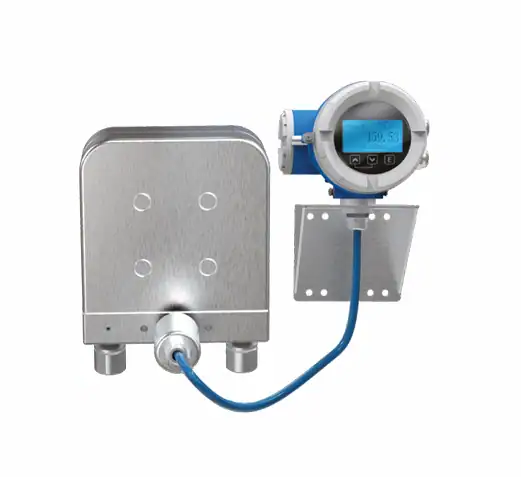
The CMASS003 series Coriolis mass flow meter is a dedicated flow meter for measuring the mass flow rate of hydrogen gas. Suitable for high-precision flow measurement in harsh environments, it is designed for extreme environments such as hydrogen (H70/H35), CNG refueling, and high-pressure industrial gas applications. It directly measures mass flow rate with an accuracy of up to ±0.1%, unaffected by changes in fluid density, viscosity, or pressure, thus ensuring reliable data for critical trade handovers and process control.
Advanced Digital Communication (Modbus RTU, HART, 4-20mA);
Real-Time 3-Line Backlit Interface;
Maintenance-Free Solid-State Technology;
Technical Parameters
MODEL
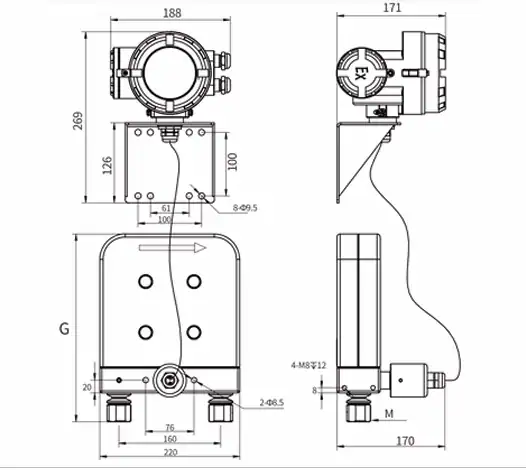
G
Max.Working Pressure
M
CMASS003
275
≤90MPa
9/16-18 UNF Female thread
≤50MPa
≤40MPa
CMASS004
275
≤35MPa
9/16-18 UNF Female thread
CMASS008
296
≤30MPa
3/4 Card sleeve
≤45MPa
13/16-16 UNF Female thread
CMASS015
296
≤30MPa
3/4 Card sleeve
≤45MPa
13/16-16 UNF Female thread
Transmitter Specifications
Power Supply
220VAC/24VDC Self-adaption
Output signal
HART,4~20mA current loop active,Modbus RTU/RS-485,Pulse active
Display;Operate
3-line backlight;Touch key control
Protection grade
IP66,IP67
Housing material
304 stainless steel,ZL401 (Transmitter)
Electrical connection
1/2 NPT,M20*1.5
Measuring Tube Material;Wetted Parts Surface Finish
316L (default),titanium/Ha C alloy/ tantalum (optional);polishable.
Process connection
Thread
Accuracy
±0.1%,±0.15%,±0.2%,±0.5 %,±1.0%
Transmitter software
CLS100 (default),optional CLS200,CLS300
>>Other certifications
Explosion proof certificate,SIL,CCS,3-A,EAC
Featured Applications
In fields such as hydrogen energy, CNG, and other high-pressure gas applications, precise, safe, and reliable flow measurement is the core of operations. Our Coriolis CMASS003 Series Hydrogen Mass Flow Meter is specifically designed to handle extreme pressure conditions, offering you flawless metering solutions.
Wide Application Fields
This series of flow meters is the ideal choice for the following high-pressure gas metering scenarios:
Hydrogen Energy Industry: Hydrogen refueling stations (H70/H35), hydrogen production plants,
hydrogen fuel cell testing platforms, hydrogen storage system metering.
CNG (Compressed Natural Gas) Field: CNG refueling stations, mother/child station trade transfer
metering, compressor outlet flow measurement.
High-Pressure Industrial Gases: Various high-pressure cylinder refilling (such as helium, oxygen, argon), special gas metering, purge gas flow control.
Research & Testing Platforms: Laboratory R&D, engine testing stands, valve and pipe testing.
systems requiring precise high-pressure gas metering.
High-Pressure Chemical Processing
Cryogenic Gas Liquefaction (LNG/Liquid Nitrogen)
Why can’t a standard Coriolis mass flow meter measure hydrogen gas?
Conventional mass flow meters can measure hydrogen, but their accuracy will be low. Especially in extreme conditions like at hydrogen refueling stations, standard Coriolis mass flow meters are insufficient. Therefore, specially designed “dedicated hydrogen mass flow meters” have been developed.
Why can’t conventional Coriolis mass flow meters measure hydrogen?
Pressure Rating
Conventional industrial Coriolis flow meters typically withstand pressures of only 4–10 MPa. Hydrogen refueling stations, however, require pressures of 35 MPa or even 70 MPa, corresponding to standard H35 and H70.
Hydrogen Embrittlement
Hydrogen molecules are only 0.29 nm in diameter, allowing them to penetrate the metal lattice and crack under stress. While standard 316L tubing can be used at low pressures, high-pressure, long-term hydrogen environments require strict control over material composition (low sulfur, low phosphorus), grain size, and austenite stability, meeting standards such as ASME B31.12 or ISO 11114-4. Using ordinary tubing directly for high-pressure hydrogen measurement will inevitably lead to problems.
Low Density Leads to Weak Signal
Hydrogen has a density of 0.0899 kg/m³, which is 1/14 the density of air. The Coriolis principle is based on the Coriolis force generated by fluid mass; the lower the density, the weaker the signal and the worse the signal-to-noise ratio. Ordinary Coriolis meters are inherently less accurate at measuring gases than liquids (liquids can achieve 0.05–0.1%, while gases are generally 0.25–0.5%), making hydrogen measurement even more challenging. Dedicated hydrogen meters often use smaller diameter, higher-frequency vibrating tubes to compensate for this.
Micro-Leakage Issues
Hydrogen molecules are small, making ordinary threaded/flange seals prone to leakage. Hydrogen has a lower explosive limit of only 4% and a minimum ignition energy of 0.017 mJ (1/15 of methane), so leaks are dangerous. Therefore, the process interfaces of dedicated hydrogen gauges almost always use the same type as medical gas cylinders/conical seals (9/16-18 UNF, 13/16-16 UNF, HiP coned-and-threaded, etc.), rather than ordinary NPT threads or flanges.
In gas flow measurement and control, it is crucial to distinguish between Normal Conditions and Standard Conditions. This is primarily because the volume of gas changes with temperature and pressure. Different standards will result in different measured gas values. This…
Analog gas flow meters specifically refer to a type of flow meter that outputs analog signals. The main function of a flow meter is to measure volumetric flow rate or mass flow rate and convert it into an electrical signal…
A rotameter, also known as a variable area flow meter, is widely used to measure the flow rate of various gases, especially in situations where no power supply is available. Whether measuring air, oxygen, nitrogen, carbon dioxide (CO2), or other…
Accurate measurement of flare gas flow presents a significant challenge in industrial process control. This is primarily due to the extreme variability of flare gas flow rates, the unpredictability of gas composition, and harsh operating environments. Thermal mass flow meters…
Why Natural Gas Flow Measurement is Pivotal? Natural gas is a vital energy source, providing electricity to industries, homes, and businesses worldwide. High-precision natural gas flow measurement is essential for ensuring fair trade, accurate trade measurement, and safe and efficient…
Gas flow measurement is an essential technology in many industrial processes. For example, in the production of chemical products, accurate measurement of the flow of gases such as oxygen and nitrogen can ensure that the reactants are added to the…
From extraction to use, natural gas undergoes long pipeline transportation, filtration, storage, and pressure regulation. Monitoring pipeline pressure during these processes is crucial to ensuring proper system operation. Natural gas pressure transmitters are designed to accurately measure a variety of…
In its gaseous form, Propane has numerous applications. Propane is usually used for residential heating, cooking, and powering small appliances. Industrially, propane can be separated from oilfield gas and cracking gas. It can be used as a raw material for…
Of course, in addition to supplying dedicated hydrogen mass flow meters, Sino-Inst also supplies hydrogen flow meters and hydrogen mass flow controllers for general industrial use. Feel free to contact us anytime for customized solutions.
Zhang Wei, possesses 20 years of experience as an automation instrumentation engineer, specializing in the research, design, installation, commissioning, and maintenance of automation instruments.
Face to various instrument communication protocols (such as Modbus, Profibus, etc.), with solid hardware circuit design and software programming skills (proficient in C language and PLC programming). Has extensive project experience; projects he has led and participated in have all achieved outstanding results, improving product accuracy, reducing costs, and increasing production efficiency.
Possesses excellent communication and coordination skills and a strong team spirit, enabling him to quickly respond to customer needs and provide high-quality automation instrumentation solutions.