Home > Blog > Quick Guide: Clamp on Ultrasonic Flow Meter Installation
Quick Guide: Clamp on Ultrasonic Flow Meter Installation
The transit-time ultrasonic flowmeter is a competitive flow measurement method in the world today. And its measurement line accuracy is higher than 1.0%. Due to the diversity of the industrial site, especially the environment around the pipeline, how to install and debug the ultrasonic flowmeter according to the specific environment has become an important subject in the field of ultrasonic flow measurement.
This article describes the installation method for ultrasonic flow meters, aiming to fully utilize their advantages of high accuracy, reliability, and stability. This method also minimizes future maintenance requirements, potentially achieving truly maintenance-free operation.
Detailed installation
The ultrasonic flowmeter should be aware of the situation before installation, including:
What is the distance from the host where the sensor is installed;
Pipe material, pipe wall thickness and pipe diameter;
Pipeline age
Fluid type, whether it contains impurities, bubbles, and whether it is full;
Fluid temperature
Whether there are interference sources at the installation site (such as frequency conversion, strong magnetic fields, etc.);
Four season temperature at the place where the host is placed;
Whether the power supply voltage used is stable;
Whether remote signals and types are needed;
According to the on-site conditions provided above, manufacturers can configure the on-site conditions, and can also make special models if necessary.
Installation location
The selection of the installation pipe section has a great impact on the test accuracy. The selected pipe section should avoid the two situations that have a large impact on the measurement accuracy.
Generally, the selection of the pipe section should meet the following conditions:
Avoid installing machines in pumps, high-power radio stations, frequency conversion, that is, where there is a strong magnetic field and vibration interference;
Select pipe sections that are uniform and dense and easy for ultrasonic transmission;
To have a long enough straight pipe section, the upstream straight pipe section of the installation point must be greater than 10D (Note: D = diameter), and the downstream must be greater than 5D;
the installation point upstream from the pump should be 30D distance;
The fluid should fill the pipeline;
There should be enough space around the pipeline for on-site personnel to operate. Underground pipelines need to be tested wells.
Installation method
Ultrasonic flowmeters generally have two probe installation methods, namely Z method and V method. However, when D <200mm and the site conditions are one of the following conditions, the Z method can also be installed:
When the turbidity of the fluid to be measured is high, no signal is received or the signal is weak when measured by the V method;
When the inner wall of the pipeline is lined;
When the service life of the pipeline is too long and the inner wall has serious fouling;
For those with better pipeline conditions, even if D is slightly larger than 200mm, in order to improve the measurement accuracy, V method can be used for installation.
Enter the parameters of the pipeline into the instrument and select the probe installation method to obtain the installation distance;
On horizontal pipelines, generally choose the middle of the pipeline, avoiding the top and bottom (the top may contain air bubbles and the bottom may have sediment);
V method installation: first determine a point and measure another point at a horizontal position according to the installation distance. Z method installation: first determine a point, measure another point at a horizontal position according to the installation distance, and then measure the symmetrical point of this point on the other side of the pipeline.
Pipeline processing
After determining the position of the probe, within the range of ± 100mm between the two installation points, use an angle grinder, file, sandpaper and other tools to grind the pipe to a bright and smooth pit. Requirements: uniform gloss, no undulations, smooth and round feel. Special attention should be paid to the fact that the grinding point must have the same arc as the original pipe. Do not sand the mounting point to a flat surface, and wipe this area with alcohol or gasoline to facilitate probe bonding.
Fine-tune the probe
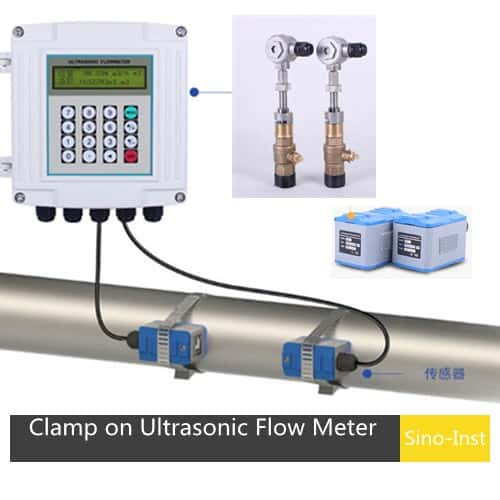
After connecting the wires, fill the inside of the probe with silicone. Leave it for half an hour. Then fix the probe to the polished pipe with silicone and clamps (note the direction of the probe, the lead end is outward). Then observe the signal strength Ratio to transmission time. If it is found to be bad, finely adjust the probe position until the signal of the instrument reaches the specified range
Application Cautions for Ultrasonic Flowmeters
The flowmeter has two modes diagonal and reflection. When the reflection mode cannot be measured, the diagonal mode may be able to measure, so we have always used the reflection mode.
The flowmeter has high requirements on the pipeline, and the insulation layer must be scraped off, otherwise it cannot be measured.
When we measure the air-conditioning water system, use a knife to cut off the insulation layer to prevent the sensor, and then stick the cut insulation layer after the measurement. The surface of the pipe is as bright as possible. If it is too rough, it must be polished with sandpaper.
It is difficult to measure when the fluid in the pipeline is not full, so the measurement location should be as straight as possible, away from elbows, valves, and other places.
The authenticity of the flowmeter reading depends on the signal strength. When the signal is too low, the result is basically unreliable, and generally, it is more than 60% or even more.
Since the readings may vary greatly, the approach we take is to allow the flowmeter to take continuous readings, such as continuously reading for one minute and then taking the average.
Measuring hot water lines is more difficult than cold water lines. Because the temperature of the hot-water pipe wall surface is high, the coupling is easily made at high temperatures. In addition to the product’s own couplant, we have all tried toothpaste.
For transit time ultrasonic flowmeters, be sure that the fluid can adequately conduct ultrasonic waves. Because the flowmeter will not measure when the ultrasonic waves cannot penetrate the flow stream between the transducers.
Ultrasonic waves must be able to penetrate the fluid for Doppler flowmeters to operate accurately.
When the fluid is relatively opaque and does not penetrate the fluid, Doppler flowmeters tend to measure the velocity of the fluid at or near the pipe wall, which can cause significant measurement error and/or cause the flowmeter to fail.
For Doppler ultrasonic flowmeters, be sure that the fluid adequately reflects ultrasonic waves. Because the flowmeter will not operate without a reflected ultrasonic signal.
Depending upon design, reflections can occur due to small bubbles of gas in the flow stream or the presence of eddies in the flow stream. If not already present in the flowing stream, generating these sources of reflection can be difficult in practice. Fortunately, some combination of bubbles of gas and/or eddies are present in most applications.
The velocity of the solid particles in slurry can be different than its liquid carrier fluid. Be careful applying ultrasonic technology when the solid particles can become concentrated in one part of the flowing stream. Such as in a horizontal pipe flowing at a relatively low velocity.
Be careful when applying Doppler ultrasonic flowmeters in slurry applications. Because the solid particles can produce strong signals that can cause the Doppler flowmeter to measure the velocity of the solids and not the velocity of the liquid.
Avoid fluids that can coat wetted transducers or coat the pipe wall in front of non-wetted transducers. Because the flowmeter will not measure when the ultrasonic waves cannot enter the flow stream.
Be sure to maintain reliable clamp-on transducer connections to the pipe wall. Because the flowmeter will not measure when the ultrasonic waves are not able to reach the fluid.
Be sure to understand the process and apply these flowmeters properly. For example, a periodic cleaning process upstream may cause the flowmeter to stop working because the dirt may not allow ultrasonic energy to pass through the fluid.
Further, if the dirt coats wetted transducers, the flowmeter may fail to operate until it is cleaned.
What is non-intrusive ultrasonic flow meter technology?
The non-intrusive detection method means that the detection medium will not cause wear to the detection instrument, so there will be no leakage.
In the flow detection of liquid media, the clamp-type ultrasonic flowmeter is made by the ultrasonic detection method that has been used for a long time. And has become a standard flow detection product. In the field of chemical product production, especially in the measurement of corrosive media or media harmful to human health. People are most willing to use this non-immersive ultrasonic testing method. However, these advantages are not limited to instruments for liquid detection.
In recent years, ultrasonic flow detection technology has been increasingly used for the detection of gaseous media. Especially in the process of natural gas transportation, transportation, and storage, non-immersive detection methods have also been widely used. In the process gas detection, this non-immersive ultrasonic clamping detection technology is very beneficial.
We specialise in measuring the flow of a liquid in a pipe by using clamp on /strap on sensors. These are high frequency sensors that penetrate through the pipe wall and the liquid to determine the fluid velocity, flow rate and total. The most common types of clamp on technologies use a doppler or transit time propagation technique.
How to Use Ultrasonic Flowmeters
Ultrasonic flowmeters are commonly applied to measure the velocity of liquids that allow ultrasonic waves to pass. Such as water, molten sulfur, cryogenic liquids, and chemicals. Transit time designs are also available to measure gas and vapor flow.
Be careful because fluids do not pass ultrasonic energy. Such as many types of slurry, limit the penetration of ultrasonic waves into the fluid.
In Doppler ultrasonic flowmeters, opaque fluids can limit ultrasonic wave penetration too near the pipe wall, which can degrade accuracy and/or cause the flowmeter to fail to measure.
Transit-time ultrasonic flowmeters can fail to operate when an opaque fluid weakens the ultrasonic wave to such an extent that the wave does not reach the receiver.
Ultrasonic level transducers are widely used for level measurement in industrial tanks, cesspools, diesel containers, and other applications. They utilize ultrasonic technology to measure the liquid level in liquid or…
Ultrasonic vs Magnetic Flow Meter, are you confused about which one to choose? Sino-Inst, based on our years of experience in flow measurement services, has compiled this blog, hoping to…
Ultrasonic flow meters use ultrasonic technology to measure liquid flow. There are two main types: Doppler effect and transit time. Both Doppler Effect and Transit Time ultrasonic flowmeters can be…
Doppler effect ultrasonic flow meters are specially designed for the measurement of liquids containing solid particles or bubbles with a lot of impurities or relatively dirty liquids. Can be configured…
Ultrasonic Level Sensor Applications are very broad. The ultrasonic liquid level sensor uses ultrasonic pulse echo to achieve liquid level measurement. It can be widely used in liquid level-material level…
We often hear about 2 wire ultrasonic level transmitter, 4 wire ultrasonic level transmitter, etc. Ultrasonic level transmitter can be divided into two-wire system, three-wire system and four-wire system. Ultrasonic…
The biggest difference between radar and ultrasonic level transmitter is the different measurement principles. Ultrasonic level transmitter uses sound waves, and radar level meter uses electromagnetic waves. Different measurement principles…
Portable ultrasonic flowmeters are essential instruments used for accurately measuring the rate of fluid flow within a pipe or conduit. Portable ultrasonic flowmeters are the most convenient Ultrasonic flow meters…
Bidirectional Flow Meters can simultaneously measure the flow of liquid or gas in both positive and negative directions. Bidirectional flow, a process in which the conveying and control functions use…
Clamp-on ultrasonic flow meters, with their non-contact measurement, easy installation, and wide applicability, have become the ideal choice for flow measurement in industries such as manufacturing, municipal utilities, energy, and agriculture.
In practical applications, proper installation of the ultrasonic flow meter, based on the fluid characteristics and pipeline conditions, can enhance the accuracy and efficiency of flow measurement. If you have any questions regarding clamp-on ultrasonic flow meters, please feel free to contact our sales engineers!
Zhang Wei, possesses 20 years of experience as an automation instrumentation engineer, specializing in the research, design, installation, commissioning, and maintenance of automation instruments.
Face to various instrument communication protocols (such as Modbus, Profibus, etc.), with solid hardware circuit design and software programming skills (proficient in C language and PLC programming). Has extensive project experience; projects he has led and participated in have all achieved outstanding results, improving product accuracy, reducing costs, and increasing production efficiency.
Possesses excellent communication and coordination skills and a strong team spirit, enabling him to quickly respond to customer needs and provide high-quality automation instrumentation solutions.