
Liquid Nitrogen Level Measurement: Real Project Case
Liquid nitrogen is a commonly used industrial gas with extremely low temperature, strong cooling capacity, and controllability. Liquid nitrogen has important applications in various industries, so it is important to monitor and control the liquid nitrogen level. Our liquid nitrogen tank level meter is a device used to monitor the liquid nitrogen level in ultra-low temperature containers (such as Dewar flasks).
Looking for the sensor itself? See our dedicated liquid nitrogen level sensor (SI-LN2 cryogenic level transmitter) product page for specifications, pricing, and request quote.
Why Is Liquid Nitrogen Level Measurement Difficult?
The physical properties of liquid nitrogen present multiple challenges to liquid level monitoring:
- First, the extremely low temperatures can cause common metal materials to become brittle and electronic components to fail.
- Second, the nitrogen mist produced by the vaporization of liquid nitrogen can interfere with optical or acoustic signals.
- Furthermore, changes in liquid level are accompanied by a dramatic phase transition (the density difference between liquid nitrogen and nitrogen gas is as much as 647 times), making traditional measurement methods based on a single medium prone to failure.
These characteristics necessitate that level gauges possess the capabilities of low-temperature resistance, immunity to phase transition interference, and high-precision response.
Real Project Case Study
Project Background
A liquid gas distributor in the Middle East needed to retrofit level measurement on 12 skid-mounted LN2 storage tanks used for medical oxygen generation and metal cutting support. Each tank held up to 1,500 L of liquid nitrogen at 1.5 MPa working pressure. The client required continuous level feedback for a remote monitoring system running on a PLC + 4-20 mA loop.
Measurement Challenge
The tanks were already in service. Retrofit meant: no pipe cutting, minimal downtime, tolerance of ambient temperatures up to 50°C (desert conditions), and a 300 mm installation slot for the probe. The client also rejected radar-based options due to past reliability issues with low-εr media.
Solution

We supplied SI-LN2 capacitive level sensors with the following spec:
- Working pressure: 1.5 MPa
- Output: 0-5 V (scaled to 4-20 mA via converter)
- Probe length: 300 mm
- Measuring range: 0-250 mm
- Process connection: M20 × 1.5 thread
- Power: 24 VDC
- Material: 316L stainless steel probe with PTFE insulation
Installation
Each probe was installed through an existing instrument port. No downtime was required beyond a brief tank isolation (≈20 min). Signal cable was routed in parallel with existing PLC wiring.
Results
- Measurement accuracy: within ±1.5% of full span
- Zero drift after 8 months of continuous operation
- System detected overfill event within 4 seconds of trigger condition
- Zero freeze-related failures under 12 hours of heavy fill cycles
How Is Liquid Nitrogen Level Measured?
| Method | Accuracy | Cryogenic Compatibility | Cost | Best For |
|---|---|---|---|---|
| Capacitance | ±1-2% | Excellent (probe handles −196°C) | Medium | Sealed cryogenic tanks, continuous measurement |
| Differential Pressure (Hydrostatic) | ±0.5-1% | Good with diaphragm seals + capillaries | Medium-High | Large storage tanks, high-accuracy requirements |
| Float / Magnetostrictive | ±1-2% | Limited (seal/bearing freezing risk) | Medium | Small Dewar tanks, point measurement |
| Weight / Load Cell | ±0.5% | Excellent (no tank penetration) | High | Very large bulk storage, highest accuracy |
1. Capacitance (Dielectric) Method
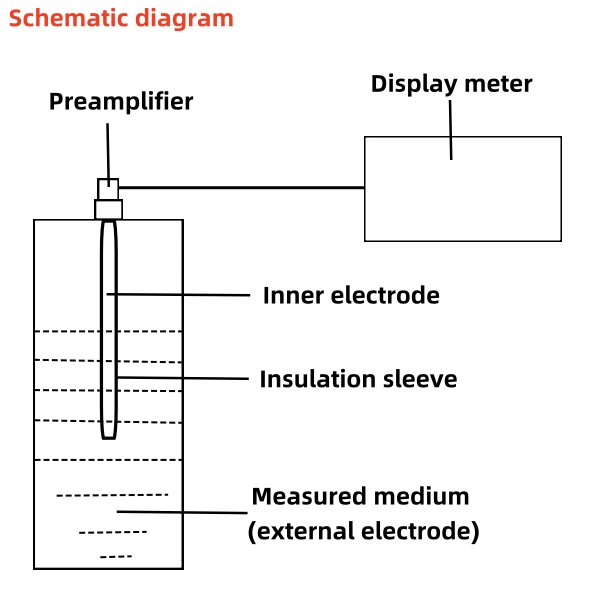
As shown in the figure above, a metal rod is inserted into the liquid nitrogen tank. At this time, the metal rod serves as one pole of the capacitor and the tank wall serves as the other pole of the capacitor. The medium between the two electrodes is the liquid and the gas on the liquid surface. Due to the different dielectric constants of liquids and gases, when the liquid level rises, the total dielectric constant value between the two electrodes increases accordingly, and thus the capacitance increases.
Conversely, when the liquid level drops, the total dielectric constant value decreases and the capacitance also decreases. Therefore, the liquid nitrogen tank level meter can measure the height of the liquid level by measuring the change in capacitance between the two electrodes.
2. Differential Pressure (Hydrostatic) Method
Differential pressure level transmitters calculate the liquid level by measuring the static pressure generated by a column of liquid nitrogen. The formula is: Liquid Level Height = Pressure Difference ÷ (Liquid Nitrogen Density × Gravitational Acceleration).
Its core components include two pressure sensors: one installed at the bottom of the container (measuring total pressure), and the other installed at the top (measuring gas phase pressure). The difference between the two is the static pressure generated by the liquid column.
Because the density of liquid nitrogen changes slightly with temperature (0.808 g/cm³ at -196℃, decreasing to 0.76 g/cm³ at -180℃), high-precision differential pressure level gauges integrate a temperature sensor for density compensation.
These devices are suitable for large storage tanks (over 100L), with a measurement accuracy of ±0.5%. However, attention must be paid to the cryogenic sealing of the sensor—usually using a metal bellows for isolation to prevent direct contact between liquid nitrogen and electronic components.
3. Float / Magnetostrictive
The buoyancy-based level gauge is the most traditional liquid nitrogen level measurement technology, its core principle being based on Archimedes’ principle. A float made of a low-temperature corrosion-resistant material (such as 316 stainless steel or Monel alloy) is suspended inside the Dewar flask. The float’s density is between that of liquid nitrogen (0.808 g/cm³) and nitrogen gas (0.00125 g/cm³). When the liquid level changes, the buoyancy force on the float changes, and the displacement is transmitted to the external scale via a magnetic coupling mechanism.
To adapt to low-temperature environments, modern buoyancy-based level gauges have made two key improvements: first, the float uses a hollow, sealed structure to ensure it does not crack at -196°C; second, the transmission rod uses a composite material of PTFE and metal to reduce measurement errors caused by low-temperature shrinkage.
This type of level gauge is suitable for small Dewar flasks, with a measurement accuracy of ±2%, but the float buoyancy needs to be calibrated periodically.
4. Weight / Load Cell
The liquid nitrogen balance is calculated by directly measuring the weight change of the entire storage tank using a high-precision weighing sensor.
High accuracy (within ±0.5%): Directly measures the total mass, unaffected by boiling, bubbles, or stratification.
Completely non-contact: No probe installation inside the container is required, preserving the vacuum insulation layer and maintaining thermal insulation performance.
High reliability: No moving parts, not easily damaged, and simple maintenance.
Measuring net/gross weight: Facilitates inventory management.
However, it requires a dedicated high-precision sensor and a robust and stable support structure. Installation requirements are high; the tank foundation needs modification to ensure it is level and free from vibration interference. It cannot distinguish between liquid and gas phases, only providing the total volume, and cannot directly indicate the liquid level.
Applicable scenarios: Scenarios with extremely high accuracy and reliability requirements (such as large biobanks, critical pharmaceutical processes, and storage of valuable samples), large storage tanks (>500L), and occasions where damage to the tank’s insulation structure is not permitted.
5. Optical Level Gauges
Laser level gauges measure liquid level by emitting a laser beam (typically 650nm red light) and utilizing the reflectivity of the liquid nitrogen surface. When the laser shines on the liquid surface, the reflected light is captured by a receiver, and the distance is calculated using the triangulation principle. Fiber optic level gauges, on the other hand, insert a fiber optic probe into the liquid nitrogen and use the abrupt change in refractive index at the liquid-gas interface (liquid nitrogen refractive index 1.2, nitrogen gas 1.00029) to determine the light intensity change.
The advantage of optical technology is its resistance to electromagnetic interference, making it suitable for medical or precision laboratory environments. However, two points need attention: first, the laser needs to penetrate the nitrogen mist, so pulse modulation technology is often used to enhance the signal; second, the fiber optic probe must be made of quartz material (resistant to temperatures as low as -200℃) to avoid low-temperature embrittlement and breakage.
Application Of Liquid Nitrogen Level Meter
Biological laboratory: In the fields of cell preservation, sperm, and embryo freezing, liquid nitrogen tanks can store samples for a long time. The liquid level meter accurately monitors the amount of liquid nitrogen to ensure that the sample is always in a suitable low temperature environment to avoid damage to the sample due to insufficient liquid nitrogen.
For example, in cell culture experiments, the liquid level meter displays the liquid nitrogen level in real time. This makes it convenient for scientific researchers to replenish liquid nitrogen in time to ensure cell activity.
Industry: Liquid nitrogen is needed for cooling in the production processes of the chemical industry and the electronics industry. The slightest carelessness in the cooling step may cause production losses and safety accidents. Therefore, real-time monitoring of the liquid nitrogen level is crucial for chemical reactions and metal cooling.
Aerospace material research and testing: Aerospace materials need to simulate the space environment for various experiments during the research and development and testing stages. Researchers can use liquid nitrogen to create a low-temperature environment close to space. Liquid nitrogen tank level meters can be used to monitor the supply of liquid nitrogen in low-temperature experimental devices.

Technical Advantages
The real-time performance of capacitive level meters is one of the important features of liquid level monitoring. Capacitive level meters can achieve continuous and real-time measurement of the liquid level in the tank, and transmit the measurement data to the operator or manager quickly and accurately. Operators can timely understand the changes in the liquid level in the tank based on these real-time data, predict the liquid level trend in advance, and thus formulate and adjust scientific and reasonable liquid level control strategies.
In order to adapt to various complex industrial environments, capacitive level meters use high-quality stainless steel materials in design and manufacturing. Stainless steel has excellent corrosion resistance, wear resistance and high strength, can resist the erosion of a variety of chemical substances, and can work stably for a long time even under harsh working conditions.
Whether in humid coastal areas, high-temperature and high-pressure chemical workshops, or storage tanks containing corrosive media, stainless steel capacitive level meters can maintain good performance and provide reliable protection for liquid level measurement.
In addition, the capacitive level meter can be customized in length and installation interface according to customer requirements to adapt to storage tanks of different sizes. And there are no moving parts, and basically no daily maintenance is required, which saves customers energy and money.
FAQ
More solutions for level measurement
- Magnetic Level Measurement: Indicators,Transmitters, Switches Or Sensors
- GWR Type Level Transmitter: An All-inclusive Guide
- Different Solutions for Fluid Level Measurement
- Float Type Level Transmitters for Continuous Level Measurement
- All-inclusive Guide To Bin Level Measurement Systems
- An Out-and-Out Guide To Different Types Of Level Transmitters
- Bitumen And Asphalt Level Meters: Let’s Learn More About Them
- Dry Materials-Bulk Solids-Powder Level Sensors Guide
- Role of Hydrostatic Level Transmitters In Well Water Level Monitoring Process
- Typical Ultrasonic Level Sensor Applications and Advantages
- Difference Between Radar and Ultrasonic Level Transmitters
- Industrial Ultrasonic Level Transmitters | Non-contact Level Measurement
- Featured 5 Guided Wave Radar Level Transmitter Types
- Guided Wave Radar Level Transmitter Installation Guide and Troubleshooting
- Hydrostatic Level Measurement-Liquid Level Measurement with Pressure Sensors
- Difference Between Radar and Guided Wave Radar Level Transmitter
Summary
Sino-Inst’s capacitive level meter has a simple structure, no moving parts, and fast dynamic response. It can be widely used in liquid level measurement in harsh environments such as high temperature, low temperature, and strong corrosion. Customers in Taiwan, China, the Middle East, Europe and the United States have purchased our products.
Our capacitive level meter supports customized pressure, temperature, probe length and installation method, aiming to customize the most suitable product for each customer. If you have any needs, please feel free to contact us.