Home > Blog
2024.4.22

Difference Between Radar and Ultrasonic Level Transmitter

The biggest difference between radar and ultrasonic level transmitter is the different measurement principles. Ultrasonic level transmitter uses sound waves, and radar level meter uses electromagnetic waves. Different measurement principles lead to different application scenarios. Radar and ultrasonic level transmitters are both non-contact level measurement technologies. Both types of liquid level meters send signals to the medium, and the signals are reflected by the medium and then return to the instrument. Distance is measured by calculating the time difference. RFQ Table of ContentsFeatur......

2024.4.22

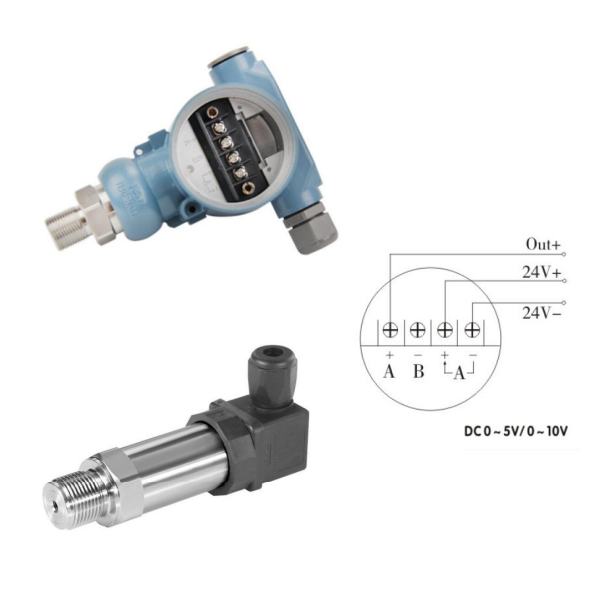
Pressure Transducer Output Signal Guide

Pressure transducer measures the pressure of fluid, gas or liquid and converts the pressure value into an electrical signal output. Convenient for industrial automation process control. Before purchasing a pressure transmitter, measuring range, Pressure Transducer Output Signal, and connecting thread are three elements that must be clarified. In practical applications, the selection of the pressure transducer output signal is very important, which directly affects the reliability and accuracy of the control system. RFQ Table of ContentsFeatured Radar and Ultrasonic Level Transmitters1. Differe......

2024.4.21

Industrial Ultrasonic Level Transmitters | Non-contact Level Measurement

Ultrasonic Level Transmitters are mainly used for continuous non-contact measurement of levels in industrial storage tanks, sewage pits, diesel containers, etc. The liquid cannot contain foam, steam, smoke, etc. The main principle of ultrasonic level measurement is to use the high-frequency vibration of ultrasonic waves and its propagation characteristics in the medium to complete the measurement. Can meet most industrial liquid level measurement needs at a low cost. RFQ Table of ContentsFeatured Radar and Ultrasonic Level Transmitters1. Different measurement principles2. The measurement blind......

2024.1.19

Top Explosion Proof Flow Meters for Explosive or Hazardous Areas

Flowmeters are divided into explosion-proof and non-explosion-proof types according to their electrical structure. Explosion Proof Flow Meters are mainly used in flammable, explosive, toxic or other hazardous environments. In these situations, the equipment may be exposed to flammable gases, steam, dust, etc., so it needs to be explosion-proof to ensure safe and reliable operation. We at Sino-Inst supply various types of Explosion Proof Flow Meters. Including: explosion proof mass flow meter, explosion proof air flow sensor, explosion-proof turbine flow meter, explosion-proof ultrasonic flow m......

2024.1.17

What Is Temperature Compensation and Pressure Compensation for Flow Meters?

The principle of temperature compensation and pressure compensation of the flow meter is based on the changes in physical parameters such as density and viscosity of the fluid at different temperatures and pressures, which affects the measurement accuracy of the flow meter. In order to eliminate this effect, temperature and pressure compensation is required. When we purchase a flow meter, we often encounter temperature compensation and pressure compensation configurations, especially for measuring gases, steam, etc. Next, let’s analyze in detail what is the temperature compensation and pressur......

2024.1.14

Differences Between Thermocouples: Type S, K, N, J, E, T

Thermocouples have the advantages of simple structure, wide measurement range, and easy processing of output signals. Therefore, thermocouples have become our preferred sensor for temperature measurement. The graduation numbers of thermocouples mainly include S, R, B, N, K, E, J, T, etc. Among them, S, R, and B belong to precious metal thermocouples, and N, K, E, J, and T belong to cheap metal thermocouples. So what’s the difference? Understanding the Differences between Thermocouples can help us choose the most suitable thermocouple. RFQ Table of ContentsFeatured Radar and Ultrasonic Le......

2024.1.9

Application Case: Mass Flow Meter Measures Lime Slurry Flow and Density

A power plant uses lime slurry as a desulfurizer. Gypsum or calcium sulfate is formed by reacting with sulfur dioxide in the flue gas. Thus, the purification and emission control of harmful gases in exhaust gas can be achieved. Measuring the density (concentration) of lime slurry is to ensure that the appropriate amount of desulfurizer can be accurately added during the desulfurization process. This ensures the desulfurization effect and the stability of equipment operation. RFQ Table of ContentsFeatured Radar and Ultrasonic Level Transmitters1. Different measurement principles2. The measureme......