

Pressure transmitter for level measurement is a relatively inexpensive and stable solution. Proper selection and configuration of pressure transmitters can effectively save on measurement costs.
On CAN-based machinery, a CAN bus pressure transmitter reports level-related pressure straight onto the network.
Pressure transmitters for level measurement can be broadly categorized into two types: one for measuring liquid levels in pipes, and the other for measuring liquid levels in wells and rivers.
Next, we will take a detailed look at their differences and how to choose the right one.
Same Principle: Hydrostatic Pressure of the Liquid Level
A pressure transmitter installed at or near the bottom of a liquid level measures the static pressure generated by the column of liquid above it. This pressure is proportional to the height of the liquid column, the density of the medium, and the acceleration due to gravity. The formula is familiar:
P = ρ × g × h
Where P is gauge pressure (Pa), ρ is the density of the medium (kg/m³), g is the acceleration due to gravity (9.81 m/s²), and h is the height of the liquid column (m).
For water at room temperature, a 1-meter rise in water column height corresponds to approximately 9.81 kPa (approximately 0.1 bar, 1.42 psi, 40 inH₂O). Knowing the maximum height the liquid in a tank can rise determines the required range of the transmitter.
| 1 = | mmH₂O | mH₂O | inH₂O | Pa | kPa | bar | mbar | psi | mmHg | kgf/cm² |
| 1 mmH₂O | 1 | 0.001 | 0.0394 | 9.807 | 0.0098 | 0.0000981 | 0.0981 | 0.001422 | 0.07356 | 0.0001 |
| 1 mH₂O | 1,000 | 1 | 39.37 | 9,806.65 | 9.807 | 0.09807 | 98.07 | 1.4223 | 73.56 | 0.1 |
| 1 inH₂O | 25.4 | 0.0254 | 1 | 249.08 | 0.2491 | 0.002491 | 2.491 | 0.03613 | 1.868 | 0.00254 |
| 1 ftH₂O | 304.8 | 0.3048 | 12 | 2,989 | 2.989 | 0.02989 | 29.89 | 0.4335 | 22.42 | 0.03048 |
| 1 Pa | 0.10197 | 0.0001 | 0.004015 | 1 | 0.001 | 0.00001 | 0.01 | 0.000145 | 0.0075 | 0.0000102 |
| 1 kPa | 102 | 0.10197 | 4.015 | 1,000 | 1 | 0.01 | 10 | 0.14504 | 7.501 | 0.0102 |
| 1 MPa | 102,000 | 102 | 4,015 | 1,000,000 | 1,000 | 10 | 10,000 | 145.04 | 7,501 | 10.197 |
| 1 bar | 10,197 | 10.197 | 401.5 | 100,000 | 100 | 1 | 1,000 | 14.504 | 750.06 | 1.0197 |
| 1 mbar | 10.197 | 0.0102 | 0.4015 | 100 | 0.1 | 0.001 | 1 | 0.0145 | 0.7501 | 0.00102 |
| 1 psi | 703.07 | 0.7031 | 27.68 | 6,894.76 | 6.895 | 0.06895 | 68.95 | 1 | 51.715 | 0.07031 |
| 1 mmHg (Torr) | 13.595 | 0.0136 | 0.5353 | 133.32 | 0.1333 | 0.001333 | 1.333 | 0.01934 | 1 | 0.001359 |
| 1 atm | 10,332 | 10.332 | 406.8 | 101,325 | 101.325 | 1.01325 | 1,013.25 | 14.696 | 760 | 1.0332 |
| 1 kgf/cm² | 10,000 | 10 | 393.7 | 98,066.50 | 98.07 | 0.9807 | 980.7 | 14.223 | 735.56 | 1 |
Based on this principle, a “Hydrostatic Level transmitter” is essentially a pressure transmitter with a suitable range and installation method.
2 Types of Pressure Transmitters for Level Measurement
Based on the above principle, to obtain the pressure at the bottom of a liquid, the pressure sensor must be in contact with the bottom of the liquid. Two common operating conditions and measurement methods are as follows:
1. Pressure level measurement at the bottom of a tank.
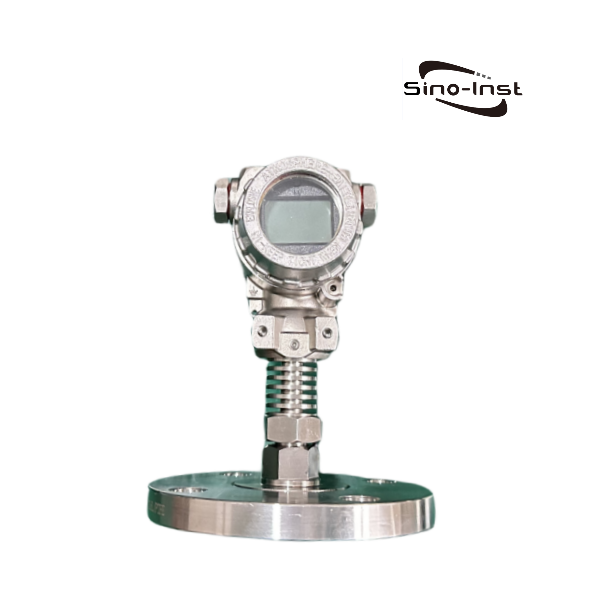
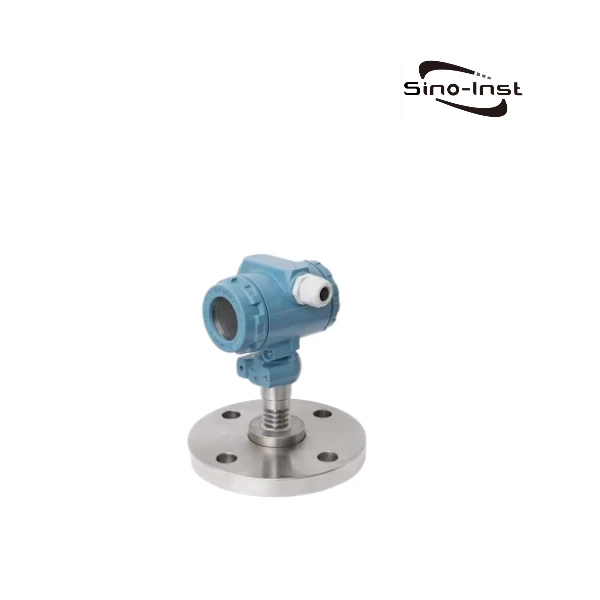
For open tanks, a pressure transmitter can be directly installed at the bottom of the tank for measurement.
Pressure transmitters can be configured with threaded, clamp, or flange mounting options, offering flexible customization. For example, flanges can be customized using the Rosemount 1199 series.
For viscous or corrosive substances, wetted materials such as Hastelloy, Monel, and PTFE can be customized. Therefore, using a pressure transmitter to measure the liquid level in open tanks is a good choice.
Our intelligent pressure and level transmitters can display pressure, level, and percentage units.
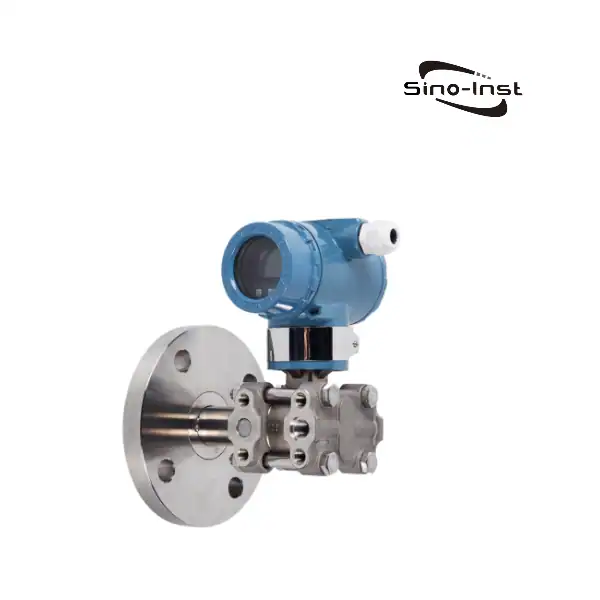
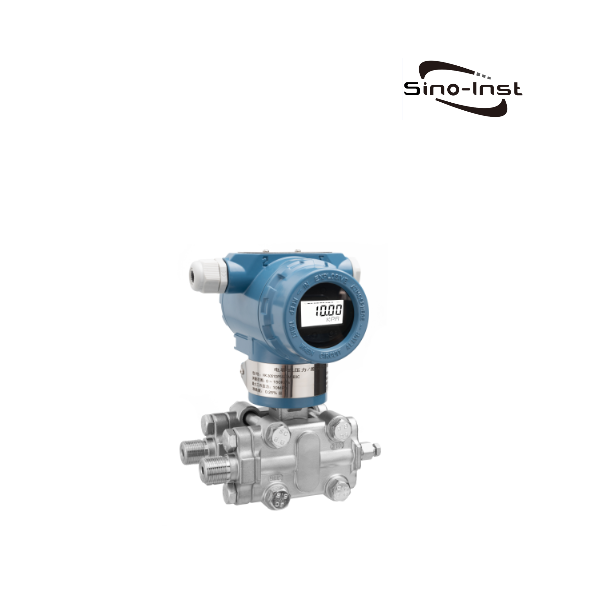
For sealed tanks or vacuum tanks, a differential pressure level transmitter needs to be selected based on the operating conditions. Please refer to our other blog post, “Differential Pressure Level Transmitter,” for an introduction.
2. Pressure level measurement in wells or underwater.
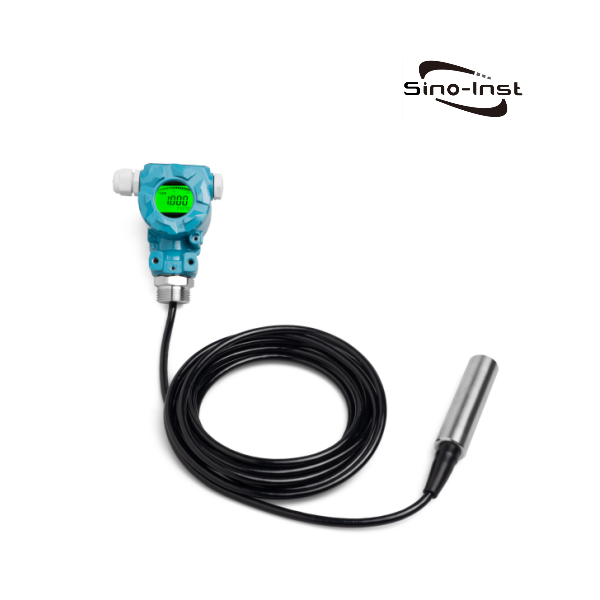
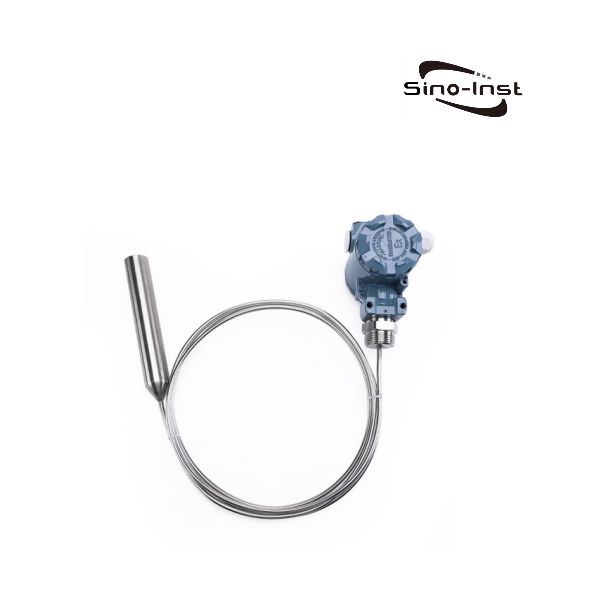
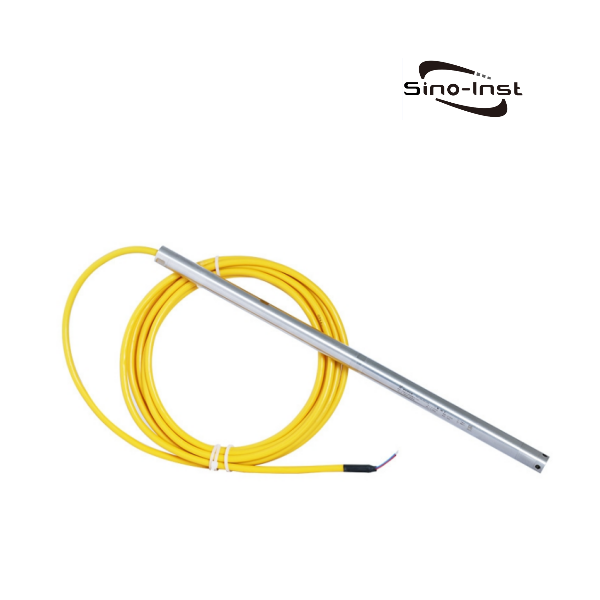
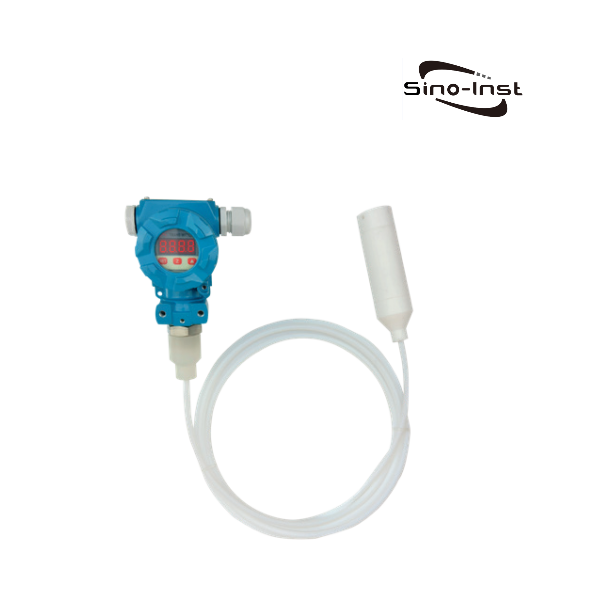
Another option is to submerge the entire pressure transmitter probe underwater. The static pressure generated by the liquid is transmitted to the sensor through the probe, and then the pressure signal is transmitted to the display via a gas cable. This allows for the calculation of the liquid level and the output of signals such as 4-20mA and 0-10V.
Its advantages include easy installation, requiring no major modifications to the container, making it particularly suitable for open containers, storage tanks, and pools.
It has a wide measurement range, covering liquid levels from tens of centimeters to 2000 meters. Submersible level transmitters are most widely used, especially in large-range deep wells.
It is highly adaptable; some specially protected models (such as corrosion-resistant and explosion-proof) can be used in harsh environments such as chemical and metallurgical industries.
However, when using it in viscous liquids or liquids containing a large amount of suspended solids, care must be taken to prevent probe clogging to avoid affecting measurement accuracy.
Selection Guide
In summary, only by selecting the correct configuration parameters can pressure level measurement be completed efficiently.
In short, you need to consider the following items in order:
- Determine the operating conditions: Is it measuring the level of a water well or an open tank?
- Installation method: Is it submersible installation or bottom mounting on the tank?
- Installation dimensions: Submersible installation is by default G1 threaded mounting, but flange mounting is also an option. Bottom mounting on the tank can also be customized with threads, clamps, or flanges.
- Medium chemical properties: Is it cold water, a chemical liquid, or a high-temperature oil? Is it corrosive, and what is its viscosity?
- Medium temperature
- Measuring range
- Cable configuration: Especially for submersible level transmitters, sometimes the measuring range and cable requirements are not consistent.
- Local display: It is recommended to configure an intelligent local digital display. This allows adjustment of units, measuring range, and other parameters.
- Signal output: Based on project management requirements, configure 4-20mA, 0-10V, RS485, or HART.
- Accuracy requirements: The standard accuracy is 0.5%FS. High precision can be customized to 0.1%FS or 0.075%FS.
Quick Selection Based on Tank Type and Medium:
Range Selection: 90% of Mistakes Start Here
We’ve seen this scenario far too many times in the field: an engineer installs a 0–2 bar pressure transmitter on a 2-meter-high water tank. Let’s do the math:
| Item | Value |
| Maximum liquid level in the tank | 2 m water column |
| Static pressure at full liquid level | ~0.196 bar |
| Transmitter range | 0–2 bar (4–20 mA) |
| Output current at full liquid level | ~5.6 mA |
| Actual signal range | 4 → 5.6 mA = only 10% of full scale |
A 10% range utilization rate will significantly reduce resolution. The correct approach is to select a pressure transmitter with a range close to the maximum process pressure. For a 2m water tank, a range of 0–0.2 bar (or 0–80 inH₂O, 0–20 kPa) should be chosen. This provides 4–20 mA full coverage of your 2-meter level, and a 10-bit ADC will give you a resolution better than 2 mm.
Our recommendation is to ensure the maximum process pressure falls within 70–100% of the transmitter’s range.
Incorrect Measurement Range Selected: Two Remedial Solutions
If you’ve already purchased a transmitter with an excessively large measurement range, or inherited an existing system, you can try the following two methods:
Solution 1: Re-span
Most smart transmitters allow the 4–20 mA output to be remapped to a narrower range than the maximum. Using the 0–2 bar transmitter mentioned earlier as an example, you can configure it to 4 mA = 0 bar and 20 mA = 0.2 bar, putting the output within your actual required range.
You will need:
- A HART handheld device or HART modem + PC software
- Local button configuration included with the transmitter (many smart transmitters have buttons under the cover)
- A free USB configuration tool provided by the manufacturer
Of course, most low-cost “factory-fixed range” pressure transmitters cannot be re-spanned.
Option Two: Scaling in PLC Software
If the hardware is fixed and cannot be re-spanned, linear mapping compensation can be performed in the PLC program. Rockwell Studio 5000 uses Engineering Units, Siemens TIA uses NORM_X / SCALE_X, and the IEC 61131 platform uses the SCALE block to map the measured raw range (e.g., 4.0–5.6 mA → 10-bit ADC count 819–1146) to the engineering range (0–2 meters).
This method does not restore the hardware resolution. However, at least the SCADA system can display the correct engineering units, and trend and alarm functions can be implemented. This is band-aid, not fix.
Technical Support
Water Level Pressure Transducers
Tank Level Measurement with Pressure Transmitters/DP Transmitters
Magnetic Float Level Gauge: Working Principle and Types
Powder/Dry Material Level Switches – Product List and Selection
Choose Digital Water Pressure Switch for Better Control
What is a Dynamic Pressure Sensor? Vs. Static
Sino-Inst’s pressure and level transmitters cover all the operating conditions mentioned above. They can be configured with 4-20mA + HART output, support factory or field recalibration of the range, and feature a standard 24VDC loop power supply.
In our customers’ actual tests, the SI-LT series products typically save 60-80% in cost compared to comparable European and American brands, with no measurable performance differences.
We support customization of measurement range, material, installation dimensions, and other detailed parameters. Please feel free to contact us to customize your Pressure Transmitter for Level Measurement.
Zhang Wei, possesses 20 years of experience as an automation instrumentation engineer, specializing in the research, design, installation, commissioning, and maintenance of automation instruments.
Face to various instrument communication protocols (such as Modbus, Profibus, etc.), with solid hardware circuit design and software programming skills (proficient in C language and PLC programming). Has extensive project experience; projects he has led and participated in have all achieved outstanding results, improving product accuracy, reducing costs, and increasing production efficiency.
Possesses excellent communication and coordination skills and a strong team spirit, enabling him to quickly respond to customer needs and provide high-quality automation instrumentation solutions.