
Anhydrous Ammonia Tank Level Measurement: Top Sensors by Tank Type
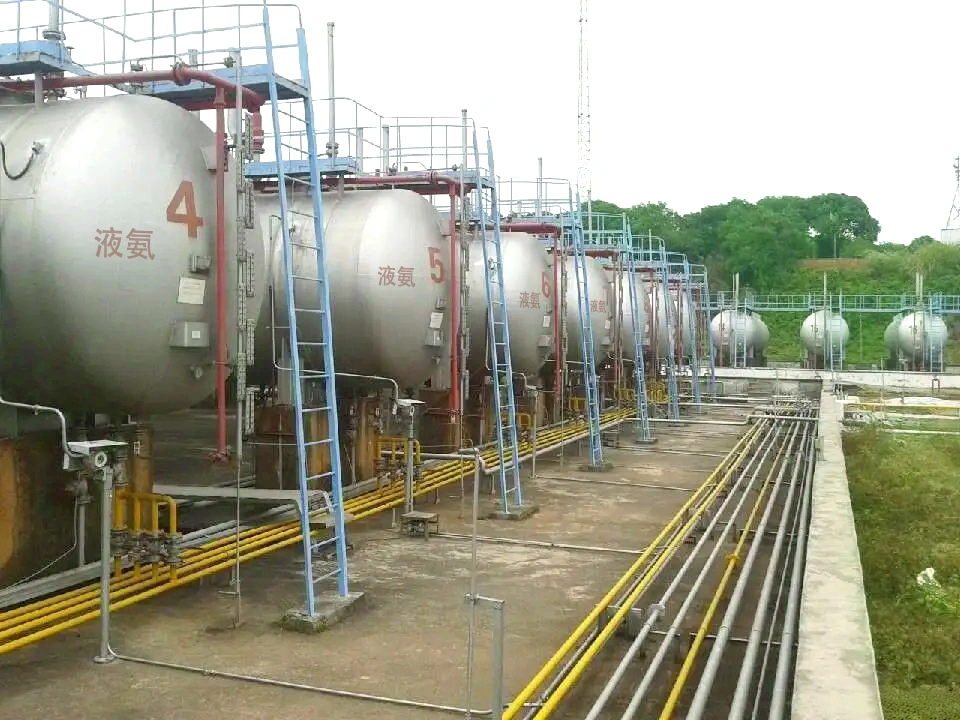
Liquid ammonia is anhydrous ammonia that becomes liquid after being pressurized or frozen. Ammonia is an important chemical raw material. For convenient transportation and storage, gaseous ammonia is usually pressurized or cooled to obtain liquid ammonia. Therefore, Anhydrous Ammonia Tank level measurement faces challenges such as low temperature -33.4℃/-28.1 °F, high pressure 0.8~1.5 MPa (116–218 psi), high corrosivity, and high toxicity.
Based on our years of experience in tank level measurement, we recommend three preferred level sensors for Anhydrous Ammonia tank level measurement and control: guided wave radar level transmitters, external ultrasonic level meters, and tuning fork level switches.
Anhydrous Ammonia Tank Types
To select an appropriate liquid level sensor for anhydrous ammonia, it is necessary to identify the common types of anhydrous ammonia tanks. Anhydrous ammonia has a boiling point of -33.5°C and a saturated vapor pressure of 506.62 kPa (at 4.7°C). Based on these physical properties, there are three common types of anhydrous ammonia tanks: fully refrigerated, semi-refrigerated, and fully pressurized.
Fully refrigerated tanks maintain the anhydrous ammonia at a temperature below its boiling point (using a refrigeration circulation system). This keeps the storage pressure at atmospheric levels, allowing for the use of vertical storage tanks, which are suitable for large-scale storage.
Semi-refrigerated tanks typically maintain the storage temperature at approximately 4°C (using a refrigeration circulation system), with an internal pressure ranging from 0.4 to 0.5 MPa.
Fully pressurized tanks store ammonia at ambient temperature; at this temperature, the saturated vapor pressure of ammonia is approximately 1.2 to 1.6 MPa. Storage at ambient temperature is the most common method.
| Types | Temperature | Pressure | Common Tank Types |
| Fully refrigerated | -33.4 °C (-28.1 °F) | Near atmospheric pressure | Vertical double-walled flat-bottom tank |
| Semi-refrigerated | Approx. 4 °C (39 °F) | 0.4–0.5 MPa (58–73 psig) | Spherical tank |
| Fully pressurized | Room temperature | 1.2–1.6 MPa (174–232 psig) | Horizontal tank, spherical tank |
Top 1: Guided-Wave Radar Level Transmitter
Guided wave radar (GWR) level transmitters are a type of radar-based level measurement instrument that utilizes contact-based sensing. It mainly comes in three types: pole type, cable type, and coaxial type. Rod and coaxial types typically have a measurement range of up to 6 meters, while the cable type can reach a maximum range of 30 meters.
GWR level transmitters operate on the principle of Time Domain Reflectometry (TDR). It transmits low-power microwave pulses along a waveguide rod or cable, which are then reflected back when they encounter a liquid surface. The liquid level is calculated by measuring the time interval between the emission of the pulse and the reception of the echo. This measurement method is unaffected by factors such as temperature, pressure, vapors, or foam, ensuring high accuracy and reliability.
Product Specifications for Our Guided Wave Radar Level Transmitters:
| Measuring range | 0–30 m |
| Accuracy/Resolution | ±10 mm |
| output | 4–20 mA / HART |
| Power supply | Two-wire system, 24 V DC (standard: 16–26 V; intrinsically safe: 21.6–26.4 V); four-wire system, 24 V DC or 220 V AC |
| show | 4-digit LCD, programmable |
| process connection | Threaded or flanged, 316L stainless steel |
| Probe material | 316L stainless steel or PTFE |
| sealing material | Viton (fluororubber) or Kalrez (perfluoroelastomer) |
| Shell | Cast aluminum, plastic, or 316L stainless steel |
| Explosion proof | Ex ia IIC T6 Ga; Ex d ia [ia Ga] IIC T6 Gb |
| Protection level | IP67 |
| Cable entry | M20×1.5 |
| Measurement interval/response time | Approx. 1 s |
| Ambient temperature (working, storage) | -40 to 80 °C |
| Minimum dielectric constant | 1.3 (when installed in a guided-wave tube) |
| Process temperature: | -40 to 200 °C |
| Process pressure: | -0.1 to 4 MPa |
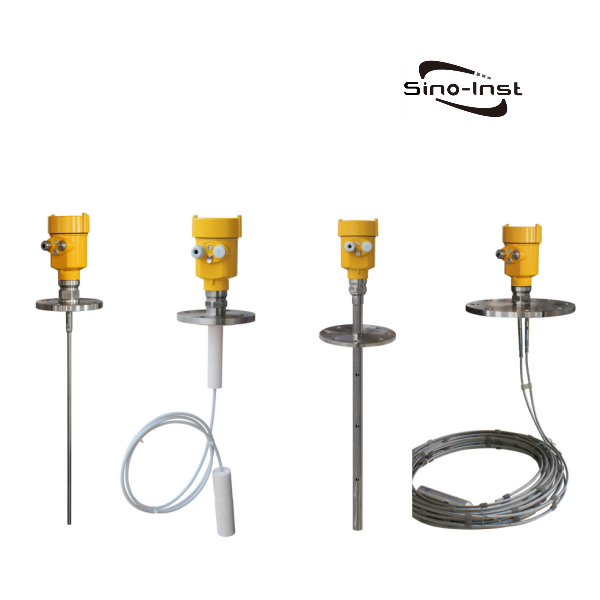
Rod, cable and coaxial probes, ranges up to 30 m. Rated -0.1 to 4 MPa with Ex ia / Ex d approvals and 4–20 mA/HART output. Specify Kalrez seals for ammonia service.
These specifications are fully compatible with fully refrigerated, semi-refrigerated, and fully pressurized Anhydrous ammonia storage tanks. Therefore, guided wave radar level gauges are more advantageous when measuring liquid ammonia, especially in large storage tanks.
In GWR transmitters, the radar signal propagates along a cable, resulting in concentrated energy, a stable signal, high measurement precision, and low operational costs. Compared to other measurement technologies, this approach offers significant advantages, particularly for large storage tanks.
So how should a guided wave radar level transmitter be installed on a liquid ammonia storage tank?
For the installation of liquid ammonia storage tanks, a top flange installation is recommended. However, there are a few points to note during installation:
- Install a bracket at the bottom, directly opposite the flange, to secure the cable probe. Prevent the cable from swaying or hitting the wall to ensure accurate liquid ammonia level measurement.
- Choosing the right cable length is crucial. It should be calculated based on the distance between the flange and the support bracket. The cable should neither be pulled too taut nor allowed to slacken or curve, as this could compromise measurement accuracy.
- When installing the probe assembly of a cable-type guided-wave radar, ensure it is positioned away from inlets, outlets, tank walls, and any internal structures. This helps prevent interference echoes that could affect measurement precision.
If a servo level gauge is used to measure liquid ammonia, the same measurement effect can be achieved, but the cost will be higher.
Top 2: External Ultrasonic Level Meter
If an anhydrous ammonia storage tank is pressurized to liquefy the contents, the interior of the tank is inevitably under high pressure. Drilling a hole in the tank would compromise its seal, creating a risk of leakage. In such cases, the External Ultrasonic Level Meter is an excellent choice.
The External Ultrasonic Level Meter enables true non-contact measurement. Based on the principle of sonar ranging, a specialized ultrasonic probe is mounted on the bottom of the tank’s outer wall. It emits ultrasonic waves that penetrate the tank wall, travel through the liquid inside the tank, reflect off the liquid surface, and are then received by the probe. A specialized algorithm is used to calculate the liquid level height. The probe is completely isolated from the measured medium by the tank wall, eliminating the need to drill holes in the tank. Installation can be performed without interrupting production or draining the tank.
Our External Ultrasonic Level Meter Specifications:
| Type | Two-wire system | Four-wire system | Intrinsically safe |
| measurable range | 3m, 5m, 10m, 20m, 30m | ||
| Measurement error | 1‰~1% (too thick tank wall, pressure, and temperature changes can affect accuracy) | ||
| display resolution | 1mm | ||
| Measurable wall thickness | 2~70mm | ||
| Power supply | DC24V | ||
| Signal output | Analog output: 4~20mA, maximum load 750Ω | ||
| Communication Interface | RS485/MODBUS/HART communication protocol | / | |
| Debug interface | infrared | ||
| power | 10w | 1w | |
| shell | Material: cast aluminum alloy | ||
| Protection level | IP67 | ||
| Explosion-proof signs | ExdllCT6 Gb | ExiallB T5Ga | |
| environment humidity | 15%~100%RH | ||
| Host applicable ambient temperature | -50℃ to +70℃ | ||
| Ultrasonic probe operating temperature | Normal Temperature: -50℃~+70℃, high temperature probe temperature can reach 100℃ | ||
| Host dimensions | Length 160mm* Width 228mm* Height 180mm | ||
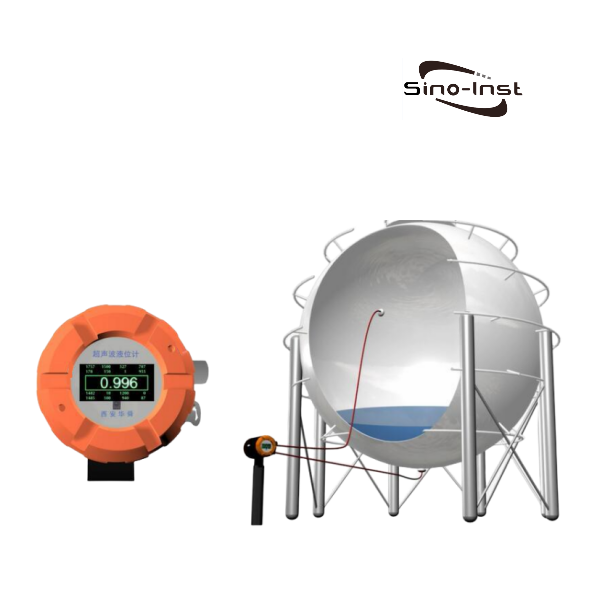
Mounted on the outside of the tank bottom, so no drilling and no shutdown. Works through 2–70 mm walls, with ranges up to 30 m.
External ultrasonic level meters can continuously measure liquid levels from outside the tank, allowing for installation without drilling holes in the tank, without open flames, and without interrupting production. The instrument features an explosion-proof design and is widely used in explosive environments. It provides a robust safety barrier for liquid ammonia storage tank projects at chemical plants. This is the definitive advantage of the External Ultrasonic Level Meter.
Of course, the purchase cost of the External Ultrasonic Level Meter is slightly higher than that of other level sensors.
Top 3: Tuning Fork Level Switch
The two types of level sensors described above provide real-time, continuous measurement of liquid ammonia levels. If you also need to control the high and low levels in an anhydrous ammonia storage tank, you can add a tuning fork level switch.
For applications such as high- and low-level alarms, overfill prevention, and low-level pump protection in liquid ammonia storage tanks, the tuning fork level switch can serve as a standalone point-level detection sensor. The tuning fork detects the presence of liquid at the measurement location by monitoring changes in its vibration state and can output an independent digital signal.
| Temperature | Medium temperature | -20℃~+220℃ |
| Ambient temperature | -40℃~+70℃ | |
| Storage temperature | -40℃~+85℃ | |
| Ambient humidity | ≤95%RH | |
| Measured media | Liquid, powder or granular solid | |
| Medium density | Solid ≥ 0.1g/cm³ | |
| Liquid ≥ 0.6g/cm³ | ||
| Solid particles | < 10 mm | |
| Liquid viscosity | <1000mm2/s | |
| Angle of repose | ≥200 | |
| Pressure Range | -0.1~+4.0MPa | |
| Material | Shell Material | Die cast aluminum alloy |
| Fork material | S304, S316 | |
| Connection method | Thread | G1/2”, G3/4”, G1”, Customized |
| Flange | Customer defined | |
| Sanitary chuck | 50.5mm, Customized | |
| Supply Voltage | DC24V AC220V 50Hz | |
| Output | Relay output | Load AC250V/4A DC60V/4A |
| Open collector (NPN) output | Load 400mA | |
| Open collector (NPN) output | Load 400mA | |
| Power consumption | AC power supply | 3W Max |
| DC power supply | 5W Max | |
| Electrical interface | M20*1.5 | |
| Protection level | IP65 | |
| Explosion-proof level | ExdIIBT1~6 ExdIICT1~6 | |
| Action time | 3S | |
| Vibration | Tuning fork vibration frequency | 300±50Hz |
| Environmental vibration level | V.L.4 Acceleration no greater than 1 g | |
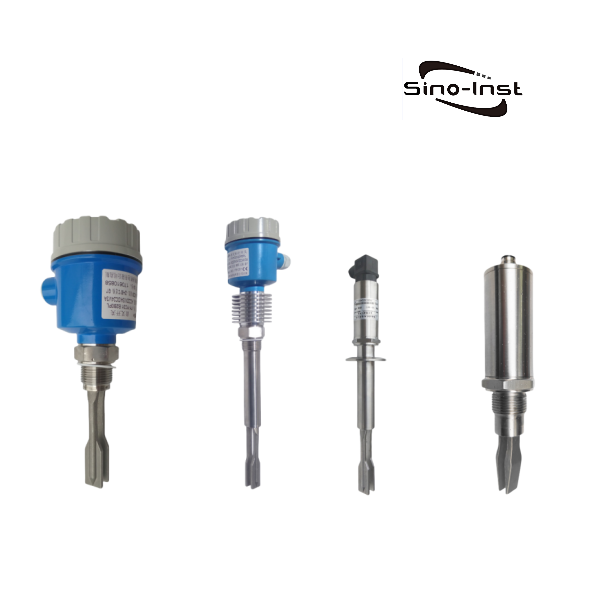
Independent high/low level alarm and overfill protection. Rated -0.1 to 4 MPa, with relay or NPN output and Ex d housing.
Therefore, by considering the tank’s temperature, pressure, internal structure, and the requirements for continuous measurement and liquid level alarms, we can select the most suitable anhydrous ammonia tank level measurement solution.
How to Choose
We have compiled a simple summary for your reference:
| Types | Fully refrigerated (-33.4 °C / -28.1 °F, near atmospheric pressure) | Semi-refrigerated (approx. 4 °C / 39 °F, 0.4–0.5 MPa / 58–73 psig) | Full pressure (ambient temperature, 1.2–1.6 MPa / 174–232 psig) | Opening Requirements | Procurement cost |
| Guided-wave radar level transmitter | Applicable; not suitable when tank height exceeds cable length (approx. 30 m) | Suitable; preferred option | Usable, preferred; requires an airtight seal—Viton seals are not suitable | One connection point on the tank top | Moderate, depending on pressure and range |
| Externally mounted ultrasonic level meter | Not applicable, due to obstruction by the thermal insulation layer | Applicable for spherical and horizontal tanks | Usable | No openings required | Relatively high |
| Tuning fork level switch | Applicable | Suitable | Usable | One connection point on the tank top or tank side | Low |
FAQ
For anhydrous ammonia storage tanks that require both continuous level monitoring and safety level control, a configuration combining a continuous level transmitter and a tuning-fork level switch can be used. The continuous level transmitter handles level display and trend monitoring, while the tuning-fork level switch provides critical high- and low-level protection, ensuring that process measurement and safety interlocks remain relatively independent.
In addition to the three types of sensors recommended in this article for anhydrous ammonia storage tank level measurement and control, other types of level sensors may also be selected based on specific parameters. Examples include dual-flange differential pressure level transmitters, 80G radar level transmitters, or magnetic flip-plate level gauges. Each has its own measurement advantages and operational limitations.
If you are still unsure which anhydrous ammonia level measurement solution to choose, please feel free to contact our sales engineers for consultation at any time.
Further Reading

Zhang Wei, possesses 20 years of experience as an automation instrumentation engineer, specializing in the research, design, installation, commissioning, and maintenance of automation instruments.
Face to various instrument communication protocols (such as Modbus, Profibus, etc.), with solid hardware circuit design and software programming skills (proficient in C language and PLC programming). Has extensive project experience; projects he has led and participated in have all achieved outstanding results, improving product accuracy, reducing costs, and increasing production efficiency.
Possesses excellent communication and coordination skills and a strong team spirit, enabling him to quickly respond to customer needs and provide high-quality automation instrumentation solutions.
Want to see more of our engineering guides in Google Search? Add Sino-Inst as a preferred source.