Vortex Flow Meter: 6 Troubleshooting Guides
Vortex flow meters are developed and manufactured based on the von Kármán vortex street principle and are primarily used to measure the flow rate of media within industrial pipelines. Their…

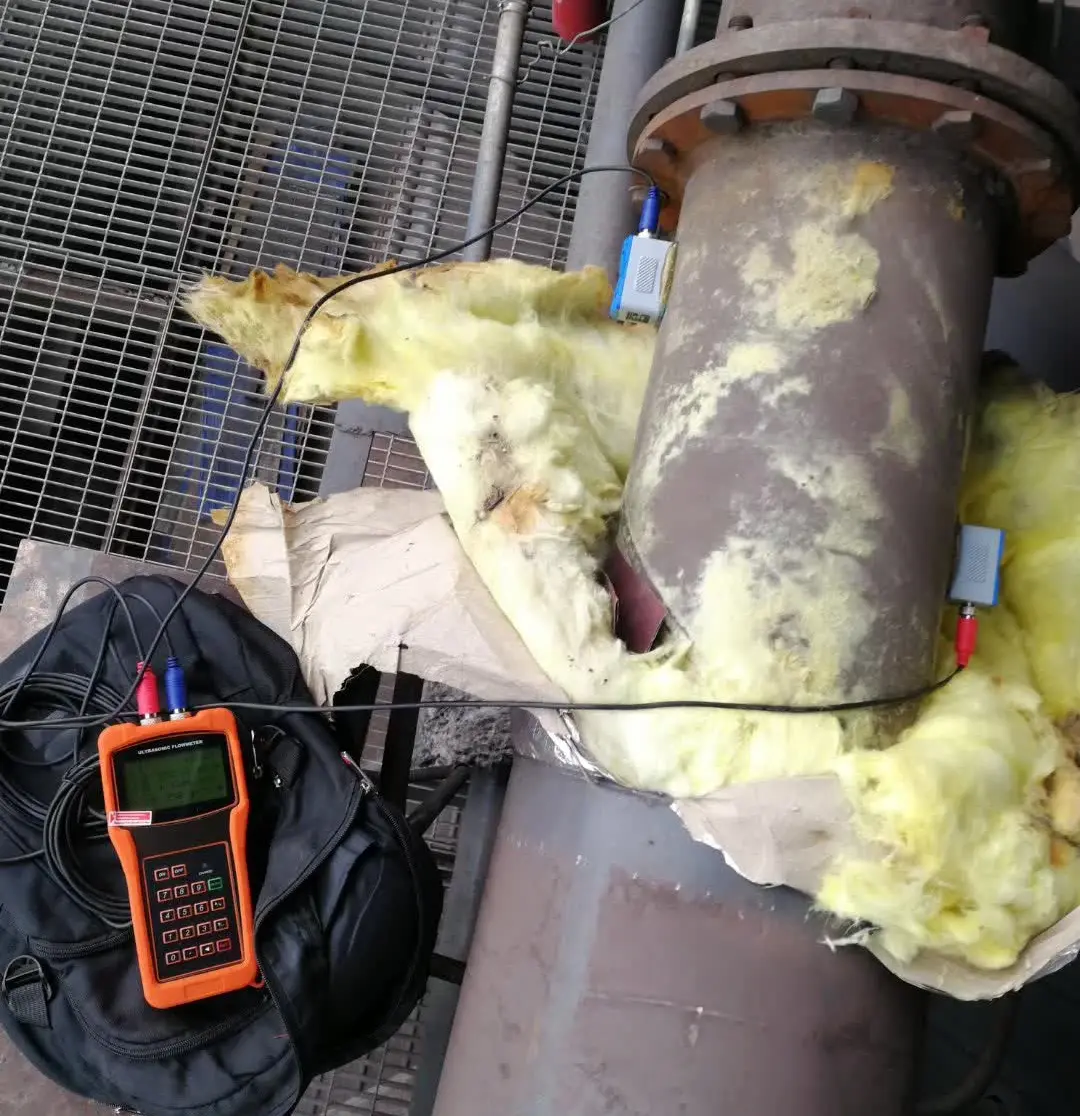
On-site flow measurement for large-diameter pipelines is often constrained by requirements such as water supply shutdowns or the need to cut into the pipe, making flexible operation difficult. For pipelines with a diameter of DN1600 or larger, handheld ultrasonic flow meters utilize a non-invasive, clamp-on measurement method; this allows flow to be measured directly from the outer pipe wall without damaging the pipeline.
Next, focusing on the challenges of flow measurement in large-diameter pipes, we will introduce the features, operating principles, and specifications of the handheld ultrasonic flow meter. We will also demonstrate practical procedures for using the device to detect leaks in drinking water pipelines.
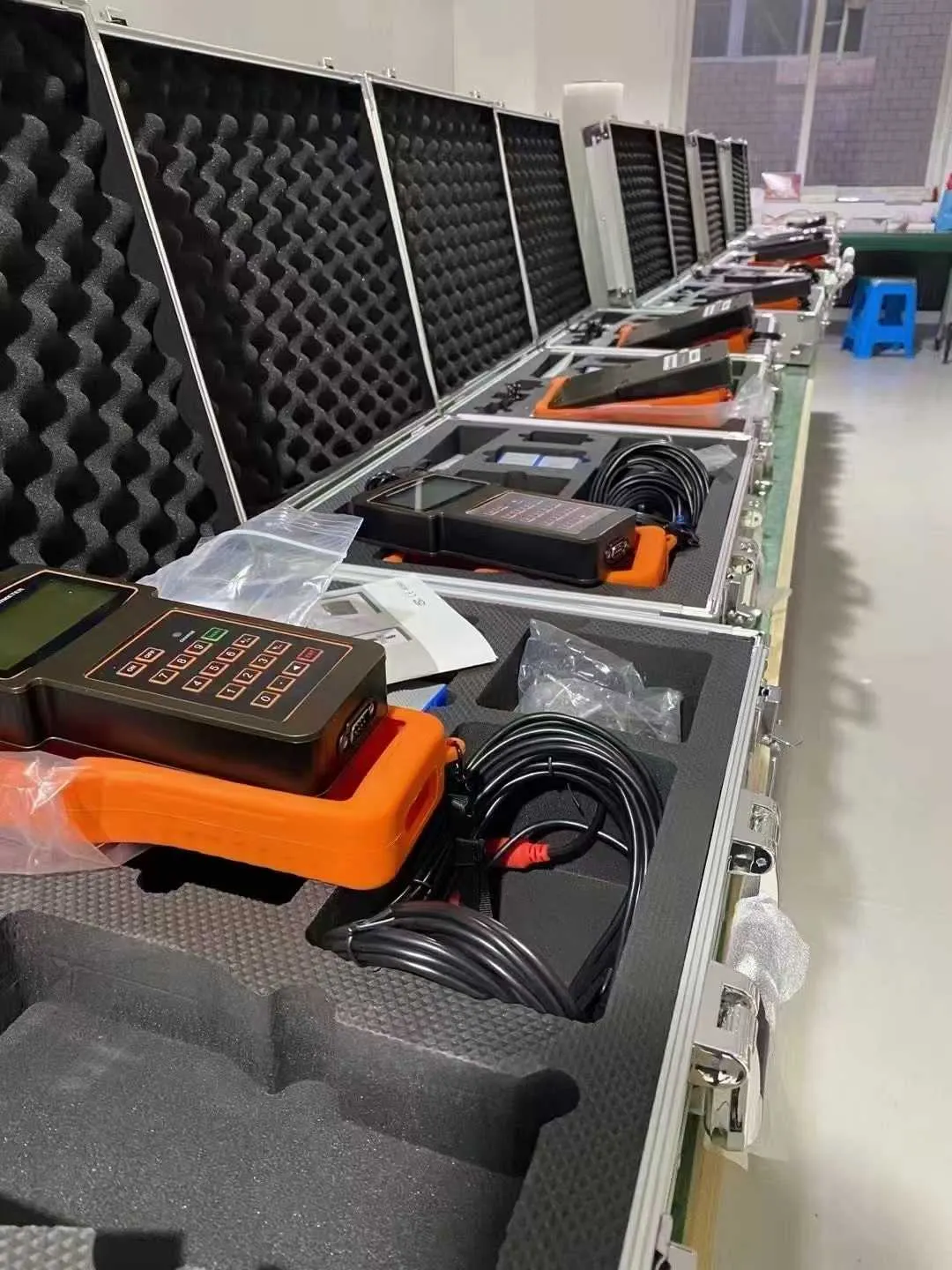
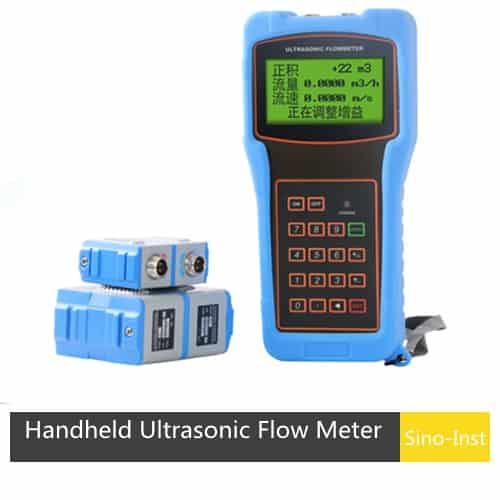
Handheld ultrasonic flow meters take non-contact liquid flow measurements, covering pipe sizes from 20 to 6000 mm (0.5–236 inches). Thanks to this non-contact design, the device is lightweight and easy to carry around. Its key features are listed below:
| Item | Performance and Specifications | |
| Host | Principle | Ultrasonic time difference principle, 4-byte IEEE754 floating-point arithmetic; |
| Accuracy | Flow rate: better than ±1%; | |
| Display | 4 x 16 dot-matrix backlit LCD display, supporting English and Italian; | |
| Signal Output | 1 OCT pulse output (pulse width 6-1000ms, default 200ms); | |
| Data Interface | Isolated RS232 serial port, allowing flow meter upgrades via PC. | |
| Pipeline Condition | Pipe Material | Suitable for all dense pipes, including steel, stainless steel, cast iron, copper, PVC, aluminum, and fiberglass. Lining is permitted. |
| Pipe Inner Diameter | 15-6000mm; | |
| Straight Pipe Section | The sensor installation distance should ideally meet the following requirements: 10D upstream, 5D downstream, and 30D from the pump outlet (D is the pipe diameter). | |
| Measurement Medium | Liquid Type | Suitable for single, uniform liquids that can conduct ultrasonic waves, such as water, seawater, industrial wastewater, acids and alkalis, alcohol, beer, and various oils. |
| Temperature | Temperature: -30-160°C; | |
| Turbidity | 10,000 ppm with minimal bubble content; | |
| Flow Velocity | 0-±10 m/s; | |
| Operating Environment | Temperature | Host: -20-60°C; Flow sensor: -30-160°C; |
| Humidity | Host: 85% RH; Sensor IP67 protection rating. | |
| Power Supply | Three built-in 1.2V 2000mAH rechargeable Ni-MH batteries provide over 12 hours of continuous operation on a full charge. An AC 90-260V power adapter allows for uninterrupted measurement. | |
| Power Consumption | 1.5W | |
| Casing Material | Flame-retardant ABS | |
| Host Weight | 390g | |
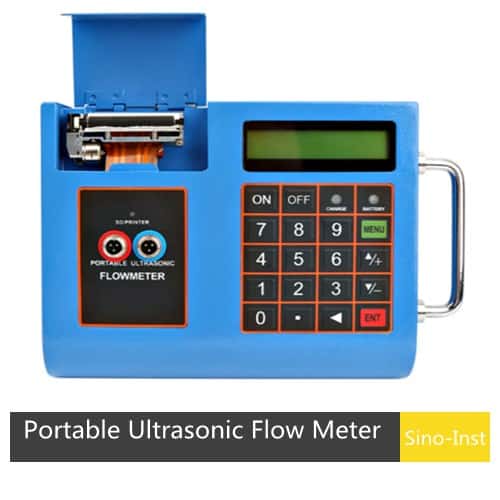
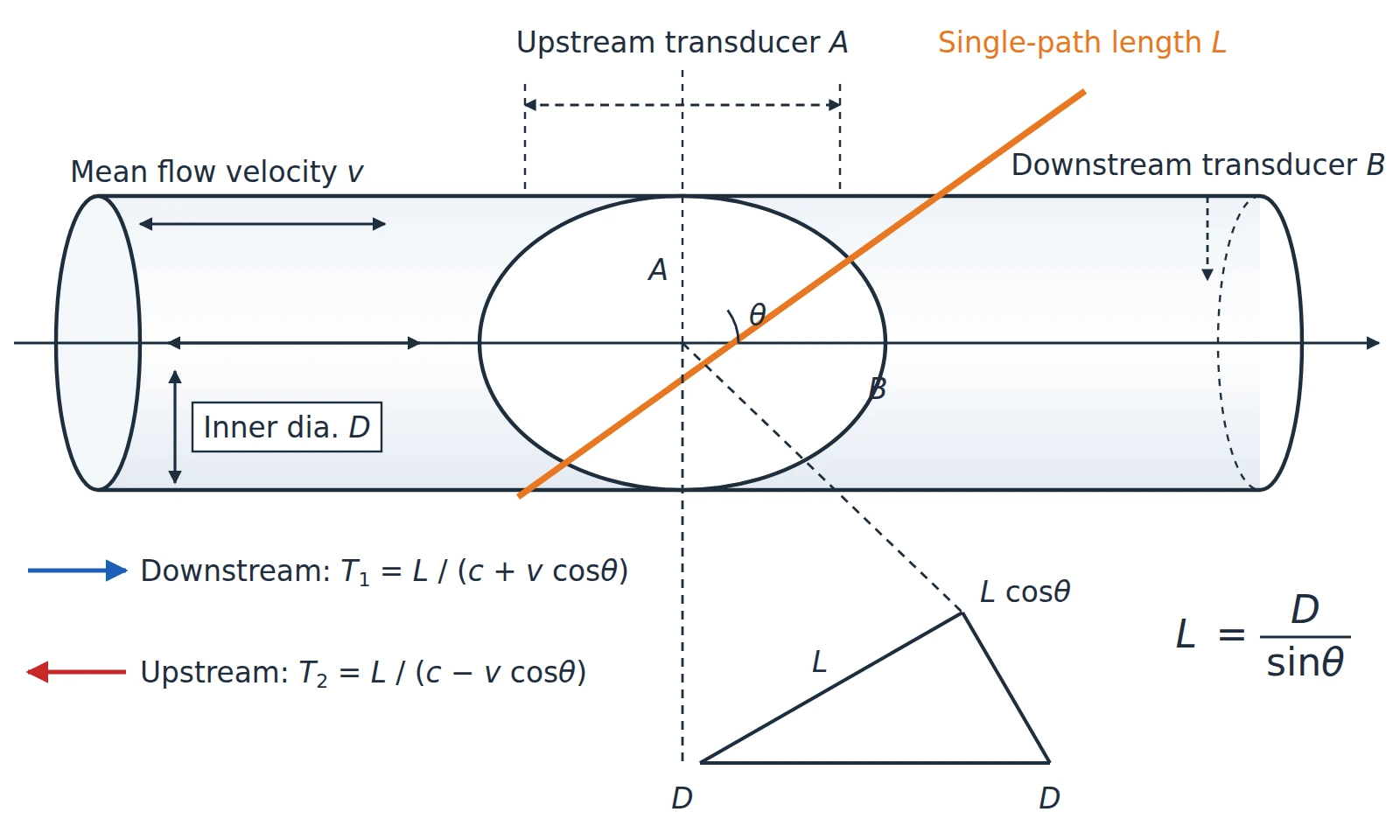
Portable ultrasonic flow meters operate based on two principles: the time-difference method and the Doppler effect.
Two ultrasonic transducers are mounted on opposite sides of the pipe, acting alternately as transmitters and receivers to send and receive ultrasonic signals.
If the fluid inside the pipe stays static, ultrasonic waves take the same amount of time travelling downstream and upstream. When the fluid flows, the wave travelling with the flow spends less time, while the wave against the flow takes longer. This creates a time difference Δt between the two paths.
The device measures this time difference. Combined with the known sound velocity C in stationary fluid and transducer separation distance L, it calculates the flow velocity V. Multiplying velocity by the pipe’s cross-sectional area gives the volumetric flow rate Q.
Core Formulas (Single/Dual Path)
Downstream time: T1 = L / (c + v cosθ)
Upstream time: T2 = L / (c − v cosθ)
Time difference: ΔT = T1 − T2 ≈ 2Lv cosθ / c² (when v ≪ c)
Flow velocity: v = (L / (2 cosθ)) × (ΔT / (T1T2))
v = (D / (2 sinθ cosθ)) × (ΔT / (T1T2)) = (D / (sin2θ)) × (ΔT / (T1T2))
Volumetric flow rate: Q = v × A = v × π(D/2)²
L: Acoustic path length (single path).
D: Inner diameter.
θ: Angle between the acoustic beam and the pipe axis.
c: Speed of sound.
v: Average flow velocity.
ΔT = T_up − T_down
When ultrasonic waves hit suspended particles or bubbles moving along with the fluid, the frequency of the reflected wave changes. This frequency shift is known as the Doppler effect.
Doppler frequency shift. Due to the motion of the scatterers, the frequency of the reflected wave shifts by Δf; the magnitude of this shift is directly proportional to the flow velocity, v.
The formula is: Δf = f₂ − f₀ ≈ 2 f₀ v cosθ / c
Flow velocity v = (Δf · c) / (2 f₀ cosθ)
Flow rate Q = A · v = (π D²/4) · v
Where:
f₀: Transmitted frequency (Hz)
f₂: Received frequency (Hz)
Δf: Frequency shift (Hz)
v: Fluid flow velocity (m/s)
c: Speed of sound in the fluid (m/s)
θ: Angle between the sound beam and the flow velocity vector (°/rad)
D: Pipe diameter (m)
A: Cross-sectional flow area (m²)
Q: Instantaneous flow rate (m³/s)
Pipeline Network Leak Detection
In urban water supply systems and older urban areas, water supply pipelines are prone to aging and leakage. Handheld ultrasonic flow meters assist water supply authorities in monitoring urban water usage.
Industrial circulating water systems
Used for routine flow checks on factory cooling water, chilled water and circulating water pipelines.
Wastewater treatment
Handheld Doppler-type ultrasonic flow meters can measure wastewater carrying suspended solids and impurities.
Petrochemical industry
Suitable for pipelines transporting process liquids, solvents and oil products, provided the medium is non-corrosive and free of excessive air bubbles.
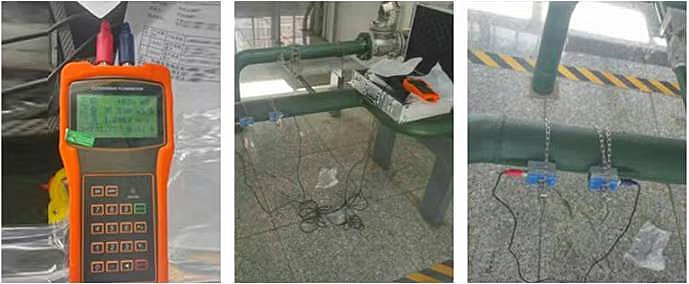
Handheld ultrasonic flow meters can rapidly pinpoint leak locations in drinking water pipelines through non-contact, portable, and multi-point measurements.
Preliminary Preparation
Clean the outer surface of the pipe, removing paint, rust, and debris.
Apply specialized ultrasonic couplant to eliminate air gaps.
Verify pipe material, outer diameter, wall thickness, liner type, and fluid type (potable water).
Selecting the Measurement Mode
Since drinking water is typically clear, the transit-time method is the preferred choice. If the pipe diameter is large or the signal is weak, select the appropriate handheld (or clamp-on) configuration.
Installation and Measurement
Place the transducer vertically against the pipe wall, as close to the pipe centerline as possible.
Enter the pipe parameters. Select the appropriate mode to measure flow velocity and flow rate.
Perform repeated measurements at multiple points。
Data Analysis and Leak Localization
Determine the location of the leakage.
Compare design flow rates with measured flow rates, or analyze flow rate differences between different points.
Pinpoint the leak location.
Incorporate supplementary information such as minimum night-time flow and pressure fluctuations.
A Spanish contractor specializing in drinking water network leak detection required a solution to measure flow rates in DN250–DN1600 pipelines without interrupting the water supply or cutting into the pipes. We recommended the handheld transit-time TUF-2000H flow meter equipped with clamp-on transducers, suitable for single, homogeneous liquids within a temperature range of -30°C to 90°C. As the pipe diameter range spanned two transducer size categories, the solution included two sets of sensors: medium and large. The device operates on a built-in battery and does not provide real-time signal output; instead, measurements rely on comparing readings taken at multiple points on-site.
For flow measurement requirements involving large-diameter pipelines (DN1600 and above), a handheld ultrasonic flow meter is the ideal choice. It offers advantages such as non-destructive clamp-on installation, no need to shut off the water supply or cut into the pipe, and excellent portability. Additionally, the device supports various installation configurations.
Sino-Inst is dedicated to providing customers with customized flow measurement solutions for large-diameter pipelines. Our handheld ultrasonic flow meters are widely used for measuring flow in a variety of liquid pipelines. Please feel free to contact us if you have any flow measurement needs!
Zhang Wei, possesses 20 years of experience as an automation instrumentation engineer, specializing in the research, design, installation, commissioning, and maintenance of automation instruments.
Face to various instrument communication protocols (such as Modbus, Profibus, etc.), with solid hardware circuit design and software programming skills (proficient in C language and PLC programming). Has extensive project experience; projects he has led and participated in have all achieved outstanding results, improving product accuracy, reducing costs, and increasing production efficiency.
Possesses excellent communication and coordination skills and a strong team spirit, enabling him to quickly respond to customer needs and provide high-quality automation instrumentation solutions.