Home > Blog > How Does Gas Composition Affect Thermal Mass Flow Meter Accuracy?
How Does Gas Composition Affect Thermal Mass Flow Meter Accuracy?
Thermal gas mass flow meters are the preferred instruments for measuring the flow of dry, stable gases—whether pure gases (such as oxygen, compressed air, nitrogen, chlorine, etc.) or gas mixtures (such as biogas).
Users often ask us a question during use: Will changing the type of gas being measured or changing the composition of the gas being measured affect the measurement of the thermal gas mass flow meter? The answer is yes.
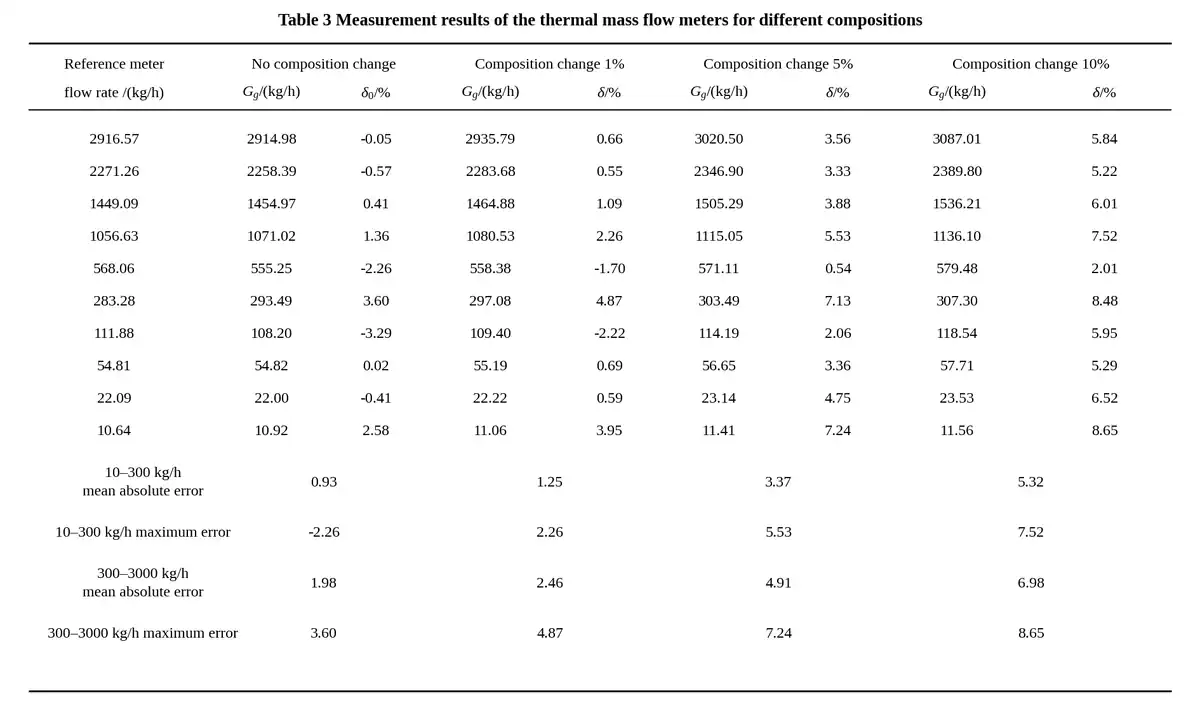
Taking air as the most common example, actual flow tests were performed on a standard calibration rig. Within a flow range of 300–3000 kg/h, variations of 1%, 5%, and 10% in the air composition setting resulted in measurement errors of 0.56%, 3.19%, and 4.94%, respectively. Let us now examine in detail how gas composition affects thermal mass flow meters.
Thermal gas mass flow meters measure gas mass flow based on the principle of heat transfer. The sensor typically consists of a temperature-sensing probe and a velocity-sensing probe; the latter is heated by an electrical circuit to a temperature higher than that of the gas.
As gas flows past the sensor, it carries away some of the heat from the velocity-sensing probe. Higher gas flow velocities result in greater heat dissipation, requiring more heating power to maintain the probe’s temperature. By monitoring the relationship between heating power and gas flow—and incorporating gas properties and calibration data—the instrument calculates the gas mass flow rate.
Consequently, thermal flow meters can measure gas mass flow directly, eliminating the need for separate mass flow conversions based on temperature and pressure, which are required for volumetric flow measurements.
What factors affect the measurement of thermal gas mass flow meters?
Measurement results from thermal flow meters are primarily influenced by the following factors:
Gas composition: Different gases possess distinct physical properties—such as thermal conductivity, specific heat capacity, and viscosity—that alter heat transfer characteristics; this is one of the most significant factors affecting thermal flow meters.
Gas temperature: Temperature fluctuations alter physical properties (thermal conductivity, viscosity, specific heat capacity) and the temperature difference between the sensor and the gas, thereby affecting heat exchange.
Gas pressure: Changes in pressure alter gas density and can affect flow dynamics and heat transfer characteristics; consequently, the sensor’s heat exchange behavior varies under different pressure conditions.
Flow velocity and flow regime: Flow velocity, the Reynolds number, and the flow regime within the pipe influence the heat transfer coefficient. Flow field disturbances caused by components such as elbows, valves, and pipe diameter reducers can also lead to measurement errors.
Sensor and installation conditions: Sensor design, insertion depth, pipe diameter, straight pipe run lengths, and installation method all impact heat transfer conditions and measurement stability.
In short: The core of thermal flow measurement lies in determining “how much heat the gas carries away.” Therefore, any factor that alters the gas’s heat transfer characteristics can potentially affect the measurement results.
Among these, gas composition is the most significant factor. Changes in the type of a single gas being measured, or variations in the composition of a gas mixture, can profoundly affect the performance of thermal gas mass flow meters.
Impact of Changes in a Single Gas Species on Thermal Gas Mass Flow Meter Measurement
Changing the type of a single gas is a straightforward scenario. For instance, suppose you originally ordered a thermal mass flow meter calibrated for nitrogen but now wish to measure argon instead. Simply switching the gas without making any adjustments is not feasible.
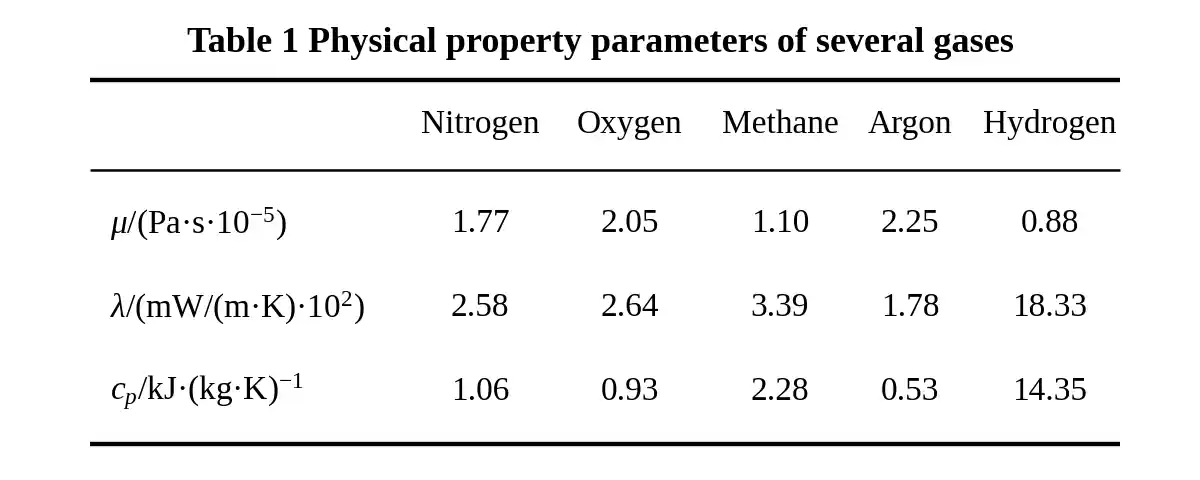
The measurement results of thermal gas mass flow meters depend on the physical properties of the gas being measured—specifically, dynamic viscosity (μ), thermal conductivity (λ), and specific heat capacity at constant pressure (Cp). These properties vary significantly across different gases, as shown in the table below.
Currently, neither our factory nor the vast majority of other manufacturers can calibrate mass flow meters using the exact gas the user intends to measure. Instead, calibration is typically performed by converting the user’s actual gas flow rate into an equivalent air flow rate.
During operation, the meter directly displays the mass flow or volumetric flow of the actual gas being measured. Therefore, when switching to a different gas, the conversion factor must be updated. You can contact us to verify the conversion factors for single-component gases.
Impact of Changes in Mixed Gas Composition on Thermal Gas Mass Flow Measurement
Variations in the composition of a gas mixture—or inaccuracies in the composition settings—introduce errors in the mixture’s dynamic viscosity (μ), thermal conductivity (λ), and specific heat capacity at constant pressure (Cp). These errors affect the physical property parameters, ultimately leading to inaccuracies in the measured mass flow rate.
Variations in the composition of a gas mixture, or inaccurate composition settings, can cause errors in the dynamic viscosity μ, thermal conductivity λ, and specific heat capacity Cp at isobaric pressure, thus affecting physical properties and ultimately leading to errors in mass flow rate.
The flow laboratory at Tianjin University in my country has conducted experiments to analyze the impact of composition variation on gas mass flow rate measurement, focusing on a typical gas mixture—air.
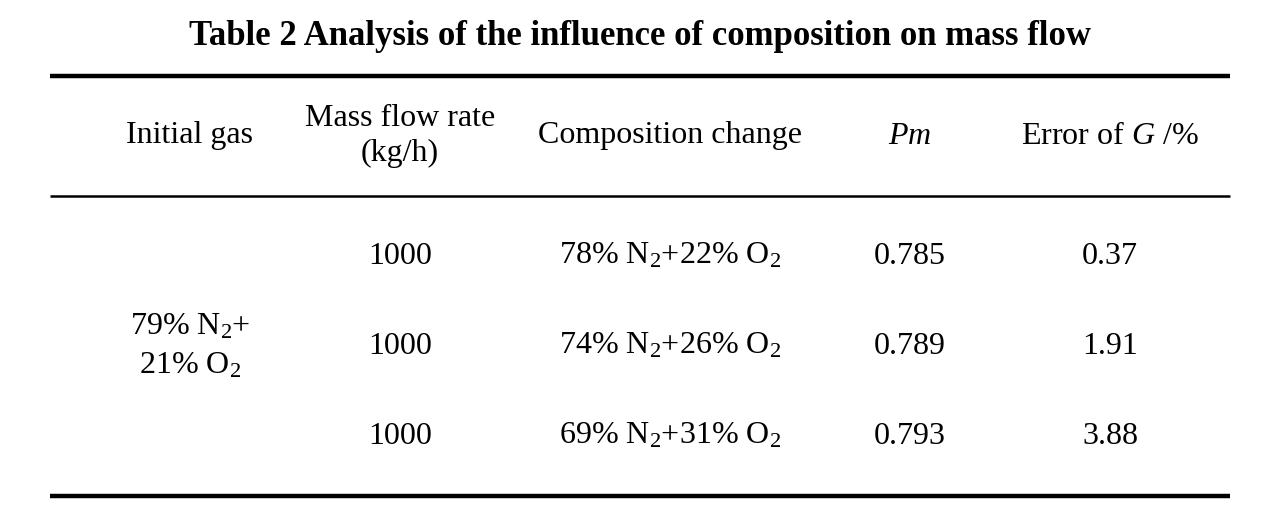
Air can be considered a gas mixture consisting of 79% N₂ and 21% O₂. The air composition is modified to 78% N₂ + 22% O₂, 74% N₂ + 26% O₂, and 69% N₂ + 31% O₂, i.e., composition changes of 1%, 5%, and 10% respectively, to analyze their effect on the mass flow rate.
The calculation conditions are 20 °C and atmospheric pressure, with a mass flow rate of the gas mixture G = 1000 kg/h. From this, the error in mass flow rate caused by different composition settings can be calculated.
Analysis and calculation show that changes in the composition of the gas mixture directly affect the gas’s physical property parameter Pm, thus affecting the mass flow rate and causing errors.
To further verify the method, air was selected as the test gas mixture, and measurements were conducted at ten flow rate points ranging from 10 to 3,000 kg/h.
Experimental validation of the aforementioned analytical calculations was carried out. Measurements were first performed using the initial composition settings, followed by measurements with modified composition settings—specifically adjustments of 1%, 5%, and 10%. The measurement results and associated errors for the various composition settings are presented in the table.
Therefore, changes in gas type, or inaccuracies or variations in gas composition settings, can significantly affect mass flow measurements. Experimental testing indicates that the critical threshold at which gas composition causes non-negligible measurement errors in thermal gas mass flow meters is 3% to 5%. In other words, when the variation in gas composition exceeds this threshold, the resulting error surpasses the inherent error of the thermal mass flow meter itself. This serves as a useful reference for practical engineering applications.
Of course, in practical applications, if you need to change the medium used with the thermal gas mass flow meter, you can contact our engineers to confirm the parameters that require modification and the necessary calibration procedures.
Biogas is a form of clean energy, primarily composed of methane (CH4) and carbon dioxide (CO2). In the fields of renewable energy, environmental protection, and energy management, biogas flow measurement…
Natural gas is a clean energy. The proportion in the energy structure is increasing year by year. The coverage of natural gas is also becoming more and more extensive. Therefore,…
Liquid and Gas ammonia (NH3) is an important industrial raw material. Ammonia flow meters are specially designed to measure the flow of industrial ammonia pipelines. Output pulse signal, 4-20mA, RS485,…
Gas turbine flow meter is a precision metering instrument used for gas flow measurement. Especially in natural gas transportation and trade settlement, the gas turbine flow meter is even more…
Ascertaining accurate and reliable measurement of gas flow rates is critical for a variety of industrial processes. The ability to measure gas mass flow accurately, rather than simply volumetric flow,…
Natural gas is a colorless and odorless hydrocarbon and an important energy source. In the production, transportation, storage, distribution, trade, and factory applications of natural gas, natural gas flow measurement…
Oxygen cleaning is a specialized cleaning procedure for special-purpose pressure transmitters, also known as oil-free. For example, oxygen pressure transmitters must undergo rigorous oxygen-grade cleaning to ensure the sensor is…
Accurate measurement of flare gas flow presents a significant challenge in industrial process control. This is primarily due to the extreme variability of flare gas flow rates, the unpredictability of…
Zhang Wei, possesses 20 years of experience as an automation instrumentation engineer, specializing in the research, design, installation, commissioning, and maintenance of automation instruments.
Face to various instrument communication protocols (such as Modbus, Profibus, etc.), with solid hardware circuit design and software programming skills (proficient in C language and PLC programming). Has extensive project experience; projects he has led and participated in have all achieved outstanding results, improving product accuracy, reducing costs, and increasing production efficiency.
Possesses excellent communication and coordination skills and a strong team spirit, enabling him to quickly respond to customer needs and provide high-quality automation instrumentation solutions.