Home > Blog > Vortex Flow Meter: 6 Troubleshooting Guides
Vortex Flow Meter: 6 Troubleshooting Guides
Vortex flow meters are developed and manufactured based on the von Kármán vortex street principle and are primarily used to measure the flow rate of media within industrial pipelines. Their stable operation depends on numerous factors, including product quality, model selection, installation, parameter configuration, and on-site interference. Drawing on years of experience in flow measurement, we analyze six common fault scenarios and examine application-related issues to help you utilize vortex flowmeters more effectively.
Fault 1: Stable readings and clear trends, but significant error
If you observe a significant error with the vortex flowmeter, it is recommended that you first check the DCS settings to verify if there are any configuration errors.
Square root extraction is the most common error. This operation applies only to differential pressure flowmeters; flow totalization for vortex flowmeters does not require square root extraction. Errors in temperature/pressure conversion formulas or density lookup formulas are also common; simply correcting these errors will resolve the issue.
Fault 2: The display returns to zero when the flow rate is slightly low
When the pipeline operates at high flow rates, the vortex flowmeter functions correctly; however, when the flow rate drops slightly, the reading falls to zero. This is primarily because the flowmeter’s lower measurement limit exceeds the pipeline’s low-flow operating range—meaning either the flowmeter’s bore size is too large or the device’s inherent lower limit is too high.
While increasing the flowmeter’s sensitivity could lower the measurement limit, doing so risks generating false readings when there is no actual flow, as high sensitivity can cause interference to be misinterpreted as a valid vortex signal.
Fault 3: Significant measurement errors or even sensor breakage occur at high flow
Measurement performance is satisfactory at low flow rates; however, at high flow rates, errors become substantial—reaching negative values of tens of percent. This phenomenon arises because the stability of the vortex flowmeter deteriorates as the flow velocity increases.
If this issue is not effectively mitigated, the system may fail to detect some of the generated vortices. For instance, if the pipeline flow exceeds the meter’s upper measurement limit, the displayed reading decreases as the actual flow rate rises. In extreme cases, the vortex-shedding element of the sensor may fracture, potentially leading to severe consequences if downstream equipment is high-value.
Therefore, the primary step is to eliminate the risk of the vortex-shedding element and sensor fracturing by switching to a larger-diameter model. Alternatively, replacing the unit with a flowmeter that has a higher upper measurement limit is a superior solution.
Fault 4: No flow, yet the vortex flowmeter displays a reading; after adjustment, zero point stabilizes, but when flow is present, there is no reading
When there is no flow in the pipeline, the vortex flowmeter outputs an interference signal; reducing sensitivity to filter out this interference allows the meter to return to zero. However, if the intensity of the interference signal exceeds that of the vortex signal at maximum flow, it means that filtering out the interference also eliminates the actual flow signal, rendering the flowmeter unusable.
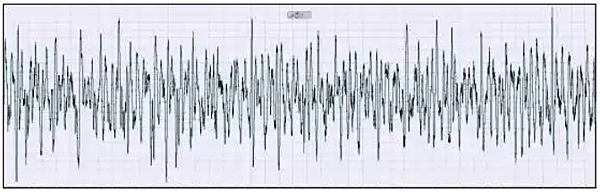
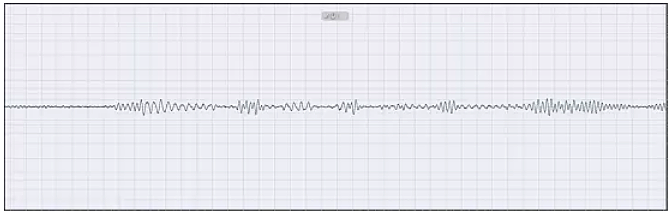
This is a serious issue indicating that the user’s initial selection parameters were inaccurate. For instance, we encountered this exact problem with a customer who had selected a vortex flowmeter. Figure 1 shows a waveform file recorded by engineers using specialized software; the readings are chaotic, and the vortex signal is completely undetectable. Figure 2 shows the results obtained by Sino-Inst using a high-performance computer with spectrum analysis and suppression software, which successfully identified the vortex signal. Calculations revealed a medium flow velocity of only 0.25–1 m/s. Under these conditions, a vortex flowmeter simply cannot operate effectively.
Figure 1: Vortex-shedding signal from a semi-water gas main (pipe diameter: 2200 mm) under vibration interference
Figure 2: Vortex-shedding signal extracted by the high-resolution interference signal spectrum identification and suppression system (flow velocity: 0.25 to 1 m/s)
Ultimately, the user had to switch to a different type of flowmeter. This serves as a case study of a failed vortex flowmeter application.
Fault 5: Abnormal fluctuation of readings and significant measurement error in the vortex flowmeter
The vortex flowmeter exhibits significant reading fluctuations and large measurement errors. For instance, even when no changes have been made to on-site valves, compressors, pumps, or other equipment—meaning the flow rate should remain stable—the indicated flow rate is incorrect. In such cases, one must consider factors that disrupt the conditions required for the formation of the Kármán vortex street, such as insufficient straight pipe sections, excessive installation misalignment, the presence of large foreign objects (snagged or adhering to the sensor), or the coexistence of gas and liquid phases. The flowmeter mistakenly identifies turbulent flow or chaotic eddies as valid vortex signals.
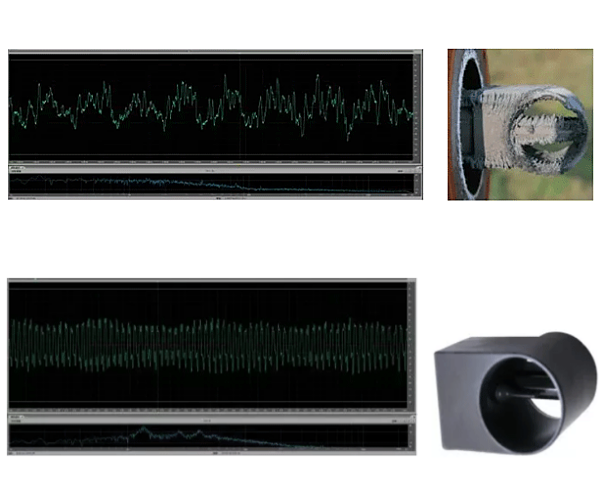
Impurities on the vortex flowmeter probe causing unstable measurement
The image above illustrates a typical measurement issue caused by fouling. In this blast furnace gas application, the meter suddenly began providing incorrect readings after a period of operation, and the vortex signal could no longer be detected. Troubleshooting led to the conclusion that the probe was clogged. After removal and cleaning of the sensor probe, the vortex flowmeter’s measurements returned to a stable state.
Fault 6: The flow changes, yet the vortex flowmeter reading remains essentially constant or fluctuates erratically, failing to reflect the actual flow trend.
If the flow rate changes but the vortex flowmeter reading remains static, there are only two possible causes: vibration interference or electromagnetic interference. Essentially, the interference signal suppresses the actual vortex signal; consequently, regardless of how the flow rate varies, the meter displays only the interference signal.
When the intensity of the vibration or electromagnetic interference signal exceeds that of the vortex signal at maximum flow, the flowmeter outputs the frequency of the interference signal rather than the vortex frequency. This is a serious fault; users are advised to relocate the meter.
Steam is the most widely used heat-transfer medium across various sectors, including industrial production, heating, and cooling. There is a significant demand for steam flow measurement, which plays a crucial…
The vortex flowmeter is a velocity-type flow instrument that operates based on the principle of fluid oscillation. Due to its simple structure, high accuracy, and wide range of applications, it…
To begin with: Vortex Flow Meters for Steam Applications The requirement for high-fidelity and trustworthy flow measurement has become pivotal across various industries, especially in applications involving steam. Steam is…
What are the advantages and disadvantages of vortex flowmeters? Understanding Vortex Flow Meter Advantages and Disadvantages can help us better choose the right flow meter. The vortex flowmeter is a…
Natural gas is a clean energy. The proportion in the energy structure is increasing year by year. The coverage of natural gas is also becoming more and more extensive. Therefore,…
Nitrogen Flow Controllers are devices specifically designed for measuring and controlling nitrogen flow. They not only measure the volumetric or mass flow rate of nitrogen, but crucially, they also control…
There are more than a dozen categories and hundreds of models of flow meters on the market, all claiming to have unique measurement advantages. So how do you choose the…
Analog gas flow meters specifically refer to a type of flow meter that outputs analog signals. The main function of a flow meter is to measure volumetric flow rate or…
Experience shows that over 80% of operational issues stem from the vortex flowmeter’s lower measurement limit exceeding the actual flow rate to be measured. Therefore, to prevent malfunctions, it is crucial to select the correct model based on the specific process requirements at the initial procurement stage. As vortex flowmeters are velocity-based instruments, performance verification and assessment of the measurement range must be conducted using the actual operating flow velocity.
Based on Sino-Inst’s engineering experience, when selecting the meter size, a “safety margin” should be incorporated into the minimum and maximum flow rate (or range) specifications provided by the process requirements, depending on the specific circumstances.
This involves verifying both the lower and upper flow limits: the lower measurement limit of the vortex flowmeter should be set at one-third to one-tenth of the process’s minimum flow rate, depending on the reliability of the process data; the upper measurement limit should be at least three times the process’s maximum flow rate.
Additionally, comprehensive factors such as straight pipe run requirements, vibration interference, and electromagnetic interference must be taken into account. Addressing these aspects ensures that potential malfunctions are avoided at the source.
Zhang Wei, possesses 20 years of experience as an automation instrumentation engineer, specializing in the research, design, installation, commissioning, and maintenance of automation instruments.
Face to various instrument communication protocols (such as Modbus, Profibus, etc.), with solid hardware circuit design and software programming skills (proficient in C language and PLC programming). Has extensive project experience; projects he has led and participated in have all achieved outstanding results, improving product accuracy, reducing costs, and increasing production efficiency.
Possesses excellent communication and coordination skills and a strong team spirit, enabling him to quickly respond to customer needs and provide high-quality automation instrumentation solutions.