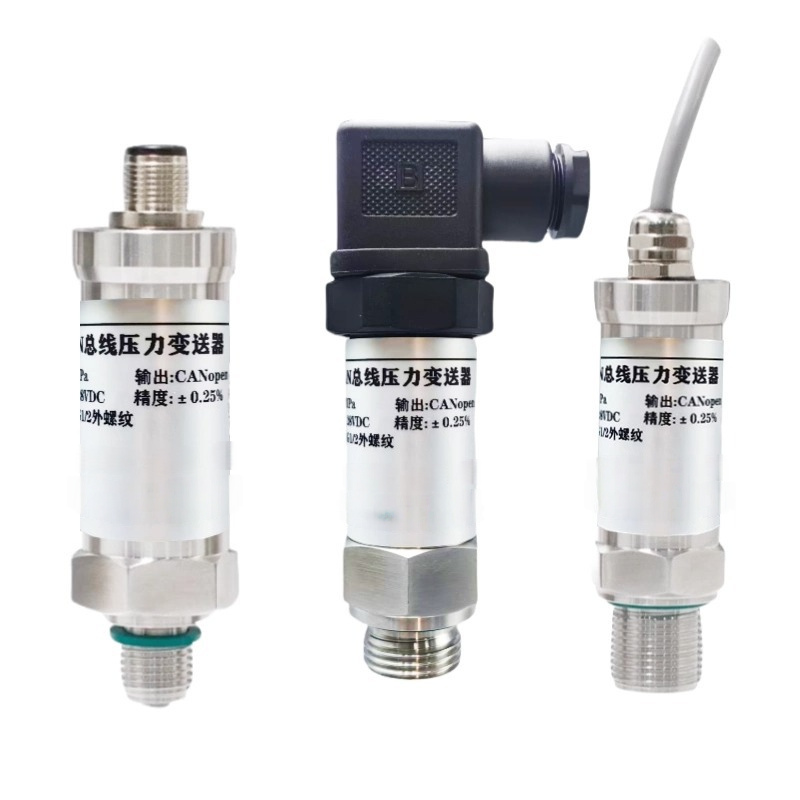
The JPT201 CAN-bus output piezoresistive pressure transmitter features adjustable zero-point and full-scale output. It utilizes a highly stable and reliable pressure sensor combined with high-performance, application-specific transmitter circuitry, ensuring overall stability and reliability. It is widely used for fluid pressure monitoring and control in industries such as petroleum, chemicals, electric power, vehicle testing, and defense.
CANopen or custom CAN 2.0B protocol output on a standard CAN frame.
Field-adjustable zero and full-scale output.
Measures gauge, absolute, and sealed-gauge pressure.
Short-circuit, reverse-polarity, and over-pressure protection built in.
Ranges from −100 kPa vacuum up to 100 MPa (1000 bar).
Accuracy to ±0.1% FS; long-term stability ±0.3% FS per year.
316L stainless diaphragm; tantalum / Hastelloy C wetted parts available for aggressive media.
IP65 / IP67 / IP68 ingress protection.
Optional flameproof construction: Exd IIC T6 Gb.
Technical Specifications
Parameter
Specification
Measuring range
−0.1…0~0.01…260 MPa (−1…0~0.1…2600 bar)
Pressure type
Gauge / absolute / sealed gauge
Over-pressure
1.5 × full scale, or 260 MPa, whichever is lower
Accuracy
±0.5% FS, ±0.25% FS, ±0.1% FS (typical 0.25%)
Long-term stability
±0.3% FS/year (max)
Zero temperature error
0.1% FS/°C (≤100 kPa); 0.05% FS/°C (>100 kPa)
Span temperature error
0.1% FS/°C (≤100 kPa); 0.05% FS/°C (>100 kPa)
Compensated temperature
0~50°C (extendable)
Operating temperature
−30~80°C
Storage temperature
−40~120°C
Power supply
12 VDC
Output signal
CAN 2.0B — CANopen or custom CAN protocol
Load resistance
≤ (U−12)/0.02 Ω, ≥15 kΩ (4-wire)
Ingress protection
IP65 / IP67 / IP68 (optional)
Electrical connection
DIN 43650 connector (IP65) or direct cable outlet (IP67)
Protection
Short-circuit, reverse-polarity, over-pressure
Explosion protection
Exd IIC T6 Gb (optional)
Materials of Construction:
Part
Material
Housing
Stainless steel 304
Pressure port
Stainless steel 304
Diaphragm
316L ultra-low-carbon stainless steel
Seal gasket
Fluororubber (FKM)
Connector housing
Plastic
For aggressive or corrosive media, tantalum diaphragm with Hastelloy C pressure port is available (material code 35). Always confirm that the wetted parts are compatible with the process media before ordering.
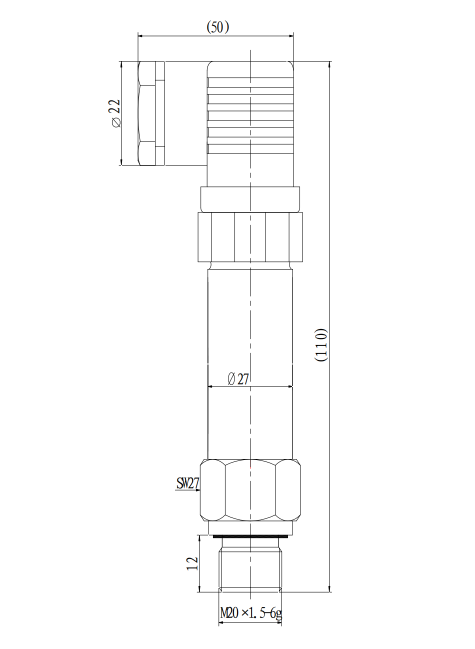
Dimensions of CAN Bus Pressure Sensor/Transducer
Order Guide
Position
Code
Selection
1. Series
JPT201
CAN bus pressure transducer
2. Range
[0~X] MPa
Any range from −0.1 to 260 MPa (−1 to 2600 bar)
3. Output
CZ
Custom CAN protocol
CO
CANopen protocol
4. Material (diaphragm / port / housing)
22
316L SS / SS / SS
24
316L SS / 316L SS / 316L SS
35
Tantalum / Hastelloy C / SS
5. Connection & options
B1
Hirschmann connector
B2
Direct cable outlet
B3
4-pin aviation connector
C1
M20×1.5 external thread
C3
G1/2 external thread
PC1
Flush diaphragm, M20×1.5 external thread
PC3
Flush diaphragm, G1/2 external thread
C*
Custom pressure connection
d
Flameproof Exd CT6 (hazardous area)
6. Pressure type
G
Gauge
S
Sealed gauge
A
Absolute
Example:JPT201 – [0~1MPa] – CO – 22 – B1C1 – G — CANopen output, 316L diaphragm with SS port and housing, Hirschmann connector, M20×1.5 thread, gauge pressure.
What is CAN Bus Output?
CAN (Controller Area Network) is a serial communication protocol bus developed by Bosch, a German company. It uses twisted-pair cable to transmit signals and is one of the most widely used fieldbuses in the world.
A single twisted pair carries the pressure value plus diagnostics, and several transducers share that one bus instead of each needing its own analog pair back to the controller. This cuts wiring on mobile machinery, test rigs, and distributed systems, and the digital value carries no signal loss over cable length—the way an analog output does.
The transducer reports pressure as a 4-byte IEEE floating-point number, high byte first (big-endian), in kPa. You can poll it on demand or set it to stream at fixed intervals, and you can run a zero-point calibration command over the bus without taking the unit off the machine.
Communication Protocol (Custom CAN 2.0B)
CAN 2.0B defines only the physical and data-link layers, so the application layer below is defined on top of the standard frame format.
Parameter
Value
Bit rate
125 kbit/s
Frame type
Standard data frame
Host → transducer ID
0x001 (configurable)
Transducer → host ID
0x101 (configurable)
Data format
4-byte IEEE float, big-endian (high byte first), unit kPa
Command set:
Function
Send
Return
Zero calibration
31 05 00 00 00 00 00 00
31 06 00 00 00 00 00 00
Start continuous transmission
31 01 xx 00 00 00 00 00
31 02 00 00 00 00 00 00, then 31 03 00 00 F1 F2 F3 F4
Stop continuous transmission
31 00 00 00 00 00 00 00
31 10 00 00 00 00 00 00
Pressure query (single read)
31 07 00 00 00 00 00 00
31 08 00 00 F1 F2 F3 F4
F1 F2 F3 F4 is the pressure value as a big-endian float in kPa. For continuous mode, xx sets the update interval:
xx
Interval
01
50 ms
02
100 ms
03
200 ms
04
300 ms
05
500 ms
06
1000 ms
A CANopen-protocol version is also available — specify output code CO when ordering.
FAQ
Both are available. Order code CO for CANopen, or CZ for our custom CAN 2.0B application protocol. The custom protocol command set is documented above.
125 kbit/s on the standard CAN frame. The transmit and receive frame IDs default to 0x101 and 0x001 and can be reassigned.
A 4-byte IEEE floating-point value in kPa, big-endian (high byte first).
Yes. Send the zero-calibration command over the bus (31 05 …); the transducer runs the calibration and acknowledges. Zero and span are adjustable.
Yes — a flameproof model rated Exd IIC T6 Gb. Add option code d.
Sino-Inst manufactures and supplies a comprehensive range of pressure sensors widely used for pressure monitoring in oil, gas, and chemical processes. Our sensors support customization of various output signals, such as 4-20mA, 0-10V, 0-5V, RS485, HART, and CAN. Please feel free to contact our sales engineers; we will provide a tailored pressure measurement solution based on your specific operating conditions.
China is the largest OEM and mass production base for industrial pressure sensors. Custom production is available for everything from standard 4-20 mA pressure transmitters to extreme operating conditions such…
In specialized applications such as power generation, high-temperature reactors, and metallurgical smelting, process pressure measurement often faces extreme conditions of “high temperature” + “differential pressure,” with the temperature of the…
An inline pressure transducer is a compact pressure transmitter that screws directly onto the pipeline via a single threaded interface. The sensitive diaphragm is in close contact with the medium,…
Pressure transmitter for level measurement is a relatively inexpensive and stable solution. Proper selection and configuration of pressure transmitters can effectively save on measurement costs. On CAN-based machinery, a CAN…
What is Absolute Pressure Transmitter? Absolute pressure transmitters are sensors that measure pressure using absolute vacuum (0 bar) as a reference. They convert the sensed physical pressure value into a…
Strain gauge pressure transmitters have good shock resistance and can withstand 100G vibration, making them more suitable for measuring large pressure ranges. They are used in pressure measurement and control…
Pressure transmitters are often installed in conjunction with manifolds, primarily for isolation, calibration, and venting. Manifolds control the input of the medium, ensuring measurement accuracy and safety. Manifolds are typically…
Water pressure measurement includes pressure detection of water pipes, water containers or equipment. Water pressure measurements can be used to determine whether a pipe, container or equipment is leaking and…
Zhang Wei, possesses 20 years of experience as an automation instrumentation engineer, specializing in the research, design, installation, commissioning, and maintenance of automation instruments.
Face to various instrument communication protocols (such as Modbus, Profibus, etc.), with solid hardware circuit design and software programming skills (proficient in C language and PLC programming). Has extensive project experience; projects he has led and participated in have all achieved outstanding results, improving product accuracy, reducing costs, and increasing production efficiency.
Possesses excellent communication and coordination skills and a strong team spirit, enabling him to quickly respond to customer needs and provide high-quality automation instrumentation solutions.