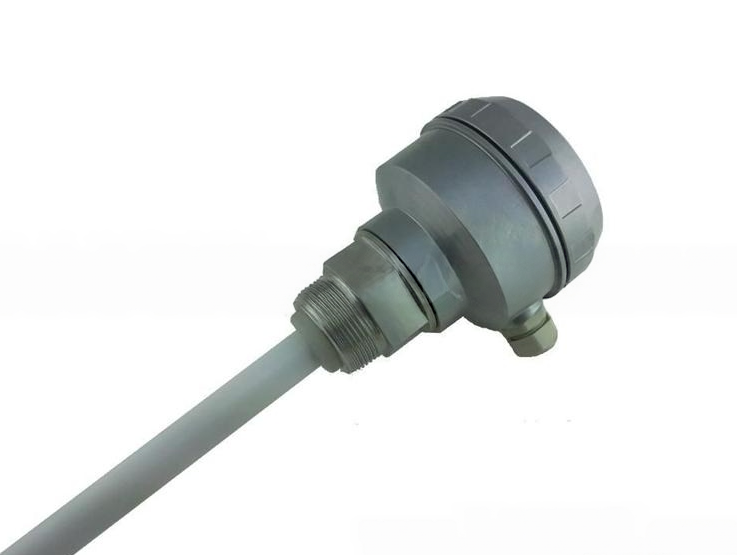
Fermentation industries—such as those involved in antibiotic production—generate significant amounts of foam. Excessive foam can overflow, leading to product loss and microbial contamination. To address this, foam levels must be continuously monitored, and appropriate amounts of antifoam agent automatically dispensed when necessary to maintain control. Our Foam Level Sensors are designed specifically for this purpose: detecting and controlling foam levels within fermentation tanks.
We offer two models of foam level sensors: PK and PM.
The PK Foam Level Sensor is an instrument specifically designed for industries such as fermentation. It utilizes a proprietary, custom-designed chip. It not only detects excessive foam generation during production but also automatically dispenses the precise amount of defoamer required. If foam is not effectively eliminated for any reason, the sensor triggers a high-level alarm upon reaching a preset height. This effectively prevents overflow, ensures safe production, and significantly reduces the workload for on-site operators.
The PM Foam Level Sensor is a fully automatic, RF-capacitance-based foam height controller that requires no calibration or manual setup. It features automatic foam recognition and automatic configuration of operating parameters, enabling “one-touch” commissioning. To meet diverse on-site requirements, the controller is available in two versions: an alarm-only model and an alarm-plus-control model.
CTS-PM-B — alarm type (alarm output only) CTS-PM-K — alarm & control type (alarm output + defoamer dosing control)
Operating principle
Automatic foam recognition and self-setting of operating parameters by a dedicated chip; no calibration and no commissioning adjustment required
Applications
Foam level alarm and automatic defoamer dosing in fermentation processes — pharmaceutical, food, biochemical and antibiotic production
Power supply
Supply voltage
220 V AC ±10 %, 50 Hz — or 24 V DC
Power consumption
< 5 W
Detection & timing
Alarm trigger point
Foam submerges more than 200 mm (20 cm) of the probe
Action delay
< 3 s
Response time (interval between doses)
2 / 4 / 8 / 16 / 32 / 64 / 128 s, DIP-switch selectable — factory setting 4 s Not fitted on the CTS-PM-B alarm type
Dosing time
1 / 2 / 4 / 8 / 16 / 32 / 64 s, DIP-switch selectable — factory setting 4 s Not fitted on the CTS-PM-B alarm type
Outputs
Alarm output
1 × normally open (SPST-NO) relay contact
Control output
1 × normally open (SPST-NO) relay contact — drives the defoamer solenoid valve Not fitted on the CTS-PM-B alarm type
Contact rating
250 V AC / 0.3 A; 28 V DC / 0.5 A (resistive load)
Terminals
1–2 power supply · 3–4 alarm relay · 5–6 control relay Terminals 5–6 are omitted on the CTS-PM-B alarm type
Process & ambient conditions
Ambient temperature (electronics)
−40 … +45 °C
Process temperature (probe)
Standard type P: −20 … +60 °C Medium-temperature type E: −40 … +200 °C
Process pressure
Pressure type Y: ≤ 3 MPa · all other versions: atmospheric
Mechanical
Process connection
R1½ male pipe thread
Probe length
300 … 2500 mm (specify when ordering)
Commissioning
Calibration
None — calibration-free
Start-up procedure
Mandatory 40 min warm-up, then one short press (< 0.5 s) of the commissioning key with the vessel empty, or with the foam at least 500 mm away from the probe
Change of vessel
Repeat the one-key start-up procedure
Ordering code
Structure
CTS-PM – F – E – M – V – L
F — Function
B = alarm type · K = alarm & control type
E — Detection environment (more than one letter may be combined)
P = standard (−20 … +60 °C) · E = medium temperature (−40 … +200 °C) · Y = pressure (≤ 3 MPa)
M — Mounting
A = R1½ thread · B = to customer specification
V — Supply voltage
A = 220 V AC · D = 24 V DC
L — Probe length
300 … 2500 mm
Example
CTS-PM-K-YE-A-D-2000 Alarm & control type, medium-temperature + pressure probe, R1½ mounting, 24 V DC supply, 2000 mm probe
Note 1 — The probe length must be chosen so that the foam is able to submerge at least 200 mm of the probe; this is the condition for reliable operation.
Note 2 — Do not switch heavy, and in particular inductive or capacitive, loads directly with the internal relay contacts. Use an interposing relay and fit a surge-suppression element across the load.
Note 3 — The earth terminal on the housing must be reliably bonded to the plant earthing system.
General
Model
CTS-PK
Description
Intelligent RF (radio-frequency) capacitance foam level controller with pre-alarm, dosing control and independent high-high alarm
Operating principle
A dedicated chip senses excessive foam generation and doses the required amount of defoamer automatically. If the foam is not suppressed, an independent high-high alarm is issued at a preset height to prevent liquid carry-over
Applications
Foam level control in pharmaceutical, food, biochemical, wastewater-treatment and antibiotic production processes
Power supply
Supply voltage
220 V AC ±10 %, 50 Hz — or 24 V DC (user selectable)
Power consumption
< 5 W
Detection & timing
Pre-alarm / dosing point
Reached when approx. 10 % of the calibrated foam height submerges the probe
High-high alarm point
Jumper selectable at 60 %, 70 %, 80 % or 90 % of the total foam height — factory setting 80 %
1 × normally open (SPST-NO) relay contact — drives the defoamer solenoid valve
High-high alarm output
1 × normally open (SPST-NO) relay contact
Contact rating
250 V AC / 0.3 A; 28 V DC / 0.5 A (resistive load)
Terminals
1–2 power supply · 3–4 high-high alarm relay · 5–6 control relay · 7–8 pre-alarm relay
Process & ambient conditions
Ambient temperature (electronics)
−40 … +45 °C
Process temperature (probe)
Standard type P: −20 … +60 °C Medium-temperature type E: −40 … +200 °C
Process pressure
Pressure type Y: ≤ 3 MPa · all other versions: atmospheric
Mechanical
Process connection
R1½ male pipe thread
Probe length
500 … 2500 mm (specify when ordering)
Housing
Two-part cover: terminal cover and display cover with sight glass; cable gland and blanking plug
Commissioning
Calibration
Two-point calibration required — empty vessel and full vessel
Start-up procedure
40 min warm-up, clear the stored calibration, press the EMPTY key with no foam touching the probe, then let the foam rise to a high but safe level and press the FULL key
Operator controls
MO = clear key · ML = empty-vessel key · MH = full-vessel key · DL / DH = calibration indicators · DP = power · DK = control · BL = pre-alarm · BH = high-high alarm
Change of vessel
The complete two-point calibration must be repeated
Ordering code
Structure
CTS-PK – E – M – V – L
E — Detection environment (more than one letter may be combined)
P = standard (−20 … +60 °C) · E = medium temperature (−40 … +200 °C) · Y = pressure (≤ 3 MPa)
M — Mounting
A = R1½ thread · B = to customer specification
V — Supply voltage
A = 220 V AC · D = 24 V DC
L — Probe length
500 … 2500 mm
Examples
CTS-PK-P-A-A-1500 Ambient temperature and atmospheric pressure, R1½ mounting, 220 V AC supply, 1500 mm probe
CTS-PK-YE-A-D-2000 Process temperature ≤ 150 °C, process pressure 2 MPa, R1½ mounting, 24 V DC supply, 2000 mm probe
Note 1 — The probe length is selected to suit the vessel: it corresponds to the distance from just above the liquid surface in the foam-free condition up to the top of the tank.
Note 2 — Do not switch heavy, and in particular inductive or capacitive, loads directly with the internal relay contacts. Use an interposing relay and fit a surge-suppression element across the load.
Note 3 — The earth terminal on the housing must be reliably bonded to the plant earthing system.
Applications
These foam level sensors are ideally suited for foam height control, alarm triggering, and automatic defoamer dispensing in production processes across sectors such as pharmaceuticals, food processing, biochemistry, wastewater treatment, and antibiotic manufacturing.
Foam Control Process
For Model PM:
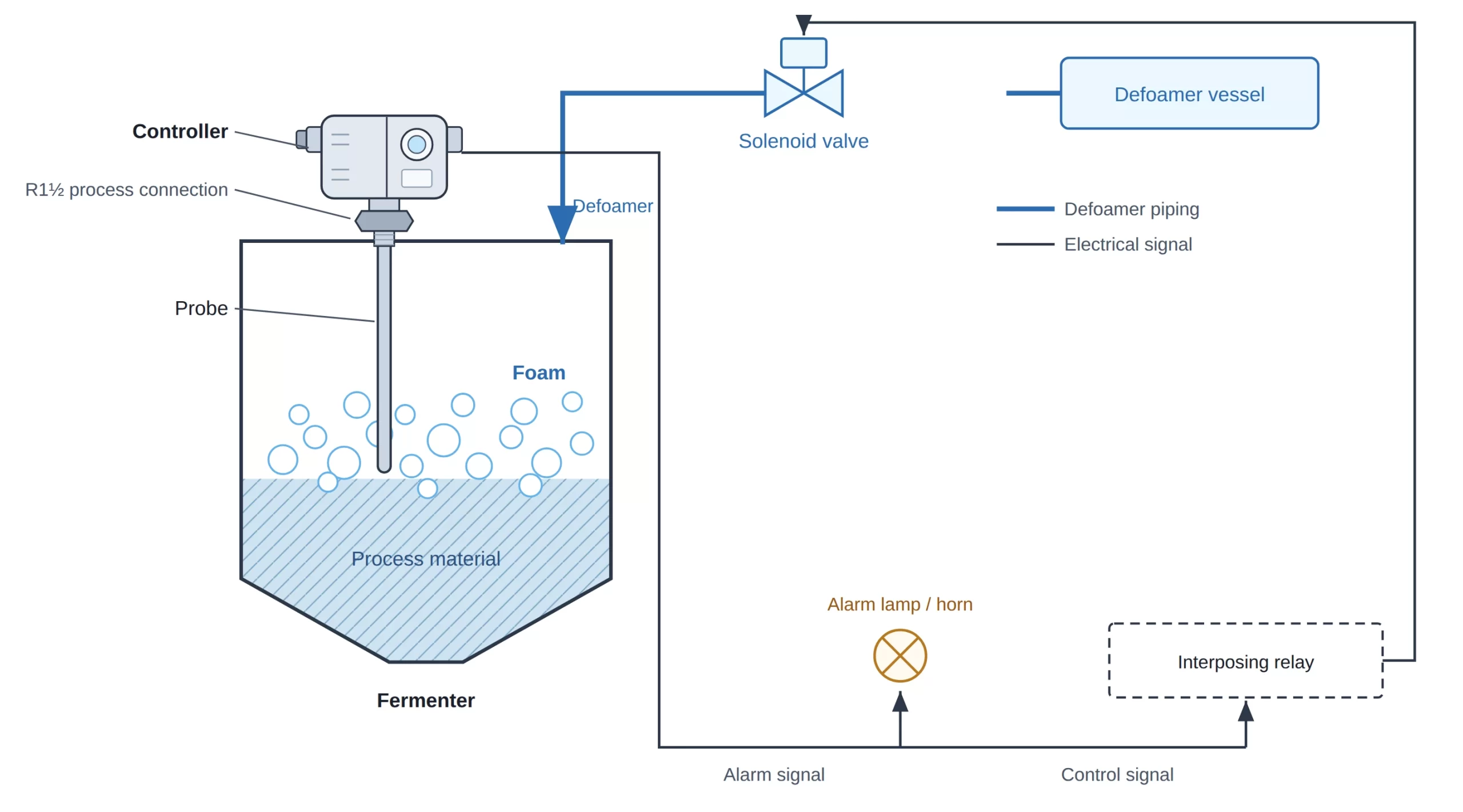
When the foam level rises to submerge part of the controller’s probe (>20 cm), the controller first issues an alarm switch signal. Once this alarm state persists for a set duration (known as the “response time,” which is user-selectable) and the foam’s continued presence is confirmed, the controller issues a control switch signal. This commands the solenoid valve to open and dispense the defoamer.
To conserve defoamer, the system stops dispensing after a set duration (known as the “dispensing time,” which is user-selectable) by closing the solenoid valve.
After allowing time for the defoamer to mix thoroughly with the foam, the system dispenses again if the foam level has not dropped, then stops once more. This cycle repeats until the foam level falls below the probe’s alarm trigger point.
Thus, defoamer dispensing occurs intermittently: dispensing for a period, pausing for the “response time,” and dispensing again if the foam level fails to drop.
Users can achieve optimal defoaming results by selecting appropriate “response time” and “dispensing time” settings.
For Model PK:
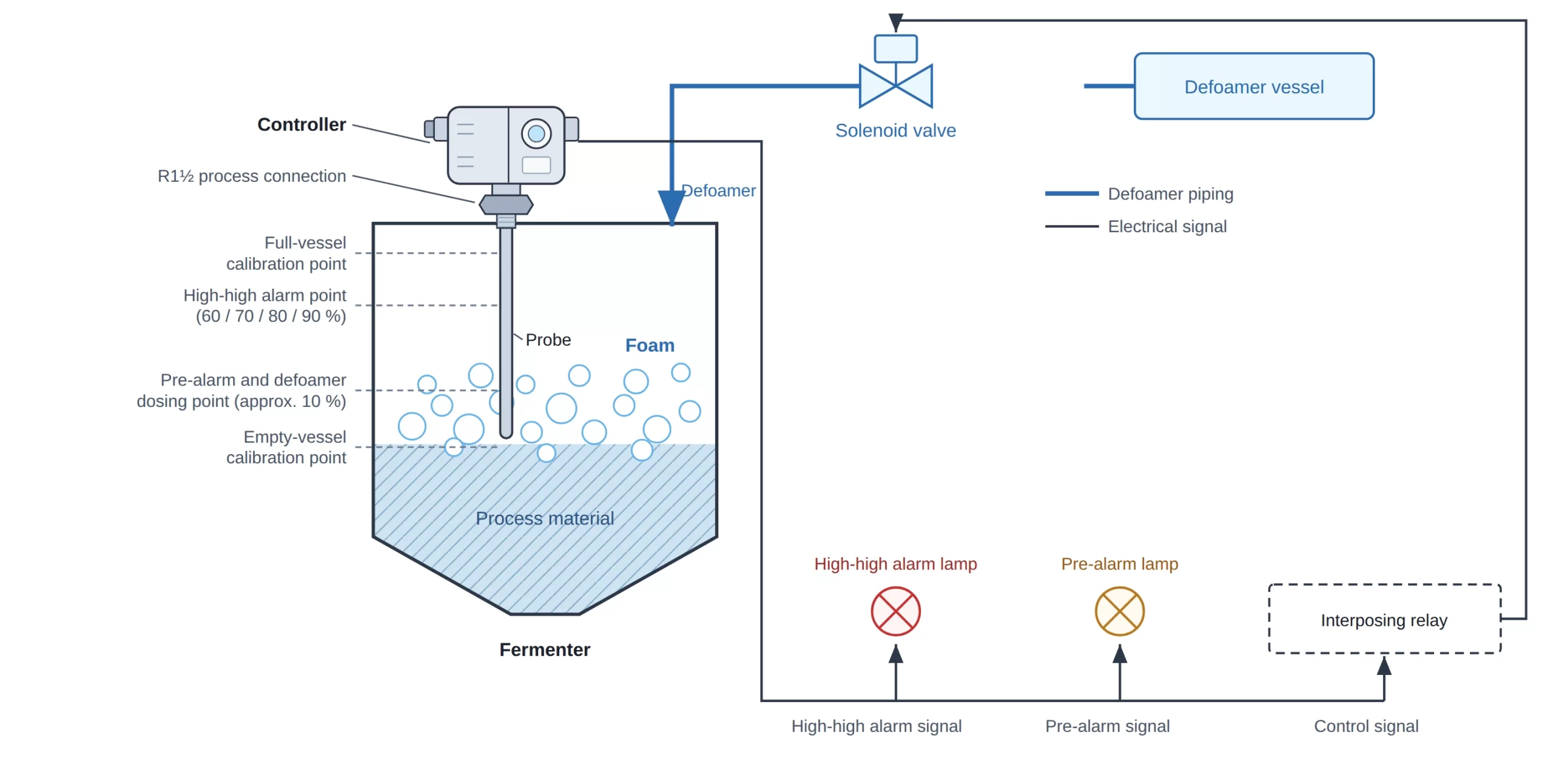
When the foam level rises to submerge part of the controller’s probe (approximately 10%), the controller first issues a pre-alarm switch signal, indicating rising foam and preparation to dispense defoamer. Once this pre-alarm state persists for a set duration (known as the “response time,” which is user-selectable) and the foam’s continued presence is confirmed, the controller issues a control switch signal. This commands the solenoid valve to open and dispense the defoamer.
To conserve defoamer, the system stops dispensing after a set duration (known as the “dispensing time,” which is user-selectable) by deactivating the control switch and closing the solenoid valve. After allowing time for the defoamer to mix thoroughly with the foam, the system dispenses again if the foam level has not dropped, then stops once more. This cycle repeats until the foam level falls below the probe’s pre-alarm trigger point.
Thus, defoamer dispensing occurs intermittently: dispensing for a period, pausing for the “response time,” and dispensing again if the foam level fails to drop.
Users can achieve optimal defoaming results by selecting appropriate “response time” and “dispensing time” settings. If, for any reason (such as a clogged defoamer line), the foam is not successfully suppressed and rises uncontrollably, the controller issues an “ultra-high level” alarm signal upon reaching a preset height, alerting operators to the need for manual intervention.
The Effect of Foam on Level Measurement
Detecting the liquid level of foaming liquids presents a common technical challenge in automated production lines across industries such as food and beverage, chemicals, pharmaceuticals, and semiconductors. In operating environments involving highly acidic or alkaline liquids, wastewater, or media prone to foaming, the abundant foam on the liquid surface can severely interfere with the measurement accuracy of traditional contact-based level sensors, leading to erroneous readings and production anomalies.
Foam interferes with liquid level measurement in two primary ways. First, the foam layer creates an additional medium above the liquid surface; contact-based sensors (such as float or capacitive level meters) may mistake the foam layer for the actual liquid level, resulting in an artificially high reading. Second, the density and thickness of the foam are unstable—fluctuating with temperature, pressure, and liquid composition—which causes persistent interference for detection algorithms relying on fixed thresholds.
Foam-related issues are particularly pronounced in scenarios such as filling lines in the food and beverage industry, reactor monitoring in the chemical industry, and wet processing in the semiconductor industry. These applications often demand millimeter-level (or higher) precision, and the measurement errors associated with traditional contact-based solutions often fail to meet process requirements.
Non-contact detection technology fundamentally eliminates physical contact with the foam layer, offering an effective solution to this problem.
Level Measurement Solutions for Foaming Liquids
Based on our experience, accurately assessing foam thickness is crucial when measuring the level of foaming liquids, as this determines the choice of measurement technology:
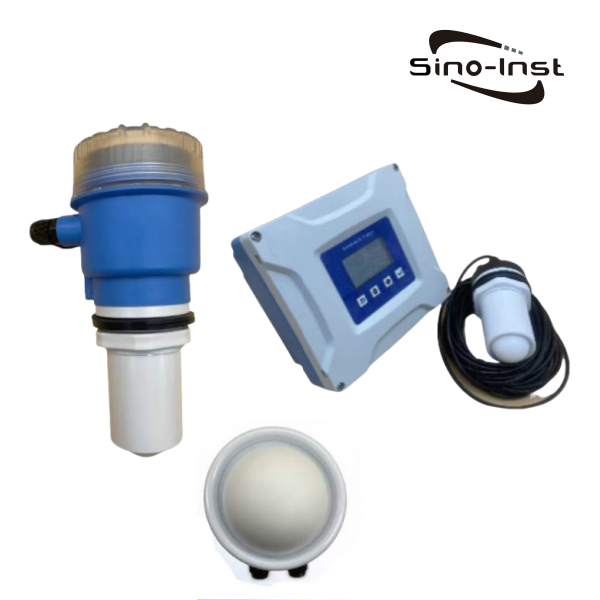
Ultrasonic Level Meters: Foam layers (especially dense or thick foam) absorb or scatter ultrasonic pulses, leading to signal attenuation, falsely high readings, or a complete loss of signal. Ultrasonic meters are generally not the preferred choice in these cases.
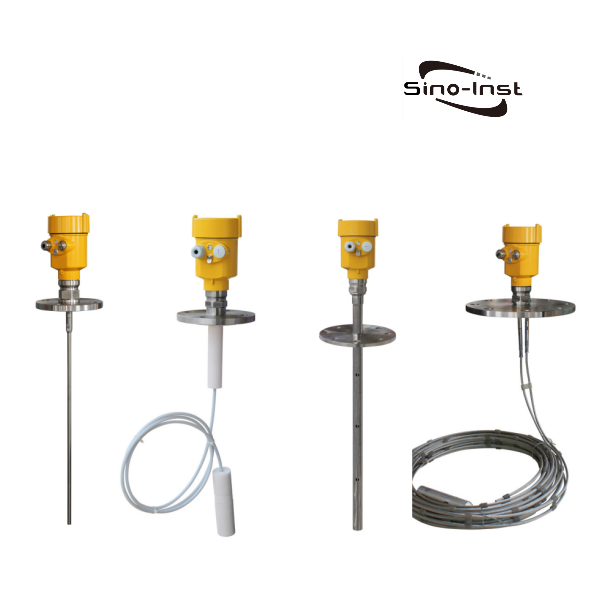
Radar Level Meters: Guided Wave Radar (transmitting microwaves via a probe) or High-Frequency Radar (e.g., 80GHz FMCW) can penetrate the foam layer to measure the actual liquid level directly. 80GHz radar meters are suitable for foam layers up to 200mm thick, while Guided Wave Radar meters can handle up to 300mm. However, the medium must not cause material buildup (fouling) on the antenna.
Hydrostatic Level Meters: These measure the hydrostatic pressure of the liquid column via a bottom-mounted pressure sensor. Theoretically unaffected by foam, care must be taken to ensure the sensor is not covered or clogged by the foam itself.
Still wells and bypass pipes are common physical auxiliary devices. By allowing liquid to enter the measurement pipe through perforations, the liquid level inside the pipe remains synchronized with the level in the main vessel, effectively isolating the sensor from agitation, flow, and foam interference. These devices are not sensors themselves but provide a stable measurement environment for instruments such as radar or ultrasonic meters.
In practical applications, the combination of a still well and a radar level meter is widely considered the optimal solution for foaming conditions. The still well eliminates most foam and turbulence effects, allowing the radar meter to perform precise measurements within the calm environment of the pipe, thereby minimizing measurement error. When integrated with dedicated foam level sensors for monitoring and control, effective management of the tank’s liquid level is achieved.
Radar or Ultrasonic: Which is Better for Foaming Liquid Level Detection?
Radar level meters generally outperform ultrasonic level meters in applications involving significant foaming. Radar microwaves can penetrate thin foam layers to reach the actual liquid surface and remain unaffected by changes in foam density; in contrast, ultrasonic waves are easily absorbed and scattered by thick foam layers, leading to echo signal distortion. However, if the foam layer is thin or absent, ultrasonic solutions offer better cost-effectiveness. It is recommended to conduct testing and verification based on the actual foam thickness and stability when selecting the appropriate instrument.
Pressure transmitter for level measurement is a relatively inexpensive and stable solution. Proper selection and configuration of pressure transmitters can effectively save on measurement costs. On CAN-based machinery, a CAN…
By Li Rui, Senior Process Engineer at Sino-Inst | Published 2026-03-24. If you’ve ever had an ultrasonic level sensor fail prematurely, there’s a good chance the probe material was wrong…
The Magnetic Float Level Gauge continuously measures the liquid level in a tank based on the principles of buoyancy and magnetic coupling. It indicates changes in liquid level by utilizing…
Powder/Dry Material Level Switches are devices used to detect when material reaches a preset level. When the material reaches or exceeds the set position, the level switch sends a signal,…
The water level pressure transducer measures water level based on the relationship between pressure and water level. It is an extremely simple, practical instrument. Of course, it can be used…
The portable ultrasonic liquid level indicator is a non-contact, handheld detection device primarily used to quickly determine the presence of liquid at a specific height within a sealed container without…
Sino-Inst possesses extensive experience in liquid level measurement and control. Our foam level sensors are essential for monitoring and controlling foam levels across various applications. The PM model foam level sensor provides limit alarms and controls the automatic dispensing of defoamers; it operates fully automatically and requires no calibration. The PK model intelligent foam height controller also provides limit alarms and controls automatic defoamer dispensing, while additionally featuring an “ultra-high” level alarm.
We have previously customized level measurement solutions for aeration tanks in wastewater treatment plants and supplied high-frequency radar level meters for chemical reactors—enabling continuous level monitoring while avoiding interference from foam. Furthermore, we have tailored solutions for absorption towers using hydrostatic level meters combined with stilling wells or bypass pipes. With our wealth of experience and high-quality products, we are well-equipped to design an effective foam level measurement and control solution for your specific needs.
Zhang Wei, possesses 20 years of experience as an automation instrumentation engineer, specializing in the research, design, installation, commissioning, and maintenance of automation instruments.
Face to various instrument communication protocols (such as Modbus, Profibus, etc.), with solid hardware circuit design and software programming skills (proficient in C language and PLC programming). Has extensive project experience; projects he has led and participated in have all achieved outstanding results, improving product accuracy, reducing costs, and increasing production efficiency.
Possesses excellent communication and coordination skills and a strong team spirit, enabling him to quickly respond to customer needs and provide high-quality automation instrumentation solutions.