
Edible Oil Tank Level Monitoring for Large Storage Tanks
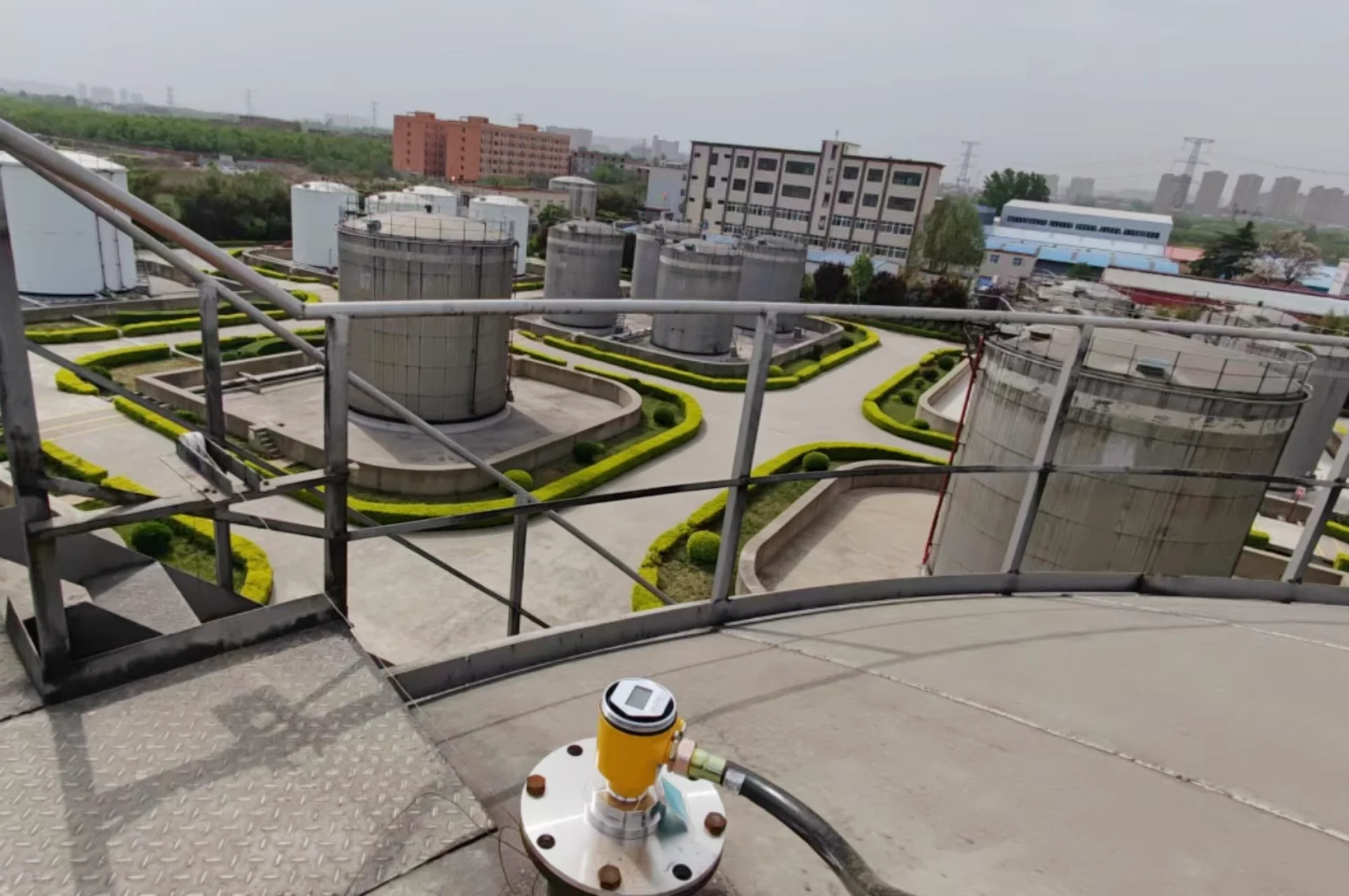
This article uses a vegetable oil storage tank 15 m in diameter and 12 m high (about 2,100 m³) as the reference case: a vertical, atmospheric-pressure tank common in grain and oil depots. Vegetable oil is a clean, free-flowing medium, but the tank height and long storage periods make long-term reliability and low maintenance the main selection criteria. For this application we recommend non-contact radar level transmitters.
Next, we will examine the key factors that must be addressed during the solution design phase: the instrument’s measurement range, the near-field “blind zone” parameters, and the installation layout on the tank roof.
Edible Oil Properties and Storage Tank Operating Conditions
Edible Oil Properties
Edible oils (vegetable oils) are liquid, combustible substances at ambient temperature and pressure. With a dielectric constant typically ranging from 2.5 to 3.5, they provide stable reflection of radar signals, making them well-suited for measurement using radar-based level instruments.
Common vegetable oils such as soybean, rapeseed and blended oil stay liquid and flow freely at normal storage temperatures. Their flash point is about 280–330 °C, far above storage temperature. Over months of storage, a thin oil film forms on probes and tank walls. On contact instruments the film can make moving parts stick; on a radar antenna its effect is minor.
Edible oils are not highly corrosive, so materials with special corrosion resistance are not required. Nevertheless, in metering applications, changes in oil temperature can lead to variations in density and volume; therefore, associated metering systems often require simultaneous temperature measurement for compensation purposes.
Operating Conditions of Large Storage Tanks
Large-scale edible oil storage tanks are typically vertical, atmospheric-pressure vessels—exemplified here by a tank with a diameter of 15 meters and a height of 12 meters. The stored medium, vegetable oil, possesses a moderate dielectric constant and good fluidity at ambient temperature. While it is not prone to coking or crystallization, long-term storage can lead to the gradual formation of an oil film on the inner tank walls and the surfaces of instrumentation components.
The roofs of such large-diameter tanks are often equipped with nozzles, reinforcing rings, and other structural elements, which can obstruct or interfere with liquid-level measurement signals. These factors must be carefully evaluated during the selection of instrumentation and the design of the installation.
Edible oil is combustible, but at storage temperature it is far below its flash point and does not form an explosive atmosphere on its own. Whether the tank area is a hazardous zone is decided by the site’s area classification, typically to IEC 60079-10-1. Zones are more likely near solvent extraction (hexane) units or heated tanks. Where a zone is assigned, instruments need matching ATEX or IECEx certification.
Selection Standards for Edible Oil Tank Level Instruments
Explosion-Proof Requirements
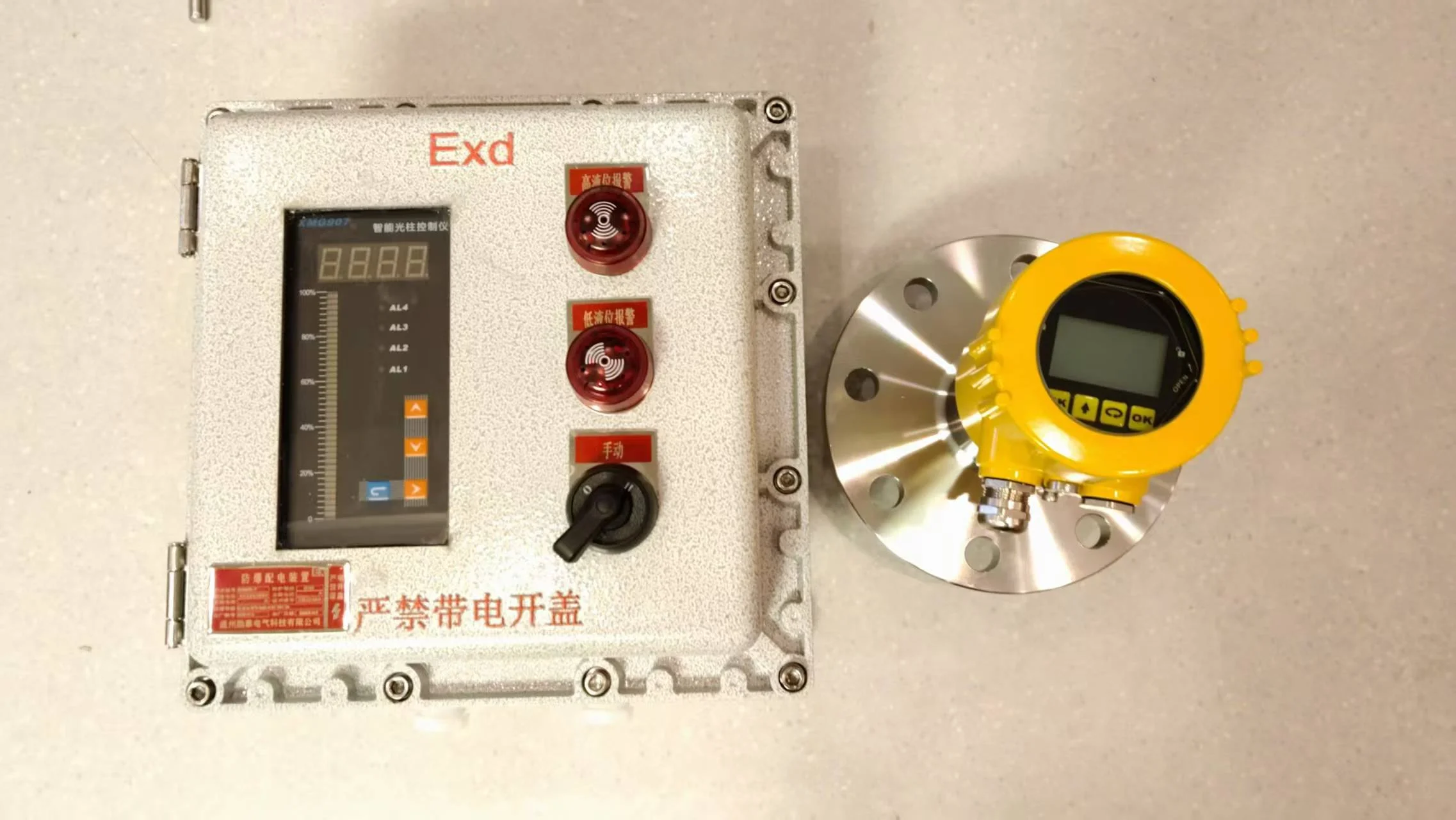
Check the site’s hazardous-area classification before selecting instruments. If the tank area is Zone 2, Ex ia or Ex d instruments rated IIB T4 are sufficient for vegetable oil. Housings on outdoor tank roofs should be IP66 or higher, and cables entering the zone need certified glands or barriers.
Food-Grade Wetted Materials
- Wetted parts (probes, floats, guide tubes, flanges and gaskets) must use food-contact materials. 316L stainless steel and PTFE are the usual choices. Typical references are FDA 21 CFR (e.g. 177.1550 for PTFE), EU 1935/2004, and the GB 4806 series for projects in China.
- Food-grade NBR, FKM and PTFE-enveloped gaskets all handle vegetable oil. Avoid EPDM, which swells in oils.
- Materials must not release metals or other contaminants into the oil. Material certificates and FDA compliance statements can be supplied on request. 3-A or EHEDG certification is normally required for hygienic process equipment, not for bulk storage tank gauges.
- Floats and probe rods shall either be fully encapsulated by PTFE or made of polished stainless steel, to eliminate risks of surface coating peeling off.
Oil Density and Float Compatibility
At room temperature, the density of edible oil is approximately 0.91–0.93 g/cm³. When ordering buoyancy-based level gauges—such as magnetic flap, magnetostrictive (float type) or displacer gauges—you must specify the oil density to the manufacturer so that a compatible float can be custom-configured.
Radar level transmitters rely on the dielectric constant (for vegetable oil, εr ≈ 2.5–3.5) to reflect signals; they are unaffected by changes in density. However, it is essential to ensure that the medium’s dielectric constant falls within the device’s specified operating range.
Oil Film and Foam Interference
Foam can form during filling, though in storage tanks it is usually light and short-lived. Higher-frequency radar is more sensitive to foam, not less: thick foam absorbs and scatters the signal. Where foam is persistent, guided-wave radar is more reliable. The real advantage of 80 GHz radar in these tanks is its narrow beam, which avoids echoes from nozzles and stiffening rings.
Oils tend to form films on sensor surfaces. Non-contact 80 GHz radar is virtually maintenance-free in this regard, whereas contact-based guided-wave radar and magnetic-float level transmitters require periodic cleaning.
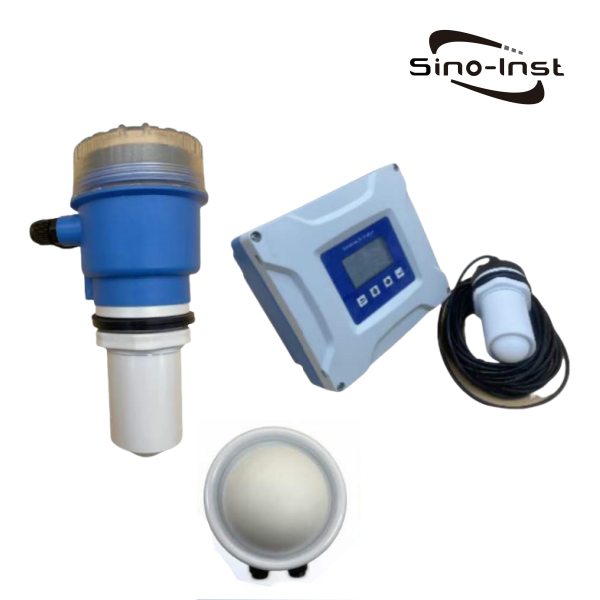
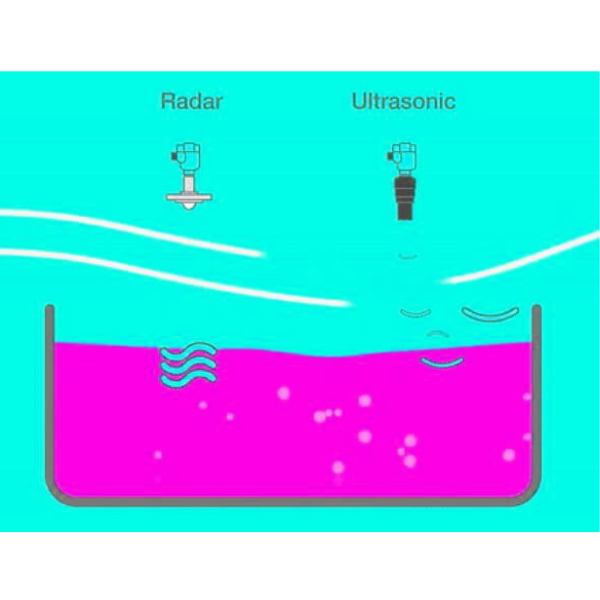
Ultrasonic level meters suit small open tanks and sumps. In a closed 12 m tank, temperature layers in the vapor space change the speed of sound, and the range is close to the limit of most ultrasonic sensors, so readings drift. Radar is the better choice for this tank size.
6 Common Level Gauges for Edible Oil Tanks Compared
Tank level monitoring systems are critical equipment in the storage and logistics industry, directly impacting operational safety and management efficiency. In large-scale oil depot projects, engineers typically implement redundant systems to ensure data reliability.
A standard system consists of sensors, transmitters, communication modules, and monitoring software. The level sensor serves as the core sensing unit of the system.
Non-Contact Radar Level Transmitter
Non-contact radar level transmitters utilize the time-of-flight principle of electromagnetic waves. Because the antenna never touches the stored medium (e.g., vegetable oil), these transmitters are well suited to large-capacity, atmospheric-pressure storage tanks—such as those 12 meters high and 15 meters in diameter.
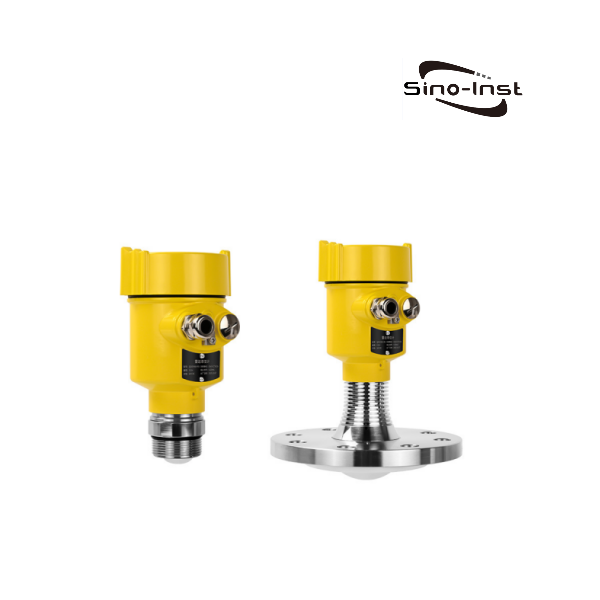
An 80 GHz radar has a narrow beam, is unaffected by oil density and temperature, and typically achieves ±2–3 mm. It mounts on a roof flange and needs little maintenance. Two points need attention at the design stage: the blind zone below the antenna, and false echoes from internal metal structures.
Magnetostrictive Level Transmitter
A magnetostrictive level transmitter is a contact-type instrument that locates the float by timing a torsional pulse along a waveguide wire. It can measure vegetable oil level as well as the oil–water interface, with an accuracy of about ±1 mm. A 12 m tank needs a flexible probe. Temperature probes can be integrated to compensate for volume errors caused by temperature changes. Its main downside is that long-term immersion leads to oil-film buildup on floats and probe rods, calling for regular on-site cleaning and maintenance.
Servo-Operated Level Gauge
Servo-operated level gauges utilize the principle of buoyancy balance and offer an accuracy of ±1 mm. They are suitable for custody transfer measurement of vegetable oils. However, they feature a complex, high-precision mechanical structure, entail high costs, and require strict adherence to verticality during installation. As components are subject to wear, the equipment necessitates professional, periodic calibration and maintenance.
Magnetic Flap Level Gauge
Built on the communicating-vessel principle, magnetic flap level gauges deliver local visual indication readable even under power failure conditions. 4–20 mA remote output can be added as an option. It is mostly used on small and medium storage tanks. On tall tanks, a sectional chamber adds many sealing points, and the float easily collects oil-film deposits. For a tank this tall, it is rarely chosen as the primary gauge.
Submersible Hydrostatic Level Transmitter
Hydrostatic level transmitters calculate level from the pressure at the tank bottom (h = P/ρg). They are easy to install and low in cost. Accuracy is typically ±0.5% FS, about ±60 mm on a 12 m range. Oil density drops by roughly 0.07% per °C, so temperature changes show up directly as level error unless density is compensated. The sensor sits at the tank bottom and can be coated by sediment. Use them for rough inventory checks, not custody transfer.
Float-Type Level Transmitter
Float-type level transmitters feature a simple structure and low cost. They typically offer an accuracy of around ±10 mm and are suitable for monitoring stable liquid levels under ambient temperature and pressure conditions.
Key Factors for Tank Level Monitoring
Accuracy Requirements
Take a large atmospheric vegetable-oil storage tank (Ø15 m, effective liquid height 12 m) as an example:
- Level monitoring and high/low alarms: a non-contact radar transmitter with ±2–3 mm accuracy is more than sufficient.
- Inventory and stock accounting: on a Ø15 m tank, 1 mm of level equals about 0.18 m³ (roughly 160 kg of oil). A ±3 mm gauge keeps volume error to about ±0.5 m³. Radar, servo and magnetostrictive gauges all meet this.
- Custody transfer: use a radar or servo gauge approved to OIML R85, with a multi-point average temperature sensor for volume correction. Class A Pt100 elements have a tolerance of ±(0.15 + 0.002|t|) °C.
Measuring Range, Blind Zone and Internal Obstructions
During instrument selection, reserve at least 15% margin for measuring range; models with 14 m or above measuring range are preferred.
Our 80 GHz series has a blind zone of 0.08–0.1 m; lower-frequency radars need more. Magnetostrictive probes have inactive zones of about 0.1–0.3 m at the top and bottom. At maximum fill, the liquid surface must stay below the blind zone. Nozzles and stiffening rings close to the antenna produce the strongest false echoes, so mount the radar clear of them.
Oil Film and Maintenance
Edible oil has a dielectric constant of 2.5–3.5. Kinematic viscosity is about 50–80 mm²/s at 20 °C and 30–35 mm²/s at 40 °C. Even with good flow, long-term storage leaves an oil film on wetted surfaces.
Magnetostrictive probes stay immersed in the oil. Film buildup on the float and probe can cause sticking or drift over time, so plan cleaning, typically once or twice a year.
A radar antenna does not touch the oil, and a light film has little effect on the reading. Inspection and occasional cleaning during scheduled tank maintenance is usually enough.
Explosion Protection and Signal Output
Where the tank area is classified as Zone 2, use instruments certified to ATEX or IECEx (equipment category II 3G or better). Ex ia or Ex d IIB T4 covers vegetable oil. Wetted parts should be 316L stainless steel.
Regarding signal output: 4–20 mA + HART supports transmission distance up to 1000 m. One Modbus RTU (RS-485) segment supports up to 32 devices without repeaters. For multi-tank centralized monitoring projects, all level and temperature signals converge into PLC or central control system. Sampling interval can be set between 1–10 s to realize real-time liquid-level tracking.
Selection Tips by Project Type
Small tanks with local reading on a tight budget: a magnetic flap gauge gives a direct visual reading without power. On a 12 m tank it needs a sectional chamber with many seals, so use it as a local backup rather than the main gauge.
Remote monitoring and high-precision inventory management: Radar level transmitters are preferred. Non-contact measuring mode meets food-hygiene specifications, supports continuous accurate measurement and connects to control room systems, well-suited for large-scale oil-processing plants with multiple storage tanks.
Small-size tanks with tight-budget constraints: Float-type level gauges can serve as alternative choices. Note that their contact design brings higher long-term maintenance costs.
Projects requiring oil-water-interface or density measurement: Servo-operated level gauges deliver the most comprehensive functions. Note that the oil viscosity must not be too high; otherwise, measurement error increases significantly.
| Type | Measurement Method | Accuracy | Viscous Oil Resistance | Maintenance Cost | Price |
| Magnetic Flap Level Gauge | Contact | ±10 mm | Fair | Medium | From USD 220 |
| Float Level Transmitter | Contact | ±10 mm | Fair | Medium | Low |
| Servo Level Gauge | Contact | ±1 mm | Poor | High | High |
| Magnetostrictive Level Transmitter | Contact | ±1 mm | Fair | Medium | Medium |
| Radar Level Transmitter | Non-contact | ±2–3 mm (±1 mm custody grade) | Good | Low | Medium to high |
| Submersible Hydrostatic Transmitter | Contact | ±0.5% FS | Fair | Medium | Low |
Recommended Solution: Radar Level Transmitters for Large Edible Oil Tanks
For large atmospheric edible-oil storage tanks (15 m diameter, 12 m height), non-contact radar level transmitters are recommended as primary monitoring instruments. Since the antenna never touches the oil, problems like oil-film buildup, moving-part jamming and signal drift can be avoided.
Verification of Measurement Range and Blind Zones: Select instrument measuring range based on tank effective liquid height with proper safety margin. Pay special attention to near-field blind zone; guarantee liquid surface will not enter blind-zone area under high-level operating status which would cause measurement failure.
Installation Guidelines: Mount radar transmitters at off-center positions on tank roofs. Keep sufficient separation distance from metal structures such as nozzles, stiffening rings, support brackets and manholes, to minimize false-echo interference. If needed, optimize measuring performance through echo curve analysis and filter-parameter configuration.
Upgrading for Custody Transfer: For custody transfer or stock reconciliation, specify a radar gauge approved to OIML R85, or a servo gauge, together with an average temperature sensor.
Explosion-Proofing and System Integration: Match the instrument certification (ATEX or IECEx) to the site’s area classification. Send level and temperature data to the control system for monitoring, trending and high/low alarms.
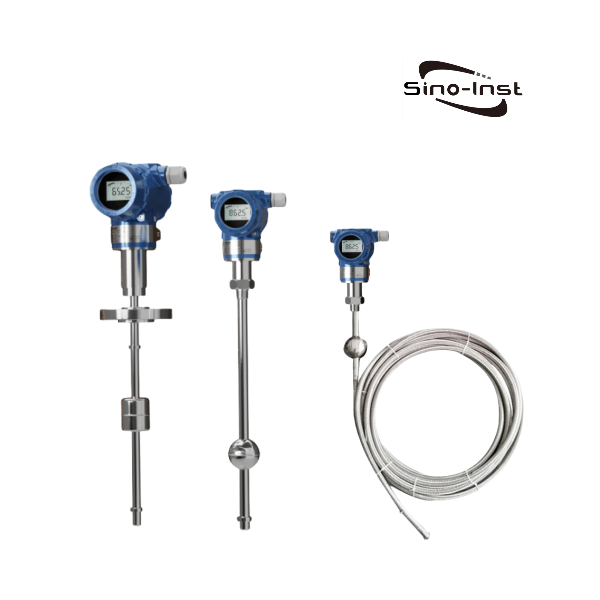
Level Instruments for Edible Oil Storage Tanks

FAQ
Reliable level monitoring is the basis of safe operation and accurate inventory management in large edible-oil tank farms. Featuring non-contact detection and low maintenance burden, non-contact radar level transmitters are well suited to large atmospheric edible-oil storage tanks such as the 12 m-high, 15 m-diameter units discussed above.
Sino-Inst supplies accurate and reliable non-contact radar level transmitters for large-scale edible-oil tank-farm level monitoring. If you have purchasing requirements or need technical consultation, feel free to reach out to our engineering team.
Further Reading
Zhang Wei, possesses 20 years of experience as an automation instrumentation engineer, specializing in the research, design, installation, commissioning, and maintenance of automation instruments.
Face to various instrument communication protocols (such as Modbus, Profibus, etc.), with solid hardware circuit design and software programming skills (proficient in C language and PLC programming). Has extensive project experience; projects he has led and participated in have all achieved outstanding results, improving product accuracy, reducing costs, and increasing production efficiency.
Possesses excellent communication and coordination skills and a strong team spirit, enabling him to quickly respond to customer needs and provide high-quality automation instrumentation solutions.