Brine, as used in industrial production, refers to aqueous solutions containing high concentrations of inorganic salts (not just sodium chloride), such as calcium chloride and sodium bromide.
Brine has a wide range of industrial applications, primarily leveraging its physical and chemical properties. These include a low freezing point, high boiling point, excellent electrical conductivity, and corrosive properties.
Whether feeding electrolyzers, measuring chemical plant processes, or monitoring cooling systems, effectively monitoring brine flow is crucial!
Characteristics of Brine and Measurement Challenges
The properties of industrial brine are both a direct basis for its application and a source of challenges.
High conductivity: Its conductivity is approximately 20-50 mS/cm, far exceeding that of pure water (approximately 0.05 mS/cm), necessitating the use of a flowmeter based on conductivity principles.
High corrosiveness: Sodium chloride solutions can accelerate metal corrosion at high temperatures (e.g., the corrosion rate of carbon steel is >0.1 mm/year), necessitating the use of corrosion-resistant materials.
Crystallization: When the temperature of brine drops, NaCl crystals may precipitate, potentially blocking pipes or adhering to sensor surfaces, affecting measurement accuracy.
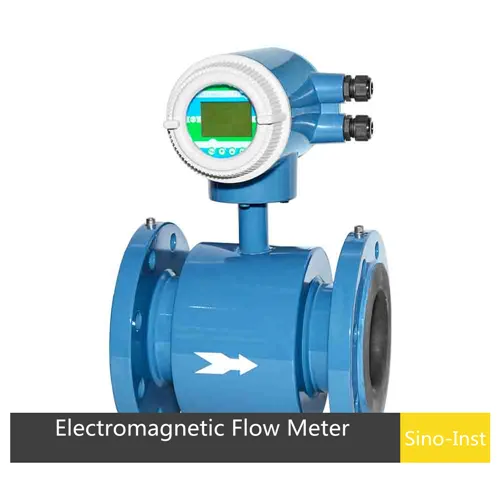
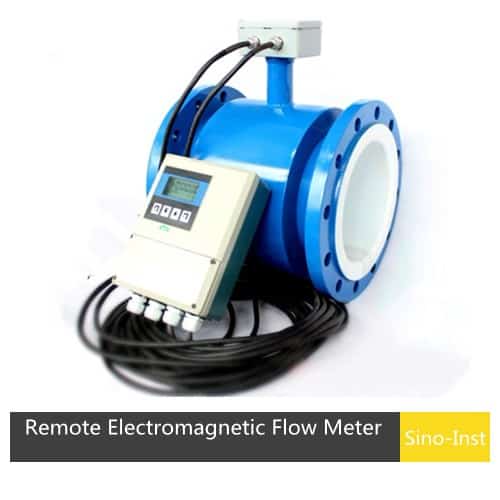
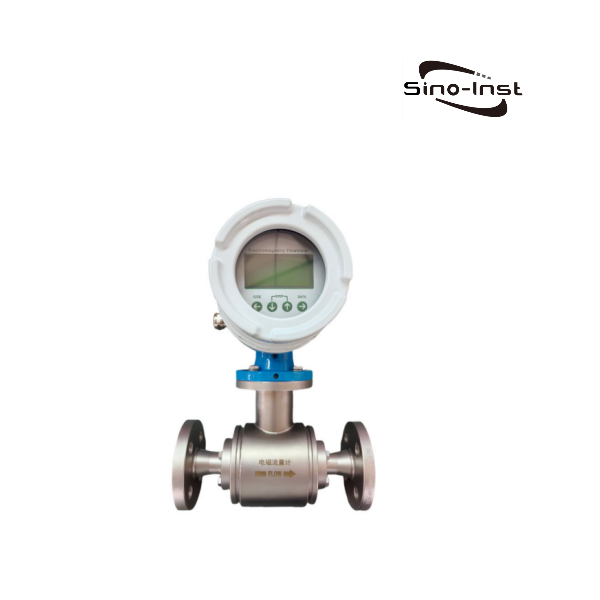
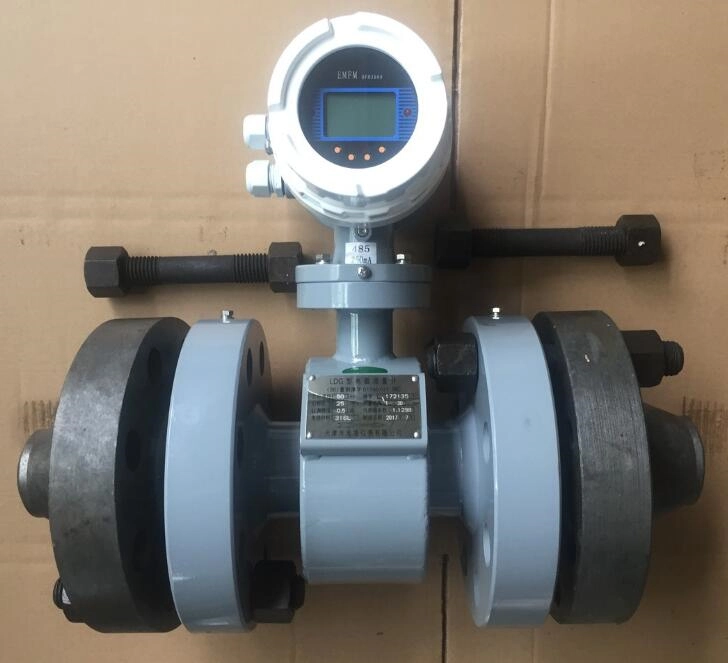
Preferred Brine Flow Meter: Electromagnetic Flow Meter
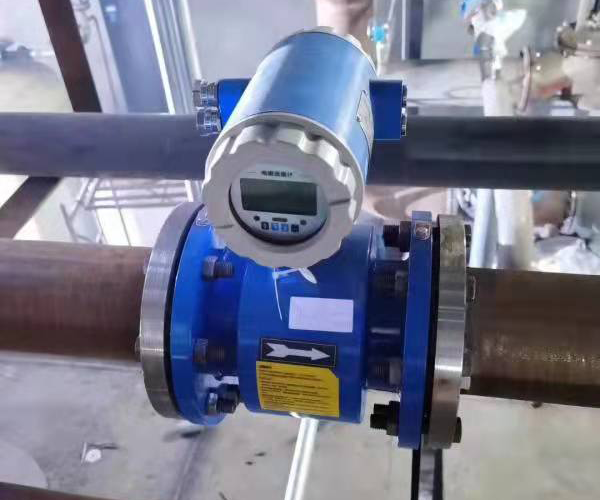
Any experienced flow meter supplier will tell you that it is best to choose an electromagnetic flow meter to measure brine flow. Furthermore, Sino-Inst will recommend the use of HC or tantalum electrodes with F46 linings based on your actual measurement parameters. Mainly because electromagnetic flowmeter has the following advantages:
Electromagnetic flowmeters are based on Faraday’s law of electromagnetic induction, inferring flow rate by measuring the induced electromotive force generated by brine cutting through magnetic lines of force. Effective measurement is possible as long as the brine conductivity is greater than 5mS/cm.
Electromagnetic flowmeters have no moving parts. Even crystallized brine will not affect measurement.
Electromagnetic flowmeters can be configured with corrosion-resistant electrodes and an F46 lining, allowing for long-term exposure to high-concentration brine.
Electromagnetic flowmeters offer high measurement accuracy, reaching 0.5%.
Electromagnetic flowmeters require minimal straight pipe runs. A straight run of five pipe diameters upstream and three pipe diameters downstream is required (e.g., a DN50 pipe requires 25 cm upstream and 15 cm downstream without valves or elbows).
We support custom electromagnetic flowmeters in sizes from DN2 ~ DN2000.
A variety of signal output options are available, including 4-20mA, pulse, frequency, and RS485.
Advantages in installation location, not limited by electromagnetic field restrictions.
Can be a purely mechanical configuration. No power supply required.
No requirements for the conductivity of the medium.
Featured Application: Electrolyzer Brine Flow Monitoring
After primary and secondary refining, refined brine enters the electrolytic cell. The flow rate must meet the process specifications for each cell. Unstable flow rate fluctuations will affect the membrane and pose significant risks to the electrolytic cell. Reliable and accurate flow meter measurements help ensure stable and efficient production.
For four electrolytic cells with a total current of 60kA, the brine flow rate for each cell ranges from 0 to 30m³/h. The operating pressure is 100kPa, the operating temperature is 60±5°C, and the brine medium is corrosive. This flow rate serves as the interlocking stop condition for each electrolytic cell, shutting down the cell when a low flow alarm occurs. Common operating conditions affecting brine flow measurement in electrolytic cells include:
Electromagnetic interference from the electrolytic cell;
Unstable pump current leading to unstable brine pump flow;
Water temperature during the production process is an important parameter to monitor. Water temperature sensors are key components in modern industries, automobiles, home appliances, and other fields. Their core function is to accurately sense and feedback temperature information. Sino-inst offers a variety of sensors for measuring water temperature. The electrical signal transmitted from the sensor … Read more
In industries such as fine chemicals, pharmaceuticals, and food processing, there is often a need to accurately measure and control small flow rates of glycerol liquids. As a viscous fluid, accurate flow measurement of glycerol is crucial for ensuring product quality and process control. Therefore, selecting the appropriate flow meter is key to ensuring measurement … Read more
Raw water is water that has not undergone any treatment. It is found in natural sources and reserves, in surface and groundwater bodies. Likewise, fresh water is also found naturally on the Earth’s surface, such as ice, wetlands, ponds, lakes, rivers, streams, and groundwater. It usually has a low concentration of dissolved salts and solids. … Read more
A method by which we can measure the amount of heat involved in a chemical or physical process is known as Calorimetry. Calorimetry is used to measure the amount of heat transferred into or from a substance. Among the several types of flow meters available, the calorimetric flow meter stands out for its reliability, preciseness, … Read more
A water flow meter can measure, monitor, and aid to control the flow of water through a pipe, hose, or other manner of instrumentation. It can provide a constant reading of the water flow rate. Measuring saltwater flow is a relatively complex process due to the corrosive nature, high salinity, and large temperature variations of … Read more
There are several types of flow meters designed to measure the flow of dirty water fluids, and they work in slightly different ways. The electromagnetic flow meter solution is best for measuring the flow of dirty water such as mining slurries, wastewater plants, etc. Unlike standard water meters used for clean water applications, these specialized … Read more
BTU meter accurately measures the thermal energy of hot and chilled water consumption in British thermal units (BTU), a basic measure of thermal energy for commercial and residential buildings. BTU meters are used in hot and chilled water systems for both commercial and industrial processes and office buildings. BTU meters comprise an accurately calibrated flow … Read more
Any polymer compound that can be used as a raw material for plastic product processing is called a resin. Resins typically soften or melt when heated. When softened, they tend to flow under external forces. At room temperature, they are solid, semi-solid, or sometimes liquid. Resins are diverse and require demanding reaction conditions. The process … Read more
What is a water flow meter? A water flow meter is a device dedicated to measuring and displaying the instantaneous and cumulative flow of water. Industrial water flow meters have more powerful functions than water meters. Water flow measurement is essential for industrial applications such as wastewater treatment. There are many different types of water … Read more
We all know that electromagnetic flow meters are the first choice for wastewater flow measurement! Indeed, electromagnetic flow meters have unique measurement advantages, such as corrosion-resistant linings and intelligent data monitoring and output. Therefore, we often see electromagnetic flow meters in water treatment plants, domestic sewage pipelines, and various other wastewater systems. For open-channel and … Read more
If you need to purchase a flow meter for home or drinking water, we recommend considering three points first: pipe diameter, flow range, and water quality. Based on our years of experience in water flow measurement, we recommend: For clean drinking water pipes of 1/2 inch to 2 inches, battery-powered ultrasonic flow meters are usually … Read more
Sino-Inst offers a variety of corrosion-resistant electromagnetic flowmeters to meet the specialized needs of brine flow measurement. Whether measuring brine in electrolyzers or cooling brine in refrigeration systems, we can select the appropriate flowmeter.
If you require brine flow measurement or have any technical questions, please feel free to contact us.
Zhang Wei, possesses 20 years of experience as an automation instrumentation engineer, specializing in the research, design, installation, commissioning, and maintenance of automation instruments.
Face to various instrument communication protocols (such as Modbus, Profibus, etc.), with solid hardware circuit design and software programming skills (proficient in C language and PLC programming). Has extensive project experience; projects he has led and participated in have all achieved outstanding results, improving product accuracy, reducing costs, and increasing production efficiency.
Possesses excellent communication and coordination skills and a strong team spirit, enabling him to quickly respond to customer needs and provide high-quality automation instrumentation solutions.