Home > Blog > LoRaWAN Clamp-On Ultrasonic Flow Meter for IoT Monitoring (myDevices Case)
LoRaWAN Clamp-On Ultrasonic Flow Meter for IoT Monitoring (myDevices Case)
A client project requires integration with the myDevices IoT platform and is seeking a flow sensor that supports LoRaWAN/LTE. The client is interested in a clamp-on ultrasonic solution. Our clamp-on ultrasonic flowmeter features a non-invasive external clamp-on installation that requires no pipe cutting and is compatible with a wide range of pipeline media.
Additionally, the clamp-on ultrasonic flowmeter supports both LoRaWAN and LTE communication protocols. It transmits flow data reliably over long distances and integrates seamlessly with IoT platforms, enabling remote online flow monitoring and data management.
Background: Addressing flow monitoring requirements for the myDevices IoT platfo
This project aims to set up remote online monitoring for pipeline flow. The customer picked myDevices as their centralized IoT management platform, and sensors have to support either LoRaWAN or LTE for wireless connectivity.
When evaluating sensor options, the customer laid out two main priorities. First, the hardware must reliably push flow readings to the myDevices platform for data ingestion, storage and visual access. Second, they hoped to keep on-site modification work to a minimum, to avoid downtime risks and high construction costs that normally come with pipeline alteration.
What Is a LoRaWAN Clamp-On Ultrasonic Flow Meter?
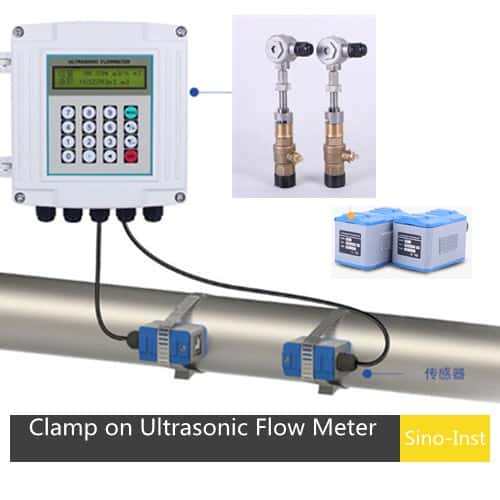
A LoRaWAN clamp-on ultrasonic flow meter is a non-contact instrument built for liquid flow measurement. Users simply attach clamp-style sensors to pipe surfaces to take readings for many kinds of liquids.
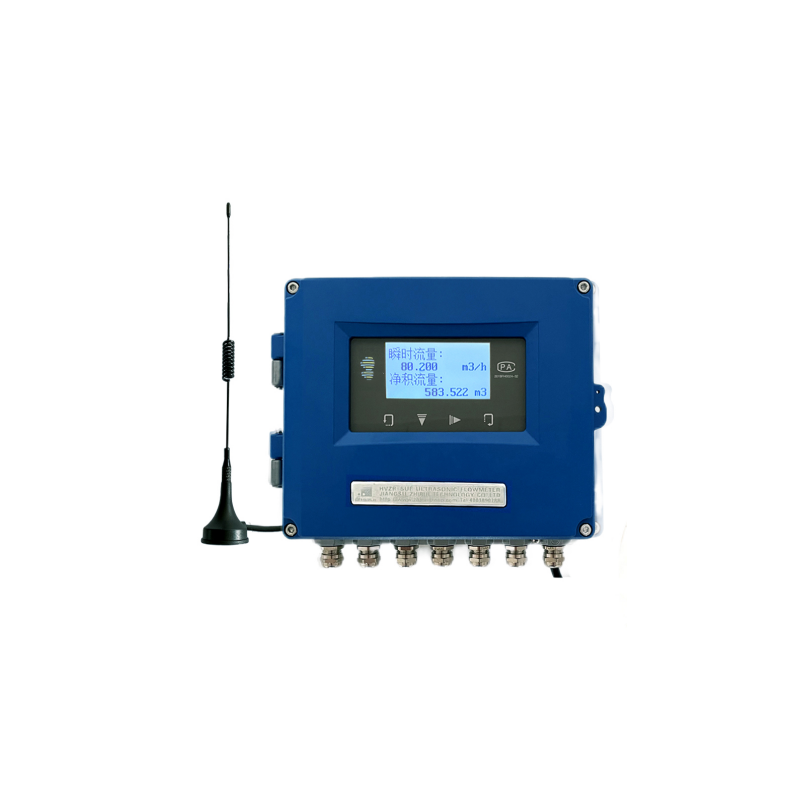
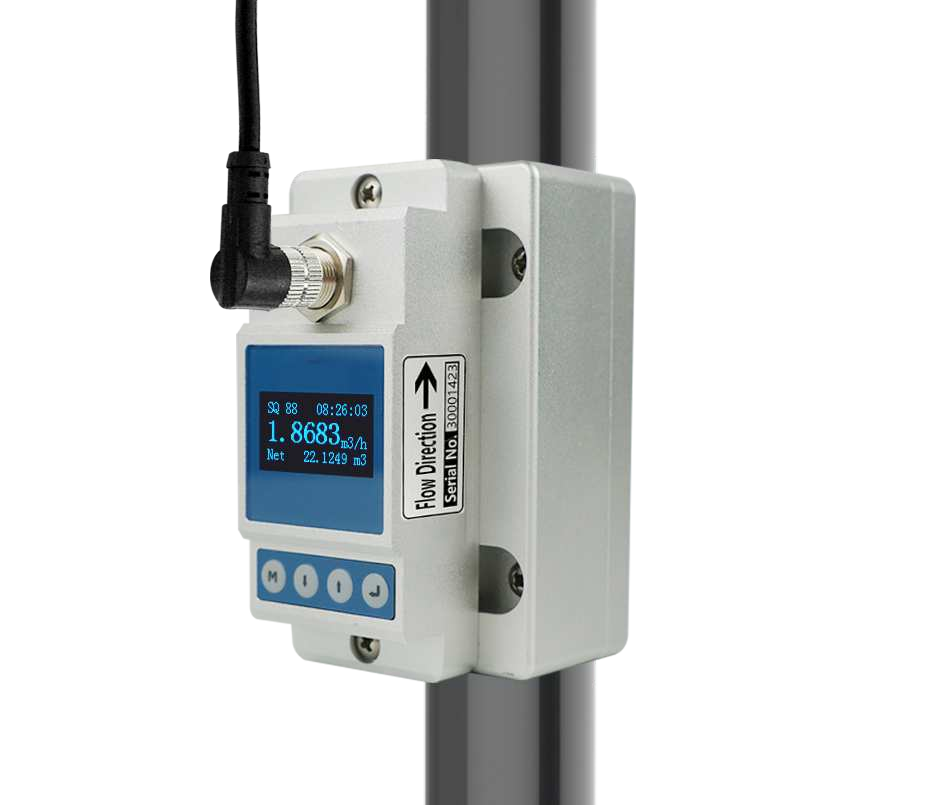
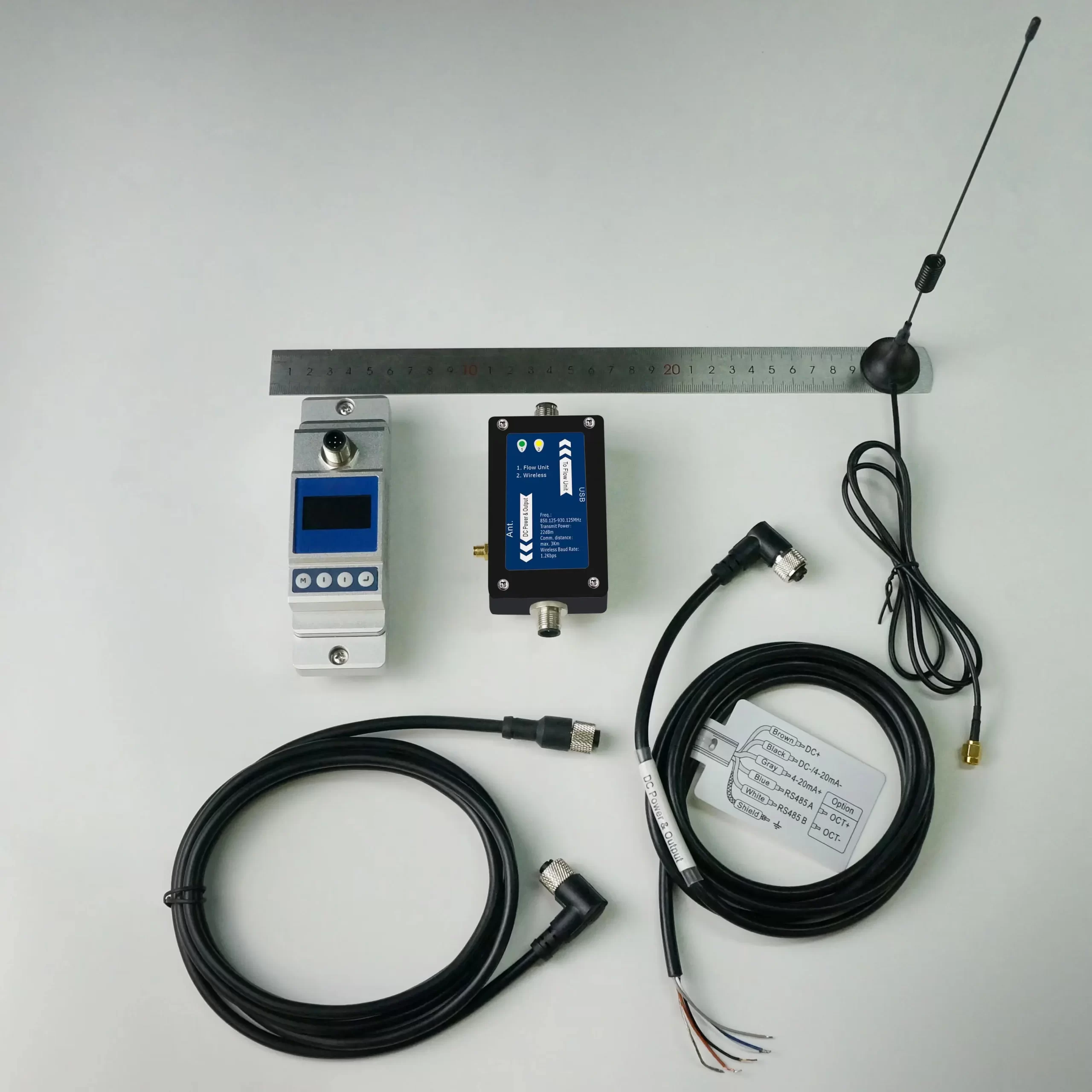
LoRaWAN clamp-on ultrasonic flowmeter consists of a main processing unit plus clamp-on sensors. Main units come in multiple form factors: handheld, portable, modular and wall-mount versions are all offered.
Key Features
The sensor uses a clamp-on mounting design, making no contact with the medium and thus resistant to corrosion and wear.
Causes no pressure loss. There are no flow-restricting components inside the pipe, so it does not increase energy consumption during transportation.
Measurement accuracy up to ±1%.
Available in multiple models, suitable for pipes with diameters ranging from DN15 to DN6000 mm.
Features a low-voltage, multi-pulse transmission circuit, which enhances the device’s service life and reliability.
Main unit has built-in LCD screen plus physical operation buttons.
Main unit and data acquisition module adopt sealed housing with IP65 ingress protection, making them fit for harsh outdoor operating environments.
Measurement Principle of LoRaWAN Clamp-On Ultrasonic Flow Meters
Clamp-on ultrasonic flowmeters utilize the time-of-flight principle. A pair of transducers alternately transmit and receive ultrasonic signals; the flow velocity is calculated based on the time difference between the propagation of ultrasonic waves in the flowing liquid in the direction of flow and against the flow. This value is then combined with the pipe’s inner diameter to calculate the instantaneous flow rate and cumulative flow.
How to Connect to myDevices
1. Communication Architecture Solutions
The clamp-on ultrasonic flowmeter offers two LoRaWAN connectivity options, which can be selected based on on-site project conditions:
The flowmeter’s main unit features a built-in LoRaWAN communication module. After the instrument collects flow data, it directly encapsulates the LoRaWAN uplink data packet without requiring additional conversion devices. This solution features simple wiring and fewer potential failure points; it is the preferred option for battery-powered versions.
The flowmeter outputs a standard RS485 Modbus-RTU signal and connects to an external, standalone LoRaWAN DTU (Data Transmission Unit) for LoRaWAN data upload. This solution requires a separate power supply for the DTU, resulting in higher overall power consumption compared to the built-in version.
2. Supported Frequency Bands
The module’s firmware is pre-programmed with the frequency band specified in the order. Each device supports only one frequency band at a time and cannot be switched on-site. CN470 (470–510 MHz) is commonly used in China. For myDevices projects overseas, EU868, US915, and AS923 are commonly used.
3. Network Activation Methods and Device Class Types
Network activation supports OTAA (recommended as the preferred method) and ABP.
OTAA: Upon power-up, the device triggers automatic handshakes and finishes key negotiation with the network server. It delivers better security and works well for large-scale roll-outs and future gateway replacement work.
ABP: DevAddr, AppSKey and NwkSKey get pre-written into flow meters. No network handshake step is needed; devices start reporting data immediately after power-on.
The device type is Class A, which is the standard type for battery-powered, low-power LoRaWAN devices. The device opens only two brief downlink reception windows after each uplink report is completed to receive commands from the platform. The rest of the time, the module remains in sleep mode to conserve battery life.
Gateways receive RF packets and forward them toward LNS for decryption and validation. Processed data then gets pushed into myDevices for visualization, storage and alert triggering.
Note that myDevices itself does not function as a LoRaWAN network server. A third-party LNS such as ChirpStack must sit in the middle as intermediate service.
5. Data Packet Format and Decoding Scripts
The device’s default payload uses the Cayenne LPP low-power protocol, natively supported by myDevices. The accompanying JavaScript decoding scripts can be imported directly into the platform for use. The scripts are available for download as part of the documentation package. In DTU transparent transmission mode, the original Modbus payload can also be selected as needed.
6. Reporting Interval and Upload Fields
The reporting interval can be configured locally. Common settings include 5 minutes, 10 minutes, 30 minutes, and 60 minutes. The more frequently data is reported, the faster the battery drains.
Each uplink data packet contains: instantaneous flow rate (unit configurable), cumulative flow retained during power loss, RSSI and SNR signal quality, and battery level. The platform can issue commands during the downlink window following a report to modify the reporting interval. However, due to Class A mechanism restrictions, commands cannot be issued at any time.
Comparison of LoRaWAN and LTE Communication Options
The clamp-on ultrasonic flow meter supports two wireless modes: LoRaWAN and LTE. Both connect to myDevices IoT platform and submit flow data, but noticeable gaps exist in transmission range, power draw, deployment prerequisites and real-time behaviour.
LoRaWAN is a low-power wide-area network (LPWAN) communication technology.
Its standout traits are long transmission distance and low power consumption. Devices can run for extended cycles powered solely by batteries. That makes it suitable for widely scattered monitoring spots where mains power supply is hard to arrange.
One downside: it depends on local LoRaWAN gateway coverage. Data upload speed remains relatively moderate, hence it fits periodic scheduled reporting best.
The LoRaWAN clamp-on ultrasonic flowmeter comes standard with a high-capacity lithium-thionyl chloride battery. Battery life primarily depends on the data reporting interval:
With a 5-minute reporting interval, the battery lasts approximately 3 to 4 years;
with a 10-minute reporting interval, the battery life is approximately 5–6 years;
with a 30-minute reporting interval, battery life can reach 8–10 years;
with a 60-minute reporting interval, battery life can exceed 10 years.
However, actual battery life may be affected by ambient temperature and wireless signal strength. When the signal is weak, the module’s transmission power consumption increases, which shortens battery life.
LTE relies on carrier cellular networks and does not require the deployment of additional gateways; it can be used wherever there is adequate signal coverage. It offers higher data reporting frequencies and lower transmission latency.
Even so, LTE draws far more operating power compared with LoRaWAN. Running purely on battery over long-term projects is not recommended. These three deployment solutions take priority:
External DC Power Supply (Most Common): 12V or 24V DC power input, tapping existing on-site power sources to keep constant connectivity. Supports high-frequency reporting down to minute-level or second-level intervals.
Solar power + lithium-ion battery pack: Solar panels paired with rechargeable batteries. Requires reliable sunlight exposure and comes with higher overall cost.
High-capacity battery pack (short-term solution only): Supports only low-frequency reporting, and the battery drains quickly. Generally used only for temporary pilot projects; not suitable for long-term projects.
The data protocols and reporting fields are identical for both communication methods. After uploading data to the myDevices platform, there is no difference in the platform’s display, storage, or reporting logic.
Suitable Operating Conditions and Pipe Sizes
Suitable Operating Conditions
Fluid Requirements: Suitable for single, homogeneous liquids capable of transmitting ultrasonic waves, such as water, seawater, wastewater, oils, and acidic or alkaline solutions. The gas content in the fluid is generally required to be ≤2%; the fluid must not contain large amounts of bubbles or solid particles.
Temperature and Pressure: The typical temperature range for standard media is approximately -30°C to +160°C. The clamp-on design itself causes no pressure loss.
Inapplicable or Limited: High requirements are placed on the condition of the pipe surface. Significant signal attenuation and measurement inaccuracies occur when the inner wall of the pipe is severely scaled or corroded.
Pipe Size Range
General-purpose clamp-on ultrasonic flowmeters cover a pipe diameter range of DN15 to DN6000. Some models support smaller pipes. The measurable pipe diameter ranges from as small as 6 mm to as large as 6500 mm.
Pipe Material Compatibility: Suitable for all sound-conducting materials such as steel, stainless steel, PVC, fiberglass-reinforced plastic, and copper; however, the pipe material and wall thickness parameters must be entered correctly. When a lining (rubber, cement, PTFE, etc.) is present, the lining material and thickness must be entered.
FAQ
LoRaWAN itself is an open, unlicensed standard. While LoRaWAN is free to use, there are costs associated with gateways and network server subscriptions.
In an unobstructed line-of-sight environment, the theoretical range is 3–10 km.
The actual effective distance from a flow meter at an industrial site to a gateway is typically 500 m to 2 km.
In open, outdoor plant areas, it is generally 1–2 km.
In factory buildings with significant obstructions, the range is typically 300–800 m.
In China, the standard band is CN470 (470–510 MHz). Elsewhere, the common bands are EU868 (863–870 MHz), US915 (902–928 MHz), and AS923.
The transit-time ultrasonic flowmeter is a competitive flow measurement method in the world today. And its measurement line accuracy is higher than 1.0%. Due to the diversity of the industrial site, especially the environment around the pipeline, how to install and debug the ultrasonic flowmeter according to the specific environment has become an important subject … Read more
A clamp-on ultrasonic flow meter is an instrument that uses high-precision ultrasonic sensing technology to measure flow rate. It mainly consists of a host and a set of ultrasonic sensors. These sensors can be installed on the outer wall of the pipe without the pipe or shutting down the system, and they will not contaminate … Read more
The occurrence of leaks puts businesses at high risk. Therefore, effective preventive measures are necessary. Ultrasonic technology is an efficient leak detection method. Ultrasonic flow meters detect leaks by non-invasively measuring fluid flow. This technology covers a variety of liquids and pipe materials. It is suitable for crude oil transportation, chemical production, and energy pipeline … Read more
Ultrasonic flow meters use ultrasonic technology to measure liquid flow. There are two main types: Doppler effect and transit time. Both Doppler Effect and Transit Time ultrasonic flowmeters can be equipped with external clamp or insert sensors. Suitable for measuring large pipe diameters and fluids that are not easily accessible. See also: ultrasonic Doppler open … Read more
An ultrasonic liquid flow meter is a non-contact flow measurement instrument. It uses ultrasonic waves to measure the velocity of a given fluid or gas. It calculates the flow rate by detecting the difference in forward and reverse sound wave propagation. It has no pressure loss and is widely applicable. It is widely used in various … Read more
On-site flow measurement for large-diameter pipelines is often constrained by requirements such as water supply shutdowns or the need to cut into the pipe, making flexible operation difficult. For pipelines with a diameter of DN1600 or larger, handheld ultrasonic flow meters utilize a non-invasive, clamp-on measurement method; this allows flow to be measured directly from … Read more
The LoRaWAN clamp-on ultrasonic flow meter, built around non-intrusive architecture, fits remote flow monitoring requirements for the myDevices IoT platform perfectly. Project teams pick LoRaWAN or LTE communication according to local network infrastructure and available power supply.
Should you have purchase interest for clamp-on ultrasonic flow meters or technical questions, feel free to reach out to our team anytime.
Zhang Wei, possesses 20 years of experience as an automation instrumentation engineer, specializing in the research, design, installation, commissioning, and maintenance of automation instruments.
Face to various instrument communication protocols (such as Modbus, Profibus, etc.), with solid hardware circuit design and software programming skills (proficient in C language and PLC programming). Has extensive project experience; projects he has led and participated in have all achieved outstanding results, improving product accuracy, reducing costs, and increasing production efficiency.
Possesses excellent communication and coordination skills and a strong team spirit, enabling him to quickly respond to customer needs and provide high-quality automation instrumentation solutions.
Want to see more of our engineering guides in Google Search? Add Sino-Inst as a preferred source.