Industrial LPG and propane storage tanks are typically horizontal bullet tanks, spherical vessels, bobtails, and high-pressure cylinders. To ensure safety stock levels and prevent tank overflows, selecting a stable and reliable industrial propane tank level sensor is critical.
However, measuring pressurized tanks presents three major challenges: strict Class I Div 1 / Zone 0/1 explosion-proof requirements; false liquid levels caused by mechanical floats due to medium boiling and vaporization; and high production downtime costs associated with draining in-service tanks through access ports.
Based on Sino-Inst’s years of experience in process instrumentation, this article will objectively compare four mainstream technologies: external ultrasonic, anti-boiling magnetic flap, 80GHz radar, and differential pressure (DP), to help you quickly identify the most suitable and cost-effective option for your operating conditions.
Differential pressure (DP) level transmitters and radar level transmitters are the two main traditional technologies for tank level measurement. Differential pressure level transmitters are primarily used for level measurement in closed tanks, while radar level transmitters offer a high-precision level measurement solution. For industrial LPG and propane tanks, both of these technologies have their limitations.
Differential Pressure (DP): Density Shift & Wet-Leg Traps
Differential pressure transmitters measure liquid level based on the gravitational pressure difference, ΔP = ρgh. Therefore, density is critical. The density of LPG and propane fluctuates dramatically with temperature; a 10°C temperature difference can cause a 3%–5% density variation. Consequently, without dynamic temperature compensation, measurement errors can be significant.
On the other hand, differential pressure transmitters require the installation of two pressure-taking lines or capillary tubes to measure liquid level. Light hydrocarbons are highly volatile, and their vapors easily condense and accumulate in the vapor-phase pressure-taking line at the top of the tank, causing the “wet-leg drift” effect. This results in continuous zero-point drift of the transmitter, requiring frequent on-site condensate drainage and calibration.
Radar Level Transmitters: Low Dielectric Constant & High Installation Costs
Propane/LPG has an extremely low dielectric constant (ϵr ≈ 1.6–1.9), making it very easy for microwaves to penetrate the liquid and reach the tank bottom, which often causes conventional 26G radar transmitters to “lose the echo.”
The new 80G radar measurement technology can achieve level measurement, but it generally requires the use of a pre-installed full-bore ball valve to ensure high accuracy and maintenance without draining the tank. It also requires the installation of a stilling well to facilitate measurement.
Therefore, 80G radar level transmitters are suitable for new large-scale petrochemical facilities. The installation requirements for radar level transmitters should be factored into the tank design from the outset. However, they are not suitable for retrofitting existing tanks without pre-reserved openings. The process of depressurizing and emptying the tank before drilling new openings for installation would be relatively costly.
TOP 1 Choice: External Non-Invasive Ultrasonic Level Measurement
Ultrasonic level measurement technology enables true non-contact, non-invasive tank level measurement. It requires no drilling, no tank cleaning, and features quick installation and commissioning, thereby reducing construction and maintenance costs. It is unaffected by changes in the liquid’s dielectric constant, fluctuations, pressure, temperature, density, and other factors.
At Sino-Inst, we offer two main categories of non-invasive ultrasonic level measurement products: portable and fixed.
Portable Ultrasonic Level Indicator for Periodic Spot-Checks (Cylinders & Racks)
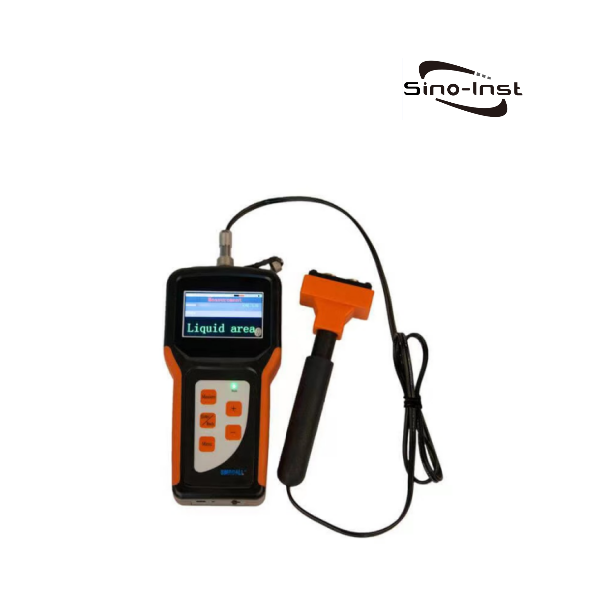
The handheld probe is placed directly against the outer wall of a gas cylinder or container and utilizes the sharp change in acoustic impedance at the gas-liquid interface to determine the liquid level boundary. It is commonly used for densely packed fire suppression cylinder arrays (CO₂, FM-200, Novec 1230), industrial propane cylinders, and small storage tanks without liquid level indicators.
Continuous External Clamp-On Ultrasonic Level Meter for Bulk Storage Tanks (HS-2000)
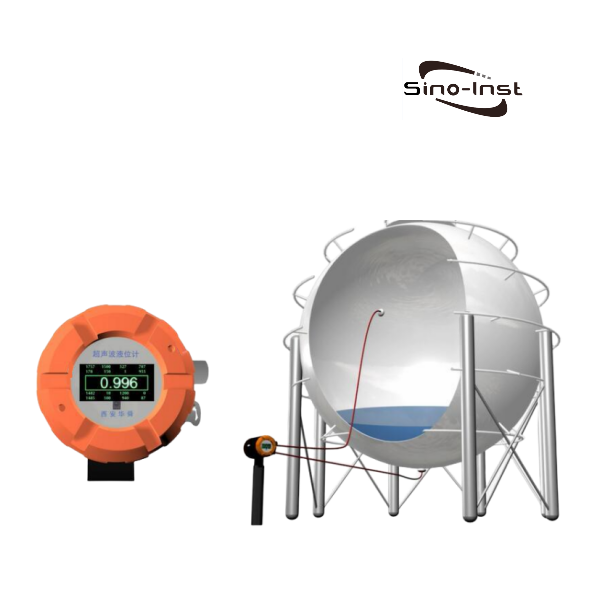
The clamp-on ultrasonic level meter utilizes the principle of sonar ranging to measure, from the bottom of the vessel in a fully isolated and non-contact manner, the liquid levels of various toxic substances, strong acids, strong alkalis, and various pure liquids within high-temperature, high-pressure, sealed vessels. The ultrasonic probe is magnetically attached or mounted via a bracket to the outer surface of the tank bottom, emitting sound waves vertically upward to penetrate thick steel plates and measure the liquid level echo. No holes need to be drilled in the container being measured, making installation simple and allowing for installation without interrupting production.
Therefore, the external clamp-on ultrasonic level transmitter is the instrument of choice for retrofitting existing tanks.
Quick installation and commissioning, thereby reducing construction and maintenance costs.
The measuring probe and main unit contain no moving mechanical parts; they are strictly sealed and isolated from the outside environment, preventing wear or corrosion.
CE certified and Exd IIC T6Gb certified.
Optional liquid level switches, liquid level alarms, or 4–20 mA / RS485 remote transmission for integration with a DCS.
TOP 2 Choice: Bypass Anti-Bubble Magnetic Level Gauges (Continuous Local & Remote)
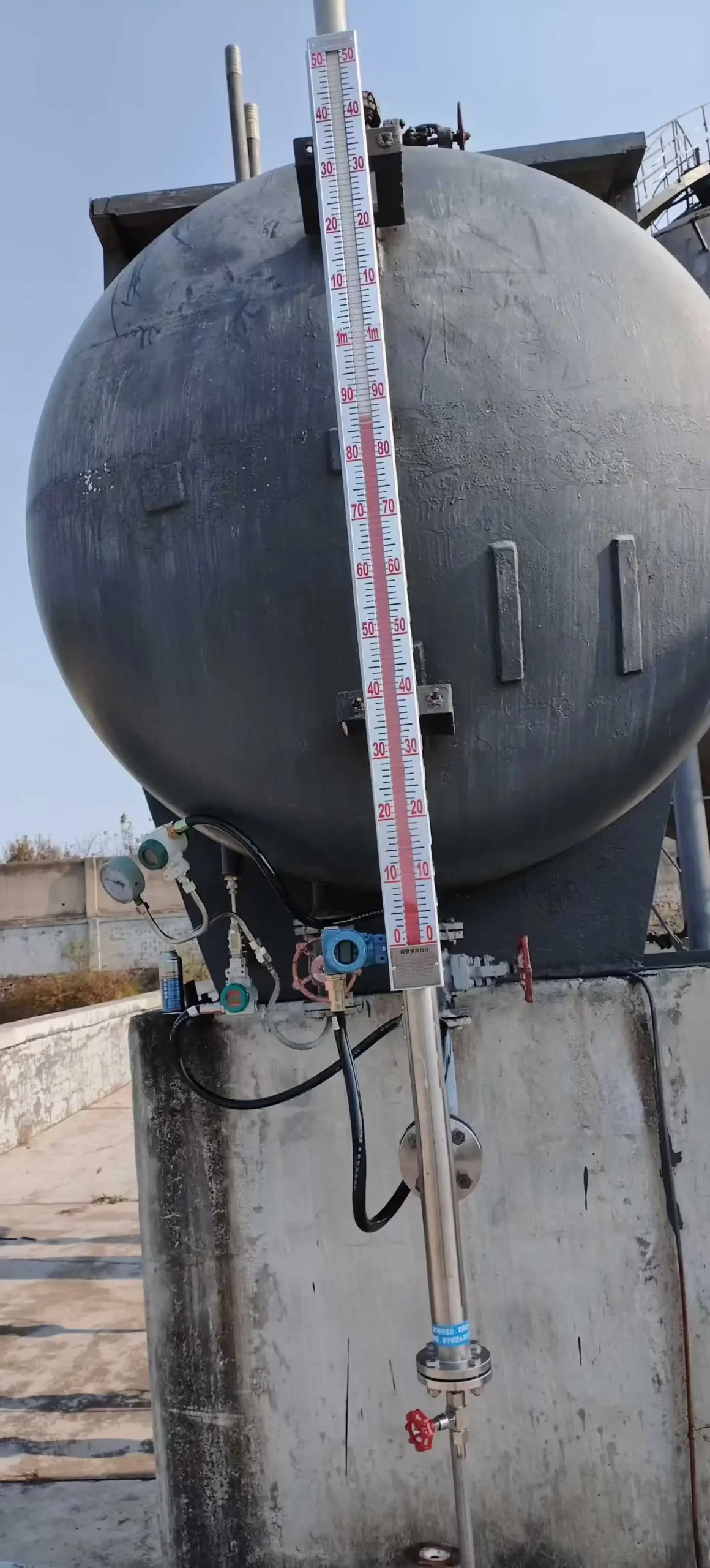
Magnetic level gauges rely on a float that rises and falls with the liquid level inside the measuring tube; magnetic coupling drives a flip-flap to indicate the liquid level. When equipped with magnetic switches and remote level transmitters, they can provide upper and lower limit alarms and control for liquid levels (or interface levels), as well as remote monitoring and control. If bubbles are present in the liquid, they may adhere to the float’s surface or move with the fluid, causing the float to bounce, jam, or display inaccurate readings.
Bubbles may form when the temperature of LPG/propane tanks fluctuates. The accumulation of bubbles reduces the apparent density of the liquid, causing the magnetic float to bounce, resulting in false liquid levels or erratic movement of the indicator columns.
Our Sino-Inst Anti-Bubble Magnetic Level Gauges feature a built-in bubble elimination device within the main chamber, which effectively suppresses erroneous liquid level readings caused by float bouncing due to bubbles, while ensuring that the float’s normal vertical movement remains unaffected. Therefore, it is an ideal solution for measuring the liquid level of highly volatile media such as propane.
No single level measurement technology fits every industrial LPG or propane installation. Your choice hinges on three factors: tank modification requirements, boiling tolerance, and downtime costs.
To help your engineering team specify the right instrument, here is a direct, side-by-side comparison of the four primary technologies used across petrochemical and bulk gas operations:
Items
Portable Ultrasonic (HS-MLI Series)
Anti-Bubble Magnetic Level Gauge
80GHz Non-Contact Radar
Differential Pressure (DP) Transmitter
Mounting Method
Handheld external probe against container wall
Side-mounted bypass chamber via process flanges
Top-mounted process nozzle (or isolation ball valve)
Greenfield mega-refineries, large Horton spheres, custody transfer
Legacy system replacement where DP piping is already installed
So, simply put, we suggest you:
Choose External Ultrasonic (HS-MLI or Clamp-On Sonar) if:
Your vessel is currently under pressure, in service, and taking it offline is out of the question.
You are inspecting manifolded gas cylinders (CO₂, FM-200, Novec 1230, or propane bottles) where traditional weighing is impractical or hazardous.
You want zero wetted parts, eliminating leak paths entirely.
Choose an Anti-Bubble Magnetic Level Gauge if:
Your operators require high-visibility, fail-safe visual inspection at the tank farm that stays functional even during full power outages.
You need a dual-purpose system: continuous local indication paired with a 4–20 mA HART signal fed directly into your plant DCS.
Your tank experiences rapid temperature swings or pressure drops that cause standard mechanical floats to bounce.
Choose 80GHz Radar if:
You are designing a greenfield, large-capacity storage sphere from the ground up, complete with a pre-engineered stilling well and full-bore isolation ball valve.
You require custody-transfer measurement accuracy (±1 mm) and have the budget for complex process integration.
Case: Retrofit of an External Level Measurement System for a 51-Foot Pressurized Spherical Tank
A petrochemical refining, storage, and transportation tank farm (Delek US project) required the installation of level monitoring on an in-service, pressurized butane spherical tank with a diameter of 51 feet (approximately 15.5 meters). The site is a typical Class I, Division 1 high-risk explosion-hazard area.
The spherical tank had been in operation for many years, and there were no spare flange openings on the tank top. Compounding the challenge, the carbon steel wall at the tank’s base is 1.125 inches (approximately 28.5 mm) thick. Conventional externally mounted ultrasonic sensors have low transmission power; when penetrating nearly 30 mm of thick alloy steel plate, the acoustic energy attenuates significantly, and multiple echoes within the plate easily drown out the true, faint liquid level signal. Switching to a through-hole radar would require tank cleaning, draining, and nitrogen purging, resulting in downtime losses of tens of thousands of dollars per incident.
Solution:
Sino-Inst engineers selected a high-power, low-frequency sonar transducer tailored for this application, paired with a highly viscous acoustic coupling agent designed for harsh outdoor conditions. The host algorithm was configured to filter out reflection noise originating from within the thick steel wall. The sensor was directly affixed to the outer wall at the bottom of the spherical tank, and the acoustic pulses successfully penetrated the 28.5 mm carbon steel plate to clearly lock onto the butane level echo.
The entire installation and commissioning process required no tank emptying or structural modifications to the tank, and production was not halted for even a single minute. The continuous level monitoring retrofit was completed with zero risk of downtime.
Order Guide
To ensure accurate product selection and pricing, please provide the following five key parameters when contacting Sino-Inst to submit an inquiry:
Vessel Type and Installation Method (Vessel Profile):
Industrial cylinder, horizontal bullet tank, or spherical tank (Horton Sphere)?
Medium Composition and Phase (Medium Characteristics):
Pure propane, butane, or an industrial LPG mixture?
Tank Wall Material and Thickness:
Material (carbon steel/stainless steel) and exact wall thickness (mm) (a key parameter for ultrasonic sound velocity calibration).
Operating Pressure and Design Temperature:
Common operating conditions: ambient temperature, operating pressure of 1.6 MPa, 2.5 MPa, or up to 4.0 MPa.
Monitoring Purpose and Output Format:
Portable periodic inspection? On-site mechanical direct reading? Or 4–20 mA / HART / Modbus remote transmission?
Tank gauging systems measure the liquid level, temperature, and, if necessary, pressure or density inside the tank, then convert the readings into storage volume or mass and send them to…
The portable ultrasonic liquid level indicator is a non-contact, handheld detection device primarily used to quickly determine the presence of liquid at a specific height within a sealed container without…
The Portable Intrinsically Safe Ultrasonic Level Sensor is a specialized instrument designed to measure the liquid level in tank trucks or monitor the presence of liquid at a specific location…
The Magnetic Float Level Gauge continuously measures the liquid level in a tank based on the principles of buoyancy and magnetic coupling. It indicates changes in liquid level by utilizing…
Stilling Wells are ingeniously designed to suppress liquid surface fluctuations and turbulence, ensuring high-precision level measurements. Surface disturbances are a problem in level measurement, whether using contact or non-contact methods…
Pressure transmitters and differential pressure transmitters can be used to measure the level of liquids such as water or fuel in vented or sealed tanks. And in many special working…
Zhang Wei, possesses 20 years of experience as an automation instrumentation engineer, specializing in the research, design, installation, commissioning, and maintenance of automation instruments.
Face to various instrument communication protocols (such as Modbus, Profibus, etc.), with solid hardware circuit design and software programming skills (proficient in C language and PLC programming). Has extensive project experience; projects he has led and participated in have all achieved outstanding results, improving product accuracy, reducing costs, and increasing production efficiency.
Possesses excellent communication and coordination skills and a strong team spirit, enabling him to quickly respond to customer needs and provide high-quality automation instrumentation solutions.
Want to see more of our engineering guides in Google Search? Add Sino-Inst as a preferred source.