Dry Materials-Bulk Solids-Powder Level Sensors Guide
Powder level sensors are mainly used for the measurement of powders and bulk solids such as silos, storage tanks, and silos. The level measurement of powders can be divided into…

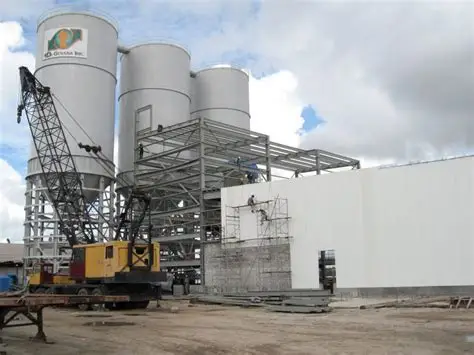
Accurate level monitoring in cement silos is directly related to production scheduling efficiency, inventory management accuracy, and equipment operational safety. This is particularly true in core stages of cement production, such as raw material storage and finished product warehousing. Cement is a dry, powdered material with a low dielectric constant (typically only 1.8–2.5) and high flowability, which can easily result in sloping material surfaces and large amounts of suspended dust inside the silo. Traditional ultrasonic and weight-drop level transmitters often suffer from measurement inaccuracies due to signal attenuation and mechanical jamming.
Combining the latest radar and 3D radar technologies, let’s take a look at the available sensors and indicators for cement silo level measurement.
Cement production generally includes stages such as raw material crushing, raw material pre-homogenization, raw meal grinding, clinker calcination, cement grinding, finished product storage, packaging, and bulk shipping. Each stage involves material storage and level management. The measurement environment in cement silos is relatively harsh.
Continuous measurement of material levels in cement silos has always been a challenge. Initially, workers had to climb to great heights to visually inspect the silos and tap the silo walls to gauge the material level. Later, drop-weight level transmitters were used. Since the measuring instrument came into direct contact with the material during measurement, various problems often arose during use, such as material buildup, broken hammers, or hammers becoming buried. Later, ultrasonic measurement was adopted, but due to the impact of dust, measurement accuracy was not high. It wasn’t until the application of radar measurement technology that it became the most widely used non-contact measurement method today.
Starting in the late 1990s, 6 GHz non-contact radar level transmitters emerged, followed by 26 GHz models, and most recently, 80 GHz radar level transmitters—which have seen the most significant advancements over the past decade or so. In the cement industry, radar level transmitters have virtually monopolized the field of level measurement, with an adoption rate reaching 90%.
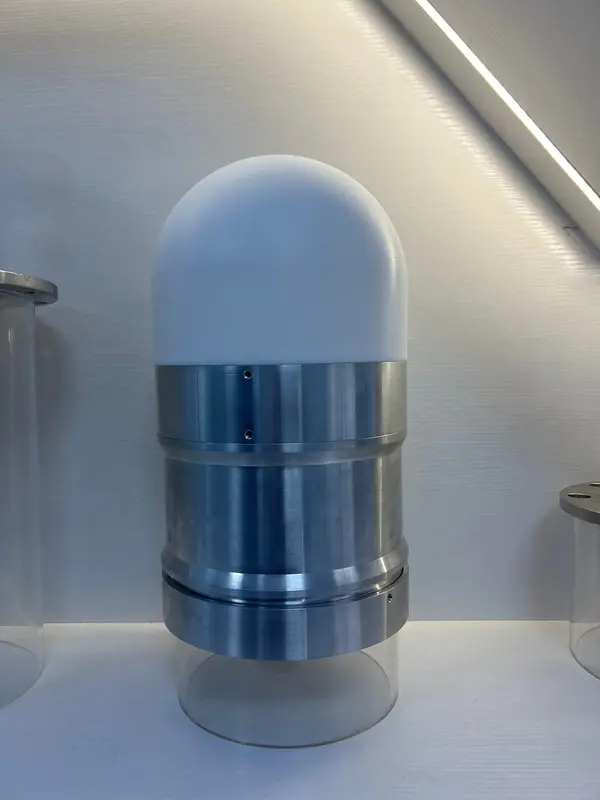
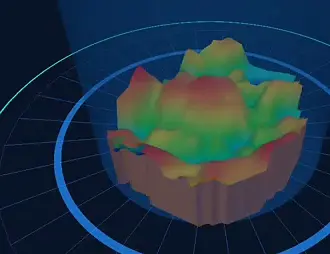
In recent years, 3D level scanners have also gained popularity among users. These scanners integrate high-frequency radar ranging, precision mechanical scanning, and artificial intelligence algorithms. By performing a comprehensive, high-density, three-dimensional scan of the entire silo interior, they construct a real-time 3D point cloud model of the material inside the silo. This enables the precise acquisition of multidimensional data, including the material’s surface topography, volume, mass, and level (maximum, minimum, and average).
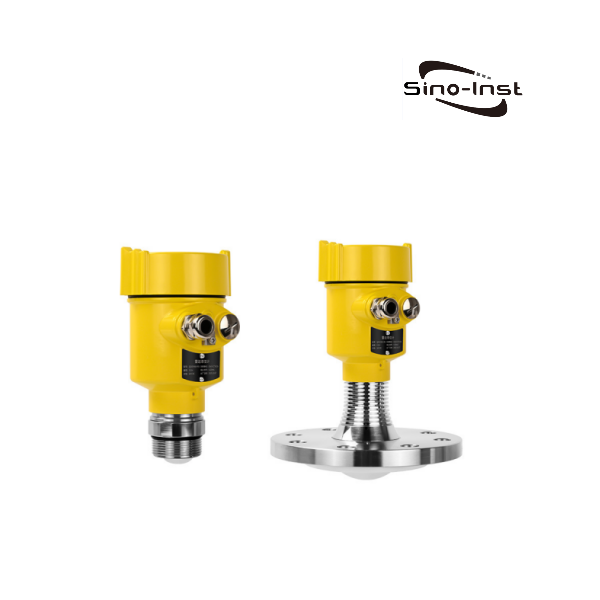
Of course, in addition to radar technology, certain special operating conditions may also require the use of capacitive level transmitters, guided-wave radar level transmitters, and drop-weight level transmitters. However, for continuous level measurement in most cement silos, 80 GHz radar level transmitters and 3D level scanners are sufficient. Below is a comparison of their specifications for your reference:
| Parameter | 80 GHz Radar FMW21 | 80 GHz Radar FMW21S | 3D Radar Level Scanner |
|---|---|---|---|
| Measurement method | Single-point distance | Single-point distance | Rotating and pitching scan of the whole material surface |
| Operating frequency | 76–81 GHz (center 80 GHz) | 76–81 GHz (center 80 GHz) | 80–140 GHz FMCW |
| Measuring range | 0.1 m~30 m / 0.3~150 m | 0.1 m~30 m / 0.3 m~150 m | Measuring radius ≤40 m |
| Accuracy | ±5 mm (distance) | ±5 mm (distance) | Volume accuracy ≤±2%–3% of full range |
| Beam angle | 3° | 3° | 1.5° |
| Output | Level or distance at one point | Level or distance at one point | 3D point cloud (PCD); highest, lowest and average level; volume; mass (calculated from on-site density) |
| Installation | Flange ≥DN80 | Flange ≥DN80 | DN200 opening on silo roof, at about 1/4 of silo diameter, at least 2 m from the feed inlet |
| Process temperature | −40~150 ℃ / −40~200 ℃ | −40~80 ℃ | Standard −25 ℃ to 75 ℃; higher with cooling accessories |
| Signal output | 4…20 mA/HART; six-wire adds RS485/Modbus | Same as FMW21 | Ethernet / fiber optic / 4G / 5G; optional output module: RS485, MODBUS TCP, 4…20 mA |
Level indicators are primarily designed to measure and indicate material levels at a single point. Their main functions include: high-level alarms (to prevent silo overflow), low-level alarms (to prevent material shortages), and interlock control for conveying systems.
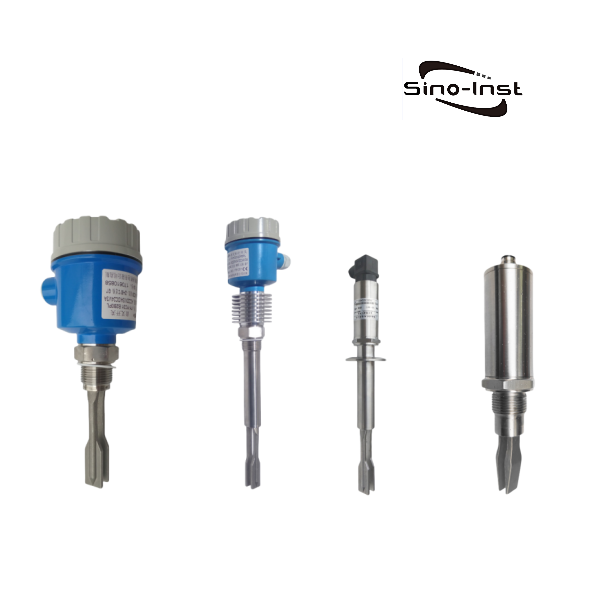
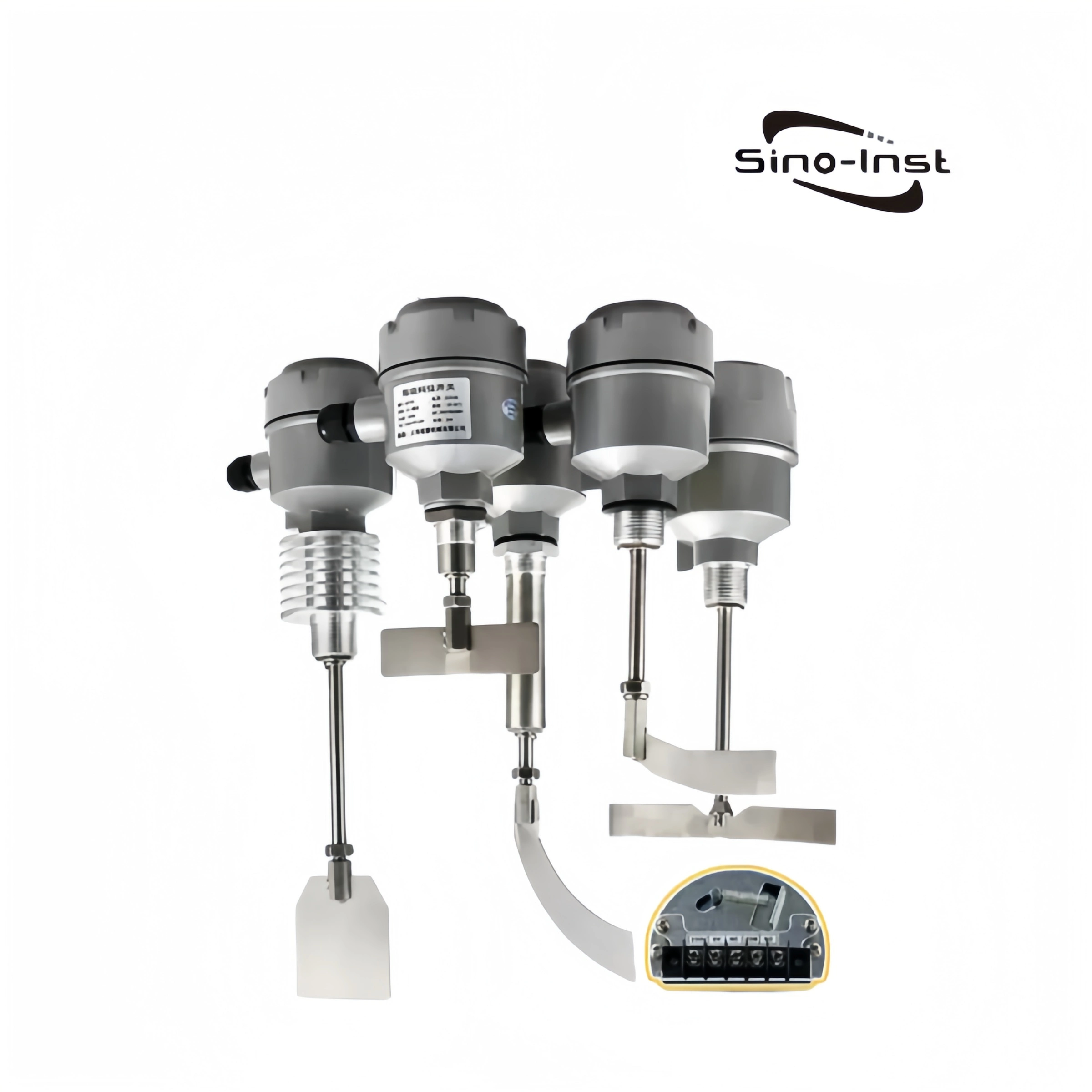
Tuning-fork vibrating level switches and rotary paddle level switches can be used as level indicators for cement silos.
A tuning fork level switch uses a piezoelectric crystal to drive the tuning fork to vibrate at its natural resonance frequency. When the tuning fork comes into contact with material, the vibration frequency and amplitude decrease; the intelligent circuit detects this change and outputs a switch signal to detect the material level.
In a rotary paddle level switch, a miniature motor inside drives the paddle to rotate at a low speed. When material blocks the paddle, the torque increases, triggering an internal microswitch to output a “material present” signal and cut off the motor’s power supply. After the material level drops, a spring resets the system, allowing the paddle to rotate again and return to the “no material” state.
| Parameter | Rotary Paddle Level Switch | Vibration Tuning Fork Level Switch |
|---|---|---|
| Media | Solids (blocky or powdery) | Liquids, powders, granules |
| Min. density | 0.5 g/cm³ | Solids ≥0.1 g/cm³ |
| Medium temperature | −10~+80 ℃ (up to 450 ℃ optional) | −20~+220 ℃ |
| Pressure | 0~0.2 MPa | −0.1~+4.0 MPa |
| Output | SPDT relay, 5 A 250 VAC | Relay or NPN |
| Explosion-proof | Ex d IIB T4 | Ex d IIB / IIC T1~6 |
| Connection | G1″ thread, 2.5″ flange | G1/2″~G1″ thread, flange, clamp |
Initially, the need for monitoring cement silo material levels was limited to determining whether the level had reached high or low limits. Later, users sought to know the exact material level height. Now and in the future, users will increasingly favor comprehensive scanning of the material surface and silo sidewalls to visualize the internal state of the silo.
There are two approaches to achieving the transition from reading the material level in a silo to calculating inventory.
First, use a level sensor combined with a volume recorder. The level sensor provides a level signal, and the volume recorder converts the level into volume or mass based on the silo’s dimensions. This approach requires the silo to have a regular shape. Additionally, a single set of equipment is generally suitable for only one silo.
Second, use a 3D radar level scanner. This method directly measures cement inventory with high precision and provides a visual representation. For open stockpiles or irregularly shaped silos, multiple level scanners can be installed. The image stitching and registration algorithms running on a cloud server automatically integrate the 3D data collected by multiple devices to present comprehensive measurement results.
Please keep in mind that the selection of a cement silo level measurement solution must be based on both the cement silo parameters and your monitoring and control requirements; both aspects must be clearly defined in advance.
1. Silo Parameters
2. Monitoring Requirements
For example, if the site has high dust levels, tall silos, and frequent material flow, we recommend a combined solution of “continuous radar level measurement + vibrating rod level switch for limit protection.” This configuration for cement silo level measurement is more comprehensive and better meets the automation management needs of modern cement silos.
From raw material storage and clinker handling to the shipment of finished cement, level data is integral to multiple stages of cement production and material management. Sino-Inst’s cement level sensors not only display the material level inside silos but also provide reference data for production planning, inventory tracking, equipment coordination, and transportation scheduling.
Why Sino-Inst? With over a decade of experience in level measurement, we can configure the right products for both continuous level measurement and point-level measurement and alarm applications. Feel free to contact our sales or engineering teams at any time to provide your cement silo parameters and measurement requirements. We will customize a suitable cement silo level measurement solution for you.
Zhang Wei, possesses 20 years of experience as an automation instrumentation engineer, specializing in the research, design, installation, commissioning, and maintenance of automation instruments.
Face to various instrument communication protocols (such as Modbus, Profibus, etc.), with solid hardware circuit design and software programming skills (proficient in C language and PLC programming). Has extensive project experience; projects he has led and participated in have all achieved outstanding results, improving product accuracy, reducing costs, and increasing production efficiency.
Possesses excellent communication and coordination skills and a strong team spirit, enabling him to quickly respond to customer needs and provide high-quality automation instrumentation solutions.
Want to see more of our engineering guides in Google Search? Add Sino-Inst as a preferred source.