Home > Blog > Explosion-Proof FMCW Radar for Water, Methanol and Acids
Explosion-Proof FMCW Radar for Water, Methanol and Acids
FMCW (Frequency-Modulated Continuous Wave) radar level meters, also known as FMCW radar level sensors, calculate the distance to liquid surfaces by comparing frequency differences between transmitted signals and reflected echoes. These devices feature small measurement dead zones and deliver millimeter-level measuring accuracy. Most commercial 80 GHz radar level meters on the market adopt this technical solution.
We recently received a technical inquiry from one chemical industry customer. The instrument needs to measure water, methanol and acidic liquids. The technical requirements include explosion-proof grade Ex ia IIC T4, measuring range 0-40 m, 4-20 mA/HART signal output, 2-inch flange process connection, and SS316L as wetted-part material.
Our 80 GHz FMCW radar meets the Ex rating, output and material requirements. Two items need adjusting: the full 40 m range calls for a DN80 flange, and hydrochloric or dilute sulfuric acid calls for a PTFE-lined flange instead of bare SS316L. Below are the four checks we ran before quoting: Ex rating, media, range and antenna material.
Ex ia (intrinsically safe) is applicable for Zone 0/Zone 1 hazardous areas and fits this measuring application. Ex ia IIC T4 represents high-grade intrinsic-safety protection.
Methanol is a Group IIA gas. IIC equipment also covers IIA and IIB, so the rating has margin. It matters here for another reason: dilute acids attacking carbon steel can release hydrogen, which is a IIC gas.
T4 limits the instrument’s surface temperature to 135 °C, well below methanol’s auto-ignition temperature. Water and the acids themselves are not flammable.
Considerations Regarding Medium Characteristics
Water delivers a stable dielectric constant and generally poses no measurement difficulty, yet condensation tends to form on the antenna surface.
Water (εr ≈ 80), methanol (εr ≈ 33), and acids such as sulfuric acid or hydrochloric acid all have relatively high dielectric constants. They produce strong echo signals, making them good candidates for radar level measurement.
Measurement Range Margins
The nominal 0-40 m measuring range is obtained under ideal lab conditions. In real-world deployment, you have to subtract the dead zone below the mounting flange; effective measuring distance may also shift depending on medium properties. When choosing equipment, add a 10%-20% safety margin and avoid running the instrument at its absolute maximum rated range.
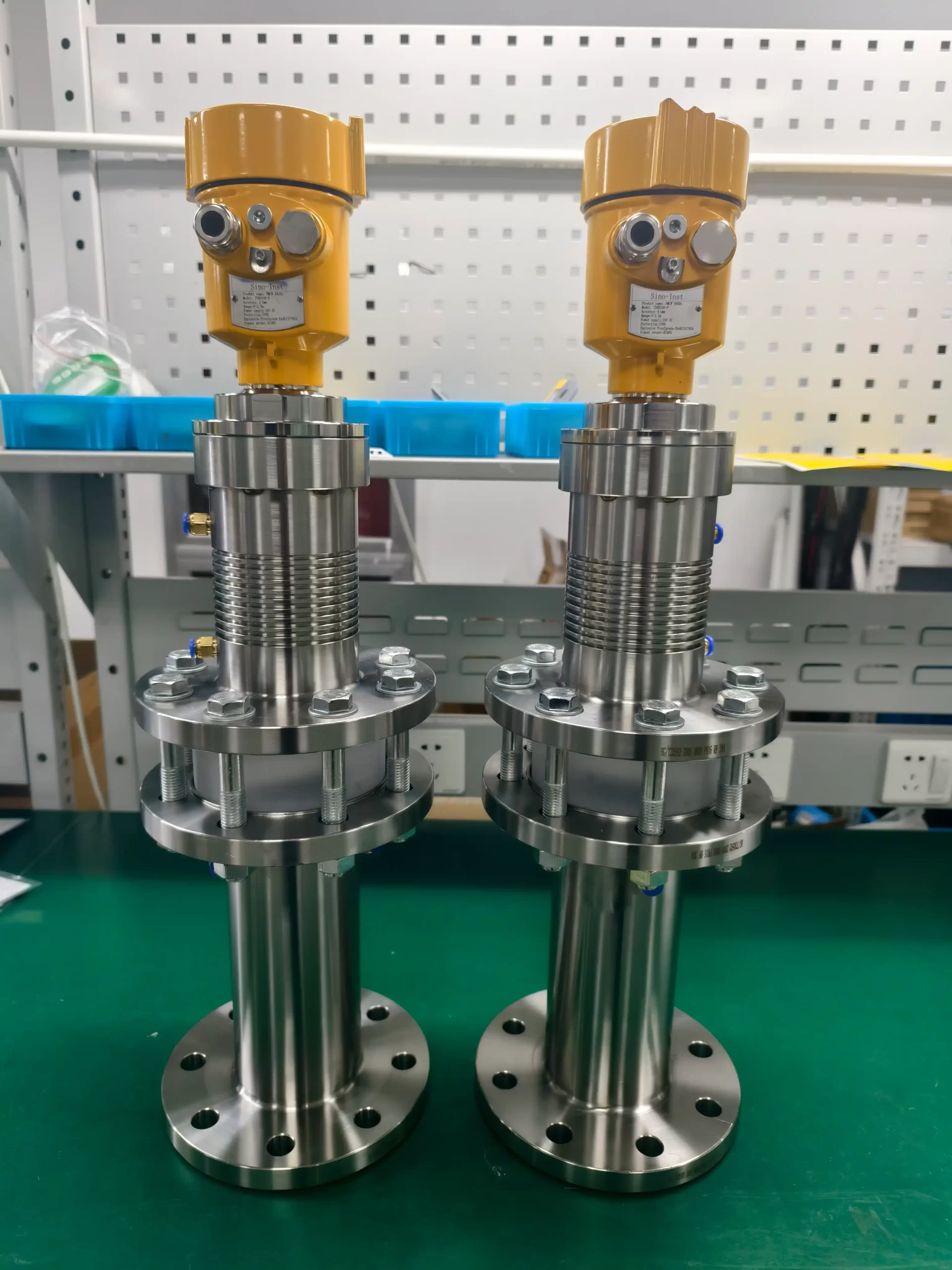
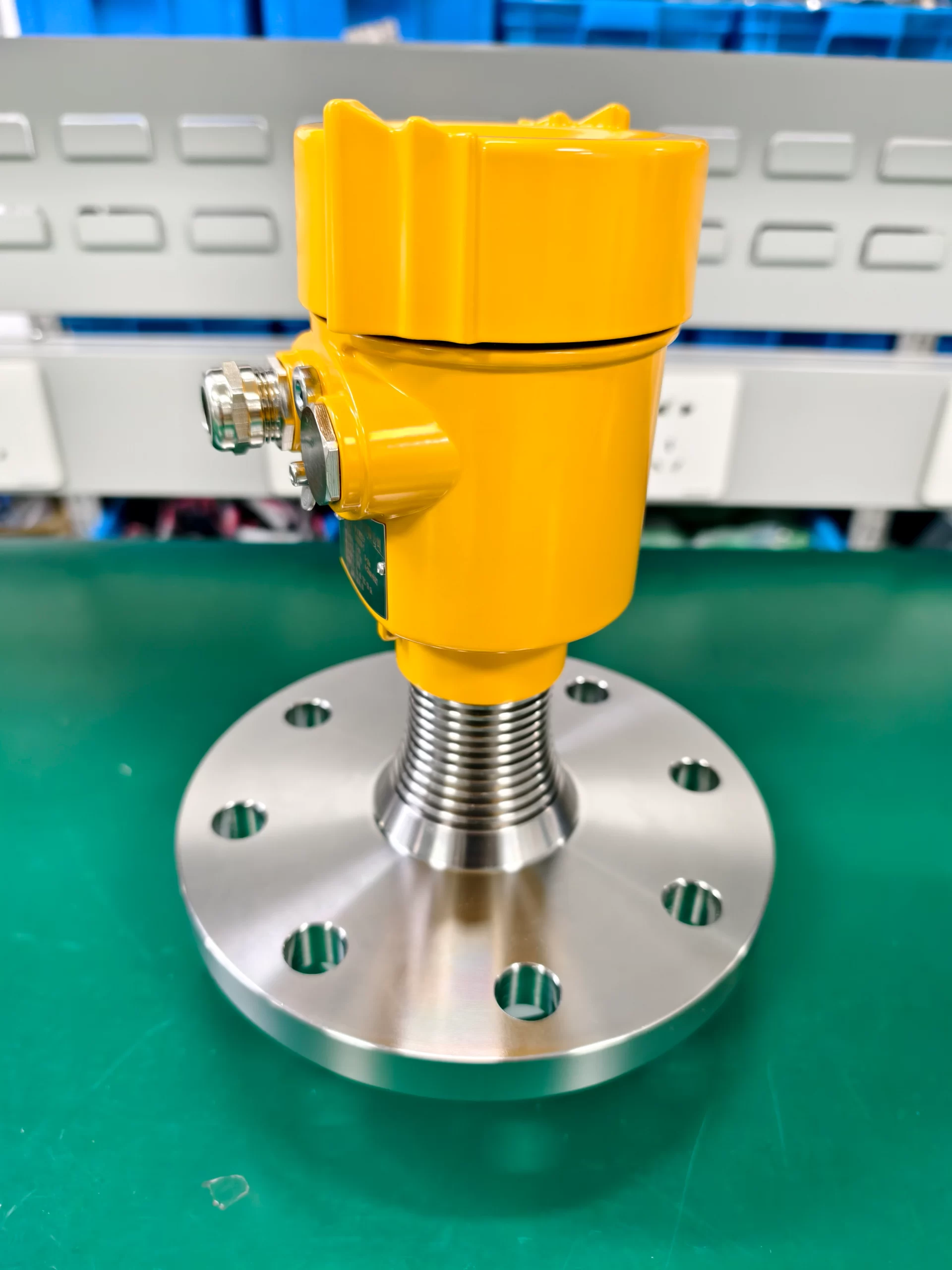
Methanol and acids reflect strongly, so at 40 m the limit is beam spread, not echo strength. A 2-inch flange takes a 44 mm lens with a 6° beam (about 4.2 m spot at 40 m), and that model is rated to 30 m. For the full 40 m, use a DN80 flange with a 76 mm lens: 3° beam, about 2.1 m spot, rated to 150 m. Keep the beam clear of tank walls, feed nozzles and internals.
FMCW Radar Measurement Principle
FMCW (Frequency-Modulated Continuous-Wave) radar level meters work by emitting continuous waves with linearly changing frequency. By comparing instantaneous frequency differences between echo signals and transmitted signals, the unit calculates both target distance and velocity.
The FMCW radar level sensor acts as the core measuring component. It handles signal transmission, receiving and preliminary signal processing, laying the foundation for high-precision level readings.
Distance Measurement Principle
Inside the sensor, the transceiver module generates microwave signals whose frequency rises linearly over time. Microwave signals are sent toward liquid surfaces via antenna, and reflected echoes are captured by the same antenna.
There is a time delay T, between the echo signal and the transmitted signal. This delay results in a frequency difference, Δf (also known as the intermediate frequency or beat frequency), between the two signals at any given moment.
Core formula:
Δf= S × 2R/c,
where S is the frequency modulation slope, R is the distance to the target, and c is the speed of light.
The greater the distance to the target, the longer the echo delay, and consequently, the larger the beat frequency. By performing an FFT (Fast Fourier Transform) on the intermediate-frequency signal to identify the peak frequency, the distance R can be calculated.
Distance resolution: ΔR = c/(2B), where B is the frequency sweep bandwidth. A larger bandwidth allows for the resolution of smaller gaps between adjacent targets.
80 GHz radar works the same way. Its advantage is bandwidth: the band allows a 5 GHz sweep, several times wider than at 26 GHz, and resolution scales with bandwidth.
Key Advantages
Why do 80 GHz FMCW radar level transmitters work well for water, methanol, acidic fluids and explosion-risk applications? This comes from a combination of practical design features: non-contact measuring mode, high-frequency microwave reflection characteristics, plus explosion-proof material and circuit implementation.
Non-contact measurement, naturally corrosion-resistant: FMCW radar measures distance by emitting microwaves through an antenna and receiving echoes from the liquid surface. It does not contact the medium at all, which eliminates wear and contamination, and it works for both liquids and solids.
Acidic fluids such as hydrochloric acid and sulfuric acid are highly corrosive. Contact-type instruments like float-type level gauges or guided-wave radars require floats or probes to stay immersed in acid for long periods. These devices need full PTFE coating, which pushes up material cost and maintenance workload.
Only the antenna and flange face are exposed to tank vapors. With a PTFE lens antenna and a PTFE-lined flange, the radar handles most acids and alkalis.
High dielectric constant generates strong echo signals: Dielectric constant is critical for radar measurement. Higher dielectric values produce stronger microwave reflection and more stable signals. Water has a dielectric constant around 80, methanol about 33, and acidic solutions generally also show high dielectric values. All these media return clear echoes, supporting ±2 mm accuracy. Even with low-dielectric media, the FMCW radar level sensor can detect faint echoes, ensuring continuous and stable measurement.
Narrow beam, small blind zone: The radar operates at 76–81 GHz with a 5 GHz sweep. The beam angle is 3° with a 76 mm lens and 6° with a 44 mm lens, so energy stays concentrated and is less likely to hit tank walls and internals. The blind zone starts at 0.1 m, and range reaches 150 m on DN80 models.
Good anti-interference performance: Water and methanol are volatile, often creating vapor or condensation inside storage tanks. Thanks to continuous signal transmit-receive cycles, the sensor collects abundant echo data and achieves a high signal-to-noise ratio. This lets the instrument reliably identify real liquid-surface echoes under steam, dust or agitator disturbance. Heavy foam and dense steam, however, attenuate 80 GHz more than 26 GHz or 6 GHz (see Step 1).
Process and safety ratings: Process temperature goes up to 200 °C (280 °C with a PEEK antenna), and pressure up to 2.5 MPa. Featuring extremely low transmission power, it can be installed in various metal or non-metal vessels and poses no harm to humans or the surrounding environment.
What Are the Differences Between FMCW Radar and Traditional Pulse-Type Radar?
Comparison of Operating Principles
The fundamental difference between FMCW radar and traditional pulse radar lies in their operating modes. Pulse radar functions intermittently—transmitting, pausing, and then receiving—and calculates distance by measuring the time delay of the return signal. In contrast, FMCW radar continuously transmits electromagnetic waves with a linearly varying frequency; it determines distance by measuring the frequency difference between the transmitted and received signals.
To use an analogy: pulse radar is like a flashlight—you flash it, wait for the reflection, and then flash it again. FMCW radar, however, is like a continuously sweeping searchlight—it emits a constant beam and identifies targets by analyzing changes in the reflected light.
Key Performance Differences
Measurement Accuracy: pulse radar typically reaches ±3–10 mm; FMCW reaches ±2 mm or better.
Blind Zone: pulse radar has relatively large dead zones (approx. 0.3-0.5 m), making it unsuitable for short-height tanks or small storage vessels. FMCW radar features small dead zones and can be mounted close to liquid surfaces.
Measurement Range: FMCW keeps a higher signal-to-noise ratio, so low-dielectric media and steam reduce its effective range less. This makes it the better fit for 0–40 m.
Interference Resistance: pulse radar has limited anti-interference capability; measurement readings tend to jump under steam, dust or agitator disturbance. FMCW radar accumulates higher energy through continuous transmission for better steam-dust penetration. Its narrow receiving bandwidth also suppresses electromagnetic interference more effectively.
Applicable Scenarios for Each Type
Pulse Radar:
Standard operating conditions—normal temperature and pressure, clean media, and an absence of significant steam or dust (e.g., typical water tanks).
Scenarios where budget is limited, and batch configuration is required.
Process control where ±10 mm accuracy is acceptable.
FMCW:
High-precision measurement scenarios.
Harsh working conditions such as high temperature, high pressure, strong dust, and strong steam.
Applications with low-profile tanks or restricted installation space.
The tank contains a complex structure with interfering sources such as stirrers.
Many buyers shopping for radar level transmitters only ask “how many GHz”, assuming higher frequency always equals better performance. This assumption does not always hold true.
4.3 GHz (C-band) Wavelength approx. 70 mm, offering strongest penetration capability. For chemical tanks with foam layers, steam condensation or suspended dust, 4.3 GHz is a reliable option; its signal can pass through foam and reach liquid surfaces. However its wide beam angle makes it vulnerable to reflection interference from internal components, especially for small-diameter tanks.
26 GHz (K-band) is the common choice for chemical tanks. Beam angle is typically 8°–18°, depending on horn size, and most units fit DN100 and larger nozzles. It suits most acid, alkali and solvent tanks.
80 GHz (W-band) produces a very narrow beam (~3°). It solves two common field problems: first, small-size tanks with DN50-DN80 nozzles where 26 GHz equipment cannot fit; second, tanks crowded with agitators, heat-exchange coils, and other internals. Note that 80 GHz performs poorly against foam and steam, so it is not recommended for foamy-liquid conditions.
Step 2: Chemical Explosion-Proof
Two critical parameters on explosion-proof nameplates are gas group and temperature group.
Gas groups fall into three categories: IIA, IIB, and IIC. IIC is the highest protection grade, covering highly ignitable gases such as hydrogen (ignition energy 17 μJ) and acetylene (19 μJ). IIA and IIB cannot substitute for higher-grade requirements. If hydrogen exists on-site, IIB-certified instruments cannot be deployed. Chemical plants handling hydrogen-containing media must select IIC-graded equipment.
Methanol auto-ignites at about 440–464 °C, far above 135 °C, so T4 is enough. The rule is that the gas’s auto-ignition temperature must exceed the T-class limit: above 135 °C needs T4, 100–135 °C needs T5, and 85–100 °C needs T6.
Step 3: Antenna Material
For chemically corrosive media, PTFE (polytetrafluoroethylene) is the preferred antenna material. PTFE resists strong acids, strong alkalis, and organic solvents, and is widely used for chemical corrosion-protection purposes.
Flat-style PTFE antennas easily accumulate residues when handling viscous or crystallizing-precipitating media. Over time, deposits build up on antenna surfaces and distort echo signals. Curved-arch antenna design mitigates this issue, as liquid media are less likely to stick and remain on curved surfaces.
A radar level transmitter is an instrument that uses microwaves to measure the level of liquids or solids; it can determine the level without coming into contact with the medium.
Typical applications include storage tanks in the petrochemical industry; storage tanks for fine chemicals or corrosive media; storage tanks for grain, oil, and related products; level measurement in marine or shipping tanks; process tanks, such as those equipped with agitators or reactors.
Steam and condensation attenuate 80 GHz more than lower frequencies, but the narrow beam usually still picks up the surface. Process temperature is rated up to 200 °C, or 280 °C with a PEEK antenna. Keep the housing within its ambient temperature limit.
Ensure the antenna is aligned vertically with the target surface to prevent tilting, which could cause the signal to strike the tank wall. Avoid internal obstructions such as agitators, heating coils, or structural supports. The length and diameter of the mounting nozzle (standpipe) must meet the instrument’s specifications; an excessively long nozzle can weaken the signal. In applications involving significant foaming or highly turbulent liquid surfaces, the use of a stilling well or a guided-wave pipe is recommended.
FMCW radar level transmitters deliver high-precision measurement, good anti-interference performance and wide-range adaptability, making them preferred instruments for demanding industrial working conditions. Our 80 GHz FMCW radar level meter supports 0–40 m level measurement (DN80 flange for the full range), and satisfies Ex ia IIC T4 explosion-proof certification and HART output requirements.
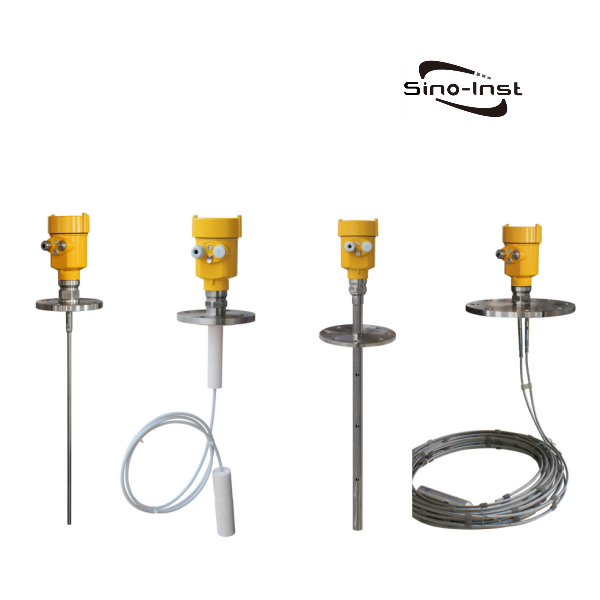
Sino-Inst supplies full-series 80 GHz radar level transmitters built on FMCW technology, fitted with mature FMCW radar sensors. Customized product development is available according to customer-specific parameters.
If you intend to purchase 80 GHz radar level transmitters or require technical consultation regarding FMCW radar level sensors, please get in touch with our engineering team.
For reactors, buffer knockout tanks and similar process equipment, operating temperatures tend to run high, and steam together with condensate commonly appear within the vessel gas space. When carrying out…
For a project involving level measurement in a sodium hydroxide (NaOH) storage tank, the client had previously used pressure-based level transmitters. Given the corrosive nature of the strong alkaline medium,…
What is a Radar Level Sensor? A radar level sensor is an instrument that uses microwave echo ranging to measure liquid levels non-contactly. It can measure both liquid and solid…
In industries such as chemical engineering, metallurgy, pharmaceuticals, electroplating, and sulfuric acid storage and transportation, sulfuric acid, as a basic raw material, is extremely corrosive. 98% concentrated sulfuric acid is…
Zhang Wei, possesses 20 years of experience as an automation instrumentation engineer, specializing in the research, design, installation, commissioning, and maintenance of automation instruments.
Face to various instrument communication protocols (such as Modbus, Profibus, etc.), with solid hardware circuit design and software programming skills (proficient in C language and PLC programming). Has extensive project experience; projects he has led and participated in have all achieved outstanding results, improving product accuracy, reducing costs, and increasing production efficiency.
Possesses excellent communication and coordination skills and a strong team spirit, enabling him to quickly respond to customer needs and provide high-quality automation instrumentation solutions.
Want to see more of our engineering guides in Google Search? Add Sino-Inst as a preferred source.