Home > Blog > Non-Contact Level Measurement for NaOH Caustic Tanks
Non-Contact Level Measurement for NaOH Caustic Tanks
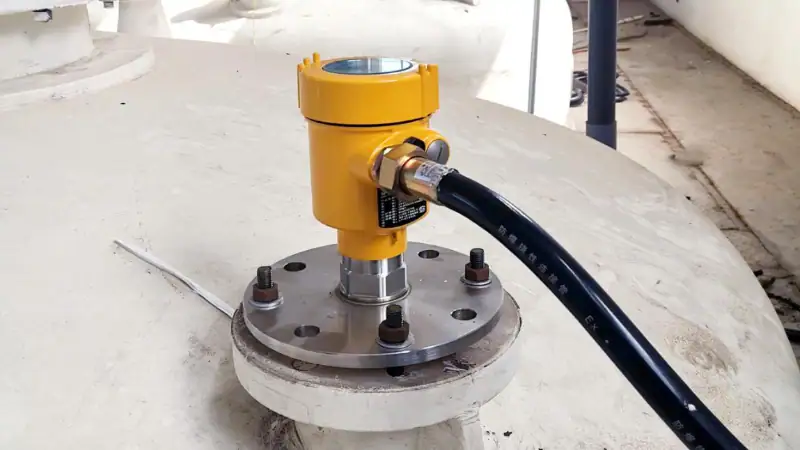
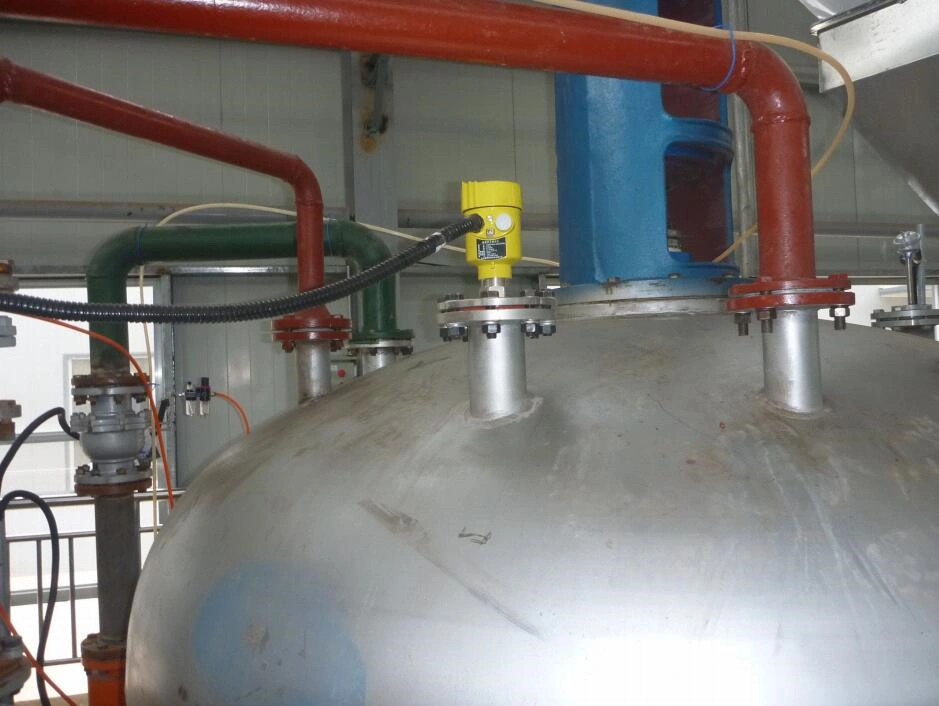
For a project involving level measurement in a sodium hydroxide (NaOH) storage tank, the client had previously used pressure-based level transmitters. Given the corrosive nature of the strong alkaline medium, we recommended an 80 GHz non-contact radar level transmitter; compared to ultrasonic alternatives, this instrument offers superior corrosion resistance and effectively handles in-tank condensation issues.
Below is an in-depth comparison between non-contact radar level meters and ultrasonic level meters, covering practical measurement principles, applicable working conditions, and real-world measuring accuracy.
A non-contact sensor detects target status, including presence, position, distance, movement or temperature without making physical contact with measured objects. It sends out or receives different forms of energy such as light, electromagnetic waves, acoustic waves, magnetic or electric fields, captures changes from target objects, and converts these signals into electrical outputs.
Radar level meters and ultrasonic level meters are typical non-contact level measuring devices.
A non-contact radar level meter takes level readings without touching process media directly. It works based on transmitting, reflecting and receiving high-frequency microwave signals (26GHz or 80GHz for instance). Liquid height is calculated according to the round-trip signal travel time.
Non-contact ultrasonic level meters also avoid direct medium contact. They send and receive ultrasonic pulse signals to work out the distance between sensors and liquid or solid surfaces.
Non-Contact Radar Level Meters vs. Ultrasonic Level Meters
Working Conditions: NaOH storage tanks run under highly corrosive conditions. Caustic mist and condensed water vapor tend to build up within the tank vapor space. Temperature shifts may create vapor layers, and caustic salt crystallization occurs under some process conditions. Both instruments mount on tank roofs as non-contact level sensors. Even so, differences in working principles lead to obvious gaps in field performance under such conditions.
1. Measurement Principles
Working Principle of Non-Contact Radar Level Meters
Non-contact radar level meters adopt high-precision antennas (mostly for 26 GHz or 80 GHz high-frequency microwaves). Microwave pulses or frequency-modulated continuous wave (FMCW) signals are aimed at liquid surfaces inside tanks. Microwaves travel through air at the speed of light, passing through air, vapor or dust layers inside tanks until they reach liquid surfaces.
When microwaves hit the surface of NaOH liquid, part of signal energy bounces back as echoes thanks to the liquid’s high dielectric constant; the rest of energy passes through the liquid medium.
Antennas pick up echo signals. Signal processing units work out liquid level values using the time difference (Δt) between signal transmission and reception together with light speed.
Calculation formula:
h = H − (c × Δt) / 2
Where: H = total height of storage tank; c = speed of light.
High-frequency radar units, especially 80 GHz models, improve ranging accuracy via frequency difference calculation. They feature short wavelength (roughly 3.75 mm) and narrow beam angle down to 3°~5°, delivering highly concentrated signal energy. For this reason, 80 GHz non-contact radar level meters are preferred.
Working Principle of Non-Contact Ultrasonic Level Meters
Electrical signals drive ultrasonic transducers to generate high-frequency acoustic pulses, normally ranging from 20 kHz to 200 kHz. These sound pulses propagate inside tanks through air or process gas and bounce off NaOH liquid surfaces driven by acoustic impedance differences.
Reflected sound signals travel back along their original paths, get captured by the same transducer and transformed into weak electrical signals. Instruments record total round-trip time T.
Calculation formula:
S = C × T / 2
Where: S = distance from transducer to liquid surface; C = speed of sound in air.
Sound speed C changes with ambient temperature (approximate formula: C ≈ 331.4 + 0.6T), so temperature compensation is required. Subtract S from tank height or installation height value to get actual liquid-level readings.
2. Measurement Accuracy
For corrosive chemical applications such as NaOH storage tanks, radar level meters generally provide better accuracy and field stability compared to ultrasonic alternatives.
Radar level meters applied on NaOH tanks can reach ±1 mm accuracy, which outperforms ultrasonic units whose accuracy typically falls between ±5 mm and ±30 mm.
80 GHz non-contact radar level meters achieve accuracy ranging from ±0.5 mm to ±2 mm. Such precision stays consistent in long-term operation even when working with high temperature, vapor, foam or sealed tank environments common for NaOH storage systems.
Ultrasonic level meters usually deliver ±5 mm~±30 mm accuracy. Their performance is heavily influenced by temperature, vapor and foam. Measurement errors will grow when deployed under complex working conditions inside NaOH tanks.
3. Applications
Non-contact radar level meters fit for:
Sites with heavy steam, smoke, dust or foam
Volatile medium measurement (hot oil, solvent etc.)
Sealed vessels under high-temperature and high-pressure conditions
Applications calling for high-precision measurement or media with low dielectric constant (for example LNG, propylene; guided-wave radar is suggested for these cases)
Non-contact ultrasonic level meters fit for:
Clean water reservoirs, fire-water tanks, river water and well-water monitoring
Simple working conditions: normal ambient temperature & pressure, no foam or steam
Cost-sensitive projects with moderate accuracy requirement (±0.25% FS)
4. Resistance to Steam and Condensation Interference (A Key Pain Point for Caustic Soda Tanks)
Ultrasonic level meters send out mechanical sound waves that rely on air as the propagation medium. Sound speed varies along with temperature changes (around 0.6 m/s per °C). High-temperature steam absorbs acoustic energy, which causes signal attenuation or even complete signal loss.
Condensate droplets sticking onto transducer surfaces create false reflection interfaces and trigger measuring errors. Therefore, under heavy steam or severe condensation, ultrasonic instruments may suffer measuring drift, loss of signal lock, or errors exceeding 50 mm.
Radar level meters transmit electromagnetic microwave signals (26 GHz or 80 GHz). Electromagnetic waves need no physical transmission medium and are barely affected by steam or condensation. High-frequency radar comes with narrow beam angles (3°-8°) and good penetration capability, securing stable echo reflection from liquid surfaces. According to field test data, even inside an 85 °C hot-water tank with persistent heavy steam, radar echo strength remains stable, and measurement error stays below ±2 mm.
Radar level meters show low sensitivity to water vapor and caustic mist inside tanks. Vapor layers will not cause obvious signal drift, and measuring performance remains steady.
Comparison Item
Radar Level Meter
Ultrasonic Level Meter
Interference Resistance
Virtually unaffected by steam, mist, or dust
Susceptible to interference from steam, foam, dust, and temperature fluctuations
Accuracy
±1–5 mm (FMCW type: ±0.5–2 mm)
±5–30 mm; significantly affected by temperature
Measurement Range
0.05–60 m (High frequency type: up to 100 m)
0.1–30 m (Large models)
Blind Zone
0.05–0.3 m
0.05–1 m
Suitability for Sealed Vessels
Yes (PTFE window)
No (sound waves cannot penetrate)
Cost
High
Low
Selection Recommendation
For NaOH storage tanks, 80G non-contact radar level transmitters are our primary recommendation. Ultrasonic level transmitters suffer obvious impact from caustic mist and condensation. They tend to have high failure rates in long term field operation and are not advised for this application.
Technical Advantages of 80GHZ Radar Level Meters
Non-contact measurement suitable for highly corrosive and harsh media. Designed for tank-top installation and free-space measurement, it is particularly well-suited for corrosive or prone-to-crystallization media such as sulfuric acid, hydrochloric acid, liquid alkali, sodium hypochlorite, and sewage.
Ultra-narrow beam for precise interference avoidance. With an 80GHz wavelength of only ~3.75mm, the beam angle can be as narrow as 3°–5°—significantly tighter than the 8°–12° range of 26GHz systems. Highly concentrated energy allows the signal to penetrate internal obstructions such as supports, heating coils, agitators, and feed inlets.
Strong interference immunity. In complex environments involving dust, steam, foam, or agitation, the 80GHz radar signal offers superior penetration and high backscatter efficiency; combined with wide-bandwidth FMCW technology (up to 4GHz), it clearly isolates the true liquid level echo.
High precision and minimal dead zone. It delivers millimeter-level accuracy (±1mm to ±2mm) and an extremely short dead zone, making it ideal for small-diameter mounting ports, narrow tanks, and full-range measurement. With a range extending from tens to over a hundred meters, it meets the continuous monitoring needs of medium-to-large vessels.
No moving mechanical parts or impulse lines; requires minimal maintenance. Suitable for long-term operation in industries such as chemicals, water treatment, environmental protection, pharmaceuticals, food processing, and petrochemicals, thereby reducing total lifecycle O&M costs.
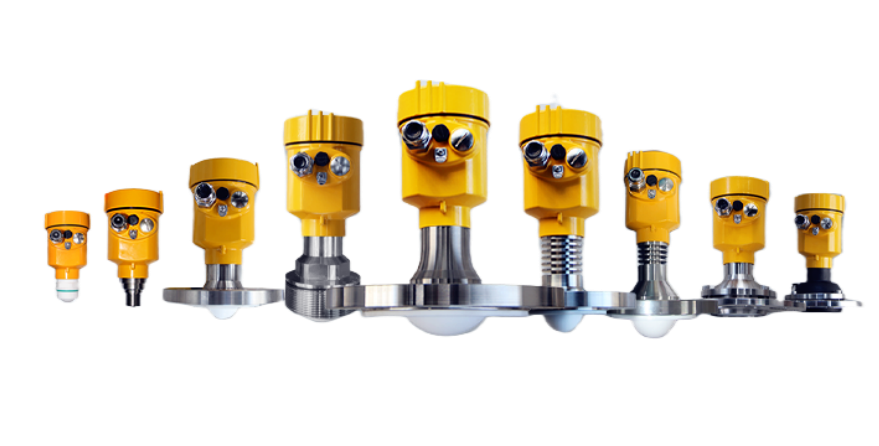
Lens antenna, can be equipped with lens antenna shield/anti-corrosion antenna/antenna heat sink/quartz isolation flange
Process Pressure
(-0.1~4)MPa
Product Dimension
φ100*270mm
Cable Entry
M20*1.5 / NPT1/2 “
Recommended Cables
AWG18 / 0.75mm²
Protection Level
IP68
Install Method
Threads or Flanges
Net/Gross Weight
2.480Kg/2.995Kg
Package Dimension
28×28×32cm
Medium temperature
-40~150℃/200℃ Customizable up to 1000℃
FAQ
Non-contact sensors utilize technology that does not require physical contact. The sensor’s sensing element does not touch or become immersed in the material being measured (whether liquid or solid); instead, it performs measurements across the intervening air space using signals such as electromagnetic or sound waves.
Radar level transmitters face limitations in operating conditions involving media with low dielectric constants, complex internal tank structures, severe surface turbulence, or thick foam layers.
The most common method is acid-base titration, which involves neutralizing the sodium hydroxide with a standard acid solution to determine its concentration.
Under appropriate storage conditions, the activity of caustic soda can be maintained for a long time. With proper storage, it retains its activity and effectiveness for several years.
Corrosiveness is assessed based on pH value or the corrosion rate of steel. Regarding pH, an aqueous solution is considered corrosive if its pH value is less than or equal to 2, or greater than or equal to 12.5.
For a turbine oil tank level measurement project, the client specified an RF capacitance level transmitter with a 700mm coaxial rod probe and PTFE insulation. The operating conditions are 200°C…
In industrial tank level measurement applications, high-performance guided-wave radar level transmitters—such as the Eclipse 706-512B-320—have become the ideal choice for many high-precision operations due to their stable measurement performance. The…
By Li Rui, Senior Process Engineer at Sino-Inst | Published 2026-03-24. If you’ve ever had an ultrasonic level sensor fail prematurely, there’s a good chance the probe material was wrong…
The Magnetic Float Level Gauge continuously measures the liquid level in a tank based on the principles of buoyancy and magnetic coupling. It indicates changes in liquid level by utilizing…
Powder/Dry Material Level Switches are devices used to detect when material reaches a preset level. When the material reaches or exceeds the set position, the level switch sends a signal,…
What is a Radar Level Sensor? A radar level sensor is an instrument that uses microwave echo ranging to measure liquid levels non-contactly. It can measure both liquid and solid…
When using liquid nitrogen tanks, it’s crucial to constantly monitor the liquid nitrogen level inside. Replenishing the tank as needed ensures the sample remains at a constant -196°C, preserving its…
In industries such as chemical engineering, metallurgy, pharmaceuticals, electroplating, and sulfuric acid storage and transportation, sulfuric acid, as a basic raw material, is extremely corrosive. 98% concentrated sulfuric acid is…
Zhang Wei, possesses 20 years of experience as an automation instrumentation engineer, specializing in the research, design, installation, commissioning, and maintenance of automation instruments.
Face to various instrument communication protocols (such as Modbus, Profibus, etc.), with solid hardware circuit design and software programming skills (proficient in C language and PLC programming). Has extensive project experience; projects he has led and participated in have all achieved outstanding results, improving product accuracy, reducing costs, and increasing production efficiency.
Possesses excellent communication and coordination skills and a strong team spirit, enabling him to quickly respond to customer needs and provide high-quality automation instrumentation solutions.