Home > Blog > Measuring Superheated Steam Mass Flow with Vortex Meters
Measuring Superheated Steam Mass Flow with Vortex Meters
Steam is the most widely used heat-transfer medium across various sectors, including industrial production, heating, and cooling. There is a significant demand for steam flow measurement, which plays a crucial role in enhancing management, ensuring fair trade, conserving energy, and improving economic efficiency.
In most cases, users monitor the mass flow rate of steam. The unit is kg/h or t/h. Why is this? And how should one choose a steam mass flow meter?
Steam flow measurement is influenced by numerous factors. Water turns into saturated steam upon heating and evaporation, with a specific relationship existing between the saturated steam’s temperature and pressure. Further heating transforms saturated steam into superheated steam; in this state, the one-to-one correspondence between temperature and pressure no longer applies. Because superheated steam offers high temperatures that meet production needs and resists phase changes during transport, it is the type most frequently measured in industrial settings.
Superheated steam flow is typically expressed as mass flow (kg/h or t/h) for three main reasons:
The volume of steam within a pipeline fluctuates with temperature and pressure; consequently, volumetric measurement would be inaccurate.
At a given pressure, there is a direct relationship between steam mass and volume. Mass-based measurement provides a clear indication of the boiler’s evaporation output. It facilitates thermodynamic calculations by allowing users to reference corresponding enthalpy tables and simplifies cost accounting. Theoretically, one ton of water yields one ton of steam; only the physical state of the substance changes.
Steam is traded based on mass, with costs or heat energy calculated according to the tonnage consumed. Once the steam specifications are defined, the corresponding heat energy can be easily calculated.
Conversion from Volumetric Flow to Mass Flow
Volumetric flow rate does not directly reflect the actual weight of steam consumed, as steam density fluctuates significantly with changes in temperature and pressure. For instance, the densities of saturated steam and superheated steam differ, and even slight variations in pressure or temperature within the same pipeline can cause density differences. Therefore, the key to accurately measuring steam mass flow lies in obtaining real-time steam density data.
Modern intelligent steam flow meters (featuring temperature and pressure compensation) typically incorporate high-precision temperature and pressure sensors. These devices monitor the steam’s operating state in real time and use built-in calculation models to automatically apply density compensation, converting volumetric flow into mass flow—usually expressed in kilograms per hour (kg/h). The conversion formula is:
Mass Flow Rate = Volumetric Flow Rate × Real-time Steam Density
Final Expression: Conversion to “Tonnes”
Tonnes/hour = Mass Flow Rate (kg/h) ÷ 1000
For example, if the measured volumetric flow rate is 200 m³/h and the system calculates the current steam density as 2.5 kg/m³ based on real-time temperature and pressure data, the mass flow rate is 500 kg/h, equivalent to 0.5 tonnes/hour. This enables enterprises to clearly track hourly steam consumption, providing a reliable basis for cost accounting and energy-saving optimizations.
Steam mass flow meters
Based on operating principles, steam flow measurement methods can be broadly categorized into two types: direct mass flow meters and inferential (or indirect) mass flow meters. The former directly measures variables functionally related to mass flow to determine the mass flow rate. The latter derives the mass flow rate through calculations using volumetric flow meters combined with instruments measuring other variables, or by utilizing a combination of flow meters based on different measurement principles.
Vortex flow meters and orifice flow meters are the preferred choices for measuring steam mass flow in industrial processes.
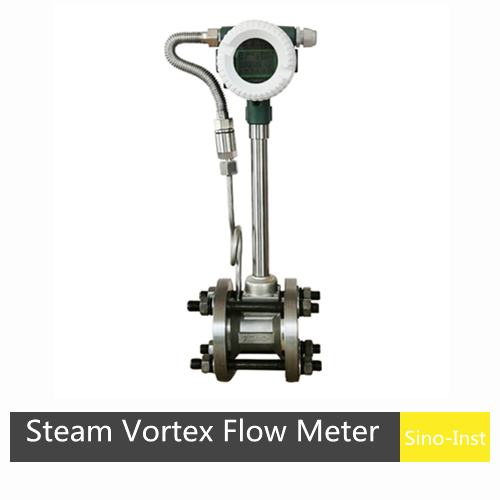
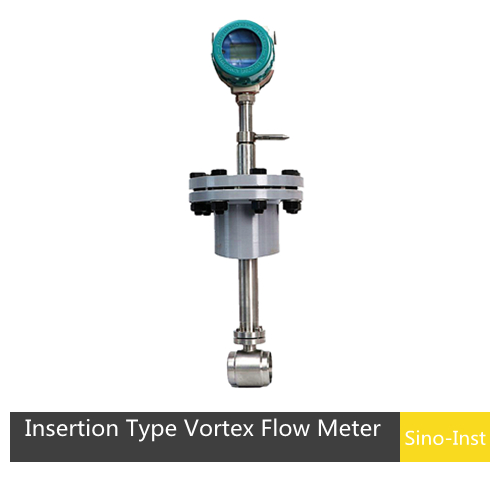
Vortex flow meters operate on the principle of the von Kármán vortex street. When steam flows past a non-streamlined bluff body (vortex shedder), vortices are shed alternately from both sides; the frequency of this vortex shedding is directly proportional to the flow velocity. Volumetric flow rate is calculated by detecting this frequency, and steam mass flow rate is subsequently determined by applying temperature and pressure compensation.
Vortex flow meters are a preferred choice for steam mass flow measurement due to the following advantages:
No moving parts, ensuring high reliability; Wide turndown ratio (10:1 to 30:1); Low pressure loss; Capable of measuring saturated and superheated steam (withstands temperatures up to 500°C);
Limitations:
Sensitive to pipeline vibration; Weak signal at low flow velocities (steam velocity must be ≥4–6 m/s); Strict requirements for straight pipe runs (15D upstream and 5D downstream);
Please refer to the table below for the measurement ranges of vortex steam mass flow meters:
Nominal Diameter
Steam
DN15
14-60 kg/h
DN20
30-150 kg/h
DN25
45-275 kg/h
DN32
75-650 kg/h
DN40
0.11-1 t/h
DN50
0.18-1.6 t/h
DN65
0.25-2.4 t/h
DN80
0.38-3 t/h
DN100
0.65-5.5 t/h
DN125
1-8.5 t/h
DN150
1.4-11 t/h
DN200
2.9-21 t/h
DN250
4.85-27.5 t/h
DN300
7.3-40 t/h
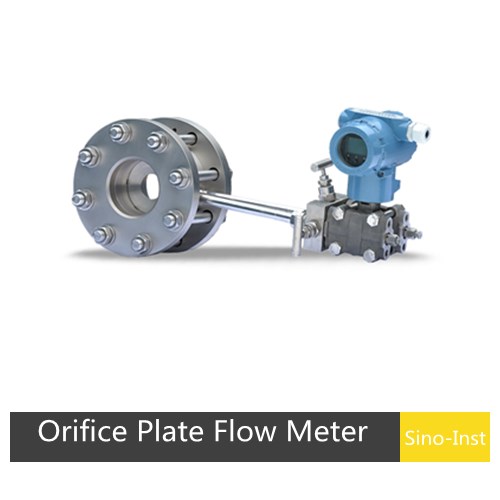
Orifice Plate Steam Mass Flow Meter
Differential pressure flow meters operate on the Bernoulli principle: a pressure difference is generated as fluid flows through a primary element (such as an orifice plate or nozzle), and the square root of this pressure difference is proportional to the flow velocity. Flow rate is calculated by measuring this differential pressure.
Advantages:
Mature technology with well-established international standards (ISO 5167); Suitable for high-temperature and high-pressure applications (no electronic components); Relatively low cost;
Limitations:
Narrow turndown ratio (3:1 to 4:1); Significant pressure loss and high energy consumption; Requires periodic replacement of the orifice plate (due to wear);
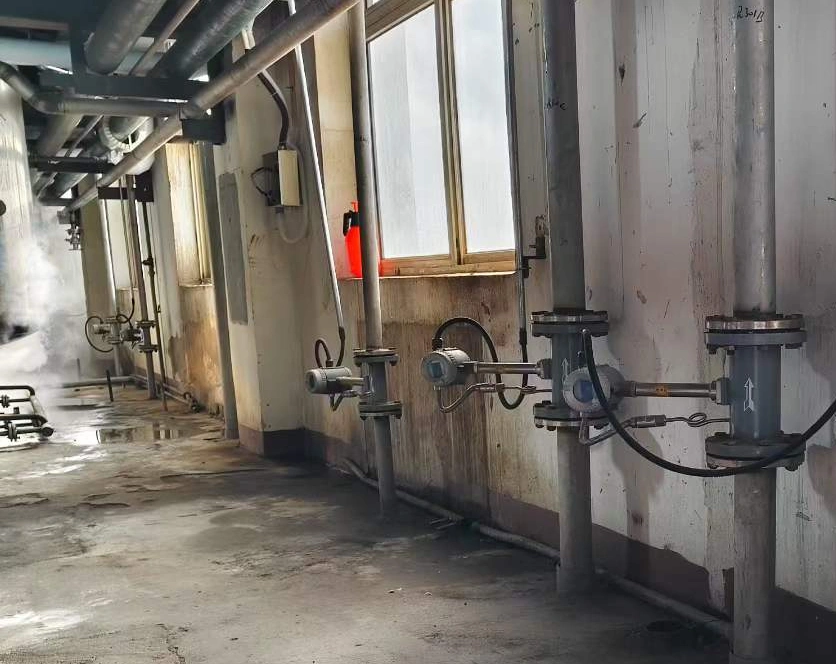
For new installations or retrofit projects, vortex steam flow meters have become the preferred choice for the vast majority of steam metering applications due to their wide turndown ratio, low maintenance requirements, and high accuracy. We have provided industrial steam mass flow measurement solutions to clients across various countries:
1. Superheated steam measurement for a plant in Kazakhstan:
Features: Temperature and pressure compensation; mass flow display
Accuracy: ±1.0%
Outputs/Communication: 4–20 mA + Pulse + HART + RS485 Modbus
Ingress Protection: IP66
2. Thermal power plant in the USA: Our DN200 steam vortex flow meter was implemented for the fiscal metering of saturated steam supplied to external customers. Replacing the existing orifice flow meter resulted in a 60% reduction in pressure loss and annual energy cost savings of hundreds of thousands of yuan, while simultaneously improving metering accuracy to ±1.0%.
In specialized applications such as power generation, high-temperature reactors, and metallurgical smelting, process pressure measurement often faces extreme conditions of “high temperature” + “differential pressure,” with the temperature of the…
To begin with: Vortex Flow Meters for Steam Applications The requirement for high-fidelity and trustworthy flow measurement has become pivotal across various industries, especially in applications involving steam. Steam is…
Steam Pressure Sensors also called Steam Pressure Transducers, play a pivotal role in modern industrial applications. In the world of steam boilers, the precise measurement of boiler pressure is paramount,…
Steam flow measurement and steam flow meters selection comparison. Steam is the most widely used heat-carrying fluid and an important secondary energy source. Steam flow measurement can effectively save energy…
Steam flow meter is a type of flowmeter that can effectively measure the mass flow and volume flow of steam. For example, in heating enterprises, the measurement of steam is…
In some industrial closed environments, vacuuming is required. The vacuum pressure sensor can be used to detect the vacuum degree of the closed environment in real time. Generally, vacuum pressure…
In many industrial and scientific applications, accurate measurement of low pressure is crucial for maintaining safety, performance, and efficiency. Low pressure transmitters/Transducers measure gauge pressure, differential pressure, and absolute pressure…
The vortex flowmeter is a velocity-type flow instrument that operates based on the principle of fluid oscillation. Due to its simple structure, high accuracy, and wide range of applications, it…
For years, Sino-Inst has focused on the R&D and production of industrial process instrumentation. Whether for steam mass flow, pressure, or temperature measurement, we can customize solutions based on user-specific parameters. Please feel free to contact our sales engineers.
Zhang Wei, possesses 20 years of experience as an automation instrumentation engineer, specializing in the research, design, installation, commissioning, and maintenance of automation instruments.
Face to various instrument communication protocols (such as Modbus, Profibus, etc.), with solid hardware circuit design and software programming skills (proficient in C language and PLC programming). Has extensive project experience; projects he has led and participated in have all achieved outstanding results, improving product accuracy, reducing costs, and increasing production efficiency.
Possesses excellent communication and coordination skills and a strong team spirit, enabling him to quickly respond to customer needs and provide high-quality automation instrumentation solutions.