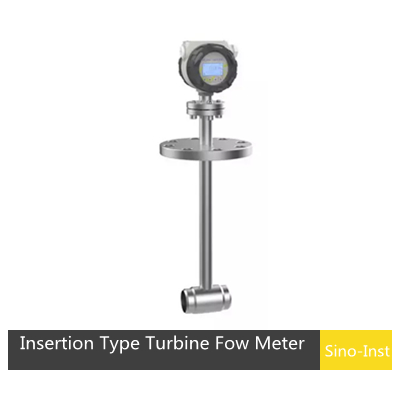
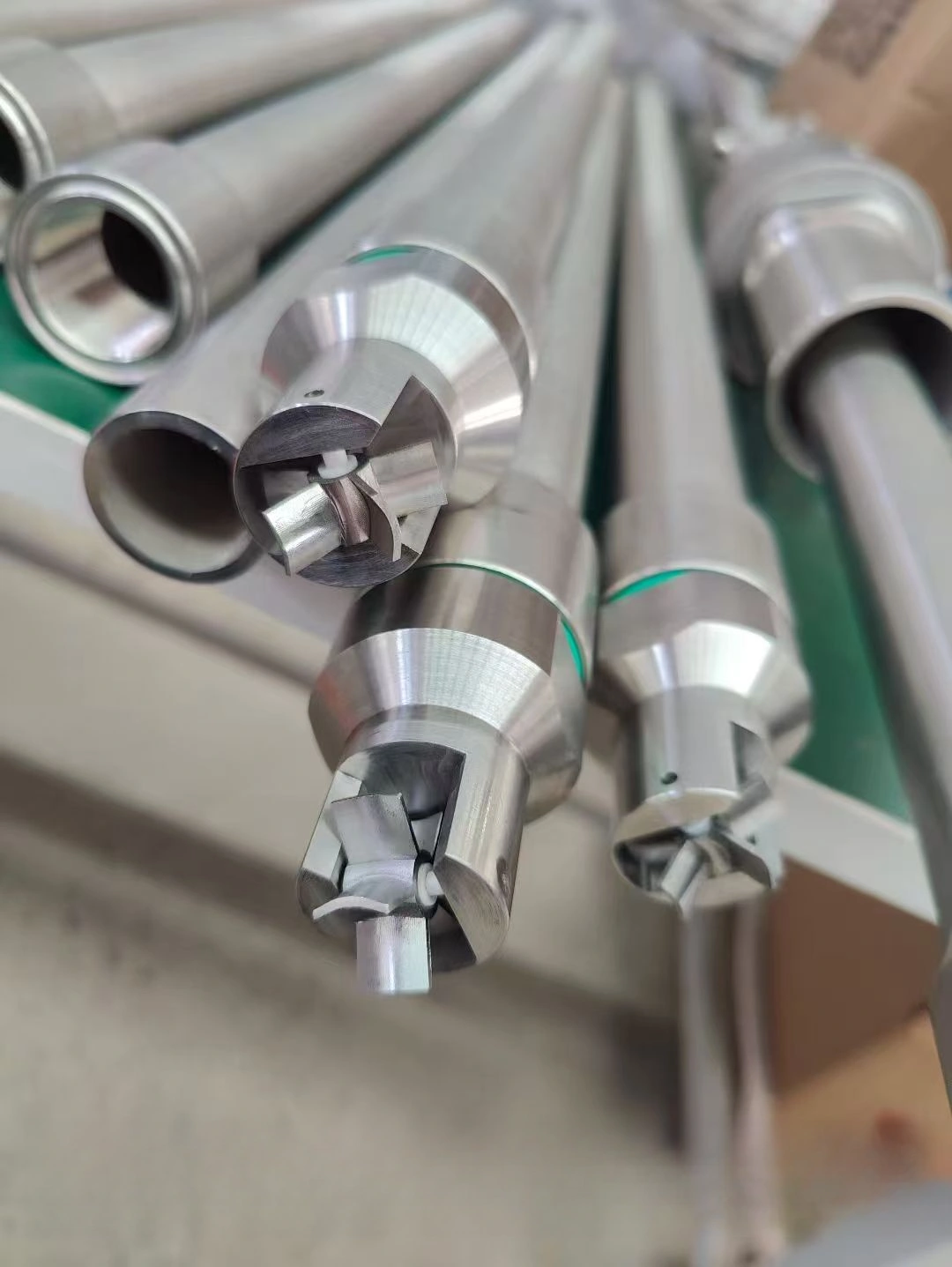
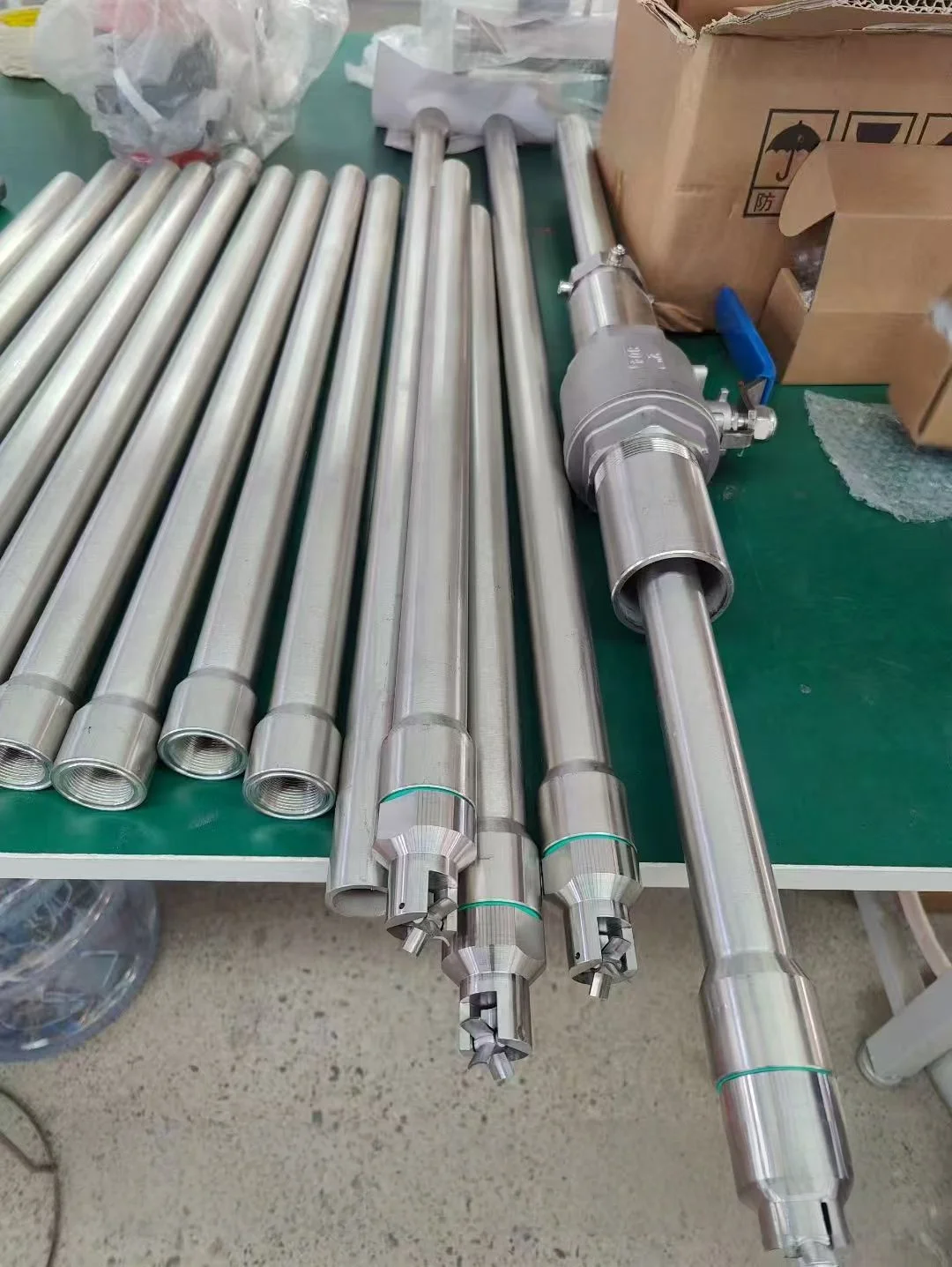
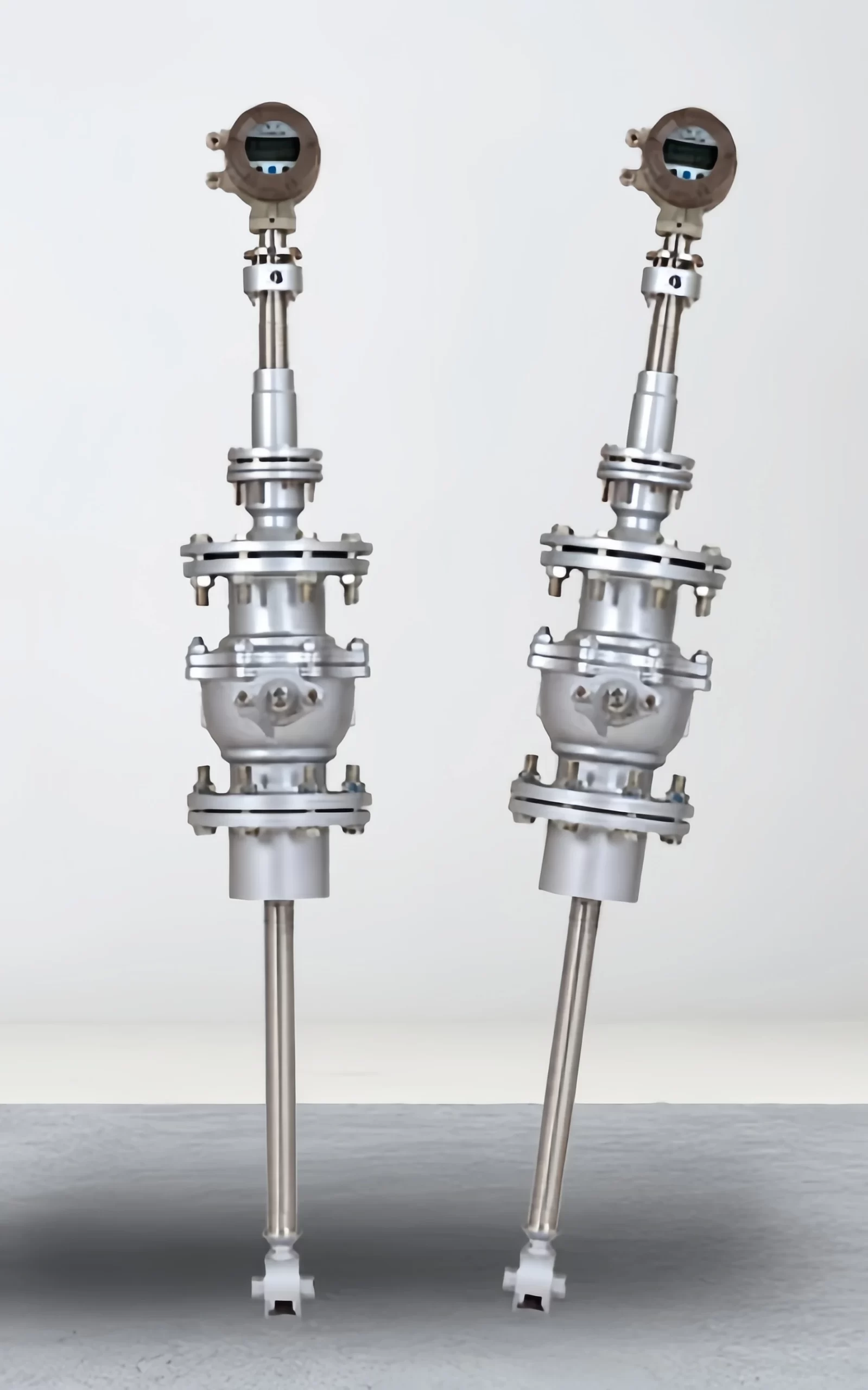
Insertion turbine flow meters are devices that combine a sensor and a display instrument. They come in two structures: with and without a shut-off valve. They are widely used for measuring the flow rate and total volume of liquids such as raw water, circulating water, and purified water in large-diameter pipelines. Based on the sensor type, insertion turbine flow meters are divided into tangential and axial sensors.
They are suitable for measuring media such as water, oil, and chemical liquids in large-diameter pipes (DN80 and above). They offer advantages such as easy installation, low maintenance costs, and low pressure loss. They are particularly suitable for installation in situations where production cannot be stopped.
No need to shut down the pipeline; installation is performed by drilling under pressure, suitable for large-diameter pipes ranging from DN80 to DN3000;
High resistance to electromagnetic interference and vibration;
The measurement coefficient remains unchanged after replacing the impeller and bearings;
Wide flow range with a low lower flow limit;
Low measurement error for the total flow of the complete flowmeter system;
Virtually no pressure loss, saving energy and electricity;
Sensors can be installed outdoors, and the entire sensor assembly can be used in submerged conditions for extended periods;
Sensors equipped with shut-off valves do not require disconnection during installation or removal;
Suitable for horizontal, vertical, and inclined pipelines;
Low costs for purchasing, installing, and maintaining the entire flowmeter system.
No need to cut off the flow, you can disassemble after closing the ball valve
Model
A
B
Accuracy
±2.5%
±2.5%
Display
Optional
Optional
Output
Optional: Pulse or 4-20mA
Optional: Pulse or 4-20mA
Communication Interface
Optional RS485
Optional RS485
Power supply
+24VDC±15%
+24VDC±15%
Explosion-proof grade
Optional ExdIIBT6 OR ExiaIICT4
Optional ExdIIBT6 OR ExiaIICT4
Protection level
IP65
IP65
Machine power consumption
<1W
<1W
Instrument material
304SS
304SS
Nominal pressure
1.0MPa
1.0MPa
temperature range
-20℃~120℃
-20℃~120℃
Ambient temperature
-20℃~70℃
-20℃~70℃
For the length of the straight pipe, the length of the straight pipe upstream of the sensor should be no less than 20DN, and the length of the downstream straight pipe should not be less than 7DN to ensure measurement accuracy.
If the length of the straight pipe section does not meet this requirement, the on-site calibration of the meter factor K may be used after on-site calibration with on-site calibration conditions.
Insertion Turbine Meter Measuring Range:
Model
Pipe measured inner diameter mm
Insertion rod length mm
Flow range m3/h corresponding to the nominal diameter DN
Full flow range
Accuracy of ±2.5% flow range
Accuracy is ±5% flow range
LWCQ-100
100
6-150
10-150
<10-6
LWCQ-150
150
13-200
20-200
<20-13
LWCQ-200
200
23-300
40-300
<40-23
LWCQ≤400
100
906
6-150
10-150
<10-6
150
13-200
20-200
<20-13
200
23-300
40-300
<40-23
250
36-450
62-450
<62-36
300
52-650
90-650
<90-52
350
70-900
120-900
<120-70
400
92-1100
160-1100
<160-92
LWCQ≤800
500
1106
150-1800
250-1800
<250-150
600
220-2500
360-2500
<360-220
700
280-3500
450-3500
<450-280
800
380-4500
640-4500
<640-380
LWCQ>800
900
1306
460-5800
800-5800
<800-460
1000
600-7000
990-7000
<990-600
1100
700-8500
1200-8500
<1200-700
Model
Pipe measured inner diameter mm
Insertion rod length mm
Flow range m3/h corresponding to the nominal diameter DN
Full flow range
Accuracy of ±2.5% flow range
Accuracy is ±5% flow range
LWCB-100
100
3-150
5-150
<5-3
LWCB-150
150
7-200
10-200
<10-7
LWCB-200
200
12-300
20-300
<20-12
LWCB≤400
100
900
3-150
5-150
<5-3
150
7-200
10-200
<10-7
200
12-300
20-300
<20-12
250
18-450
31-450
<31-18
300
26-650
45-650
<45-26
350
35-900
60-900
<60-35
400
46-1100
80-1100
<80-46
LWCB≤800
500
1100
75-1800
125-1800
<125-75
600
110-2500
180-2500
<180-110
700
140-3500
225-3500
<225-140
800
190-4500
320-4500
<320-190
LWCB>800
900
1300
230-5800
400-5800
<400-230
1000
300-7000
495-7000
<495-300
1100
350-8500
600-8500
<600-350
Order Guide
In addition to regular products, we support customization
Model SI-3208-
Code
description
LWC
Insertion turbine flow sensor
B
Ball valve plug-in type (axial)
Q
Simple plug-in (tangential)
Y
Liquid pipeline
Nominal diameter
-2
2mm(Pipe thread G3/8″)
-4
4mm(Pipe thread G1/2″)
-6
6mm(Pipe thread G1/2″)
-10
10mm(Pipe thread G1/2″)
-15
15mm(Pipe thread G1″)
-25
25mm(Pipe thread G11/4″)
-40
40mm(Flange type)
-50
50mm(Flange type)
-80
80mm(Flange type)
-100
100mm(Flange type)
-150
150mm(Flange type)
-200
200mm(Flange or plug-in)
-250
250mm(Flange or plug-in)
-300
300mm(Flange or plug-in)
Accuracy level
A
Accuracy 2.5%
B
Accuracy 1.0%
C
Accuracy 0.5%
Signal output
M
Integrated LCD display with 4~20mA current output
J
Supporting flow totalizer split display
S
The matching flow totalizer displays and outputs 4~20mA separately.
Insertion Type Turbine Fow Meters are classified into LWCB/Q tangential sensors and LWCB/Q axial sensors, depending on the sensor type. The Insertion Type Turbine Fow Meter sensor (referred to as the sensor) is matched with the display instrument to form a plug-in turbine flowmeter, which can be widely used for measuring the flow rate and total amount of liquid water, such as large-diameter pipeline source water, circulating water, and purified water.
Insertion Type Turbine Fow Meters are widely used in the measurement of liquid media, for large and medium-diameter pipes in industrial sectors,such as tap water, petroleum, chemical, metallurgy, power plants, textiles, paper, and water supply and drainage, and are also commonly used in other calibers.
Coriolis mass flow meters and thermal mass flow meters are the two main categories of mass flow meters. They use different measurement technologies and are both undergoing continuous development and improvement. Coriolis mass flow meters are evolving to handle high-temperature,…
Coriolis flow meter calibration is performed to ensure the measurement accuracy of mass flow meters. Mass flow meters are high-precision measuring instruments, and maintaining high measurement accuracy is critical in applications such as industrial processes and trade settlement. Coriolis flow…
What is a Dual Element Thermocouple? The thermocouples we commonly use typically have only one set of measuring elements, whereas dual-element thermocouples have two sets. A dual-element thermocouple specifically refers to a temperature sensor with two sets of thermocouples encapsulated…
For temperatures below 750°C, reducing atmospheres, or when on a tight budget, choose a Type J thermocouple; for higher temperatures, oxidizing atmospheres, or general-purpose temperature measurement applications, choose a Type K thermocouple. Type J and Type K thermocouples have the…
A Type J thermocouple—also known as an iron-constantan thermocouple—consists of a positive leg (JP) made of 99.95% pure iron and a negative leg (JN) made of a copper-nickel alloy known as constantan (55% copper, 45% nickel). While these thermocouples have…
A client project requires integration with the myDevices IoT platform and is seeking a flow sensor that supports LoRaWAN/LTE. The client is interested in a clamp-on ultrasonic solution. Our clamp-on ultrasonic flowmeter features a non-invasive external clamp-on installation that requires…
Insertion-type turbine flow meters are in-line flow measurement instruments that detect fluid velocity and calculate flow rate by inserting a sensor probe into the pipe. Sino-Inst’s Insertion-type Turbine Flow Meters are suitable for measuring media such as water, oil, and chemical liquids in large-diameter pipes (DN80 and above). They offer advantages such as easy installation, low maintenance costs, and low pressure loss, making them particularly suitable for applications where installation cannot be delayed.
Sino-Inst has many years of experience in manufacturing turbine flow meters and supports customized parameters, including cryogenic, high-temperature, high-pressure, and small-diameter models. Please feel free to contact our sales engineers!
Zhang Wei, possesses 20 years of experience as an automation instrumentation engineer, specializing in the research, design, installation, commissioning, and maintenance of automation instruments.
Face to various instrument communication protocols (such as Modbus, Profibus, etc.), with solid hardware circuit design and software programming skills (proficient in C language and PLC programming). Has extensive project experience; projects he has led and participated in have all achieved outstanding results, improving product accuracy, reducing costs, and increasing production efficiency.
Possesses excellent communication and coordination skills and a strong team spirit, enabling him to quickly respond to customer needs and provide high-quality automation instrumentation solutions.