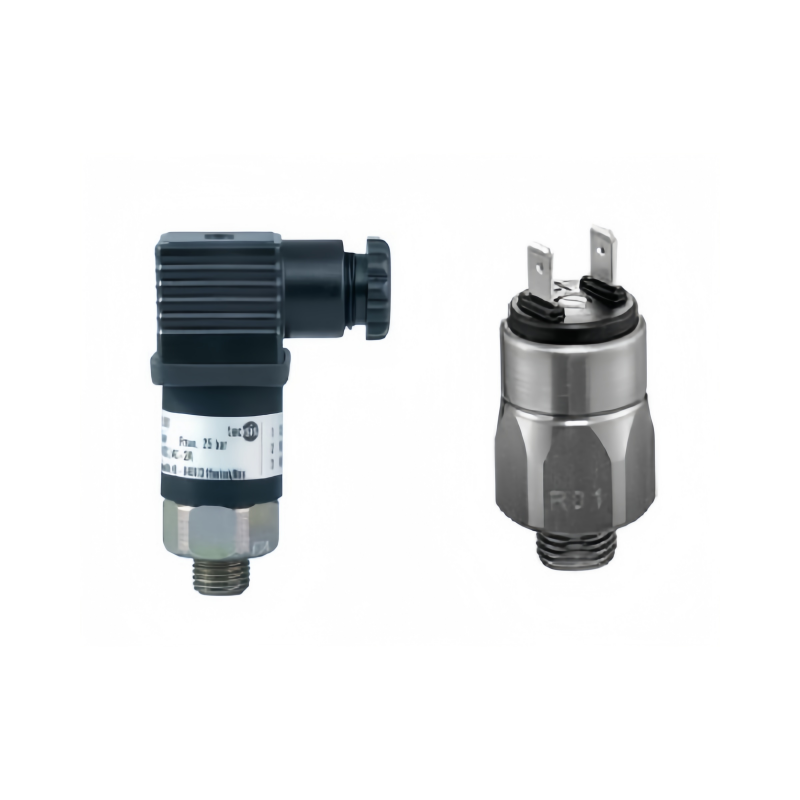
Mechanical Adjustable Pressure Switch can convert physical quantities such as air pressure or hydraulic pressure into an electrical switch signal. It has a built-in diaphragm or piston-type sensing element with a wide measuring range. The setting can be adjusted arbitrarily within 0-40MPa.
Sino-Inst’s Mechanical Adjustable Pressure Switch can be used to measure: water, oil, and gas pressure.
Diaphragm: NBR Piston: Steel piston with NBR seal Process connection: Galvanized steel
Measuring range:
Connector Material
Model
Maximum allowable pressure (bar)
Damage pressure (bar)
Setting range (bar)
Error (bar)
Fixed hysteresis (bar)
Weight (kg)
Copper
2010-02.5M
25
55
0.2-2.5
3% set value
10-20% preset (25-35%, 1-5% optional)
0.1
2010-005M
25
55
0.8-5.0
2010-012M
25
55
1-12
Steel
2010-050S
200
900
5-50
2010-100S
300
900
10-100
2010-200S
300
900
20-200
2010-400S
500
1230
50-400
Dimension
Adjusting the Pressure Switch Point
Step 1: Use a screwdriver to loosen the protective cover retaining nut and remove the protective cover and female connector. (Do not rotate the Hirschmann connector left or right during removal to avoid damaging the wiring.)
Step 2: Refer to the diagram above and use a screwdriver to adjust the pressure switch point. Adjust clockwise for a larger value and counterclockwise for a smaller value.
Adjustable Pressure Switch Operating Principle
A mechanical adjustable pressure switch is a device widely used in industrial automation control systems to monitor and control fluid or gas pressure.
This switch typically consists of a spring-loaded piston, an adjustment knob, and a set of electrical contacts. The operating principle is that when the system pressure reaches a preset threshold, the piston moves under the pressure, triggering the electrical contacts to close or open, thereby achieving automatic control or alarm functions for the relevant equipment.
The user can adjust the spring preload by rotating the adjustment knob to set different pressure trigger points, making this switch adaptable to a variety of application scenarios.
Adjustable Pressure Switch Applications
In practice, mechanical adjustable pressure switches, with their simple structure, high reliability, and low cost, have found widespread application in various mechanical equipment, compressed air systems, hydraulic systems, and other fields. In compressor control systems, they can help automatically adjust pressure, ensuring equipment operates within a safe range.
In water supply systems, they can be used to control the start and stop of water pumps to maintain constant water pressure.
A high-temperature pressure sensor is an instrument that accurately measures the pressure of high-temperature media. It converts pressure into an electrical signal and maintains stable operation even at high media temperatures. Industries like steelmaking, chemicals, and petroleum are essential, as a failure could lead to production halts. Therefore, it is crucial. Customized Case Sharing A … Read more
Pressure switches and pressure sensors are both devices used to detect pressure. However, they differ significantly in their functions, operating principles, and application scenarios. Understanding Pressure Switch vs Sensor can help you choose the most suitable product. First, for us, the main difference between pressure switches and pressure sensors lies in their functions. A pressure … Read more
From extraction to use, natural gas undergoes long pipeline transportation, filtration, storage, and pressure regulation. Monitoring pipeline pressure during these processes is crucial to ensuring proper system operation. Natural gas pressure transmitters are designed to accurately measure a variety of gas pressures. Low and high pressures, gauge pressure, absolute pressure, and differential pressure can all … Read more
Gases are important raw materials in industrial production and laboratories. Such as oxygen, nitrogen, hydrogen, and natural gas. Gases are generally stored and transported in tanks and delivered through pipelines. Monitoring gas pressure during transportation and production helps ensure safe operations and reduce production costs. How do you measure gas pressure? What devices are needed … Read more
Hydraulic pressure sensors are used to monitor the pressure in hydraulic systems. They ensure the safe operation of the system and provide information for controlling valves. The function of a hydraulic system is to increase force by changing pressure. It uses oil as the working medium. By utilizing the pressure of the oil, it controls … Read more
Pressure measuring devices are industrial automation instruments used to measure the pressure of gases, liquids, or steam. They are widely used in various industrial production process control, machinery equipment status monitoring, scientific research, and other fields. Learning about common industrial pressure measuring devices can help you choose the most suitable product. Pressure Measuring Devices Types … Read more
Pressure and flow in pipelines are two important parameters for industrial processes. Pressure or differential pressure, flow rate, and pipe diameter are all related. For example, the Bernoulli equation, the Poiseuille equation, etc., all try to sort out the relationship between pipeline flow, pressure, and pipe diameter. It is important to monitor pressure and flow … Read more
Industrial liquid oxygen is a colorless and odorless liquid oxygen with low temperature and flammable properties. In the fields of petroleum, chemical industry, and medical treatment, liquid oxygen is widely used in the production process. Its leakage may cause serious harm to operators and equipment. Real-time monitoring of the pressure of liquid oxygen tanks and … Read more
Pressurized air is used for multiple purposes in engineering. And air pressure sensors offer measurement and control of these important pressure levels. Digital Air Pressure Sensors are among the most successfully commercialized micro-devices. They are designed to electronically detect air, gas, or liquid pressure changes for monitoring or regulation. We’ll explore the core functionality, types, … Read more
Sino-Inst’s Mechanical Adjustable Pressure Switch features a screw adjustment using a 2mm Allen wrench, allowing users to easily set the switching point. Its simple structure, high reliability, and low cost have made it widely used in various mechanical equipment, compressed air systems, hydraulic systems, and other fields.
If you need to purchase a pressure switch or have any technical questions about adjustable pressure switches, please feel free to contact us.
Zhang Wei, possesses 20 years of experience as an automation instrumentation engineer, specializing in the research, design, installation, commissioning, and maintenance of automation instruments.
Face to various instrument communication protocols (such as Modbus, Profibus, etc.), with solid hardware circuit design and software programming skills (proficient in C language and PLC programming). Has extensive project experience; projects he has led and participated in have all achieved outstanding results, improving product accuracy, reducing costs, and increasing production efficiency.
Possesses excellent communication and coordination skills and a strong team spirit, enabling him to quickly respond to customer needs and provide high-quality automation instrumentation solutions.