Do Pressure Sensor Work at 450 Degree Celsius?
Pressure sensors can operate with media temperatures of 450°C. It is important to clarify that this refers to the temperature of the medium itself, not the ambient temperature.
Standard pressure sensors typically measure media temperatures in the range of -20°C to 80°C. Custom high-temperature pressure sensors can measure pressures in media at 450°C; however, the main body of the sensor must remain in an ambient-temperature environment. This is because the sensor body contains a circuit board that would be damaged by temperatures exceeding 80°C. The sensor’s cable must also be kept out of high-temperature environments.
The ability of pressure sensors to measure media at 450°C is primarily due to the following custom features:
1. High-temperature silicone oil filling
Silicone oil is a type of polyorganosiloxane with a chain-like structure and varying degrees of polymerization. In the production of diffused silicon pressure sensors, silicone oil serves as a pressure transmission medium and protects the sensor chip. Depending on the specific application, different types of silicone oil—such as high-temperature, low-temperature, or standard grades—are used for filling.
For diffused silicon pressure sensors, fluorinated oil is recommended when the medium temperature exceeds 200°C, whereas silicone oil is recommended for temperatures below 200°C.
2. Heat Sink Cooling Structure
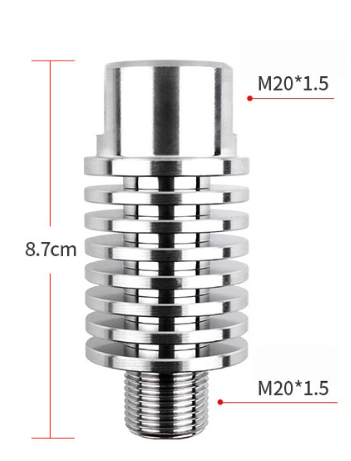
For high-temperature media, a heat sink cooling structure can be installed between the pressure sensor and the pressure transmitter. Our stainless steel heat sink features evenly spaced fins for rapid heat dissipation.
Our heat sink unit consists of 8 fins and can reduce the temperature by 0–150°C. For media at even higher temperatures, multiple heat sink units can be stacked to meet measurement requirements for temperatures up to 450°C.
3. Water-Cooled Structure
The water-cooled structure involves installing a circulating water cooling system between the pressure sensor and the pressure transmitter. Continuous circulation of cold water provides cooling. Utilizing special imported materials, an isolated diaphragm design, and water circulation cooling, the sensor can measure media temperatures up to 1300°C, making it suitable for pressure measurement and control in high-temperature environments such as engine exhaust gases and industrial kilns.
4.Remote Pressure Transmission via Pressure Tubing
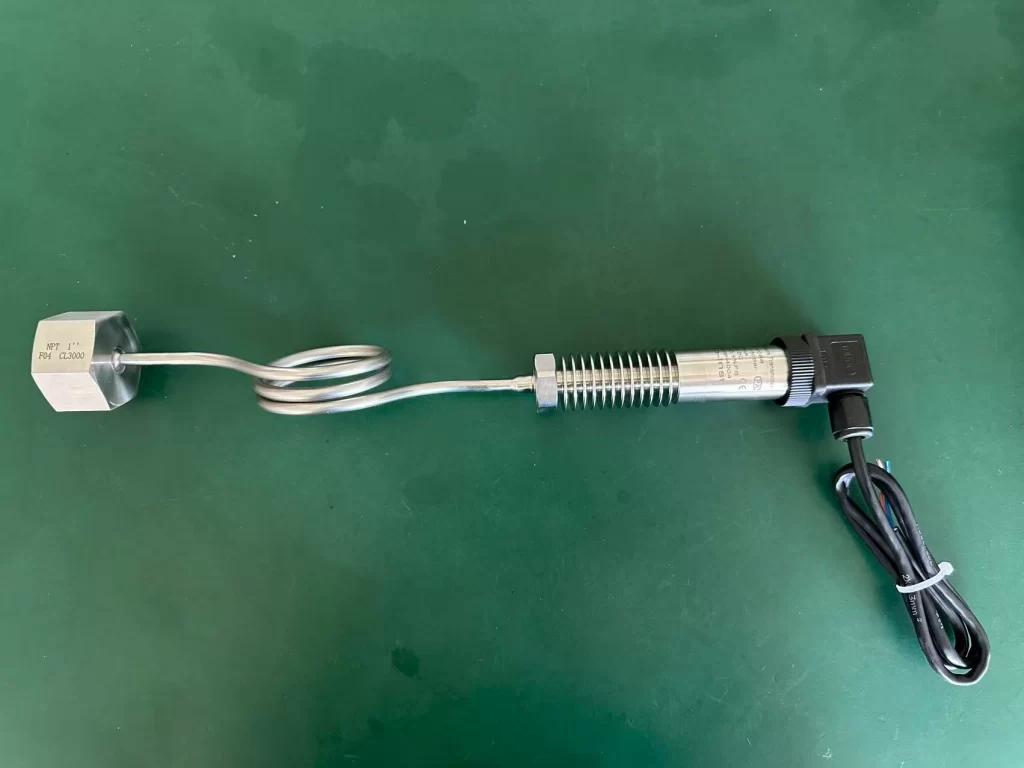
Use pressure tubing to cool the medium and install the pressure sensor at a more distant location. This is the lowest-cost solution for measuring the pressure of high-temperature media.
Use a transmitter with a vent/drain valve on the side, and install the pressure tapping port on the side of the process pipe. When the working medium is a liquid, install the vent/drain valve on the upper part of the flange to allow gas to escape; when the working medium is a gas, install the vent/drain valve on the lower part of the flange to allow liquid to drain out.
5. Temperature Compensation Technology
For electronic components, output signals tend to drift with temperature fluctuations when other conditions remain constant. To mitigate this, specific algorithms are employed to correct the output, thereby eliminating the impact of temperature changes on the signal within a defined range. This process is known as temperature compensation.
The static characteristics of most pressure sensors are closely linked to ambient temperature. In practical applications, significant fluctuations in ambient temperature—and the resulting thermal output—can lead to substantial measurement errors, thereby affecting the sensor’s static performance. Consequently, design measures must be taken to minimize or eliminate the impact of temperature variations on measurements; in some cases, temperature compensation parameters are even more critical than the nominal accuracy class, depending largely on specific operating conditions.
Sino-Inst’s full range of pressure transmitters features built-in multi-point temperature drift compensation algorithms. By pre-collecting test data across the entire operating temperature range of -30°C to 80°C, precise compensation models are established. These models enable real-time correction of signal deviations caused by ambient temperature changes, ensuring zero-point stability even under extreme high- or low-temperature operating conditions.
Choosing the Right High Temperature Pressure Sensor
When selecting a high-temperature pressure transducer, the following should be considered:
- Medium and ambient temperature
- Pressure range
- Medium compatibility
- Materials and structure
- Environment and output type
- Accuracy and stability
By carefully evaluating these factors, you can find the right high-temperature pressure sensor. Our team at Sino-inst is ready to help you meet these requirements and find a solution suitable for your application.
More Pressure Measurement Solutions
Oxygen cleaning is a specialized cleaning procedure for special-purpose pressure transmitters, also known as oil-free. For example, oxygen pressure transmitters must undergo rigorous oxygen-grade cleaning to ensure the sensor is…
China is the largest OEM and mass production base for industrial pressure sensors. Custom production is available for everything from standard 4-20 mA pressure transmitters to extreme operating conditions such…
In specialized applications such as power generation, high-temperature reactors, and metallurgical smelting, process pressure measurement often faces extreme conditions of “high temperature” + “differential pressure,” with the temperature of the…
An inline pressure transducer is a compact pressure transmitter that screws directly onto the pipeline via a single threaded interface. The sensitive diaphragm is in close contact with the medium,…
Pressure transmitter for level measurement is a relatively inexpensive and stable solution. Proper selection and configuration of pressure transmitters can effectively save on measurement costs. On CAN-based machinery, a CAN…
What is Absolute Pressure Transmitter? Absolute pressure transmitters are sensors that measure pressure using absolute vacuum (0 bar) as a reference. They convert the sensed physical pressure value into a…
Strain gauge pressure transmitters have good shock resistance and can withstand 100G vibration, making them more suitable for measuring large pressure ranges. They are used in pressure measurement and control…
Pressure transmitters are often installed in conjunction with manifolds, primarily for isolation, calibration, and venting. Manifolds control the input of the medium, ensuring measurement accuracy and safety. Manifolds are typically…
Sino-Inst manufactures and supplies a full range of pressure sensors. We offer various models and can tailor solutions to the specific needs of different applications. This includes not only high-temperature pressure sensors, but also low-temperature sensors, sensors with special threads, and sensors made of special materials.
If you need to purchase high-temperature pressure transducers or have related technical questions, please contact our engineers!
Zhang Wei, possesses 20 years of experience as an automation instrumentation engineer, specializing in the research, design, installation, commissioning, and maintenance of automation instruments.
Face to various instrument communication protocols (such as Modbus, Profibus, etc.), with solid hardware circuit design and software programming skills (proficient in C language and PLC programming). Has extensive project experience; projects he has led and participated in have all achieved outstanding results, improving product accuracy, reducing costs, and increasing production efficiency.
Possesses excellent communication and coordination skills and a strong team spirit, enabling him to quickly respond to customer needs and provide high-quality automation instrumentation solutions.