Home > Blog
2025.10.29

7-Point Checklist for Selecting Industrial Oxygen Flow Meters

The accurate flow measurement of oxygen is a foundational requirement across numerous industrial, medical, and scientific domains. Here, we’ll explore the principles and practices of selecting the right Industrial Oxygen Flow Meters. We’ll analyze gaseous and liquid oxygen, as well as factors like temperature and pressure, and compare various flow measurement technologies. Our goal is to provide a structured framework to help you make an informed purchasing decision. RFQ Table of ContentsPoint 1: Characterize Your Oxygen and Flow ConditionsGaseous Oxygen vs. Liquid Oxygen (LOx)Oper......

2025.10.28

What Is Solvent Flow Meter? Industrial Selection Guide

Solvent flow meters: This term may sound complex, but they are crucial tools in many industries. The chemical industry, in particular, requires precise solvent addition. In this guide, we’ll delve deeper into the meaning and importance of these devices. Sino-Inst’s solvent flow meters can measure flow as low as 0.1 L/H. From the food we eat to the cars we drive, solvent flow meters play a key role in ensuring quality and efficiency. RFQ Table of ContentsPoint 1: Characterize Your Oxygen and Flow ConditionsGaseous Oxygen vs. Liquid Oxygen (LOx)Operating Pressure and Temperature Rang......

2025.10.27

What are Capacitive Level Sensors?

Capacitive level sensors are a crucial technology for monitoring the level of liquids and solid powders. Capacitive level sensors are a type of level transmitter that can be used for measuring the level of liquids, oils, and solids. They have no moving parts and are unaffected by water vapor, dust, or condensation. Capacitive level sensors are widely used for continuous measurement. They offer stable and reliable operation and are resistant to high temperatures and high pressures. Intelligent level sensors use a two-wire (loop-powered) 4-20mA DC measurement signal, making them easy to calibrat......

2025.10.23

What Is Flow Meter Turndown?

While turndown is often included in flow meter specifications, few people can explain its meaning. Regardless of the flow rate in your facility, choosing the right flow meter isn’t just about size or cost. Turndown is one of the most critical and often overlooked factors. This article will provide a comprehensive understanding of flow meter turndown and adjustable range: What is a flow meter’s turndown? Why is it so important? We’ll also discuss the turndowns of different flow meter types, and more. RFQ Table of ContentsPoint 1: Characterize Your Oxygen and Flow ConditionsGas......

2025.10.21

Choosing the Right Level Switch for Industrial Applications: A Complete Guide

Accurate liquid level detection is crucial for product quality and operational safety. Therefore, liquid level switches are essential components in industrial processes. They monitor and control liquid levels in tanks and containers.Level switches are widely used in industrial environments such as chemical and food production. Sino-Inst offers high-quality level switches and solutions. These includes float, capacitive, and radar-based types. RFQ Table of ContentsPoint 1: Characterize Your Oxygen and Flow ConditionsGaseous Oxygen vs. Liquid Oxygen (LOx)Operating Pressure and Temperature RangeFl......

2025.10.19

Sulfuric Acid Flow Measurement

Sulfuric acid is a vital industrial raw material used in the manufacture of fertilizers, pharmaceuticals, pigments, detergents, and batteries. It is widely used in industries such as petroleum purification, metal smelting, and dye production. In the production and transportation of sulfuric acid, accurate flow measurement is crucial for process control, cost management, and safety. Due to its highly corrosive nature, the selected flowmeter must be resistant to this corrosion. RFQ Table of ContentsPoint 1: Characterize Your Oxygen and Flow ConditionsGaseous Oxygen vs. Liquid Oxygen (LOx)Operati......

2025.10.17

Radar Gauge for Level Measurement

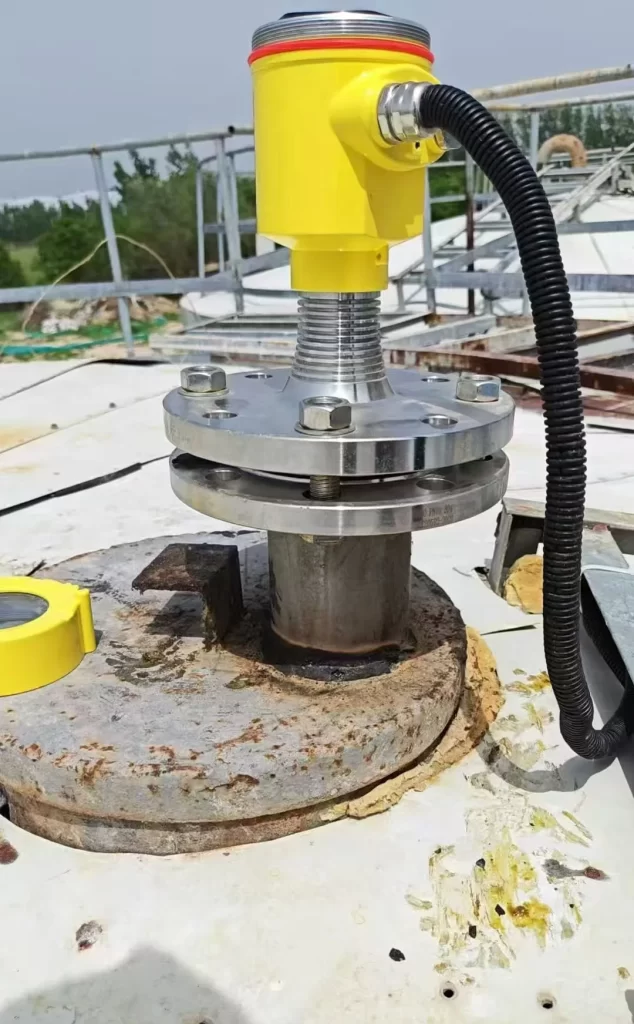
Radar level gauges, with their non-contact measurement, high accuracy, and adaptability, have become the preferred technology for tank level monitoring. Using high-frequency microwave pulse or continuous wave technology, radar level gauges accurately measure levels by calculating the time difference between the electromagnetic wave’s transmission and its reflection back to the receiving antenna. In large tank applications, their measurement accuracy can reach ±2mm, far exceeding that of traditional float-type or differential pressure level transmitters. RFQ Table of ContentsPoint 1: Char......