Home > Pressure Sensor > Piezoelectric Pressure Transducer – Quartz, Threaded Mount
Piezoelectric Pressure Transducer – Quartz, Threaded Mount
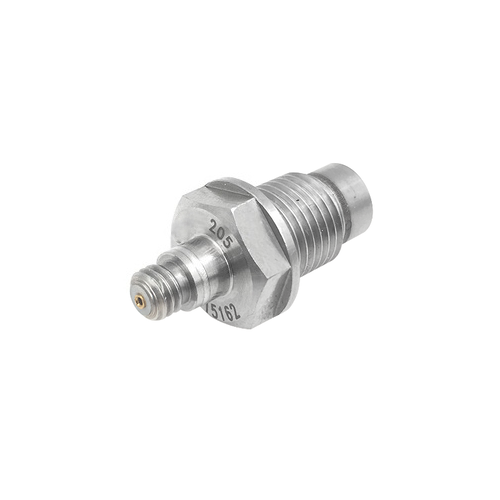
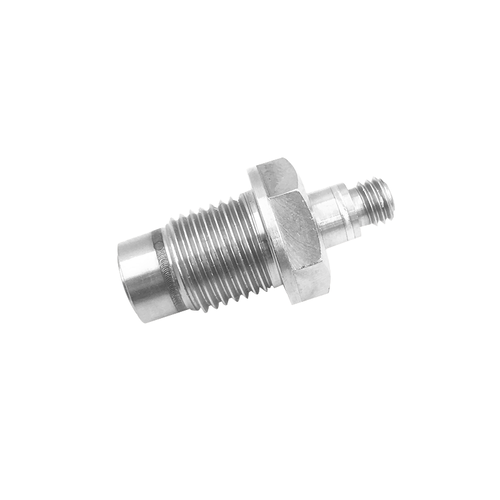
The SI-YD205 Piezoelectric Pressure Transducer is an M10 × 1 threaded-mount pressure transducer. Utilizing a quartz crystal as the piezoelectric element, it offers a wide frequency response and high rigidity, with a pressure sensitivity of approximately 100 pC/MPa. The SI-YD205 is well-suited for pressure measurements in high-frequency, transient, and harsh environments—such as monitoring pressure in pipelines or measuring blast/explosion pressures. When paired with a charge amplifier, it enables high-precision measurements.
Working Principle of the Quartz Crystal Piezoelectric Pressure Transducer
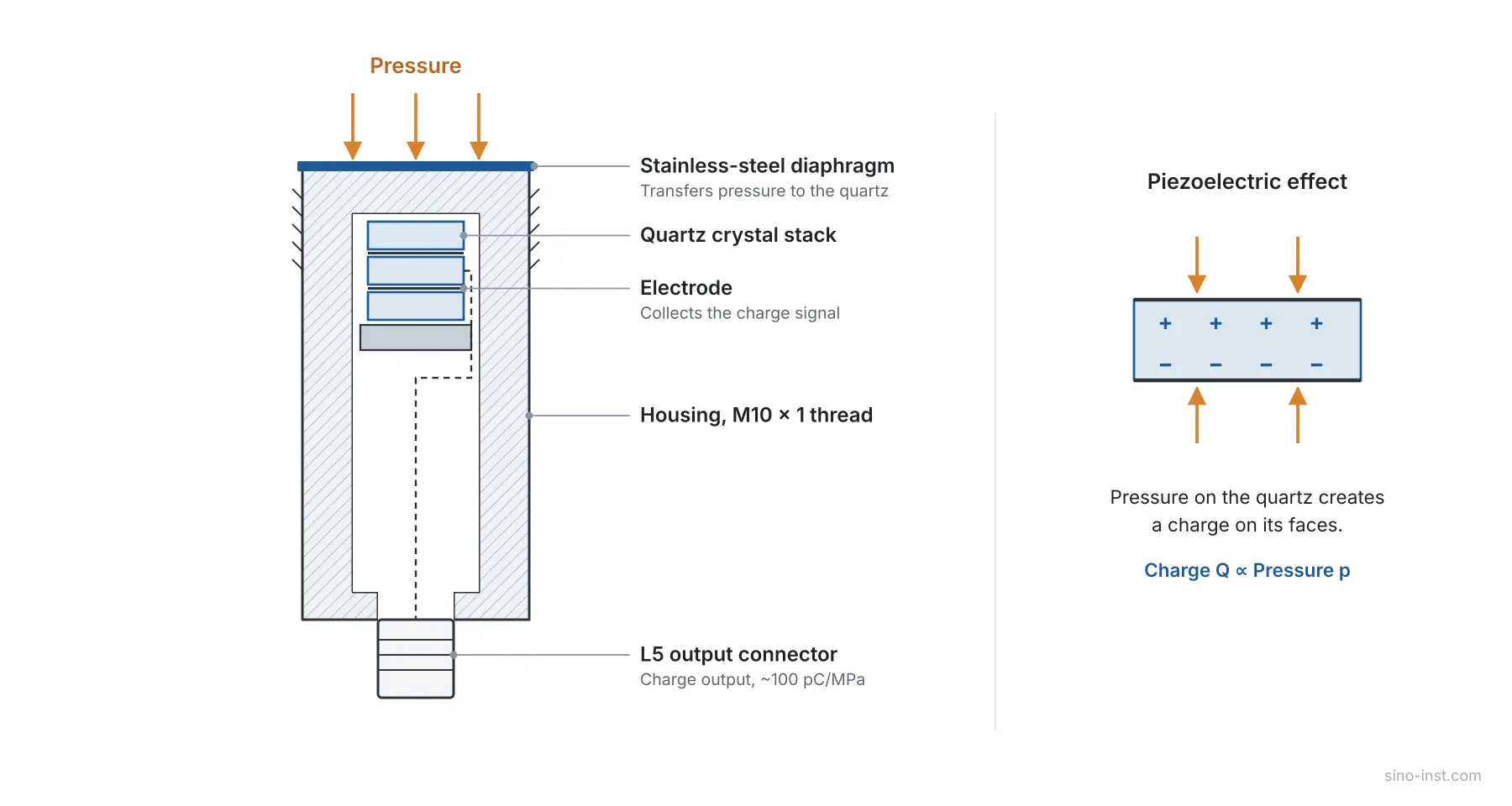
Our piezoelectric pressure transducers use quartz crystals as the sensing element, utilizing the piezoelectric effect to convert measured pressure into changes in charge. Our SI-YD205 piezoelectric pressure transducer has a charge output of approximately 100 pC/MPa.
In 1880, French scientist Pierre Curie and his brother Jacques Curie first discovered the piezoelectric effect in quartz crystals: when a crystal is subjected to mechanical pressure, an electric charge is generated on its surface; conversely, when an electric field is applied, the crystal undergoes deformation.
The core of the transducer is a stack of precision-cut quartz plates behind a stainless-steel diaphragm. Pressure on the diaphragm compresses the quartz, and an electric charge proportional to the pressure appears on the crystal faces. Electrodes collect this charge and pass it to the output connector. Quartz is used because its sensitivity is very stable over time and temperature, and it has extremely high insulation resistance (> 10¹³ Ω).
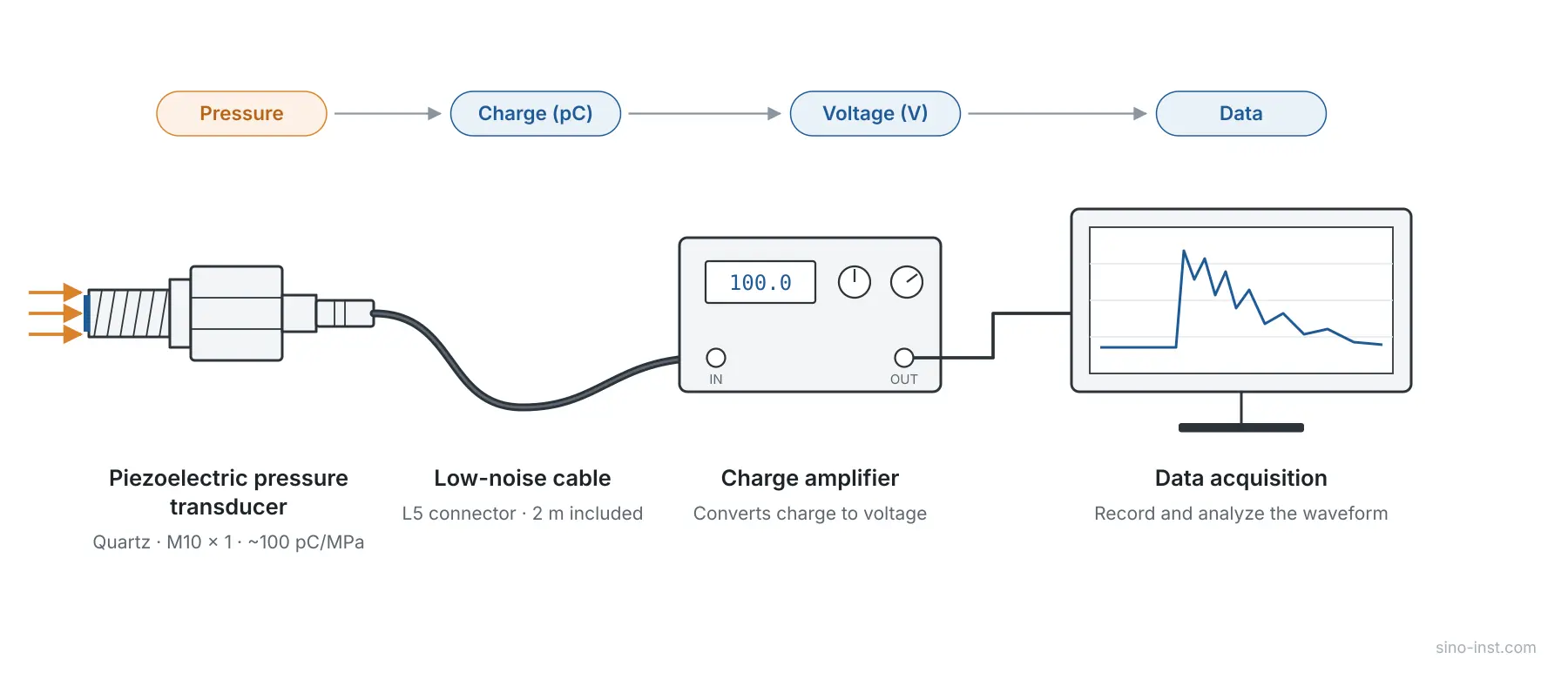
Therefore, the quartz crystal piezoelectric pressure transducer measurement setup includes: the sensor, a low-noise L5 cable (a 2-meter cable is included), a charge amplifier that converts the charge signal into a voltage signal, and your data acquisition system. Since the charge signal is very weak, be sure to use the included low-noise cable and ensure it remains securely fixed during the measurement process. Please note: Moving the cable may introduce noise. Additionally, we offer a charge amplifier designed specifically for use with this sensor.
Piezoelectric or Piezoresistive Pressure Transducer?
Piezoelectric and piezoresistive pressure transducers are two distinct types of products. In short, if you need to measure rapidly changing (transient) pressures, our SI-YD205 piezoelectric pressure transducer is the right choice. For measuring static pressure or conducting long-term pressure monitoring, you should opt for our SI-90 or SI-1180 pressure transducers instead.
Featured Applications
1. Explosion and Shock Wave Testing
Shock waves generated by explosions rise from zero to peak pressure in just a few microseconds and have a very short duration. With a natural frequency exceeding 100 kHz and high crystal stiffness, the SI-YD205 can fully record the entire rise and decay process. It is commonly used in shock tube tests, closed detonator tests, and for measuring reflected pressure on pipeline and vessel walls.
Before measuring in the near-detonation zone, it is recommended to perform a dynamic calibration on the shock tube first. If you need to measure free-field shock waves in air, a specialized pen-type sensor is required; this model is not suitable for that purpose.
2. Pipeline Pressure Pulsations and Water Hammer
When a pump suddenly stops or a valve closes rapidly, the pressure in the pipeline fluctuates violently within an extremely short time—this is known as water hammer. Conventional pressure transmitters have a slow response time and often measure “smoothed-out” values, failing to capture the true peak values.
The SI-YD205 features an M10×1 thread and can be mounted directly on a pipeline pressure tap to capture peak values and complete waveforms of transient pressures. It is suitable for water hammer analysis in water transmission lines and pumping stations, as well as for verifying the effectiveness of water hammer mitigation measures.
3. Pressure Fluctuations in Hydraulic Systems and Pumps
Pressure pulsations occur at the outlets of hydraulic pumps, plunger pumps, and compressors. These pulsations have a high frequency, but their amplitude is relatively small compared to the system pressure. Piezoelectric sensors respond only to pressure changes and can resolve these minute fluctuations even under high system pressures.
Suitable for performance testing of hydraulic component test benches, pumps, and valves. The standard range is 0–30 MPa, with an optional range of 0–60 MPa, covering most hydraulic systems.
4. Laboratory Calibration and Research
Each sensor is shipped with a calibration certificate. When used with a charge amplifier and a piston-type pressure gauge, quasi-static calibration can be performed; therefore, these sensors are commonly used for dynamic pressure measurements in testing technology experiments and research projects at universities.
Not Suitable for the Following Applications
Long-term static pressure measurement or process control: Please select a piezoresistive pressure transmitter, such as the SI-1180 or SI-2088.
Engine combustion chamber cylinder pressure and other applications where temperatures exceed 150°C: High-temperature piezoelectric sensors must be used.
FAQ
The Sino-Inst piezoelectric pressure transducer has a natural frequency higher than 100 kHz. Typically, the flat measurement range extends to approximately 20% of the natural frequency. The lower frequency limit depends on the charge amplifier settings; for this reason, the sensor can also measure quasi-static pressure over short periods.
It can only measure static pressure for short periods (i.e., quasi-static measurements). Under a constant load, the charge output will drift slowly. For long-term static pressure measurements, please use a piezoresistive transmitter (such as the SI-1180). If you need both static pressure readings and fast dynamic readings, please refer to the SI-90 high-frequency pressure sensor.
Not necessarily. If you only need to obtain pressure values within a few milliseconds, a standard pressure transmitter will suffice. You should choose this type of sensor when you need to observe the pressure waveform itself (e.g., shock waves, pulsations, or water hammer peaks).
Pressure acting on the diaphragm compresses a stack of quartz crystals. The quartz crystals then generate a charge proportional to the pressure—for this model, the ratio is approximately 100 pC/MPa. A charge amplifier then converts this charge into a voltage signal.
The product comes with a 2-meter low-noise cable. If a longer cable is required, please request it separately. Keep the cable secured during measurement to minimize noise interference.
Piezoelectric and piezoresistive pressure sensors are two commonly selected types of pressure sensors in industrial processes. Differences in their operating principles result in distinct advantages for each. Piezoelectric sensors have higher sensitivity and faster response times, enabling them to provide relatively precise pressure measurements. Therefore, piezoelectric pressure sensors are used to measure dynamic pressure. Piezoresistive … Read more
Master dynamic pressure sensor technology. We’ll guide you through the piezoelectric principle, fast response characteristics, and industrial applications. What is a Dynamic Pressure Sensor? Dynamic pressure sensors are specifically designed to measure dynamic pressure with high frequency variations and steep pressure waveform rise times. They measure instantaneous pressure changes, not “average” pressure. Dynamic pressure sensors … Read more
In fields such as military engineering, explosive testing, oil and gas exploration, materials and geotechnical mechanics, trauma medicine, and hydraulic power testing, the precise measurement of high-frequency transient pressure waveforms places stringent demands on the dynamic performance of sensors. The SI-90 high-frequency dynamic pressure transmitter is designed specifically for these applications. Through micromachining technology, it achieves … Read more
What Is a Pressure Snubber? A pressure snubber, also known as a pressure buffer, is a device designed to prevent intense fluid pulses and protect pressure instruments from damage. It is suitable for pressure systems where the medium being measured experiences pressure spikes, intense pulses, and rapid fluctuations. It is often used in conjunction with … Read more
What is a Pressure Transducer? It is often called a pressure transmitter. An absolute Pressure Transducer is a device that measures the pressure relative to 0 Pa. Then, a Gauge Pressure Transducer is an instrument that measures the pressure with atmospheric pressure as the reference point. A Differential Pressure Transducer measures the difference between pressures … Read more
You need to measure pressure, so you are going to purchase a pressure transmitter. Then you will find that there are many types of pressure sensors on the market. You will see capacitive pressure transmitter, MEMS pressure sensor, absolute pressure transmitter, differential pressure transmitter, pressure transmitter diaphragm type, 4-20mA pressure transmitter and many more. So … Read more
Zhang Wei, possesses 20 years of experience as an automation instrumentation engineer, specializing in the research, design, installation, commissioning, and maintenance of automation instruments.
Face to various instrument communication protocols (such as Modbus, Profibus, etc.), with solid hardware circuit design and software programming skills (proficient in C language and PLC programming). Has extensive project experience; projects he has led and participated in have all achieved outstanding results, improving product accuracy, reducing costs, and increasing production efficiency.
Possesses excellent communication and coordination skills and a strong team spirit, enabling him to quickly respond to customer needs and provide high-quality automation instrumentation solutions.