High Viscosity Flow Meters
How to measure the flow of viscous liquids? For example: glue, heavy oil, asphalt, etc. Commonly used flow meters may not be suitable. High Viscosity Flow Meters are instruments for…

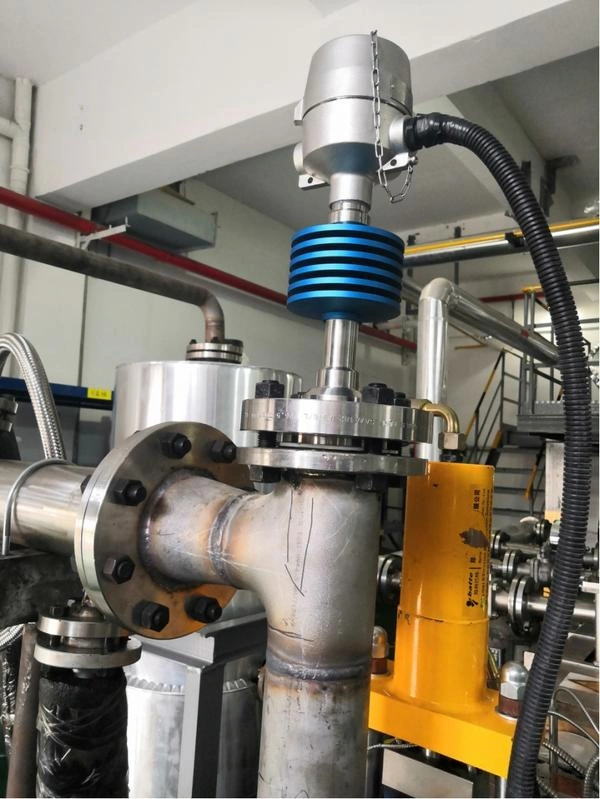
When purchasing an online viscometer, do you often encounter this situation: you specify the viscosity in cSt at 50°C, but the manufacturer provides the value in cP, leaving you confused?
Dynamic viscosity (μ) is a fluid’s internal resistance to shear, measured in centipoise (cP = mPa·s). Kinematic viscosity (ν) is that value divided by density, in centistokes (cSt = mm²/s): ν = μ / ρ. Water is about 1 cP and 1 cSt at 20 °C — which is why the two get confused. Most inline viscometers output cP; cSt requires a density input.
Previously, we received inquiries from two users about online viscometers. Interestingly, they both needed to purchase online viscometers, but the units of viscosity they specified were different.
One inquiry came from a trading company that does procurement for refineries, measuring petroleum products and hydrocarbon-based fluids. Continuous real-time measurement, measuring range from 0.5 to 6,000 cSt. Another sample comes from a water-based paint and ink factory. 50 to 200 cP, requires temperature compensation, operating conditions 0 to 40°C, output 4–20mA.
The same type of online viscometer, two units. And this wasn’t just something the customer casually wrote down.
Refinery users require cSt because that’s how viscosity is defined in the petroleum industry. ASTM D445—the viscosity figures on almost every fuel and lubricant datasheet are derived from this capillary method. It measures kinematic viscosity. The classification system built upon it, ISO 3448 for industrial lubricants, and ISO 8217 for marine fuels, all use this unit.
Paint users require cP because the industry standard is based on the rotational method. Instruments like Brookfield apply a known torque and directly read the fluid’s resistance to it—this is dynamic viscosity. Paint manufacturers don’t calculate density because they’re truly concerned with how the paint behaves under the shear of pumps, rollers, and nozzles—a property directly related to force.
Therefore, the units on the datasheet already indicate the industry they come from. cSt indicates petroleum-related industries, while cP indicates paint, ink, chemical, and food-related industries.
So, to clearly distinguish between cSt and cP, it’s necessary to understand the difference and relationship between dynamic viscosity and kinematic viscosity.
Dynamic viscosity refers to a fluid’s resistance to flow under the influence of an external force. Also known as absolute viscosity. It is the parameter used when external stress is applied or under conditions other than those governed solely by gravity.
Dynamic viscosity is defined as the ratio of shear stress to the shear rate. Physically, it represents the internal friction force generated by the interaction of the fluid between two parallel plates, each with an area of 1 square meter and separated by a distance of 1 meter, when one plate moves at a relative velocity of 1 m/s. It serves as the coefficient of internal friction characterizing fluid viscosity and is denoted by the symbol μ.
Unit: Pa⋅s = (N/m²)⋅s = N⋅s/m²
Other commonly used units include mPa·s, cP, and P.
1 Pa·s = 1,000 mPa·s = 1,000 cP
| From-To | Pa·s | mPa·s | cP | P |
| Pa·s | 1 | 1000 | 1000 | 10 |
| mPa·s | 0.001 | 1 | 1 | 0.01 |
| cP | 0.001 | 1 | 1 | 0.01 |
| P | 0.1 | 100 | 100 | 1 |
Kinematic viscosity represents a fluid’s resistance to flow under the influence of gravity alone. It reflects the internal friction characteristics of a fluid in motion—specifically, the energy dissipation caused by internal molecular friction. A higher value indicates greater viscous resistance, making the fluid more difficult to move.
Kinematic viscosity accounts for both the fluid’s viscosity and its inertial effects (represented by density).
Fluids with low kinematic viscosity (e.g., gases): Inertial forces dominate; flow is easily affected by external disturbances.
Fluids with high kinematic viscosity (e.g., honey): Viscous forces dominate; flow is slow and difficult to accelerate.
Unit: m²/s
Commonly used unit for kinematic viscosity: cSt.
1 m²/s = 1,000,000 cSt (10⁶)
1 cSt = 0.000001 m²/s (10⁻⁶)
You might wonder whether two fluids with the same dynamic viscosity can have different kinematic viscosities; indeed, if dynamic viscosity (μ) is identical but density (ρ) differs, then kinematic viscosity (ν) will differ. Let us examine the conversion relationship between them in more detail.
Dynamic viscosity and kinematic viscosity are related to density by the formula ν = μ / ρ, where μ is dynamic viscosity, ρ is density, and ν is kinematic viscosity.
The formula above can be used to convert between kinematic viscosity and dynamic viscosity. Note that the density of the liquid is required for this conversion. Density values are determined by the type of liquid and the temperature, as density varies with temperature.
The three quantities involved in the conversion relationship mentioned above are all affected by temperature; therefore, viscosity is typically cited alongside the corresponding temperature.
The viscosity of a liquid is fundamentally determined by the intermolecular forces that pull on the molecules, resisting their tendency to slide past one another. As temperature rises, thermal motion intensifies and the average distance between molecules increases, causing these attractive forces to weaken. Consequently, molecular layers slide past each other more easily. Thus, the hotter the liquid, the thinner it becomes—meaning its viscosity decreases.
Regarding density, a rise in temperature causes the liquid to expand; the same mass occupies a larger volume, resulting in a decrease in density.
Therefore, temperature is a crucial factor in the measurement and description of viscosity.
Converts within dynamic units (Pa·s, mPa·s, cP, P) and within kinematic units (m²/s, mm²/s, cSt, St) with no extra data. Crossing between the two groups requires a density, because ν = μ / ρ.
Needed only when crossing between μ and ν.
Labels the result only — not used in the maths.
Why temperature is not a calculation input here. Converting cP to cSt needs density, not temperature. Correcting a viscosity to a different temperature is a separate operation that needs two known data points for that specific fluid — use the calculator below. Note also that μ and ρ must both be taken at the same temperature and at the same point in the line.
Enter two known viscosity–temperature points from the fluid’s datasheet (for example 40 °C and 100 °C), then read the viscosity at any other temperature. ASTM D341 states that log₁₀[log₁₀(ν + 0.7)] is linear against log₁₀(T) — so two points define the line.
Valid for Newtonian petroleum fluids. Accuracy falls off when extrapolating well outside the two reference points, and the correlation does not hold below the cloud point of waxy oils. The steepness of this line is what the Viscosity Index (ASTM D2270) describes.
There are numerous methods for measuring viscosity in the laboratory:
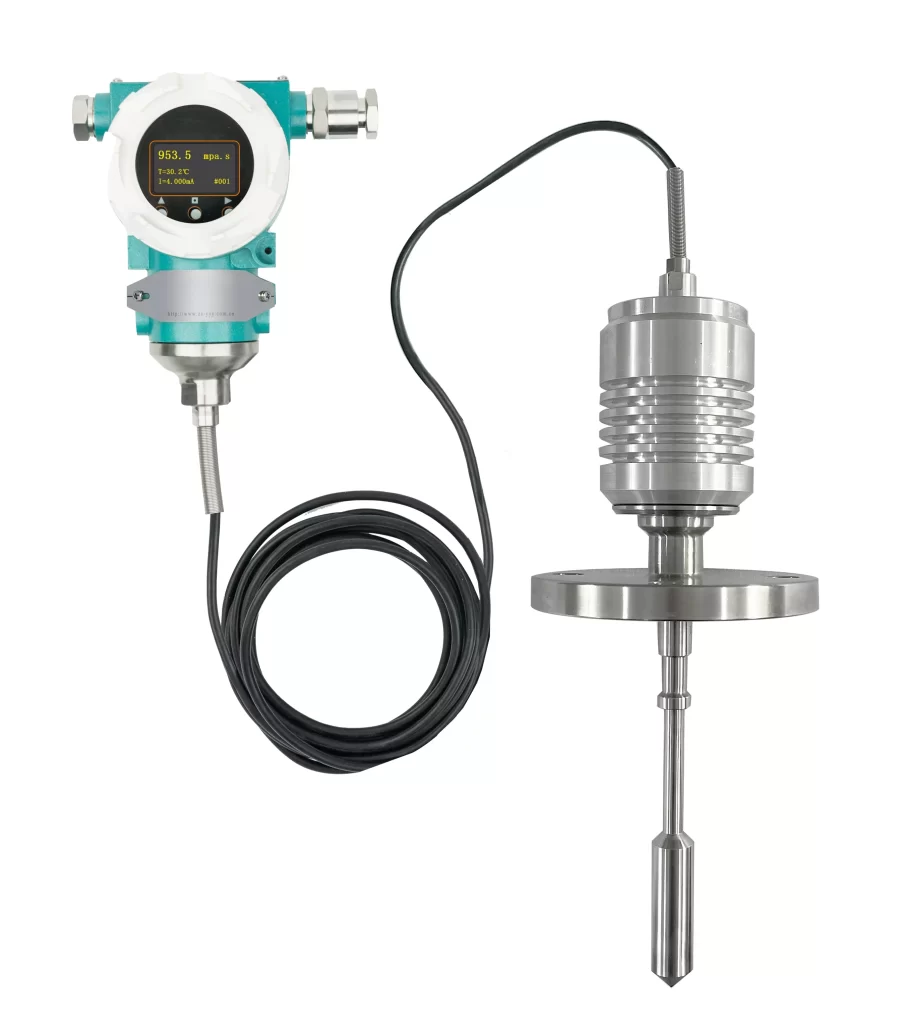
However, factory production and industrial processes require more robust measurement solutions. Online vibrating viscometers are analytical instruments specifically designed for real-time viscosity measurement directly within the process environment.
These instruments utilize a conical-cylindrical element that oscillates rotationally along its radial axis at a specific frequency. As fluid flows over the sensor element—which resembles a conical sphere—the probe shears the fluid, resulting in energy loss caused by viscous drag. This energy loss is detected by electronic circuitry and converted by a processor into a displayable viscosity reading.
By altering the shape of the sensor element, the system can measure media with varying viscosities. Since fluid shearing is achieved through vibration—eliminating the need for moving parts, seals, or bearings—the device features a fully sealed, pressure-resistant structure. It is widely applicable for precise viscosity measurement in both industrial settings and laboratories.
Many types of viscometers measure dynamic viscosity (in cP). To obtain kinematic viscosity (in cSt), a secondary calculation is usually required. This can be performed either by the online instrument itself or via a PLC.
Solution 1: Assign a fixed density value to the instrument.
When dealing with a single medium of stable density, simply setting a density constant within the viscometer allows the instrument to convert and display readings from cP to cSt. This approach requires neither an additional meter nor system modifications; it is the most cost-effective option and the one most frequently included in our quotations.
The trade-off is that the constant remains fixed. Accuracy is compromised if the medium type changes, the water content fluctuates, or the temperature drifts significantly. However, referring back to the calculations in the previous section, using a fixed density value results in a deviation of only about 0.7% even with a 10°C temperature drift. For the vast majority of single-product oil applications, this margin of error is entirely acceptable.
Solution 2: Install an inline density meter.
This approach is only necessary when the density of the medium undergoes a substantial change. Examples include switching between multiple product types, blending lines, crude oil with fluctuating water content, slurries with varying solids content, or operating temperatures fluctuating by more than 30 or 40 degrees Celsius. In these scenarios, calculating kinematic viscosity (ν) using real-time density data provides meaningful results.
By feeding both the density and dynamic viscosity signals into a PLC or secondary instrument, accurate kinematic viscosity can be calculated using the appropriate algorithm.
If you are unsure how to choose, please contact our sales engineers for consultation.
Viscosity measurement has always been a complex yet critical task, and distinguishing between dynamic viscosity and kinematic viscosity is particularly important. At Sino-Inst, we have years of experience customizing measurement solutions—covering viscosity, density, and temperature—for a wide range of liquid media, including petroleum, diesel, adhesives, and coatings. If you are unsure how to configure a viscometer, please feel free to contact our sales engineers at any time.

Zhang Wei, possesses 20 years of experience as an automation instrumentation engineer, specializing in the research, design, installation, commissioning, and maintenance of automation instruments.
Face to various instrument communication protocols (such as Modbus, Profibus, etc.), with solid hardware circuit design and software programming skills (proficient in C language and PLC programming). Has extensive project experience; projects he has led and participated in have all achieved outstanding results, improving product accuracy, reducing costs, and increasing production efficiency.
Possesses excellent communication and coordination skills and a strong team spirit, enabling him to quickly respond to customer needs and provide high-quality automation instrumentation solutions.