Case: Non-Contact Ultrasonic Flow Meter For Water
A clamp-on ultrasonic flow meter is an instrument that uses high-precision ultrasonic sensing technology to measure flow rate. It mainly consists of a host and a set of ultrasonic sensors…

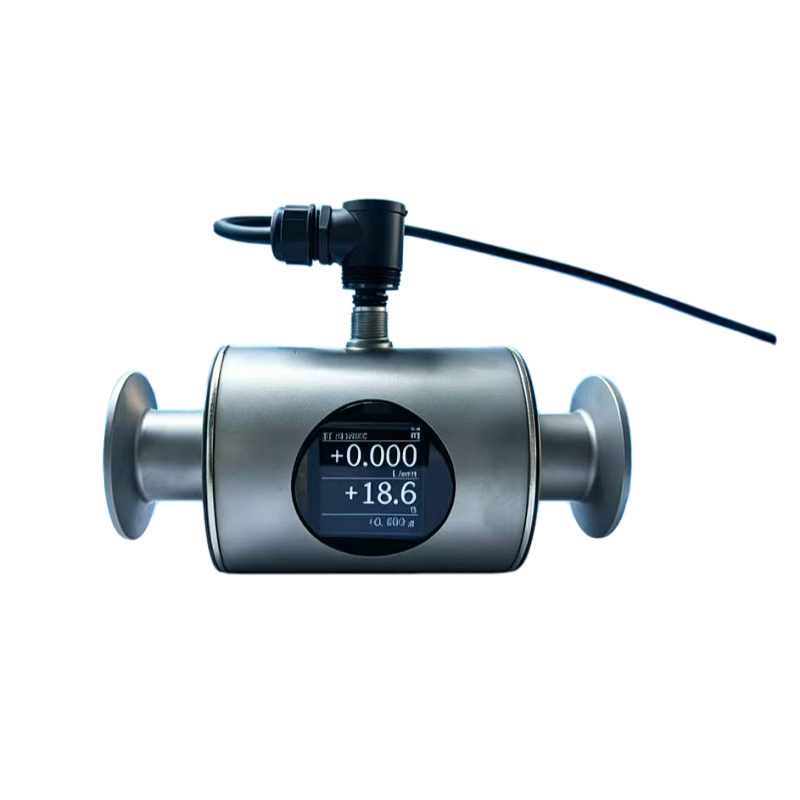
LD-S Electromagnetic Flow Meter is built for the job standard magmeters struggle with — accurately measuring pure water, RO water and other low-conductivity liquids, reliably down to ≥1 µS/cm. It integrates the flow sensor, a PT100 temperature sensor, a polysilicon pressure sensor and the transmitter into one compact, easy-to-install unit, so you measure flow, temperature and pressure of conductive media with a single instrument.
Powered by a 32-bit ARM Cortex-M4 processor and 24-bit ADC with adaptive variable-frequency excitation, the LD-S delivers fast, high-accuracy measurement and built-in self-diagnostics — empty-pipe detection, excitation-circuit fault detection and flow alarms.
| Item | Specification |
|---|---|
| Model | LD-S (standard) / LD-SH (high-temperature) Compact Electromagnetic Flowmeter |
| Measured medium | Conductive liquids, conductivity ≥1 µS/cm |
| Measured parameters | Flow + Temperature (PT100) + Pressure (optional) — integrated |
| Size range | DN6–DN80 (6/10/15/20/25/32/40/50/65/80) |
| Accuracy | Flow ±0.3% / ±0.5% (selectable); Temperature ±0.5 °C; Pressure ±8 kPa |
| Rangeability (turndown) | 1:150 |
| Liner | PEEK (standard) / PVDF (optional) |
| Electrode | Hastelloy C (HC, default) / 316L |
| Body material | 304 (standard) / 316L |
| Process connection | Sanitary tri-clamp (PN16) / Threaded (PN40) / Flange (PN40); others customizable |
| Nominal pressure | Tube body up to 4.0 MPa; selectable 1.0 / 1.6 / 2.5 / 4.0 MPa (clamp & with pressure sensor: max 1.6 MPa); range −0.1–4.0 MPa |
| Medium temperature | Standard −40 to +75 °C; High-temp (SH) −40 to +125 °C |
| Ambient temperature | −25 to +75 °C |
| Output signals | 4–20 mA, IO-Link, RS485 (MODBUS-RTU), frequency, pulse, 2× digital I/O |
| Electrical connection | M12 4-pin connector |
| Power supply | DC 18–36 V (24 V typ.) |
| Power consumption | < 5 W |
| Protection rating | IP67 |
| Display | Color LCD, auto-rotates 90° to pipe orientation |
| Straight pipe runs | Not required (unique flow-conditioning structure) |
| Standards | JB/T 9248-1999; JJG 1033-2007 |
| Size | Flow range (L/h) | Flow range (L/min) |
|---|---|---|
| DN6 | 10 – 750 | 0.17 – 13 |
| DN10 | 20 – 1,500 | 0.33 – 25 |
| DN15 | 35 – 5,000 | 0.58 – 83 |
| DN20 | 40 – 6,000 | 0.67 – 100 |
| DN25 | 100 – 15,000 | 1.67 – 250 |
| DN32 | 150 – 20,000 | 2.50 – 333 |
| DN40 | 250 – 38,000 | 4.17 – 633 |
| DN50 | 400 – 60,000 | 6.67 – 1,000 |
| DN65 | 500 – 75,000 | 8.33 – 1,250 |
It is possible, but it depends on the conductivity and the specific flow meter used.
Standard electromagnetic flow meters generally require a medium conductivity of above 5 µS/cm. With low-conductivity media, the signal induced at the electrodes becomes too weak; the signal-to-noise ratio drops, causing readings to fluctuate or even zero out completely. This is why many manufacturers simply list pure water, RO water, and deionized water as “unsuitable” applications. It is not that the electromagnetic principle itself fails, but rather that the lower limit of conventional designs imposes a constraint.
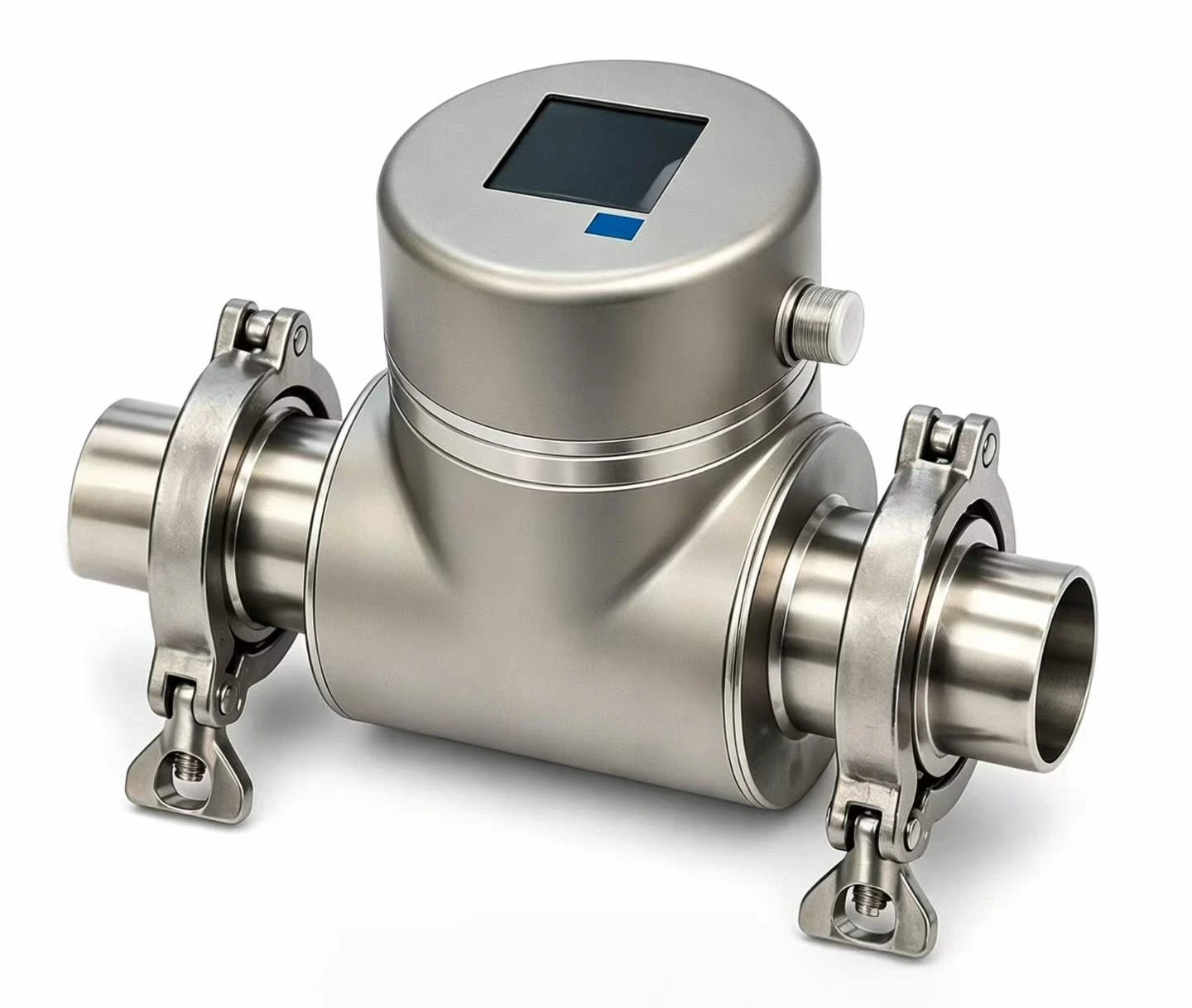
Why is pure water difficult to measure? Ultrapure water and deionized water can have conductivity as low as 0.055 µS/cm; RO (reverse osmosis) permeate typically ranges from 1 to 10 µS/cm, while secondary industrial purified water is usually under 2 µS/cm. In other words, the conductivity of most pure water systems falls precisely into the range that standard electromagnetic flow meters cannot handle.
Our LD-S electromagnetic flow meter pushes this lower limit down to ≥1 µS/cm. This is achieved not through a single parameter, but through a coordinated system: adaptive variable-frequency excitation stabilizes weak signals; a 24-bit ADC combined with full digital signal processing suppresses noise; and the PEEK liner and electrodes are injection-molded as a single, seamless unit, ensuring reliable operation even under negative pressure conditions. In practical terms, it provides stable measurement for applications such as primary RO-purified water (<10 µS/cm) and secondary industrial purified water (<2 µS/cm).
| Water grade | Conductivity | LD-S |
|---|---|---|
| RO water (3rd stage) | <10 µS/cm | ✔ Measured reliably |
| Industrial purified water (2nd stage) | <2 µS/cm | ✔ Measured reliably |
| Borderline low conductivity | ≥1 µS/cm | ✔ Works (lower limit) |
| Ultrapure / EDI / DI water | <1 µS/cm | ✘ Use a turbine or ultrasonic meter |
Electromagnetic flow measurement is no longer suitable for applications involving ultrapure water, EDI product water, or deionized water with conductivity levels below 1 µS/cm. In such cases, we generally recommend switching to a turbine flow meter or an ultrasonic flow meter.
Typical applications include the distribution of purified water and water for injection in the pharmaceutical industry, high-purity water and rinse water loops in the semiconductor and electronics sectors, product water monitoring for RO/EDI systems, and boiler feedwater metering.
| Field | Code | Description |
|---|---|---|
| Converter type | S | Standard compact electromagnetic flowmeter |
| SH | High-temperature compact version (medium up to +125 °C) | |
| Nominal diameter (mm) | 6 / 10 / 15 / 20 / 25 / 32 / 40 / 50 / 65 | DN6–DN65 (DN80 on request — confirm with factory) |
| Connection type | F | Flanged (PN40) |
| L | Threaded (PN40) | |
| K | Sanitary tri-clamp (PN16) | |
| Q | Other mounting method | |
| Accuracy class | 0 | Class 0.3 (±0.3%) |
| 1 | Class 0.5 (±0.5%) | |
| Pressure rating | 1 / 2 / 3 / 4 | 1.0 / 1.6 / 2.5 / 4.0 MPa |
| 6 | Other pressure rating | |
| Output function | A | 4–20 mA |
| I | IO-Link | |
| M | RS485 (MODBUS-RTU) | |
| F | Frequency output | |
| P | Pulse output | |
| S | Digital (switch) output | |
| Supply voltage | 2 | DC24V (18–36 V) |
| Sensor liner | K | PEEK |
| D | PVDF | |
| Electrode | 1 | 316L stainless steel |
| 2 | Hastelloy C (HC) — default | |
| Temperature sensor (standard) | T | PT100 (−40 to +125 °C) |
| Pressure sensor (optional) | P | Pressure sensor (0–1.6 MPa) |
Notes
Example: LD-S-25-K-0-2-M-2-K-2-T-P : Standard converter, DN25, tri-clamp, ±0.3% accuracy, 1.6 MPa, RS485 (Modbus-RTU) output, DC24V, PEEK liner, HC electrode, PT100 temperature sensor, with pressure sensor.
The LD-S electromagnetic flowmeter is specifically designed for measuring pure water and low-conductivity media.
The LD-S operates based on Faraday’s law of electromagnetic induction. As a conductive liquid flows through the measuring tube, it acts like a conductor cutting across magnetic field lines, inducing an electromotive force (EMF) perpendicular to the flow direction; this EMF is directly proportional to the flow velocity.
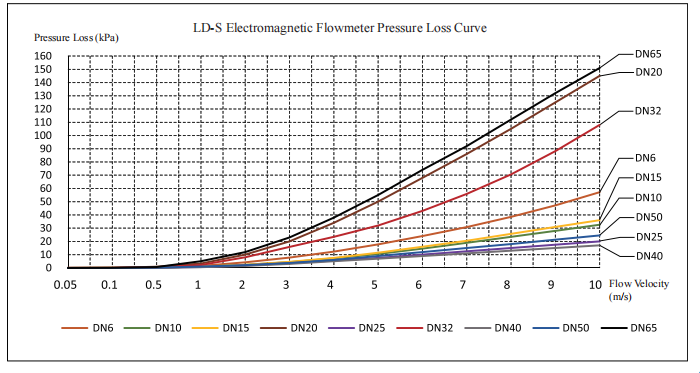
A pair of electrodes on the tube wall captures the signal and transmits it to the transmitter, where it undergoes amplification, conversion, and filtering to calculate instantaneous and cumulative flow rates. The system features no moving parts and no flow-restricting elements protruding into the flow path, resulting in negligible pressure loss and a low risk of clogging.
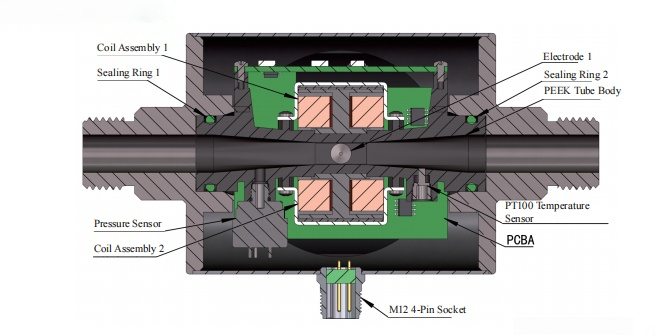
When measuring pure water, low conductivity weakens the induced signal. Conventional electromagnetic flowmeters often struggle to maintain an adequate signal-to-noise ratio in such conditions, leading to reading instability. The LD-S addresses this through signal chain enhancements: adaptive variable-frequency excitation ensures stable magnetic field generation; a 24-bit ADC combined with full digital signal processing suppresses noise; and the electrodes are integrally molded with the PEEK liner—eliminating gaps—to ensure reliable operation even under negative pressure. Coupled with a specialized flow path design, the meter requires no straight pipe sections upstream or downstream for installation. These combined features enable a minimum measurable conductivity of ≥1 µS/cm, meeting the requirements for measuring the flow of industrial pure water and low-conductivity liquids.
The LD-S Electromagnetic Flow Meter is a new addition to the Sino-Inst lineup, specifically designed for measuring the flow of pure water and other low-conductivity media. It is perfectly suited for RO pure water and industrial purified water applications. In addition to this specialized model, we offer a comprehensive range of electromagnetic flow meters, including high-pressure, insertion, and sanitary types. We support customization of specifications such as installation methods and signal outputs; please feel free to contact our sales engineers at any time.
Zhang Wei, possesses 20 years of experience as an automation instrumentation engineer, specializing in the research, design, installation, commissioning, and maintenance of automation instruments.
Face to various instrument communication protocols (such as Modbus, Profibus, etc.), with solid hardware circuit design and software programming skills (proficient in C language and PLC programming). Has extensive project experience; projects he has led and participated in have all achieved outstanding results, improving product accuracy, reducing costs, and increasing production efficiency.
Possesses excellent communication and coordination skills and a strong team spirit, enabling him to quickly respond to customer needs and provide high-quality automation instrumentation solutions.