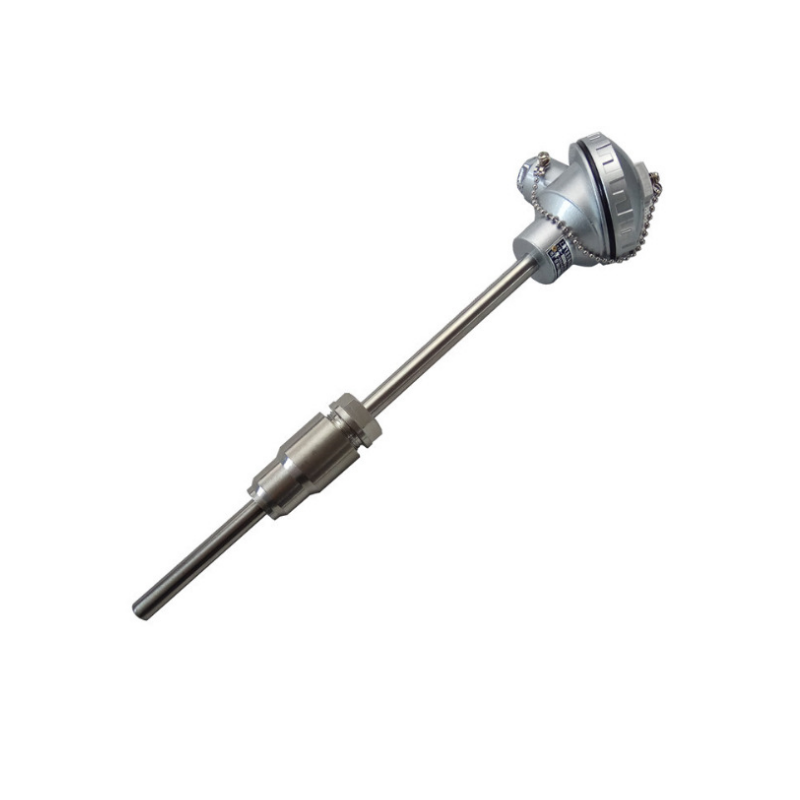
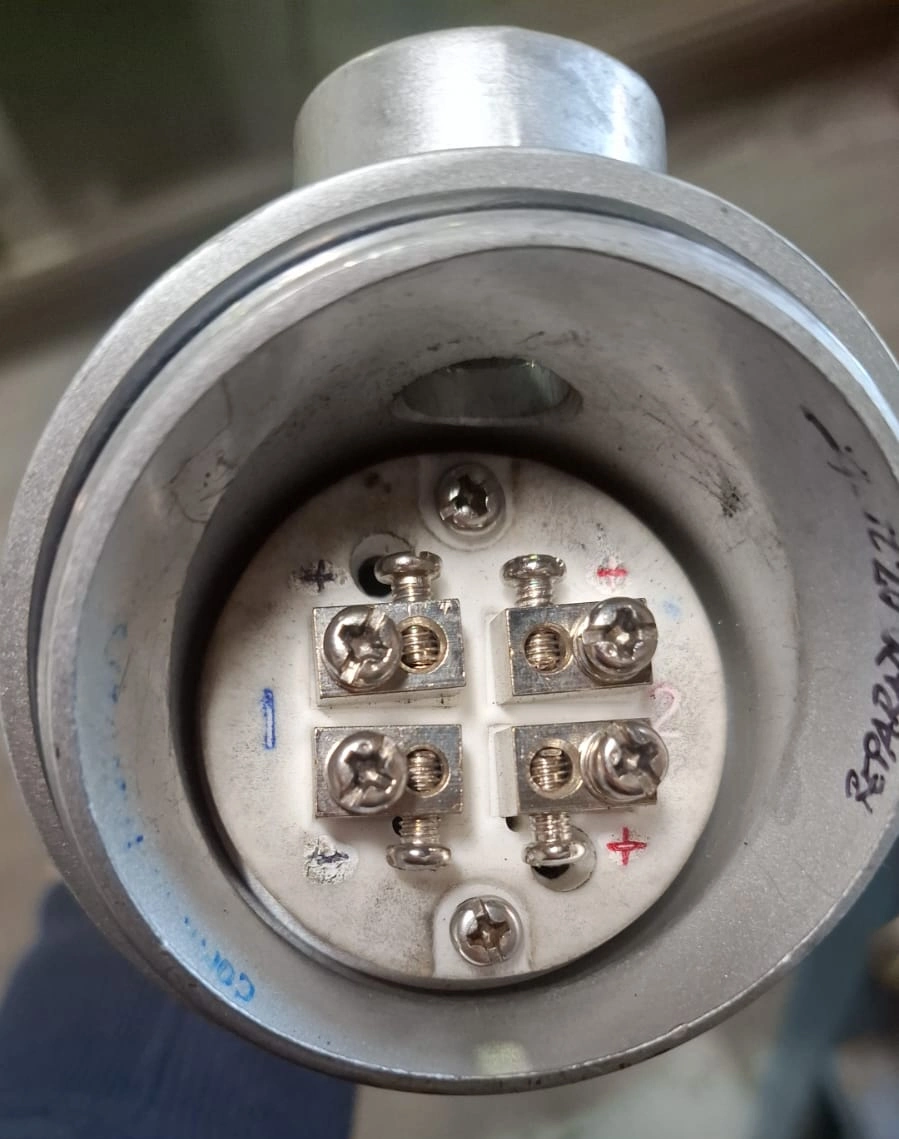
What is a Dual Element Thermocouple? The thermocouples we commonly use typically have only one set of measuring elements, whereas dual-element thermocouples have two sets. A dual-element thermocouple specifically refers to a temperature sensor with two sets of thermocouples encapsulated within a protective tube, capable of outputting two temperature signals. It can be used for backup purposes, or for one channel for control and the other for recording or calibration.
Dual Element Thermocouples feature dual output interfaces, allowing them to be connected to two separate temperature controllers. Dual-element configurations are commonly used at critical measurement points, vulnerable areas, and locations requiring interlock control to ensure reliability.
At Sino-Inst, we offer custom dual-element thermocouples in various calibration types, including S, K, and J. Structures can be sheathed or assembled. Details such as probe outer diameter, length, and thread type can all be customized. Minimum order quantity is 1 unit, with a lead time of approximately 1 week.
Reduced-tip protection tube, built-in temperature transmitter, explosion-proof
Customizable
Accuracy (Tolerance)
Type
Class I
Class II
K, N
±1.5°C (-40 to 375°C); ±0.4% of reading (375 to 1000°C)
±2.5°C (-40 to 333°C); ±0.75% of reading (333 to 1200°C)
E
±1.5°C (-40 to 375°C); ±0.4% of reading (375 to 800°C)
±2.5°C (-40 to 333°C); ±0.75% of reading (333 to 900°C)
J
±1.5°C (-40 to 375°C); ±0.4% of reading (375 to 750°C)
±2.5°C (-40 to 333°C); ±0.75% of reading (333 to 750°C)
T
±0.5°C (-40 to 125°C); ±0.4% of reading (125 to 350°C)
±1.0°C (-40 to 133°C); ±0.75% of reading (133 to 350°C)
S, R
±1.0°C (0 to 1100°C); ±[1 + 0.003 × (t − 1100)]°C (1100 to 1600°C)
±1.5°C (0 to 600°C); ±0.25% of reading (600 to 1600°C)
B
Not available
±0.25% of reading (600 to 1700°C)
Class II is standard. Class I is available on request.
Ordering: Outer diameter, length, and thread specifications can be customized based on your drawings or existing parts. Minimum order quantity is 1 unit. Lead time is approximately 1 week. A report is included with the shipment.
Why Use Two Elements in One Thermocouple
Why choose a dual-element thermocouple? Why not simply install two separate thermocouples? Sino-Inst believes there are several key reasons:
1. Reduce the Number of Drilled Holes
Reducing the number of drilled holes is crucial for high-pressure vessels and pipelines. A dual-element thermocouple requires only one drilled hole and one mounting location. Adding more holes not only increases costs but also raises the risk of leaks.
2. Providing a Backup
A thermocouple may lose its signal output due to broken junctions, loose connections, or other issues.
If only a single temperature sensor is used, staff will notice the thermocouple has failed when the signal disappears. However, procuring a new thermocouple and replacing it takes time. During this period, the production process must be suspended, and in high-temperature, high-pressure environments, the system must first cool down and depressurize. This increases operational costs.
Therefore, at critical temperature measurement points, in areas prone to damage, and in zones requiring interlock control, using dual thermocouples allows operators to handle the above issues with ease. When the signal from one thermocouple is lost, the system can manually or automatically switch to the signal from the other. This provides ample time to procure and replace the faulty thermocouple.
3. Monitoring Drift
Temperature-sensing elements also gradually degrade at high temperatures, causing the output temperature to drift. If only a single temperature sensor is used, temperature measurement drift is extremely difficult to detect. Staff simply have no data for comparison.
When the temperatures from the two thermocouples show inconsistencies, we can quickly develop a response plan. Calibrate them against a standard temperature gauge to determine which one has drifted. Inspect each thermocouple in turn, or replace them as soon as possible.
4. Multiple Signal Outputs
The purpose of temperature sensors is to provide signals for subsequent monitoring and control equipment. A single thermocouple can only output one temperature signal, which is often insufficient. For example, a furnace temperature signal may need to be connected to a temperature controller to adjust the flame, to a data logger for analysis, or to an alarm device.
You might wonder why we don’t split the signal from a single thermocouple between two devices. This is because the thermocouple signal is very weak—only a few tens of millivolts—and connecting two instruments in parallel would cause mutual interference.
A dual-element thermocouple outputs two independent temperature signals that do not interfere with each other, allowing users to make better use of both signals. For example, one signal can be connected to a controller while the other is connected to a data logger; or, one signal can be connected to a controller while the other is connected to an alarm.
However, please note that the two temperature signals must be connected to separate inputs and should not be connected in parallel. If connected in parallel, the two signals will mix into a single signal, making it impossible to detect if one of them drifts.
Dual vs Single Element Thermocouple
Dual-element thermocouples and single-element thermocouples are the same in terms of measurement principles and accuracy. The only difference is whether the protective tube contains one set or two sets of thermocouple wires.
Item
Single Element Thermocouple
Dual Element Thermocouple
Number of wire pairs
1 pair
2 pairs, independent of each other
Terminals
2
4
Output signals
1
2
Instruments it can feed
1
2, e.g. a controller and a recorder
If one element fails
No signal until it is replaced
Switch to the second element and keep running
Detecting drift
Nothing to compare against, hard to spot
Compare the two readings
Minimum sheath diameter (MI type)
Φ2 mm
Φ3 mm
Wire size in the same sheath diameter
Thicker
Thinner
Extension cable
1 pair
2 pairs
Input channels used
1
2
Price
Lower
Higher; the gap is larger for noble metal types (S, R, B)
Accuracy class
Class I or Class II
Class I or Class II, same as single
How to Choose?
Although dual-element thermocouples offer clear application advantages, they also come with higher installation costs. Therefore, we recommend making your selection based on your actual needs.
Situations where a single-element thermocouple is sufficient:
The measurement point is non-critical; if it fails, replacement can wait without affecting production.
A signal needs to be provided to only one instrument.
Installation space is very limited, requiring a thin sheathed thermocouple such as Φ2 mm.
The budget is tight, especially for precious metal thermocouples.
Situations where a dual-element thermocouple is recommended:
Critical measurement points where the cost of production downtime for replacement far exceeds the additional expense.
High-temperature, high-pressure environments or locations where installation and removal are difficult—you do not want to shut down the furnace just to replace a single thermocouple.
The same temperature requires both control and recording or alarm functions.
Interlock protection is required, or there are concerns about thermocouple wire drift at high temperatures.
Regarding Thermocouple Wire Diameter:
When installing two pairs of thermocouple wires inside a protection tube with the same outer diameter, each wire must be made slightly thinner. Although the thickness of the thermocouple wire does not affect temperature measurement, it does impact service life. We recommend using thicker thermocouple wires whenever possible in long-term high-temperature operating conditions. Please let us know your installation clearance requirements, and we will customize a solution for you.
Dual Element Thermocouple Order Guide
There are two scenarios for purchasing dual-element thermocouples: new installations and replacements. In either case, please gather the following information in advance to facilitate your order:
Measured medium
Temperature scale requirements: K, N, S, etc.
Confirm whether it is a single-element or dual-element thermocouple: Open the junction box and count the terminals; if there are 4, it is a dual-element thermocouple.
Required outer diameter of the protection tube.
Confirm the total length below the thread and the insertion depth.
Mounting method and dimensions: threaded or flanged; thread specifications (e.g., M26×1.5); whether fixed or adjustable.
Operating temperature range
Element diameter: For precious metal thermocouples such as S, R, and B types, please specify the diameter, as it affects both price and service life.
If you are replacing an old dual-element thermocouple, please take a photo of the nameplate first. If the nameplate information is unclear, measure the dimensions listed above and send us the photos.
Customer Case
A user previously contacted us to replace an old Type S dual-element thermocouple. It was approximately 515 mm long, 10 mm in diameter, with element diameters ranging from 0.3 to 0.5 mm, and an operating temperature not exceeding 1100°C. The user also provided some photos of the old thermocouple.
After discussing the details, we confirmed the following: 515 mm is the total length; the mounting thread is M26×1.5, paired with a nut of the same specification; and we quoted a price based on 0.3 mm platinum-rhodium wire. Finally, we provided the customer with the following custom configuration:
Type S dual-element thermocouple
Probe length: 515 mm
Platinum-rhodium wire diameter: 0.3 mm
Temperature limit: up to 1100°C
Diameter: 10 mm
M26×1.5 nut
FAQ
No. The measuring ends of the two thermocouple pairs in a dual-element thermocouple are located at the same position; they essentially measure the temperature at the same point, so the readings from both channels should be virtually identical.
This depends on the configuration of your controller or transmitter, as well as the intended use of your temperature signals. Two input signals require two input channels. If your controller or transmitter supports this, you can connect them.
Additionally, if you intend to compare the two sets of signals to monitor drift in the temperature sensors, you can connect both sets of temperature signals.
No. When wired in parallel, the two signals combine into a single signal, so you won’t be able to detect if one of them drifts. Since there is still only one monitoring instrument or recorder, this does not serve as a backup. The correct approach is to connect each element to a separate input.
0.3 to 0.5 mm; we can customize this according to your requirements. The thicker the thermocouple wire, the longer its service life at high temperatures; however, the price is also higher, as platinum-rhodium wire is priced by weight. The thermocouple wire diameter will be specified on our quotation.
Yes. We offer dual-element Pt100 RTDs in both assembled and sheathed configurations. The outer diameter of the sheathed dual-element models ranges from Φ4 to Φ8 mm. Dual-element, three-wire RTDs feature 6 terminals in the junction box.
Approximately 1 week, with a minimum order quantity of 1 unit. We can also accommodate custom orders for outer diameter, length, and thread specifications, and will provide a test report with the shipment.
Thermocouples have the advantages of simple structure, wide measurement range, and easy processing of output signals. Therefore, thermocouples have become our preferred sensor for temperature measurement. The graduation numbers of thermocouples mainly include S, R, B, N, K, E, J, T, etc. Among them, S, R, and B belong to precious metal thermocouples, and N, … Read more
When configuring temperature sensors, you’ll encounter the option of whether to configure a thermocouple sheath, and the requirements for its size and material. Sometimes, a thermocouple sheath is also called a thermowell or temperature sensor protective tube. So what exactly is a thermocouple sheath, and how do we choose one? Based on Sino-Inst’s experience, we’ve … Read more
What is Cold Junction Compensation in Thermocouples? Cold junction compensation is a corrective measure taken in thermocouple measurements to eliminate measurement errors caused by the cold junction temperature deviating from 0°C. The need for cold junction compensation in thermocouples stems from their working principle. Let’s analyze this in detail. Why is Cold Junction Temperature Compensation … Read more
Zhang Wei, possesses 20 years of experience as an automation instrumentation engineer, specializing in the research, design, installation, commissioning, and maintenance of automation instruments.
Face to various instrument communication protocols (such as Modbus, Profibus, etc.), with solid hardware circuit design and software programming skills (proficient in C language and PLC programming). Has extensive project experience; projects he has led and participated in have all achieved outstanding results, improving product accuracy, reducing costs, and increasing production efficiency.
Possesses excellent communication and coordination skills and a strong team spirit, enabling him to quickly respond to customer needs and provide high-quality automation instrumentation solutions.