Home > Blog > J Type vs K Type Thermocouple: Difference & How to Choose
J Type vs K Type Thermocouple: Difference & How to Choose
For temperatures below 750°C, reducing atmospheres, or when on a tight budget, choose a Type J thermocouple; for higher temperatures, oxidizing atmospheres, or general-purpose temperature measurement applications, choose a Type K thermocouple.
Type J and Type K thermocouples have the same factory accuracy, which is ±2.2°C or ±0.75%. Type K can measure up to 1250°C, while Type J is generally limited to 750°C; Type J has higher sensitivity, approximately 50 µV/°C, compared to Type K’s approximately 41 µV/°C; and Type J is less expensive, but its positive electrode is made of iron, which is susceptible to moisture and high-temperature oxidation.
Thermocouples measure temperature by utilizing the voltage generated when two different metals are exposed to a temperature difference. Different calibration types correspond to different metal pairings.
In the Type J thermocouple, the positive electrode is iron, and the negative electrode is constantan (approximately 55% copper and 45% nickel). Iron is inexpensive and generates a high voltage—10.78 mV at 200°C. However, iron is prone to rust, and oxidation accelerates significantly above approximately 540°C; therefore, Type J thermocouples are generally only used up to 750°C.
In Type K thermocouples, the positive electrode is made of nickel-chromium (approximately 90% nickel and 10% chromium), and the negative electrode is made of nickel-aluminum (approximately 95% nickel, with small amounts of aluminum, manganese, and silicon). Both are nickel-based alloys that are resistant to oxidation and can be used up to 1250°C. The trade-off is a slightly lower voltage—8.14 mV at 200°C—and higher material costs.
Type J uses iron to achieve lower cost and higher sensitivity, while Type K uses nickel to achieve high-temperature resistance.
Temperature Range and Service Life
Type J is recommended for use at 0–750°C, while Type K is recommended for −200–1250°C.
The calibration table lists a maximum temperature of 1200°C for Type J, but that is merely the range specified in the table. The iron material in Type J thermocouples oxidizes rapidly at high temperatures. Therefore, Type K thermocouples are generally more durable than Type J thermocouples.
The service life of a thermocouple also depends on the diameter of the sheath. Fitting a thermocouple with a protective sheath helps protect the sensing element. The thinner the sheath, the lower the temperature it can withstand over the long term. Below are the long-term operating temperatures for our sheathed thermocouples:
Sheath OD
Type J (stainless steel sheath)
Type K (stainless steel sheath)
Type K (GH3030 nickel alloy sheath)
Φ2 mm
400°C
600°C
800°C
Φ3 mm
500°C
800°C
800°C
Φ4, Φ5 mm
500°C
800°C
900°C
Φ6, Φ8 mm
600°C
800°C
1000°C
For the same sheath diameter, Type K runs 200 to 300°C hotter than Type J.
Two pieces of advice:
For long-term exposure to temperatures above 500°C, Type J probes should use at least Φ6. For temperatures exceeding 600°C, switch to a Type K thermocouple.
For long-term use of a Type K thermocouple above 800°C, a standard stainless steel sheath is insufficient; an alloy sheath—specifically GH3030—must be used.
Atmosphere: What Each Type Can’t Handle
At high temperatures, the metal wires of a thermocouple can react with the surrounding gases. Such reactions lead to inaccurate readings and, in severe cases, can even cause the wires to break.
One of the wires in a Type J thermocouple is made of iron, which is sensitive to oxygen. When used at high temperatures in air, the iron oxidizes rapidly; in humid environments, it is prone to rusting. However, it remains very stable in oxygen-free environments, such as those containing hydrogen or carbon monoxide.
Type K thermocouples consist of two nickel-alloy wires. They are resistant to oxygen and can be used for long periods in air at temperatures exceeding 1,000°C. Their vulnerability lies in oxygen-deficient conditions: at high temperatures, a lack of sufficient oxygen causes the readings to gradually drift toward lower values.
Operating environment
Which to choose
Furnaces, kilns and flues in air
Type K
Reducing atmospheres such as hydrogen or carbon monoxide, below 600°C
Type J
Vacuum
Type J
Inert atmospheres such as argon or nitrogen
Either
Damp locations or where condensation forms
Type K
Sulfur-bearing gases
Neither as bare wire. Use a protection tube
In actual use, most thermocouples are encased in a protective tube, so the metal wires do not come into direct contact with the surrounding gas. In this case, the choice of protective tube material is more important than the thermocouple type. To learn how to select a protective tube, check out this guide to selecting protective tubes.
Color Codes: ANSI, IEC and GB
The positive and negative terminals of a thermocouple are identified by wire color. However, there are three different color standards in use.
Standard
Type J positive (+)
Type J negative (−)
Type K positive (+)
Type K negative (−)
ANSI (USA)
White
Red
Yellow
Red
IEC (International)
Black
White
Green
White
GB (China)
Red
Purple
Red
Black
Two colors cause most wiring mistakes:
Red. In ANSI, red is the negative wire. In GB, red is the positive wire.
White. On a Type J thermocouple, white is positive in ANSI and negative in IEC.
Before connecting a thermocouple, please verify which standard it follows. By default, we supply products that adhere to the Chinese national standard (GB); if you require ANSI or IEC color coding, please specify this when placing your order.
Are J-Type and K-Type Thermocouples Interchangeable?
No. Type J and Type K thermocouples cannot be used interchangeably because their electrode materials, thermoelectric properties, temperature measurement ranges, and operating environments are completely different.
Thermocouples operate based on the Seebeck effect: when two different metals or alloys form a circuit, a temperature-dependent thermoelectric potential is generated when there is a temperature difference between the measuring end and the reference end.
Type J and Type K thermocouples are made of completely different materials and generate different thermoelectric voltages. Type J produces a voltage of approximately 50 µV/°C, while Type K produces a voltage of approximately 41 μV/°C. Therefore, the two cannot be used interchangeably.
How to Choose
Use the table below to make your choice.
Your Application
Choose
Continuous use above 600°C
Type K
Furnace or kiln in air
Type K
Reducing atmosphere, below 600°C
Type J
Damp, condensing or below freezing
Type K
Below 600°C, tight budget, instrument accepts Type J
Type J
Replacing a probe on existing equipment
Same type as the original
Not sure
Type K
For high temperatures: Choose Type K.
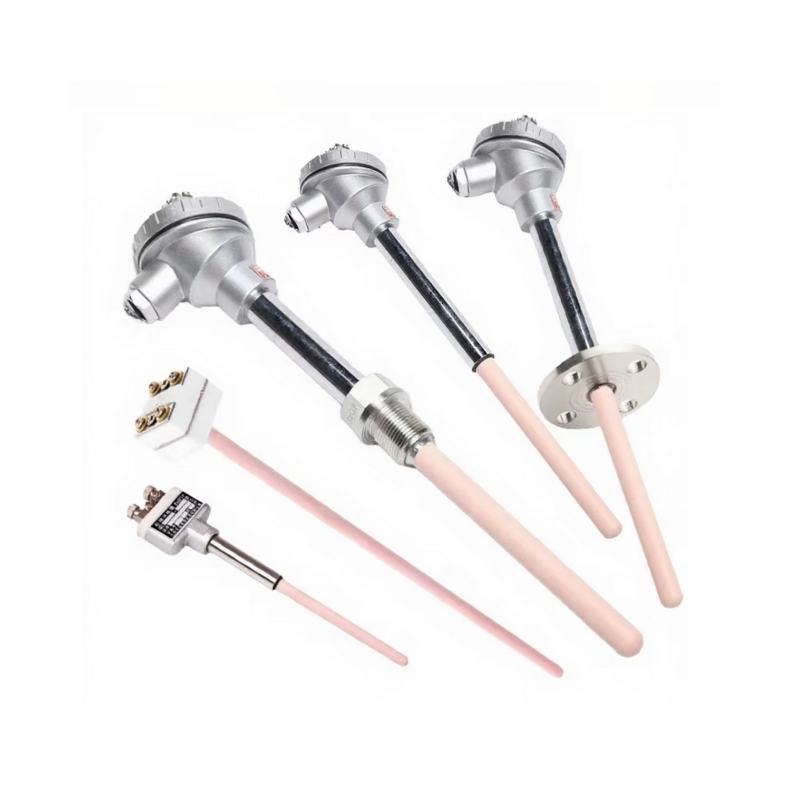
We once received an inquiry for a sensor capable of measuring up to 1300°C. Since Type J cannot handle this temperature, we recommended a Type K thermocouple equipped with an alumina (corundum) protective tube—10 mm in outer diameter and 250 mm in length. Metal sheaths cannot withstand such high temperatures, which is why we opted for alumina.
For replacing existing probes: Stick to the original type.
A power plant in the U.S. needed to replace temperature probes on engine cylinder liners. With an alarm threshold of 320°F (160°C) and a shutdown threshold of 374°F (190°C), a Type J thermocouple would have been perfectly adequate. However, because they were already using Type K—and their control system was configured for it—we supplied a Type K unit.
In such cases, do not attempt to switch to a “more suitable” thermocouple type. Changing the type would require updating both the instrument settings and the compensating cables; missing even one detail could result in temperature readings being off by tens of degrees.
For other scenarios: Type J can save you money.
If the temperature is moderate, the environment is dry, and your instrumentation supports Type J, it is a perfectly fine choice—and it is more cost-effective than Type K. Type J is commonly found in plastics processing machinery and various legacy equipment.
Still unsure? Choose Type K. It has a broader operating range, which minimizes the risk of an incorrect selection.
Send us your temperature requirements, the medium being measured, and the installation dimensions, and we will help you determine the right model.
No. A Type J thermocouple consists of iron and constantan, while a Type K thermocouple is made of nickel-chromium and nickel-aluminum. Because they are composed of different materials and follow different standard calibration curves for their thermoelectric properties, they are not interchangeable.
Type K and Type J thermocouples differ significantly in terms of material composition, temperature measurement range, and magnetic properties. The positive leg of a Type J thermocouple is made of iron and is magnetic, whereas the positive leg of a Type K thermocouple is made of a nickel-chromium alloy and is non-magnetic; therefore, they can be distinguished using a magnet. Alternatively, the type can be identified by measuring the thermocouple’s millivolt output and comparing it against a standard calibration table.
Type J and Type K thermocouples share the same standard-grade accuracy: ±2.2°C or ±0.75%. The difference lies in their long-term stability, not in their initial factory-specified accuracy.
Thermocouples have the advantages of simple structure, wide measurement range, and easy processing of output signals. Therefore, thermocouples have become our preferred sensor for temperature measurement. The graduation numbers of thermocouples mainly include S, R, B, N, K, E, J, T, etc. Among them, S, R, and B belong to precious metal thermocouples, and N, … Read more
A type K thermocouple is a widely used thermocouple in temperature measurement. Type K thermocouples are typically composed of two different metal alloys: a chromium-nickel alloy and an aluminum-nickel alloy. Type K thermocouples are inexpensive, highly accurate, reliable, and have a wide temperature range. Their maximum continuous operating temperature is approximately 1100°C. They provide accurate … Read more
What is Cold Junction Compensation in Thermocouples? Cold junction compensation is a corrective measure taken in thermocouple measurements to eliminate measurement errors caused by the cold junction temperature deviating from 0°C. The need for cold junction compensation in thermocouples stems from their working principle. Let’s analyze this in detail. Why is Cold Junction Temperature Compensation … Read more
Zhang Wei, possesses 20 years of experience as an automation instrumentation engineer, specializing in the research, design, installation, commissioning, and maintenance of automation instruments.
Face to various instrument communication protocols (such as Modbus, Profibus, etc.), with solid hardware circuit design and software programming skills (proficient in C language and PLC programming). Has extensive project experience; projects he has led and participated in have all achieved outstanding results, improving product accuracy, reducing costs, and increasing production efficiency.
Possesses excellent communication and coordination skills and a strong team spirit, enabling him to quickly respond to customer needs and provide high-quality automation instrumentation solutions.
Want to see more of our engineering guides in Google Search? Add Sino-Inst as a preferred source.