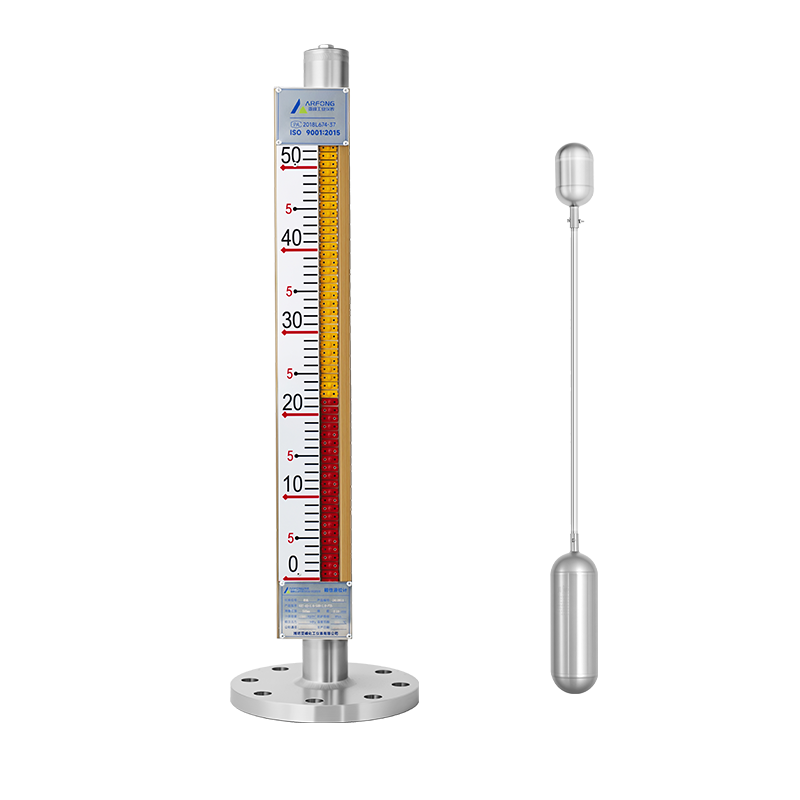
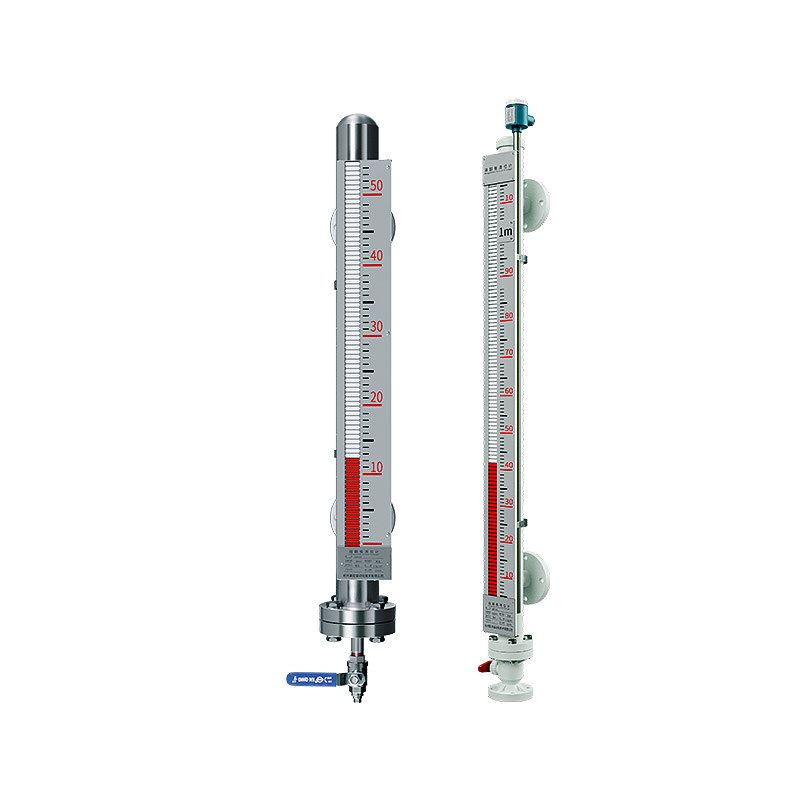
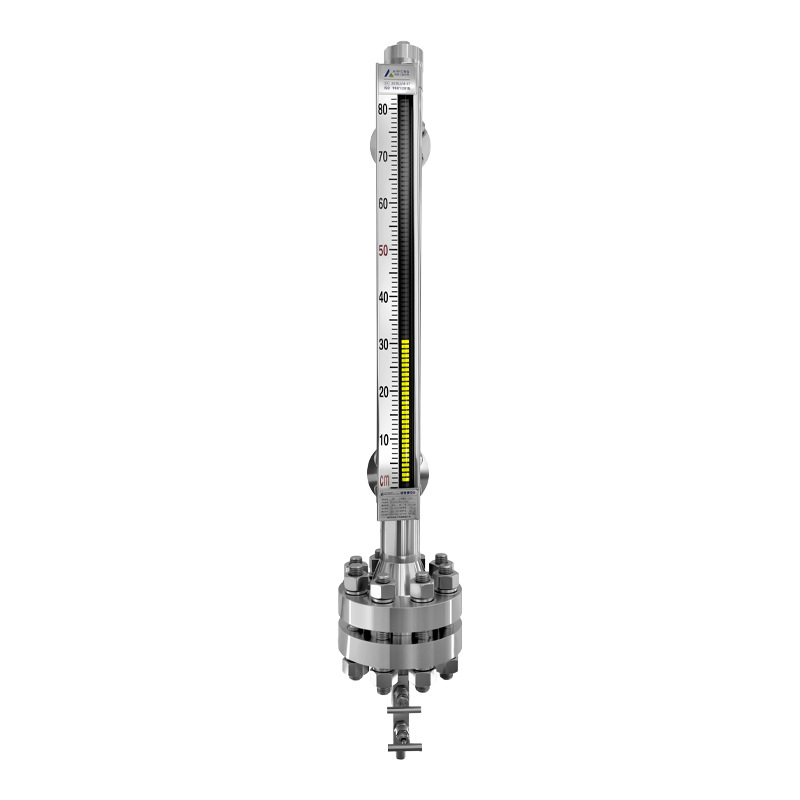
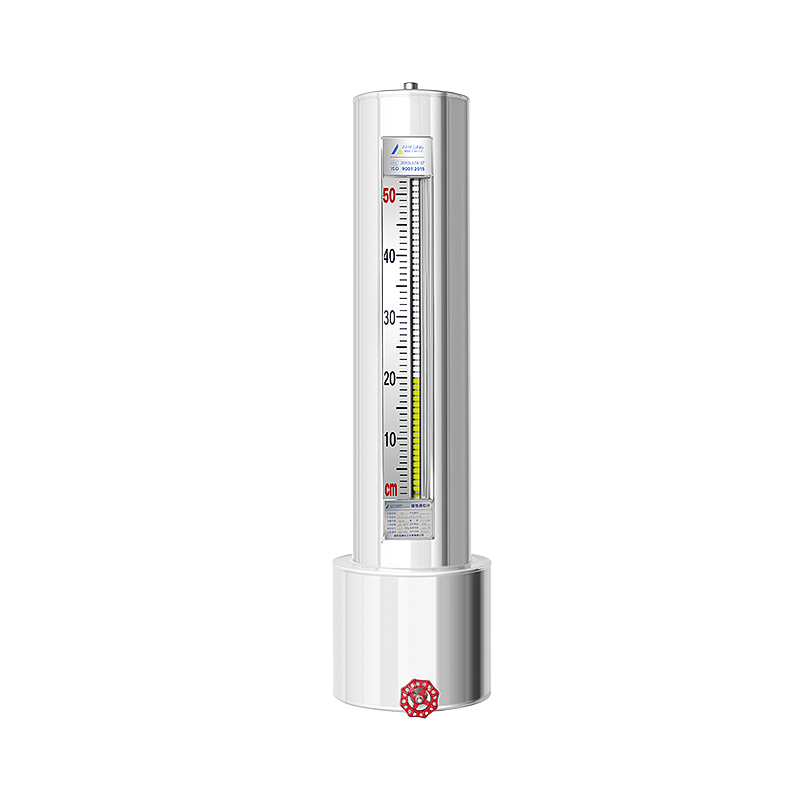
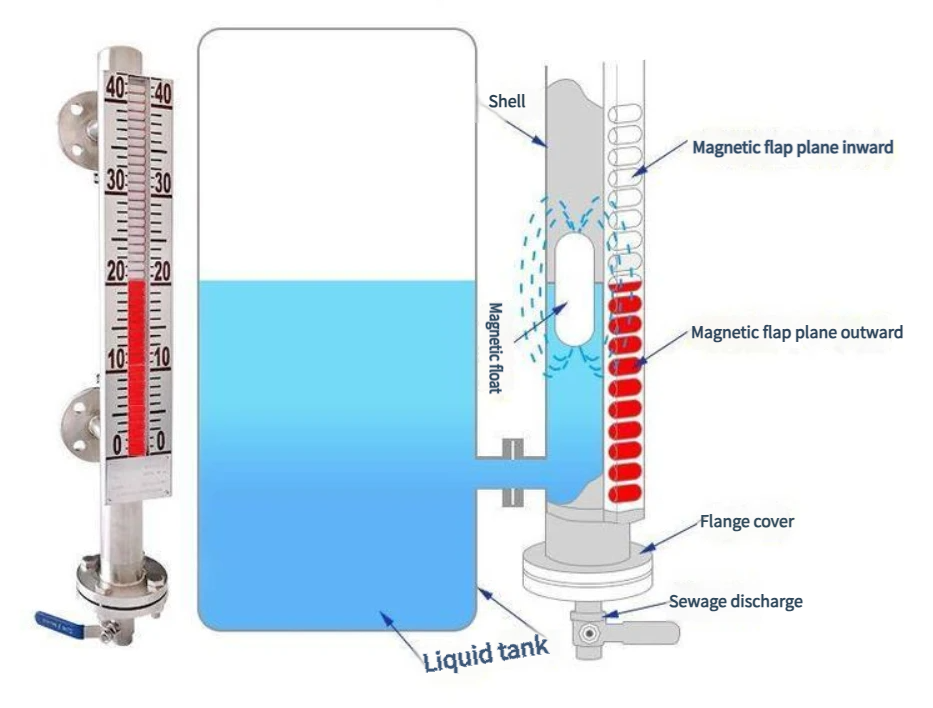
Magnetic Level Indicators are widely used field level measurement instruments for detecting the liquid level in various towers, tanks, vessels, spherical containers, and boilers. This series of Magnetic Level Indicators offers high sealing performance, leak-proof protection, and suitability for high-temperature, high-pressure, and corrosion-resistant applications.
Magnetic Level Indicators overcome the shortcomings of glass plate level gauges, such as poor indication clarity and fragility. They provide complete measurement without blind spots, clear display, and a large measurement range. Equipped with level alarms and control switches, they can achieve upper and lower limit alarms and control of liquid levels or interfaces. With a transmitter, level and interface signals can be converted into a two-wire 4-20mA DC standard signal, enabling remote detection, indication, recording, and control.
Benefits
The red section indicates the liquid level, while the upper white area represents the non-liquid portion.
Visibility extends up to 60 meters.
Protection ratings available: IP65, IP66/IP67.
Versatile installation options include top-mounted, side-mounted, and more.
The measured medium is completely isolated from the indicator structure. Excellent sealing performance prevents leakage.
Integrates local indication, remote transmission, and alarm control switching with freely adjustable settings.
Full-process measurement with no blind zones.
Wide operating pressure range, with pressure resistance from vacuum to 42 MPa.
Minimum density down to 0.45 g/cm³.
Extensive operating temperature range, suitable for -190°C ~ +450°C.
The Magnetic Level Indicator is a device specifically designed for liquid level measurement, ingeniously combining the principles of magnetic pole coupling and Archimedes’ principle (the law of buoyancy) with the characteristics of mechanical transmission. This level gauge can measure both the liquid level and the interface between two media of different densities.
The Magnetic Level Indicator has a cavity (called the main tube or outer shell) that houses a float. This cavity connects to the container via a flange or other interface, forming a communicating vessel. In this way, the liquid level inside the instrument’s cavity is at the same height as the liquid level in the container, so the float inside the cavity rises and falls with the rise and fall of the liquid level in the container.
When the liquid level rises, the magnetic float drives the tilting column to rotate 180°, displaying red or green. When the liquid level falls, the magnetic float drives the tilting column to rotate 180° in the opposite direction, displaying white. The height of the red (or green) band indicates the height of the measured liquid level, achieving the purpose of measuring and displaying the position of the measured liquid (interface).
Based on this, its application range has been continuously expanded, resulting in various types of products that, while detecting liquid levels, also possess more practical functions.
For example: While monitoring the liquid level, the magnetic switch signal can be used to control or alarm the liquid level; a 4~20mA transmitter is added to the existing column level gauge, so that while monitoring the liquid level on-site, the changes in the liquid level are transmitted to the control room through the transmitter sensor, cable and instrument, realizing remote monitoring and control.
Featured Applications
Magnetic Level Indicators are widely used in various liquid storage tanks, reservoirs, pools, reaction vessels, fermentation tanks, liquid ammonia storage tanks, ammonia separators, boiler drums, high and low pressure heaters, condensers, evaporators, and other pressure vessels in the petroleum, chemical, oilfield, pharmaceutical, food, and wine industries. Available materials include 304, 321, 316L, 0Cr18Ni9, 304 or 0Cr18Ni9+PTFE, 00Cr17Ni14Mo21Cr18Ni9Ti, PVC, and PP. Multiple installation options are available to suit different applications and environmental requirements.
Magnetic Level Indicators are reliable for level detection in high-temperature, low-temperature, high-pressure, highly corrosive, highly toxic, and hazardous environments. Examples include:
Boilers: Steam drum liquid level;
Power: Auxiliary equipment (high-pressure heater, low-pressure heater, deaerator, condenser, shaft seal heater, etc.), chemical water treatment;
Powder/Dry Material Level Switches are devices used to detect when material reaches a preset level. When the material reaches or exceeds the set position, the level switch sends a signal,…
The water level pressure transducer measures water level based on the relationship between pressure and water level. It is an extremely simple, practical instrument. Of course, it can be used…
The portable ultrasonic liquid level indicator is a non-contact, handheld detection device primarily used to quickly determine the presence of liquid at a specific height within a sealed container without…
In the rapidly developing industrial sector, liquid level measurement is becoming increasingly important. Capacitive level transmitters are an important solution. They have no moving parts and are unaffected by water…
What is a Radar Level Sensor? A radar level sensor is an instrument that uses microwave echo ranging to measure liquid levels non-contactly. It can measure both liquid and solid…
Stilling Wells are ingeniously designed to suppress liquid surface fluctuations and turbulence, ensuring high-precision level measurements. Surface disturbances are a problem in level measurement, whether using contact or non-contact methods…
The Magnetic Level Indicator offers diverse output signals, enabling long-distance liquid level indication, detection, control, and recording. Sino-Inst continuously upgrades its Magnetic Level Indicator technology and improves its manufacturing processes, expanding the application areas and scope of this level gauge.
If you require a customized liquid level measurement solution, please feel free to contact our sales engineers.
Zhang Wei, possesses 20 years of experience as an automation instrumentation engineer, specializing in the research, design, installation, commissioning, and maintenance of automation instruments.
Face to various instrument communication protocols (such as Modbus, Profibus, etc.), with solid hardware circuit design and software programming skills (proficient in C language and PLC programming). Has extensive project experience; projects he has led and participated in have all achieved outstanding results, improving product accuracy, reducing costs, and increasing production efficiency.
Possesses excellent communication and coordination skills and a strong team spirit, enabling him to quickly respond to customer needs and provide high-quality automation instrumentation solutions.